
Matthew 21:1-14 is about Jesus entering Jerusalem triumphantly, cleansing the temple, and demonstrating his authority as the Son of God through miraculous healings, emphasizing the need for true worship and faithfulness to God.
1 Now when they drew near to Jerusalem and came to Bethphage, to the Mount of Olives, then Jesus sent two disciples,
2 saying to them, “Go into the village in front of you, and immediately you will find a donkey tied, and a colt with her. Untie them and bring them to me.
3 If anyone says anything to you, you shall say, ‘The Lord needs them,’ and he will send them at once.”
4 This took place to fulfill what was spoken by the prophet, saying,
5 “Say to the daughter of Zion, ‘Behold, your king is coming to you, humble, and mounted on a donkey, on a colt, the foal of a beast of burden.’”
6 The disciples went and did as Jesus had directed them.
7 They brought the donkey and the colt and put on them their cloaks, and he sat on them.
8 Most of the crowd spread their cloaks on the road, and others cut branches from the trees and spread them on the road.
9 And the crowds that went before him and that followed him were shouting, “Hosanna to the Son of David! Blessed is he who comes in the name of the Lord! Hosanna in the highest!”
10 And when he entered Jerusalem, the whole city was stirred up, saying, “Who is this?”
11 And the crowds said, “This is the prophet Jesus, from Nazareth of Galilee.”
12 And Jesus entered the temple and drove out all who sold and bought in the temple, and he overturned the tables of the money-changers and the seats of those who sold pigeons.
13 He said to them, “It is written, ‘My house shall be called a house of prayer,’ but you make it a den of robbers.”
14 And the blind and the lame came to him in the temple, and he healed them.
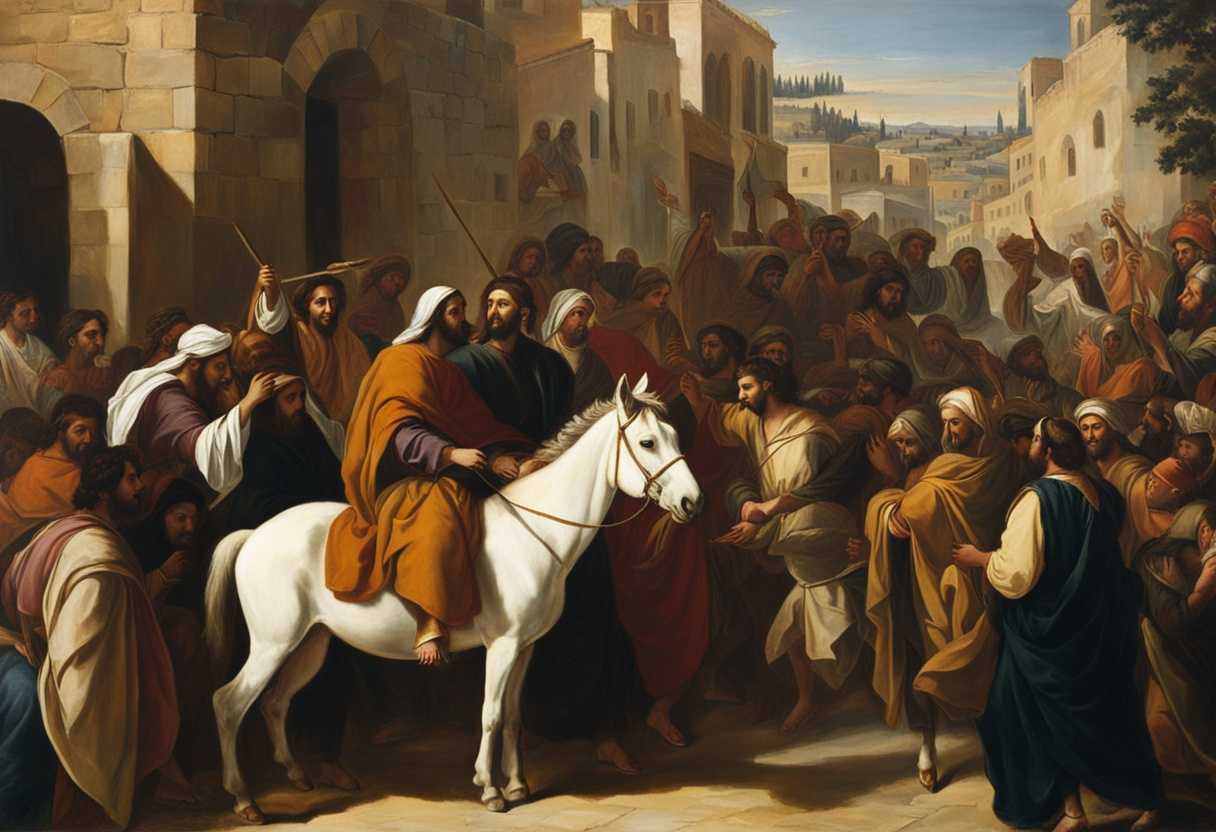
Setting the Scene for Matthew 21:1-14
In Matthew chapter 21, Jesus and his disciples are approaching Jerusalem for the Passover festival. As they near the city, Jesus instructs two of his disciples to go ahead and find a donkey and its colt tied up in a nearby village. He tells them that if anyone questions them, they are to say that the Lord needs them, and they will be allowed to bring the animals to him.
The disciples follow Jesus’ instructions and find the donkey and colt just as he said. They bring the animals to Jesus, who then mounts the donkey and begins to ride towards Jerusalem. As they make their way, a large crowd gathers, spreading their cloaks on the road and waving palm branches, shouting, “Hosanna to the Son of David! Blessed is he who comes in the name of the Lord!”
The scene is filled with excitement and anticipation as the people recognize Jesus as the long-awaited Messiah. The atmosphere is festive, with the crowd rejoicing and praising Jesus as he enters Jerusalem, fulfilling the prophecy of Zechariah 9:9. The disciples are amazed at the response of the people and the significance of the moment as they witness Jesus’ triumphal entry into the city.
What is Matthew 21:1-14 about?
The verse showcases a pivotal moment in Jesus’s ministry as he enters Jerusalem triumphantly. This event marks the beginning of the final week of Jesus’s life, known as Holy Week, which includes significant events such as the Last Supper, the crucifixion, and the resurrection. Jesus is demonstrating his authority and power as the Son of God as he overturns tables in the temple and heals the blind and the lame.
Have you ever thought about the symbolism behind Jesus’s actions in the temple? Jesus is challenging the corruption and exploitation that had infiltrated sacred spaces by overturning the tables of the moneychangers, emphasizing the importance of true worship and righteousness. Jesus is not only showcasing his miraculous abilities but also embodying the compassion and love that are central to his teachings by healing the blind and the lame. This verse underscores the themes of justice, mercy, and divine power that are fundamental to Jesus’s ministry and message.
Understanding what Matthew 21:1-14 really means
In Matthew 21:1-14, we witness a pivotal moment in Jesus’ ministry as He enters Jerusalem triumphantly, fulfilling prophecies and asserting His authority. The scene unfolds with Jesus instructing His disciples to fetch a donkey and her colt, symbolizing humility and the fulfillment of Zechariah’s prophecy. The crowd’s enthusiastic welcome, shouting “Hosanna,” signifies their recognition of Jesus as the promised Messiah, the Son of David. This momentous entry sets the stage for Jesus’ subsequent actions in the temple, where He drives out the money changers and declares it a house of prayer, emphasizing the true purpose of worship and communion with God.
The phrases used in this passage carry profound meanings that resonate with believers today. “Go into the village” underscores the importance of obedience and trust in following Jesus’ instructions, even when they may seem unconventional. “The Lord needs them” highlights Jesus’ divine authority and the meticulous fulfillment of God’s plan, reminding us that every detail in God’s kingdom has significance. “Hosanna to the Son of David” encapsulates the crowd’s acknowledgment of Jesus as the long-awaited Messiah, challenging us to recognize His kingship in our lives and offer Him genuine worship.
Drawing connections to other biblical passages enriches our understanding of Jesus’ actions. Zechariah 9:9’s prophecy of a humble king riding on a donkey finds fulfillment in Jesus, affirming His messianic identity. Isaiah 56:7 reinforces the concept of the temple as a house of prayer for all nations, echoing Jesus’ cleansing of the temple. Psalm 118:25-26, echoed in the crowd’s cries of “Hosanna,” emphasizes the plea for salvation and blessings upon the Lord’s chosen one.
The relevance of this passage to contemporary believers is profound. It challenges us to emulate the disciples’ obedience and trust in following God’s guidance, even when it may seem unconventional. Recognizing Jesus as the King in our lives prompts us to offer Him genuine worship and surrender. Jesus’ cleansing of the temple serves as a reminder for us to evaluate our places of worship and our hearts, ensuring they are focused on true communion with God rather than worldly distractions.
Consider a church community that shifted its focus from prayer and worship to fundraising events. Upon a new pastor’s arrival emphasizing prayer and Bible study, resistance initially arose. However, as the congregation embraced a renewed focus on God’s presence, transformation ensued. This anecdote mirrors Jesus’ actions in the temple, illustrating that genuine worship and connection with God should always be our priority.
Reflecting on the significance of Jesus’ triumphal entry and temple cleansing equips us to apply these lessons to our spiritual journeys. Obedience, recognition of Jesus as King, and the purity of worship are timeless principles that challenge us to align our lives with God’s will and prioritize authentic communion with Him.
What actions are we taking to honor God’s house?
We are actively seeking to create a spiritual atmosphere that honors God’s house. We are demonstrating reverence and respect for His presence by keeping His sanctuary clean, orderly, and free from distractions. We commit to upholding the sanctity and holiness of God’s house through our words, actions, and attitudes by following the example set in the scripture.
Furthermore, we are ensuring that God’s house is a place of prayer and worship where His people can come together to seek Him wholeheartedly. We are dedicating ourselves to engaging in sincere and meaningful worship, lifting up our voices in praise and adoration, and offering our prayers and supplications before Him. We acknowledge God’s supreme authority and sovereignty over His house by doing so, demonstrating our desire to draw near to Him with sincerity and devotion. We are striving to uphold the sacredness of God’s house as a place of encounter with Him in our actions and intentions. We convey our reverence for His presence and our commitment to honoring and glorifying Him in all that we do by being faithful stewards of His temple. Our efforts to honor God’s house are driven by a deep sense of love, gratitude, and reverence for the One who dwells within its walls, and we seek to cultivate an atmosphere that is conducive to His divine presence and leading.
Application
Let’s embody the humility and obedience shown by Jesus in our own lives. Like a well-oiled machine at work, let’s align our actions with God’s plan. Just as we prioritize our family, let’s embrace this reminder to serve faithfully. It’s time to put our faith into action with decisiveness and intent. How will you heed this call to be a beacon of light in the modern world?

Reverend Michael Johnson is an experienced Church Minister with a profound expertise in spirituality and guidance. With a serene presence and a compassionate heart, he has faithfully served his congregation for over 20 years, leading them on a spiritual journey towards inner peace and enlightenment. Reverend Johnson’s extensive knowledge of religious philosophies and profound understanding of human nature have made him a trusted confidant and mentor to many, as he seamlessly weaves his profound wisdom into life teachings. Reverend Johnson’s calming demeanor and empathetic nature continue to uplift and heal souls, nurturing a sense of unity and tranquility within his community.