
Matthew 27:11-54 is about the trial, crucifixion, death, and burial of Jesus Christ as a fulfillment of Scriptures and the ultimate sacrifice for the sins of humanity.
11 Now Jesus stood before the governor, and the governor asked him, “Are you the King of the Jews?” Jesus said, “You have said so.”
12 But when he was accused by the chief priests and elders, he gave no answer.
27 Then Pilate said to him, “Do you not hear how many things they testify against you?”
14 But he gave him no answer, not even to a single charge, so that the governor was greatly amazed.
15 Now at the feast the governor was accustomed to release for the crowd any one prisoner whom they wanted.
16 And they had then a notorious prisoner called Barabbas.
17 So when they had gathered, Pilate said to them, “Whom do you want me to release for you: Barabbas, or Jesus who is called Christ?”
18 For he knew that it was out of envy that they had delivered him up.
19 Besides, while he was sitting on the judgment seat, his wife sent word to him, “Have nothing to do with that righteous man, for I have suffered much because of him today in a dream.”
20 Now the chief priests and the elders persuaded the crowd to ask for Barabbas and destroy Jesus.
21 The governor again said to them, “Which of the two do you want me to release for you?” And they said, “Barabbas.”
22 Pilate said to them, “Then what shall I do with Jesus who is called Christ?” They all said, “Let him be crucified!”
23 And he said, “Why? What evil has he done?” But they shouted all the more, “Let him be crucified!”
24 So when Pilate saw that he was gaining nothing, but rather that a riot was beginning, he took water and washed his hands before the crowd, saying, “I am innocent of this man’s blood; see to it yourselves.”
25 And all the people answered, “His blood be on us and on our children!”
26 Then he released for them Barabbas, and having scourged Jesus, delivered him to be crucified.
27 Then the soldiers of the governor took Jesus into the governor’s headquarters, and they gathered the whole battalion before him.
28 And they stripped him and put a scarlet robe on him,
29 and twisting together a crown of thorns, they put it on his head and put a reed in his right hand. And kneeling before him, they mocked him, saying, “Hail, King of the Jews!”
30 And they spit on him and took the reed and struck him on the head.
31 And when they had mocked him, they stripped him of the robe and put his own clothes on him and led him away to crucify him.
32 As they went out, they found a man of Cyrene, Simon by name. They compelled this man to carry his cross.
33 And when they came to a place called Golgotha (which means Place of a Skull),
34 they offered him wine to drink, mixed with gall, but when he tasted it, he would not drink it.
35 And when they had crucified him, they divided his garments among them by casting lots.
36 Then sitting down, they kept watch over him there.
37 And over his head they put the charge against him, which read, “This is Jesus, the King of the Jews.”
38 Then two robbers were crucified with him, one on the right and one on the left.
39 And those who passed by derided him, wagging their heads
40 and saying, “You who would destroy the temple and rebuild it in three days, save yourself! If you are the Son of God, come down from the cross.”
41 So also the chief priests, with the scribes and elders, mocked him, saying,
42 “He saved others; he cannot save himself. He is the King of Israel; let him come down now from the cross, and we will believe in him.”
43 He trusts in God; let God deliver him now, if he desires him. For he said, ‘I am the Son of God.’”
44 And the robbers who were crucified with him also reviled him in the same way.
46 And about the ninth hour Jesus cried out with a loud voice, saying, “Eli, Eli, lema sabachthani?” that is, “My God, my God, why have you forsaken me?”
46 And about the ninth hour Jesus cried out with a loud voice, saying, “Eli, Eli, lema sabachthani?” that is, “My God, my God, why have you forsaken me?”
47 And some of the bystanders, hearing it, said, “This man is calling Elijah.”
48 And one of them at once ran and took a sponge, filled it with sour wine, and put it on a reed and gave it to him to drink.
49 And the rest said, “Let us see whether Elijah will come to save him.”
50 And Jesus cried out again with a loud voice and yielded up his spirit.
51 And behold, the curtain of the temple was torn in two, from top to bottom. And the earth shook, and the rocks were split.
52 The tombs also were opened. And many bodies of the saints who had fallen asleep were raised,
53 They came out of the tombs after his resurrection and went into the holy city and appeared to many.
54 When the centurion and those who were with him, keeping watch over Jesus, saw the earthquake and what took place, they were filled with awe and said, “Truly this was the Son of God!”
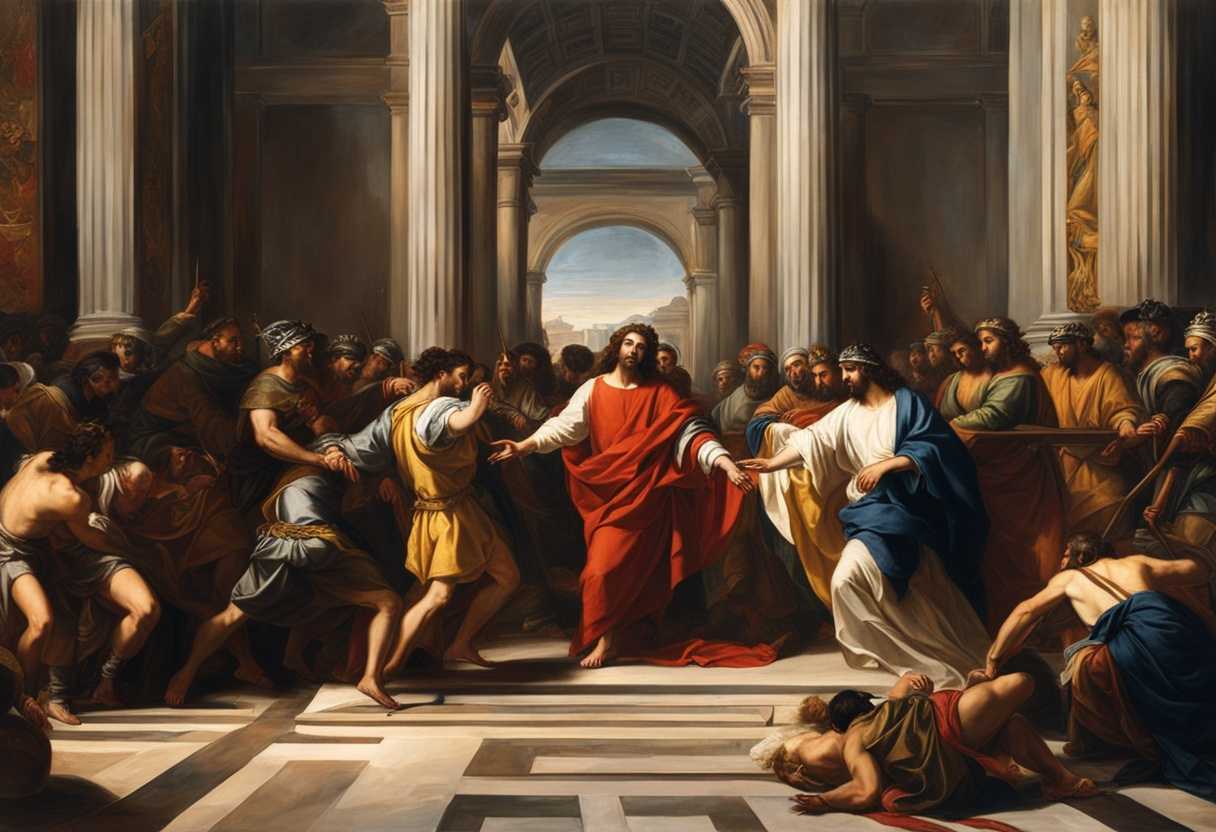
Setting the Scene for Matthew 27:11-54
The scene described in Matthew 27:11-54 takes place in Jerusalem during the time of the Roman governor Pontius Pilate. Jesus, who has been brought before Pilate by the chief priests and elders, stands trial in front of a large crowd that has gathered in the courtyard of the governor’s residence. The atmosphere is tense as accusations are hurled at Jesus, and the crowd grows increasingly agitated.
Pilate, a powerful and conflicted figure, questions Jesus about the charges brought against him. Meanwhile, the chief priests and elders, along with a mob incited by them, demand Jesus’ crucifixion. The scene is chaotic, with emotions running high as Pilate tries to navigate the political and religious pressures bearing down on him.
Surrounding the main characters are Roman soldiers, onlookers, and disciples of Jesus, including Mary Magdalene and John. The setting is a mix of Roman architecture and the bustling streets of Jerusalem, adding to the dramatic tension of the momentous events unfolding.
What is Matthew 27:11-54 about?
This verse speaks to a pivotal moment in Christian theology and history. Jesus, who is believed to be the son of God, faces a trial and ultimately sacrifices his life by being crucified on the cross. This act is seen as an atonement for the sins of humanity, offering a path to salvation and redemption. Through his death, Christians believe that Jesus took on the sins of the world, bridging the gap between humanity and God.
Have you ever considered the depth of love and sacrifice in this story? The idea that someone would willingly give up their life to save others is a powerful and profound concept. It shows the extent of God’s love for humanity and the lengths to which he would go to offer forgiveness and reconciliation. This verse serves as a reminder of the ultimate act of love and grace, inviting us to reflect on our own beliefs and relationship with God.
Understanding what Matthew 27:11-54 really means
In Matthew 27:11-54, we witness a pivotal moment in the narrative of Jesus’ passion, encompassing His trial before Pilate, the crucifixion, and the profound events that unfolded thereafter. This passage holds immense significance in Christian theology, as it encapsulates the ultimate sacrifice of Jesus for the redemption of humanity, highlighting themes of suffering, redemption, and access to God.
As Pilate questions Jesus, “Are you the king of the Jews?” we see Jesus affirming His identity and mission, acknowledging His kingship but clarifying that His kingdom is not of this world (John 18:36-37). This interaction underscores the divine nature of Jesus and His purpose to establish a spiritual kingdom beyond earthly realms. The juxtaposition of earthly power and heavenly authority is stark, emphasizing the transcendent nature of Jesus’ mission.
The chilling cry of the crowd, “Crucify him!” echoes through the passage, symbolizing the rejection and suffering Jesus endured at the hands of humanity. This demand for crucifixion resonates with the prophecy of the suffering servant in Isaiah 53:3-5, portraying Jesus as the sacrificial lamb who bears the sins of the world. The crowd’s rejection stands as a stark reminder of humanity’s capacity for injustice and cruelty, contrasting with Jesus’ unwavering love and forgiveness.
In the moment of deepest anguish, Jesus cries out from the cross, “My God, my God, why have you forsaken me?” quoting Psalm 22:1. This cry encapsulates the profound weight of bearing the sins of humanity and fulfilling the prophetic scriptures. Jesus’ abandonment by God in that moment reflects the depths of His sacrifice and the extent to which He identified with human suffering, offering a profound insight into the redemptive work of the cross.
The tearing of the temple curtain at Jesus’ death symbolizes the inauguration of a new covenant, granting all believers direct access to God through Jesus. This act signifies the removal of barriers between humanity and the divine, as depicted in Hebrews 10:19-20, which speaks of the new and living way opened through Jesus’ sacrifice. The torn curtain represents the profound transformation brought about by Jesus’ sacrifice, offering reconciliation and intimacy with God to all who believe.
Today, the message of Jesus’ sacrifice and redemption remains as relevant as ever. His willingness to endure injustice and suffering resonates with those facing similar challenges, offering solace in the knowledge that Jesus understands and shares in their pain. The torn curtain symbolizes the universal access to God through Jesus, inviting all to experience a personal relationship with the divine. By reflecting on the depth of Jesus’ love and sacrifice, we are called to respond by deepening our faith and embodying the principles of love, justice, and redemption in our daily lives.
How can we show compassion and forgiveness in suffering?
Jesus Christ on the cross demonstrates the ultimate example of compassion and forgiveness in suffering in the passage you mentioned. Despite facing immense pain and agony, Jesus not only forgave those who crucified Him but also showed compassion to the criminal being crucified beside Him. His words, “Father, forgive them, for they do not know what they are doing,” exemplify his boundless compassion and willingness to forgive even in the midst of suffering.
This serves as a powerful reminder for us to show compassion and forgiveness in our own lives, especially during times of suffering. We are called to extend grace and forgiveness to those who may have wronged us, just as Jesus showed mercy and understanding towards his persecutors. We can help spread love and healing in a world that often feels overwhelmed by pain and hardship by following His example and embodying these traits in our interactions with others.
Application
Pause and consider the selfless act of love that Christ showed on the cross – his sacrifice speaks volumes. Think about the depth of his suffering and the incredible cost he paid for our salvation. Let this profound message stir your heart to live with thankfulness and loyalty towards Him. How will you honor His extraordinary love demonstrated on the cross of Calvary?

Reverend Michael Johnson is an experienced Church Minister with a profound expertise in spirituality and guidance. With a serene presence and a compassionate heart, he has faithfully served his congregation for over 20 years, leading them on a spiritual journey towards inner peace and enlightenment. Reverend Johnson’s extensive knowledge of religious philosophies and profound understanding of human nature have made him a trusted confidant and mentor to many, as he seamlessly weaves his profound wisdom into life teachings. Reverend Johnson’s calming demeanor and empathetic nature continue to uplift and heal souls, nurturing a sense of unity and tranquility within his community.