
Matthew 27:32-56 is about Jesus being led to Golgotha, where he is crucified alongside two criminals, fulfilling the prophecy and demonstrating his sacrificial love for humanity, leading to darkness covering the land, the temple veil tearing, and ultimately his death and burial.
32 As they went out, they found a man of Cyrene, Simon by name. They compelled this man to carry his cross.
33 And when they came to a place called Golgotha (which means Place of a Skull),
34 they offered him wine to drink, mixed with gall, but when he tasted it, he would not drink it.
35 And when they had crucified him, they divided his garments among them by casting lots.
36 Then sitting down, they kept watch over him there.
37 And over his head they put the charge against him, which read, “This is Jesus, the King of the Jews.”
38 Then two robbers were crucified with him, one on the right and one on the left.
39 And those who passed by derided him, wagging their heads
40 and saying, “You who would destroy the temple and rebuild it in three days, save yourself! If you are the Son of God, come down from the cross.”
41 So also the chief priests, with the scribes and elders, mocked him, saying,
42 “He saved others; he cannot save himself. He is the King of Israel; let him come down now from the cross, and we will believe in him.”
43 He trusts in God; let God deliver him now, if he desires him. For he said, ‘I am the Son of God.’”
44 And the robbers who were crucified with him also reviled him in the same way.
46 And about the ninth hour Jesus cried out with a loud voice, saying, “Eli, Eli, lema sabachthani?” that is, “My God, my God, why have you forsaken me?”
46 And about the ninth hour Jesus cried out with a loud voice, saying, “Eli, Eli, lema sabachthani?” that is, “My God, my God, why have you forsaken me?”
47 And some of the bystanders, hearing it, said, “This man is calling Elijah.”
48 And one of them at once ran and took a sponge, filled it with sour wine, and put it on a reed and gave it to him to drink.
49 And the rest said, “Let us see whether Elijah will come to save him.”
50 And Jesus cried out again with a loud voice and yielded up his spirit.
51 And behold, the curtain of the temple was torn in two, from top to bottom. And the earth shook, and the rocks were split.
52 The tombs also were opened. And many bodies of the saints who had fallen asleep were raised,
53 They came out of the tombs after his resurrection and went into the holy city and appeared to many.
54 When the centurion and those who were with him, keeping watch over Jesus, saw the earthquake and what took place, they were filled with awe and said, “Truly this was the Son of God!”
55 There were also many women there, looking on from a distance, who had followed Jesus from Galilee, ministering to him,
56 among whom were Mary Magdalene and Mary the mother of James and Joseph, and the mother of the sons of Zebedee.
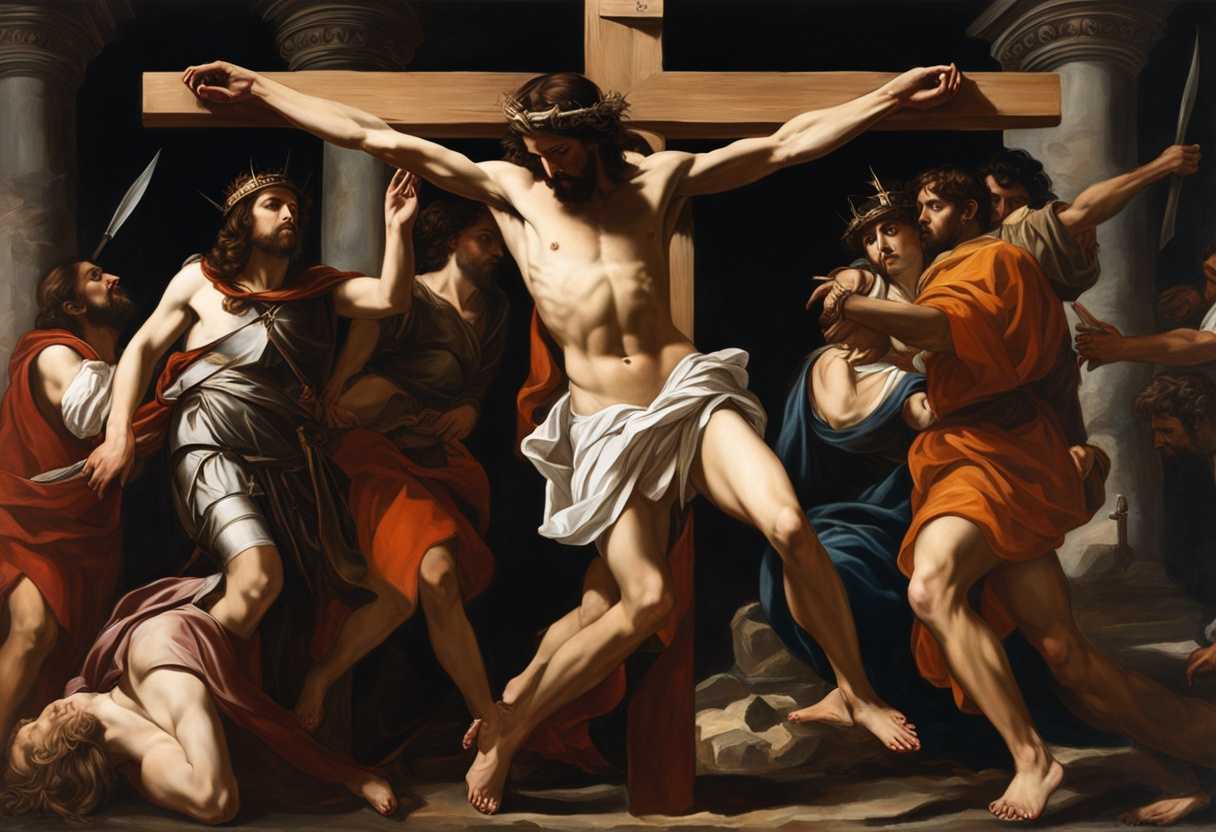
Setting the Scene for Matthew 27:32-56
The scene described in Matthew 27:32-56 takes place on the road to Golgotha, where Jesus is led to be crucified. The Roman soldiers compel a man named Simon of Cyrene to carry Jesus’ cross because Jesus is weakened from the beatings and torture He has endured. The crowd following Jesus includes many onlookers, some of whom are mourning and wailing for Him, while others are mocking and jeering at Him. Among the crowd are also the chief priests, scribes, and elders who orchestrated Jesus’ arrest and trial.
The atmosphere is tense and charged with emotion as Jesus, Simon, and the soldiers make their way through the streets. The weight of the cross, the cries of the crowd, and the knowledge of what is to come create a somber and heavy mood. The scene is chaotic, with people pushing and shoving, and the air is thick with dust and the sounds of anguish and anger. Despite the chaos, there is a sense of solemnity and gravity as Jesus walks towards His crucifixion, bearing the sins of the world on His shoulders.
What is Matthew 27:32-56 about?
This verse carries a profound message of sacrifice, redemption, and love. Jesus, believed by Christians to be the son of God, willingly endured immense suffering and humiliation on the cross to atone for the sins of all humanity. Despite being mocked and enduring excruciating pain, Jesus demonstrated unparalleled love and forgiveness, offering himself as a sacrifice to save others from their sins. This act of selflessness and compassion is a central tenet of the Christian faith, reminding believers of the ultimate sacrifice made for their salvation.
Reflecting on this verse prompts us to contemplate the depth of Jesus’ love and the significance of his sacrifice. It challenges us to consider the concept of redemption and the power of forgiveness. How does this act of self-sacrifice inspire us to love more deeply, forgive more readily, and serve others with compassion? What does it mean for us personally to accept the gift of salvation that Jesus offered through his crucifixion? We meditate on the crucifixion of Jesus, reflecting on our own actions, relationships, and beliefs, understanding the profound impact of Jesus’ sacrifice on our lives.
Understanding what Matthew 27:32-56 really means
The crucifixion of Jesus Christ, as depicted in Matthew 27:32-56, stands as a pivotal moment in Christian faith. It is the ultimate act of sacrifice and redemption, where Jesus bore the weight of humanity’s sins on the cross. The significance of this event lies in the belief that through his death and resurrection, Jesus offered salvation and eternal life to all who believe in him.
As we delve into the key phrases of this passage, we encounter the poignant image of Simon of Cyrene being forced to carry the cross. This act symbolizes the shared burden of suffering and the call to bear one another’s crosses in solidarity. The mention of Golgotha, meaning ‘the place of the skull,’ adds a layer of symbolism, representing the place of death and the triumph of life through Christ’s sacrifice.
The cry of Jesus, “My God, my God, why have you forsaken me?” reveals the depth of his suffering and the profound mystery of the divine plan. This moment captures the anguish of separation from God as Jesus takes on the sins of the world. The tearing of the temple curtain signifies the end of the old covenant and the opening of a new way for humanity to access God directly through Jesus, the ultimate High Priest.
The centurion’s declaration, “Surely he was the Son of God!” underscores the recognition of Jesus’ true identity and the transformative power of witnessing his sacrifice. This acknowledgment points to the universal significance of Jesus’ death, inviting all people to recognize him as the Son of God and the savior of the world.
Connecting this passage to other biblical texts, such as Isaiah 53:5, we see the fulfillment of prophecy in Jesus’ suffering for the sake of humanity’s redemption. John 3:16 highlights the profound love behind Jesus’ sacrifice, offering eternal life to those who believe in him. Hebrews 10:19-20 emphasizes the newfound access to God through Jesus’ sacrifice, inviting believers to approach the Most Holy Place with confidence.
In today’s world, the themes of suffering, sacrifice, and redemption remain relevant. Jesus’ sacrifice transcends time and culture, offering hope and transformation to all who embrace his message. By reflecting on the crucifixion and carrying our own crosses in service to others, we can embody the selfless love exemplified by Jesus on the cross.
Consider the story of an individual who found solace and renewal through understanding the significance of Jesus’ crucifixion. This anecdote illustrates how the message of the cross can bring comfort and strength in the midst of personal struggles, pointing to the enduring power of Christ’s sacrifice in our lives.
In conclusion, let us meditate on the profound truths revealed in Matthew 27:32-56. May we internalize the message of Jesus’ sacrifice, finding inspiration to live lives of love, service, and faith. Let us offer a prayer of gratitude for the gift of salvation through the cross, embracing the transformative power of Christ’s sacrifice in our hearts and minds.
How can we show compassion for those who suffer?
We can show compassion for those who suffer by following the example set in this verse, which shows Jesus Christ being crucified. Emulating the compassion displayed by Jesus towards those who were inflicting pain upon him is a powerful way to show empathy and understanding towards others who are hurting. We can strive to offer compassion and forgiveness to those who may have wronged us or are in need of our support, just as Jesus forgave those who crucified him and showed compassion to a criminal being crucified alongside him.
Additionally, we can offer practical help and support to those who are suffering, much like how Simon of Cyrene helped Jesus carry the cross. Whether it is through acts of service, listening, or simply being present for someone in their time of need, showing kindness and empathy can go a long way in alleviating the suffering of others. We can demonstrate genuine compassion and care for the well-being of those facing difficult circumstances by extending a helping hand and walking alongside them.
Furthermore, reflecting on the sacrifice made by Jesus on the cross can inspire us to show compassion towards all who are suffering. Jesus endured immense pain and suffering for the salvation of humanity, teaching us that true compassion often involves selflessness and sacrifice. We can embody the spirit of compassion exemplified by Jesus Christ by being willing to go out of our way to support and uplift those who are in distress.
Application
Let’s draw inspiration from the sacrificial love of Jesus on the cross as we dive into Matthew 27:32-56. His unwavering commitment urges us to embrace his love and grace daily. It’s time to mirror his selflessness and compassion in our interactions, radiating forgiveness and hope in our modern lives. Will you heed his call and embark on this transformative journey today?”

Reverend Michael Johnson is an experienced Church Minister with a profound expertise in spirituality and guidance. With a serene presence and a compassionate heart, he has faithfully served his congregation for over 20 years, leading them on a spiritual journey towards inner peace and enlightenment. Reverend Johnson’s extensive knowledge of religious philosophies and profound understanding of human nature have made him a trusted confidant and mentor to many, as he seamlessly weaves his profound wisdom into life teachings. Reverend Johnson’s calming demeanor and empathetic nature continue to uplift and heal souls, nurturing a sense of unity and tranquility within his community.