
Matthew 27:39-44 is about the mockery and taunting Jesus endured while on the cross, revealing the depth of human cruelty and lack of understanding towards the significance of his sacrifice.
39 And those who passed by derided him, wagging their heads
40 and saying, “You who would destroy the temple and rebuild it in three days, save yourself! If you are the Son of God, come down from the cross.”
41 So also the chief priests, with the scribes and elders, mocked him, saying,
42 “He saved others; he cannot save himself. He is the King of Israel; let him come down now from the cross, and we will believe in him.”
43 He trusts in God; let God deliver him now, if he desires him. For he said, ‘I am the Son of God.’”
44 And the robbers who were crucified with him also reviled him in the same way.
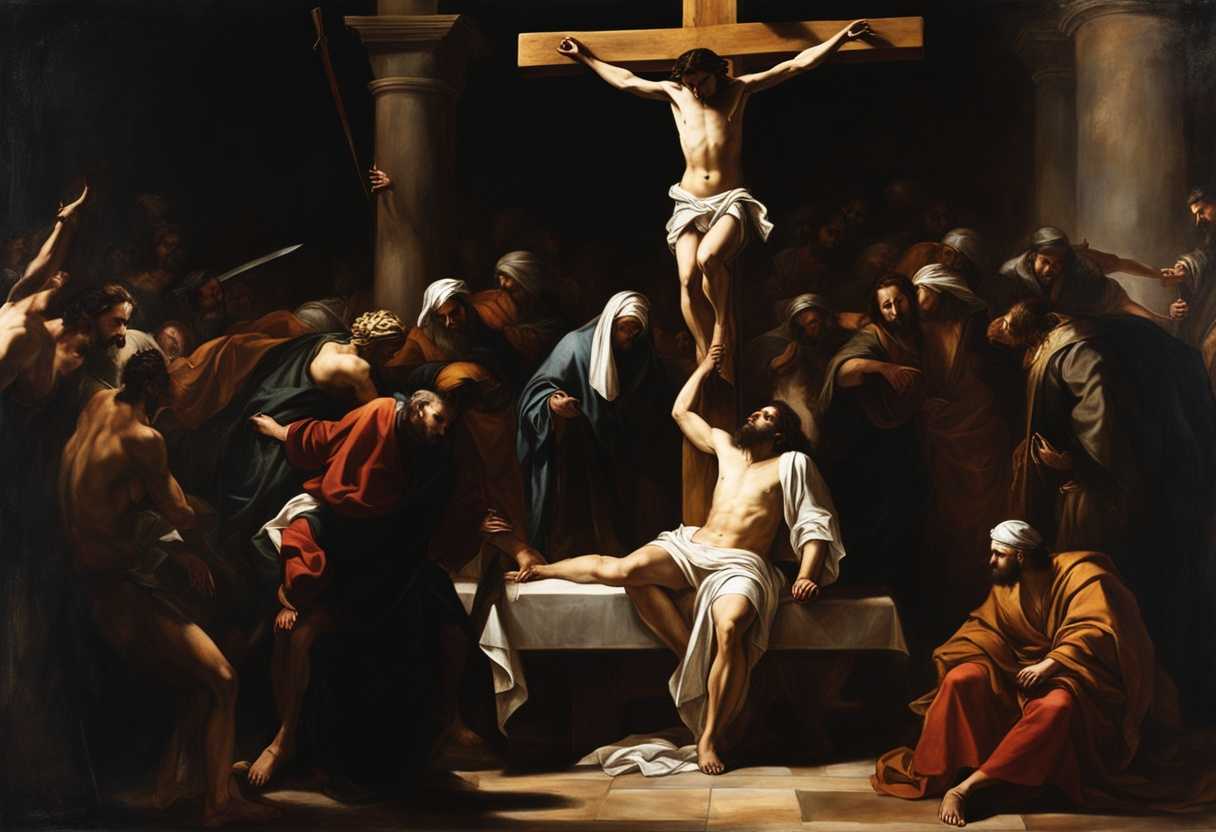
Setting the Scene for Matthew 27:39-44
The scene described in Matthew 27:39-44 takes place at Golgotha, the place of the crucifixion of Jesus. The Roman soldiers have nailed Jesus to the cross, and he is now hanging between two criminals who are also being crucified. A crowd has gathered around, including the chief priests, scribes, and elders who are mocking Jesus, challenging him to save himself if he truly is the Son of God. The soldiers are also taunting him, offering him sour wine to drink and daring him to come down from the cross.
Among the onlookers are Mary, the mother of Jesus, and some of his disciples, who are watching in sorrow and disbelief. The atmosphere is tense and somber, with the sound of jeers and insults filling the air. The sky is darkened, adding to the sense of foreboding and despair. Despite the mockery and ridicule, Jesus remains on the cross, enduring the pain and humiliation as part of his ultimate sacrifice for the sins of humanity.
What is Matthew 27:39-44 about?
We witness a profound moment of challenge and mockery towards Jesus as He hangs on the cross in this powerful verse. The mockers question Jesus’ ability to save others when he seemingly cannot save Himself. This challenging statement is loaded with deep theological implications and serves as a test of Jesus’ identity and power. It brings to light the tension between faith and doubt, between the seen and unseen, between the expectations of the world and the reality of divinity. We reflect on this verse, delving into the essence of Jesus’ sacrifice and the ultimate demonstration of love and humility. It prompts us to question our own understanding of salvation and the profound mystery of the Cross. How does Jesus’ response to these mockers redefine our perception of strength and power? How does this moment of vulnerability unveil the depth of God’s love for humanity? Let us ponder on these questions and allow this verse to deepen our faith and understanding of the enduring power of the Cross.
Understanding what Matthew 27:39-44 really means
The passage in Matthew 27:39-44 paints a vivid picture of the mockery and insults hurled at Jesus while He hung on the cross. It wasn’t just the religious leaders or soldiers who scorned Him; even ordinary passersby joined in, shaking their heads in derision. This collective rejection and public scorn highlight the extent of Jesus’ humiliation and suffering. It’s crucial to grasp the context of Jesus’ crucifixion – a moment of immense pain and shame, yet also the fulfillment of prophecy and the ultimate act of love and sacrifice.
In Isaiah 53:3, we find a prophecy foretelling Jesus’ suffering and rejection, emphasizing His identification with human pain. Psalm 22:7-8 echoes the scene of mockery at the crucifixion, with onlookers challenging Jesus to prove His trust in God. These passages serve as poignant reminders of the fulfillment of ancient prophecies in Jesus’ crucifixion. Luke 23:34 captures Jesus’ response to His mockers, a prayer for forgiveness that exemplifies His unwavering love and grace even in the face of extreme suffering.
The relevance of this passage to people today is profound. Many individuals encounter ridicule, rejection, and suffering in various forms. Jesus’ endurance and forgiveness in the midst of mockery offer a powerful example of responding to adversity with grace and love. His steadfast faith in the face of challenges inspires us to hold onto our beliefs even when they are questioned or ridiculed by others. The lesson of forgiveness from Jesus’ crucifixion teaches us to extend grace to those who wrong us, mirroring His profound capacity for forgiveness.
Consider Sarah, a young woman facing constant mockery at her workplace for her faith. Feeling isolated and hurt by her colleagues’ comments, she finds solace in the story of Jesus’ crucifixion. Just as Jesus forgave His mockers, Sarah draws strength to forgive her colleagues and live out her faith with dignity. The story of Jesus’ suffering and forgiveness becomes a source of inspiration and resilience for her in the face of adversity.
Reflecting on the phrases in this passage deepens our understanding of Jesus’ sacrifice. The taunts of “He saved others, but he can’t save himself!” challenge Jesus’ identity and mission, revealing a profound misunderstanding of His purpose. Even the rebels crucified alongside Him joined in the insults, emphasizing the depth of human cruelty and Jesus’ profound isolation. Through these details, we gain insight into the extent of Jesus’ sacrifice and find strength and inspiration for our own lives.
Why do people mock and challenge Jesus?
People mock and challenge Jesus because they do not believe in His divine power and authority. They taunt Him, saying if He truly is the Son of God, He should be able to save Himself. Their lack of faith and understanding lead them to ridicule Jesus, not realizing that He is willingly sacrificing Himself for the redemption of humanity. The mocking and challenges serve as a reflection of their own disbelief and ignorance of the significance of Jesus’ actions.
Furthermore, some people may mock and challenge Jesus out of a desire to see a spectacle or entertainment without recognizing the gravity of the situation. Their jeering is a manifestation of their own sinful nature and their failure to grasp the true purpose of Jesus’ mission on Earth. Through their actions, they reveal their hardness of heart and inability to comprehend the deep love and sacrifice that Jesus embodies for all of mankind.
Application
In a world where words cut like sharp blades, let us be the architects of compassion and kindness. Just as we build our careers and nurture our families, let us also cultivate a culture of empathy and respect. Let our actions be the cornerstone of a new way forward, where understanding triumphs over hostility. Will you join hands in planting the seeds of love and unity in the soil of our society?

Reverend Michael Johnson is an experienced Church Minister with a profound expertise in spirituality and guidance. With a serene presence and a compassionate heart, he has faithfully served his congregation for over 20 years, leading them on a spiritual journey towards inner peace and enlightenment. Reverend Johnson’s extensive knowledge of religious philosophies and profound understanding of human nature have made him a trusted confidant and mentor to many, as he seamlessly weaves his profound wisdom into life teachings. Reverend Johnson’s calming demeanor and empathetic nature continue to uplift and heal souls, nurturing a sense of unity and tranquility within his community.