
Matthew 8:8-10 is about a Roman centurion displaying profound faith in Jesus by acknowledging His authority and power to heal from a distance, prompting Jesus to marvel at the centurion’s faith and revealing that faith surpasses social or religious boundaries.
8 The centurion answered, “Lord, I am not worthy to have you come under my roof, but only say the word, and my servant will be healed.
9 For I too am a man under authority, with soldiers under me. And I say to one, ‘Go,’ and he goes, and to another, ‘Come,’ and he comes, and to my servant, ‘Do this,’ and he does it.”
10 When Jesus heard this, he marveled and said to those who followed him, “Truly, I tell you, with no one in Israel have I found such faith.
Setting the Scene for Matthew 8:8-10
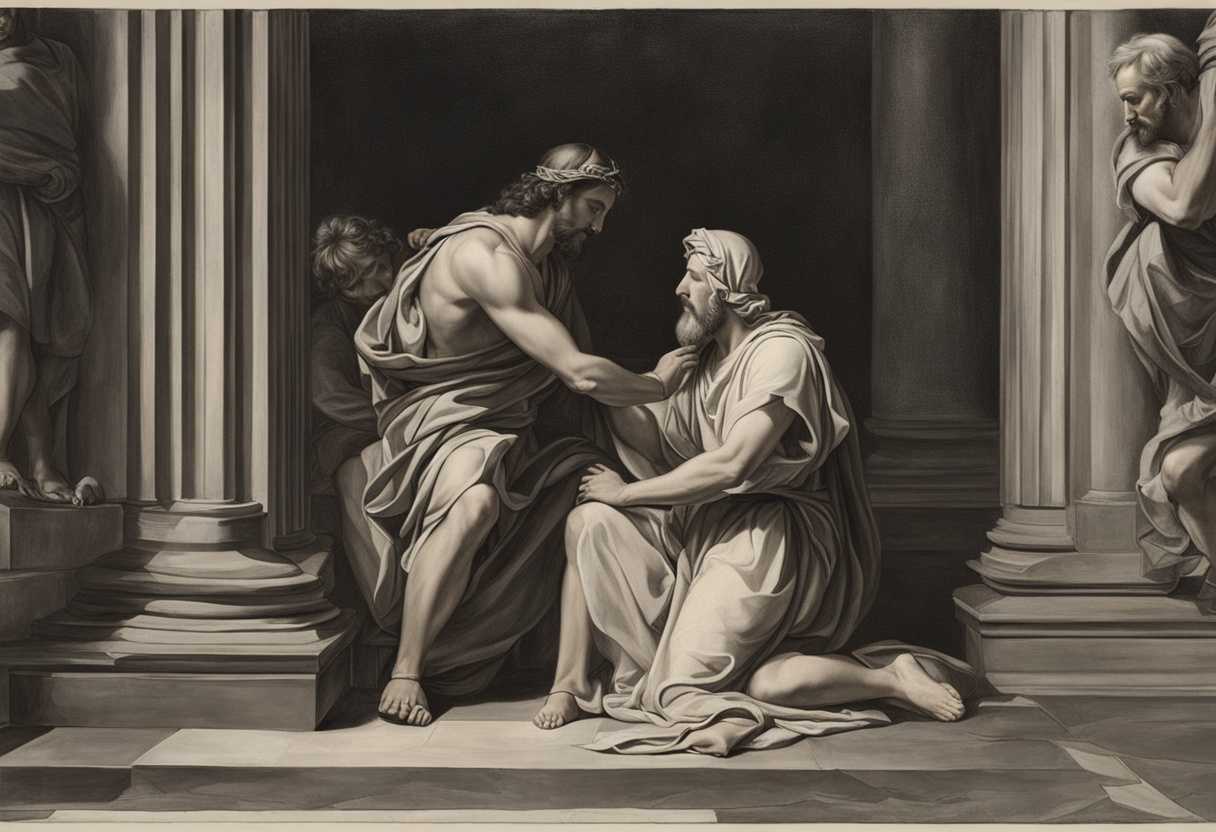
In Matthew chapter 8, we find a scene where a Roman centurion approaches Jesus. The centurion is a man of authority in the Roman army, responsible for a hundred soldiers. He comes to Jesus seeking help for his paralyzed servant. The centurion’s servant is at home, suffering and in need of healing. The centurion, known for his faith and humility, approaches Jesus with a request for healing, acknowledging Jesus’ power and authority.
The scene takes place in Capernaum, a town located on the northern shore of the Sea of Galilee. Jesus is surrounded by a crowd of people who have been following Him, witnessing His teachings and miracles. The centurion, a Gentile, demonstrates remarkable faith in Jesus, believing that a mere word from Him can heal his servant. This interaction between the centurion and Jesus highlights the universal nature of Jesus’ ministry, reaching beyond the boundaries of ethnicity and social status. Jesus is amazed by the centurion’s faith, declaring that he has not found such great faith in all of Israel. This encounter serves as a powerful example of faith and humility, showing that anyone, regardless of background, can approach Jesus with faith and receive His help.
What is Matthew 8:8-10 about?
This verse showcases the powerful faith of a Roman centurion in Jesus’ ability to heal his servant. The centurion, a symbol of Roman authority and power, humbly approaches Jesus, recognizing Him as the ultimate authority over sickness and healing. Despite being a Gentile and not a part of the Jewish community, the centurion’s faith surpasses cultural and religious barriers, highlighting the inclusive nature of Jesus’ ministry.
Have you ever marveled at the depth of faith displayed by the centurion in this story? His belief in Jesus’ power to heal, without even needing to witness a physical demonstration, is truly inspiring. It challenges us to reflect on our own faith and trust in God’s limitless power to work miracles in our lives and those around us. The centurion’s story reminds us that faith knows no boundaries and that a sincere heart of trust in Jesus can move mountains and bring forth miracles beyond our wildest imagination. Let us trust in Jesus’ authority to bring healing, restoration, and hope, striving to emulate the unwavering faith of the centurion in our own lives.
Understanding what Matthew 8:8-10 really means
In Matthew 8:8-10, we encounter the narrative of the Roman centurion who approaches Jesus seeking healing for his servant. This account showcases the centurion’s remarkable faith and understanding of authority. The centurion, a man accustomed to giving orders and having them obeyed, humbly acknowledges Jesus’ divine authority by expressing his unworthiness for Jesus to enter his home. Instead, he demonstrates profound faith by declaring that a mere word from Jesus would be enough to heal his servant. Jesus, astounded by the centurion’s faith, commends him, stating that such faith is unparalleled even among the people of Israel.
The key phrases in these verses hold significant meanings that resonate with believers today. The centurion’s humility in admitting his unworthiness to have Jesus physically present reflects a deep reverence for the holiness of Christ. His statement, “But only say the word, and my servant will be healed,” underscores his unwavering faith in Jesus’ power and authority. Jesus’ acknowledgment of the centurion’s exceptional faith serves as a testament to the transformative impact of genuine belief in Christ’s authority.
This story finds parallels in other biblical passages, such as Luke 7:1-10, which provides further insights into the centurion’s faith. Additionally, Hebrews 11:1 emphasizes the essence of faith as the assurance of things hoped for and the conviction of things unseen, mirroring the centurion’s trust in Jesus’ healing power. James 4:6 reinforces the importance of humility in faith, highlighting God’s favor towards the humble and His opposition to the proud.
The relevance of the centurion’s story extends to contemporary believers in various ways. It serves as a compelling example of faith in action, urging individuals to trust in Jesus’ authority and power even in the absence of tangible evidence. Embracing humility, like the centurion, is crucial in fostering a genuine relationship with God. Moreover, recognizing and submitting to Jesus’ divine authority can revolutionize our approach to prayer and deepen our faith.
To illustrate the enduring impact of the centurion’s faith, envision a modern-day scenario where someone facing a severe illness combines medical treatment with fervent prayer, firmly believing in Jesus’ ability to bring healing. This individual mirrors the centurion’s faith by trusting in Jesus’ authority to transcend physical limitations and bring about restoration. Such narratives inspire us to cultivate a similar unwavering faith in Jesus’ transformative power, irrespective of our circumstances.
In conclusion, the account of the Roman centurion encapsulates timeless lessons on faith and humility. By acknowledging Jesus’ authority with reverence and approaching Him with a humble heart, we open ourselves to experiencing His miraculous work in our lives. Just as the centurion’s faith impressed Jesus, may our unwavering trust in Christ’s authority lead us to profound encounters with His transformative power.
How can we approach Jesus with humility and faith?
Approaching Jesus with humility involves recognizing our own limitations and weaknesses compared to His power and authority. When the centurion in the passage acknowledged that he was not worthy to have Jesus come to his house, he demonstrated humility by understanding his own unworthiness and recognizing the greatness of Jesus. We can approach Jesus with humility by acknowledging our own shortcomings and submitting to His will with a sense of reverence and respect.
Approaching Jesus with faith involves believing in His ability to help and trusting that He has the power to bring about change. The centurion’s faith was evident in his belief that Jesus only needed to say the word for his servant to be healed. Likewise, when we approach Jesus with faith, we trust in His power and authority to work in our lives, knowing that He is able to intervene and bring about the transformation we seek. Approaching Jesus with humility and faith positions us to receive His grace and experience His miraculous work in our lives.
Application
Picture your daily grind—balancing work, family, and life’s chaos. Just like the centurion from Matthew 8:8-10 amazed Jesus with his unwavering faith, you too can inspire miracles in your life. Trust in Jesus’ power and authority, confident that He can change any situation with a simple word. Approach Him with humility and belief, seeking His mighty intervention. Are you ready to show that kind of faith and see extraordinary transformations in your life?

Reverend Michael Johnson is an experienced Church Minister with a profound expertise in spirituality and guidance. With a serene presence and a compassionate heart, he has faithfully served his congregation for over 20 years, leading them on a spiritual journey towards inner peace and enlightenment. Reverend Johnson’s extensive knowledge of religious philosophies and profound understanding of human nature have made him a trusted confidant and mentor to many, as he seamlessly weaves his profound wisdom into life teachings. Reverend Johnson’s calming demeanor and empathetic nature continue to uplift and heal souls, nurturing a sense of unity and tranquility within his community.