
Ruth 3:1-18 is about Ruth’s act of courage, loyalty, and trust as she follows Naomi’s instructions to approach Boaz at the threshing floor, symbolizing her faithfulness and commitment to her mother-in-law and ultimately to God’s plan for her life.
1 Then Naomi her mother-in-law said to her, “My daughter, should I not seek rest for you, that it may be well with you?
2 And now is not Boaz our relative, with whose young women you were? See, he is winnowing barley tonight at the threshing floor.
3 Wash therefore and anoint yourself, and put on your cloak and go down to the threshing floor, but do not make yourself known to the man until he has finished eating and drinking.
4 And when he lies down, observe the place where he lies. Then go and uncover his feet and lie down, and he will tell you what to do.”
5 And she said to her, “All that you say I will do.”
6 So she went down to the threshing floor and did just as her mother-in-law had commanded her.
7 And when Boaz had eaten and drunk, and his heart was merry, he went to lie down at the end of the heap of grain. Then she came softly and uncovered his feet and lay down.
8 At midnight the man was startled and turned over, and behold, a woman lay at his feet!
9 He said, “Who are you?” And she answered, “I am Ruth, your servant. Spread your wings over your servant, for you are a redeemer.”
10 And he said, “May you be blessed by the Lord, my daughter. You have made this last kindness greater than the first in that you have not gone after young men, whether poor or rich.
11 And now, my daughter, do not fear. I will do for you all that you ask, for all my fellow townsmen know that you are a worthy woman.
12 And now it is true that I am a redeemer.
13 Remain tonight, and in the morning, if he will redeem you, good; let him do it. But if he is not willing to redeem you, then, as the Lord lives, I will redeem you. Lie down until the morning.”
14 So she lay at his feet until the morning, but arose before one could recognize another. And he said, “Let it not be known that the woman came to the threshing floor.”
15 And he said, “Bring the garment you are wearing and hold it out.” So she held it, and he measured out six measures of barley and put it on her. Then she went into the city.
16 And when she came to her mother-in-law, she said, “How did you fare, my daughter?” Then she told her all that the man had done for her,
17 She replied, “These six measures of barley he gave to me, for he said to me, ‘You must not go back empty-handed to your mother-in-law.’”
18 She replied, “Wait, my daughter, until you learn how the matter turns out, for the man will not rest but will settle the matter today.”
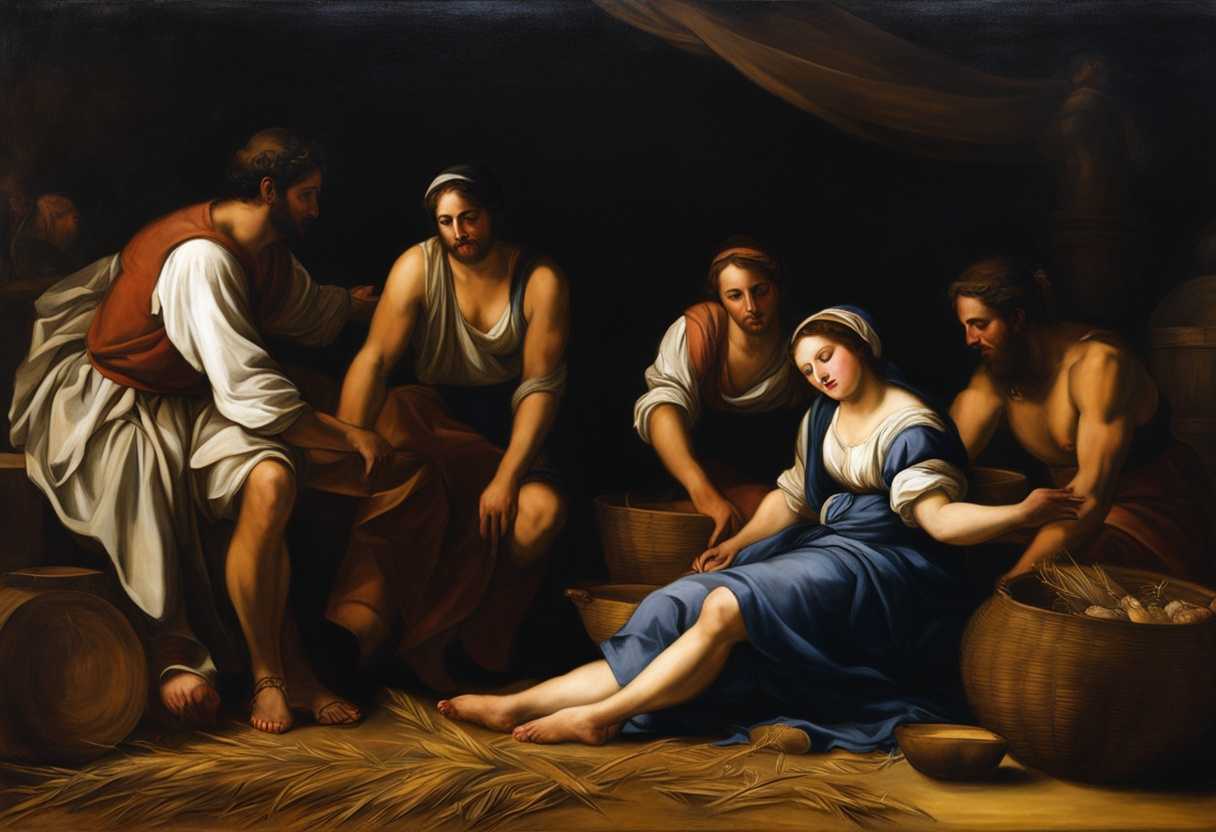
Setting the Scene for Ruth 3:1-18
In Ruth chapter 3, we find Ruth, a Moabite woman, and her mother-in-law, Naomi, living in Bethlehem. Naomi had returned to Bethlehem after the death of her husband and two sons, leaving her widowed daughter-in-laws, Ruth and Orpah, behind. Ruth, however, chose to stay with Naomi, declaring her loyalty and faithfulness to her mother-in-law and to Naomi’s God.
One day, Naomi comes up with a plan to secure Ruth’s future and find her a husband. She instructs Ruth to go to the threshing floor where Boaz, a relative of Naomi’s deceased husband, is working. Ruth follows Naomi’s instructions and goes to the threshing floor in the dead of night. There, she uncovers Boaz’s feet and lies down. When Boaz wakes up and finds Ruth at his feet, she asks him to spread his garment over her, a symbolic gesture of asking for his protection and provision as her kinsman-redeemer.
The scene at the threshing floor is filled with tension and anticipation as Ruth takes a bold step to secure her future and honor her commitment to Naomi. The surroundings are dark and quiet, with the only sound being the rustling of the grain and the soft whispers between Ruth and Boaz. This pivotal moment sets the stage for the unfolding of a beautiful love story and the fulfillment of God’s plan for Ruth and Boaz.
What is Ruth 3:1-18 about?
Ah, the story of Ruth and Boaz is truly a beautiful reflection of faith and redemption. Ruth, a Moabite widow, shows immense loyalty and trust in God by following her mother-in-law, Naomi, to Bethlehem. Here, Ruth’s encounter with Boaz not only demonstrates her faithfulness to her family but also her unwavering trust in God’s plan for her life. Through her actions and humility, Ruth exemplifies what it means to seek redemption and hope in times of difficulty and uncertainty. As we delve into this verse describing Ruth seeking redemption through Boaz, we are reminded of the power of faith and obedience. Ruth’s willingness to humble herself and trust in God’s provision ultimately leads to her being blessed by Boaz, who acts as a redeemer in her life. This narrative serves as a reminder to all of us that when we exhibit faithfulness and trust in God, He can work miracles in our lives and bring about redemption in the most unexpected ways. So, let us reflect on Ruth’s story and ask ourselves – are we willing to trust in God’s plan for us, even when the path may seem uncertain or challenging?
Understanding what Ruth 3:1-18 really means
The Book of Ruth is a captivating tale of loyalty, love, and redemption, with Ruth 3:1-18 highlighting Ruth’s bold initiative to secure her and Naomi’s future by approaching Boaz, a kinsman-redeemer. This chapter serves as a crucial turning point, laying the foundation for the eventual union of Ruth and Boaz, leading to the lineage of King David and, ultimately, Jesus Christ.
In this passage, Naomi’s heartfelt concern for Ruth’s well-being shines through as she expresses her desire to seek rest for her, signifying a stable and secure home—a vital need for widows in ancient times. Ruth’s act of uncovering Boaz’s feet and lying down symbolizes her humility and trust in his integrity, a cultural gesture of seeking protection and proposing marriage. Her plea for Boaz to spread his cloak over her signifies a request for his protection and a symbolic proposal of marriage, highlighting the concept of a redeemer—a relative responsible for aiding family members in need.
Drawing parallels from related biblical passages such as Leviticus 25:25, Deuteronomy 25:5-10, and Proverbs 31:10-31, we gain a deeper understanding of the cultural and religious context surrounding the roles of kinsman-redeemers, levirate marriage, and the virtues of a noble woman, all of which are exemplified in Ruth’s actions and character.
The timeless themes of loyalty, faith, and divine providence in Ruth 3 resonate with contemporary audiences, serving as a poignant reminder of the significance of remaining faithful and trusting in God’s plan amidst life’s uncertainties. The notion of seeking and providing “rest” or security for our loved ones remains relevant today, urging us to prioritize the well-being of our families and communities.
To illustrate this relevance, envision a scenario where a single mother struggles to provide for her child, and a compassionate family friend steps in to offer support, mirroring Boaz’s role as a redeemer. This modern-day anecdote underscores how we can embody God’s provision and care by extending kindness and responsibility to those in need.
In conclusion, Ruth 3:1-18 encapsulates a narrative of faith, courage, and divine orchestration, challenging us to emulate integrity and compassion while trusting in God’s guidance and provision as we strive to fulfill His purposes.
How can we show loyalty and kindness to others?
We can take inspiration from the actions of Ruth in this passage to show loyalty and kindness to others. Ruth’s loyalty is demonstrated through her commitment to support and provide for her mother-in-law, Naomi. She shows kindness by selflessly putting Naomi’s needs before her own desires and comforts. Ruth’s actions showcase how loyalty and kindness go hand in hand – loyalty is about sticking by someone’s side through thick and thin, while kindness involves actively caring for and helping others in their time of need.
We can follow Ruth’s example by staying true to our commitments and supporting those who are close to us, even when it may be inconvenient or challenging. We can strengthen our relationships and make a positive impact on the lives of those around us by demonstrating unwavering loyalty and extending acts of kindness to others. We not only fulfill our duty to show love and compassion to others but also embody the principles of faith and selflessness that are integral to living a meaningful and fulfilling life.
Application
Let’s mirror Ruth’s obedience and courage in our own lives. Just like her, let’s trust in God’s plan even when uncertainties cloud our path. Let’s bravely follow His guidance with determination and humility, seeking His will earnestly. Will you take that step of faith today and trust in the divine plan laid out for you?

Reverend Michael Johnson is an experienced Church Minister with a profound expertise in spirituality and guidance. With a serene presence and a compassionate heart, he has faithfully served his congregation for over 20 years, leading them on a spiritual journey towards inner peace and enlightenment. Reverend Johnson’s extensive knowledge of religious philosophies and profound understanding of human nature have made him a trusted confidant and mentor to many, as he seamlessly weaves his profound wisdom into life teachings. Reverend Johnson’s calming demeanor and empathetic nature continue to uplift and heal souls, nurturing a sense of unity and tranquility within his community.