
Ruth 3:1-9 is about Ruth’s courage and loyalty as she follows Naomi’s instructions to seek Boaz’s protection and propose a social custom that involves him becoming her kinsman-redeemer, thus demonstrating faith, trust, and an understanding of the importance of family and provision in difficult times.
1 Then Naomi her mother-in-law said to her, “My daughter, should I not seek rest for you, that it may be well with you?
2 And now is not Boaz our relative, with whose young women you were? See, he is winnowing barley tonight at the threshing floor.
3 Wash therefore and anoint yourself, and put on your cloak and go down to the threshing floor, but do not make yourself known to the man until he has finished eating and drinking.
4 And when he lies down, observe the place where he lies. Then go and uncover his feet and lie down, and he will tell you what to do.”
5 And she said to her, “All that you say I will do.”
6 So she went down to the threshing floor and did just as her mother-in-law had commanded her.
7 And when Boaz had eaten and drunk, and his heart was merry, he went to lie down at the end of the heap of grain. Then she came softly and uncovered his feet and lay down.
8 At midnight the man was startled and turned over, and behold, a woman lay at his feet!
9 He said, “Who are you?” And she answered, “I am Ruth, your servant. Spread your wings over your servant, for you are a redeemer.”
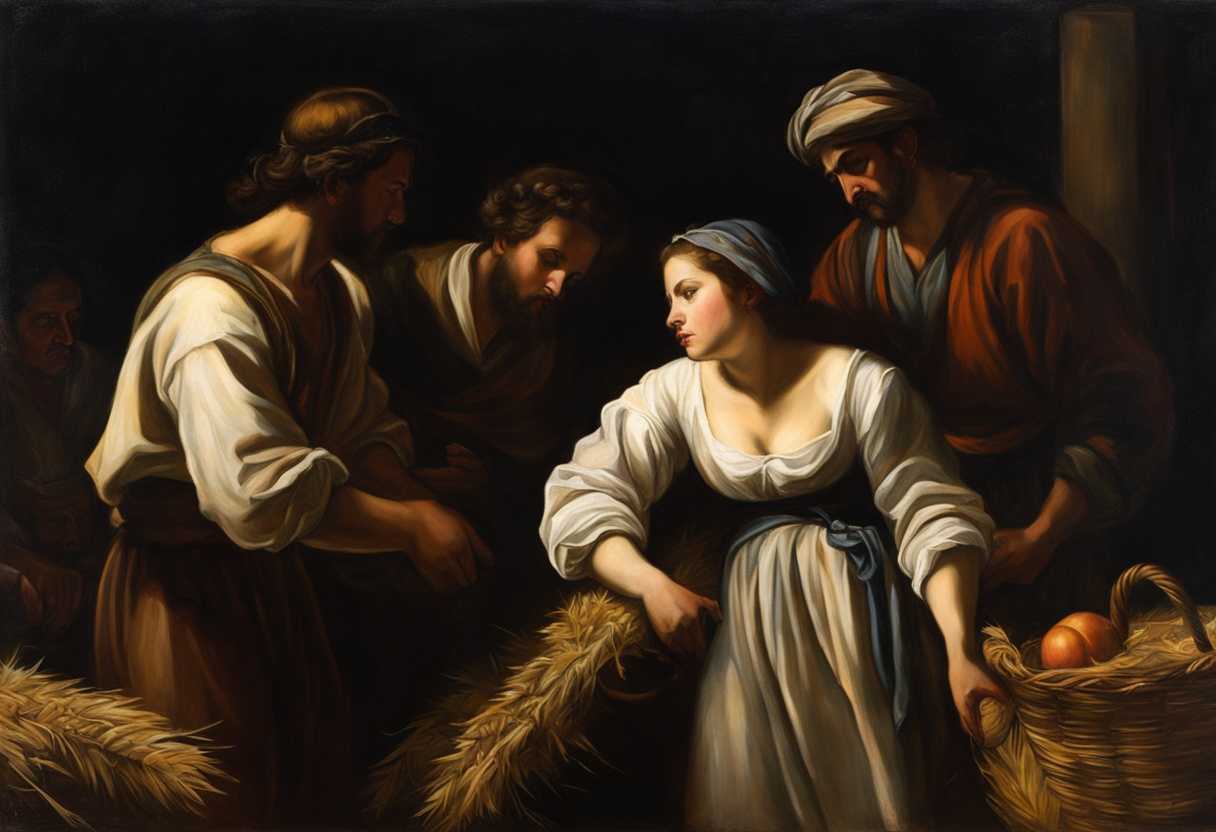
Setting the Scene for Ruth 3:1-9
In Ruth chapter 3, we find Ruth, a Moabite woman, and her mother-in-law, Naomi, living in Bethlehem. Naomi had returned to Bethlehem after the death of her husband and two sons, and Ruth had chosen to stay with her and embrace her faith. The scene is set in the barley fields of Boaz, a wealthy relative of Naomi’s late husband.
One day, Naomi comes up with a plan to secure a future for Ruth. She instructs Ruth to go to the threshing floor where Boaz would be winnowing barley that evening. Ruth follows Naomi’s guidance and waits until Boaz has eaten and drunk, and his heart is merry. She then uncovers his feet and lies down. Startled, Boaz wakes up and finds Ruth at his feet. Ruth then asks Boaz to spread his cloak over her, a symbolic gesture of asking for his protection and provision as her kinsman-redeemer.
The scene is filled with tension and anticipation as Ruth takes a bold step to secure her future and honor her family. The moonlight illuminates the quiet and peaceful threshing floor, adding a sense of intimacy to the encounter between Ruth and Boaz. This pivotal moment sets the stage for the unfolding of a beautiful love story and the fulfillment of God’s plan for Ruth and Naomi.
What is Ruth 3:1-9 about?
Ruth’s commitment to following Naomi’s guidance and instructions is witnessed in this verse. Ruth’s actions reveal her deep loyalty, trust, and faith in Naomi’s wisdom. Ruth shows humility and willingness to put her trust in Naomi’s plan by seeking Boaz’s protection and provision in the way Naomi instructed her, demonstrating a profound bond between the two women.
Ruth’s actions also showcase her resilience and strength as a woman facing adversity. Despite the challenges and uncertainties she encounters, Ruth remains steadfast in her determination to provide for herself and Naomi. Through her actions, Ruth exemplifies the power of faith, love, and trust in overcoming difficulties and finding a way forward in the face of adversity. We reflect on Ruth’s story, reminding us of the importance of trusting in the guidance of those wiser and more experienced than us. Like Ruth, we can draw strength from our faith and humility to navigate challenges and seek protection and provision in times of need. Ruth’s example encourages us to approach difficult situations with grace, faith, and trust in the wisdom of those who guide and support us.
Understanding what Ruth 3:1-9 really means
The Book of Ruth unfolds a captivating tale of loyalty, love, and redemption, showcasing the unwavering commitment of Ruth, a Moabite widow, to her Israelite mother-in-law, Naomi. In Ruth 3:1-9, we find Naomi advising Ruth to visit the threshing floor where Boaz, a potential kinsman-redeemer, is winnowing barley. This setting sets the stage for a pivotal moment in the narrative, where crucial decisions are made that will shape the characters’ futures.
Naomi’s poignant words to Ruth, “My daughter, should I not seek rest for you, that it may be well with you?” reveal her deep concern for Ruth’s security and stability. The term “rest” here conveys not just physical repose but also a sense of finding a safe and settled home. As Naomi instructs Ruth to prepare herself and go to the threshing floor, the act symbolizes a new beginning and readiness for a significant change in their lives.
The instruction for Ruth to uncover Boaz’s feet and lie down, trusting that he will guide her, reflects a cultural gesture of humility and a plea for protection and provision. This act signifies Ruth’s faith in Boaz’s integrity and Naomi’s wisdom in orchestrating a plan that aligns with their hopes for the future. These actions speak volumes about the characters’ trust in each other and in God’s providential care.
Drawing parallels from other biblical passages, such as Proverbs 31:10-31, Leviticus 25:25, and Matthew 1:5, we see themes of noble virtues, the role of a kinsman-redeemer, and Ruth’s inclusion in the genealogy of Jesus. These connections deepen our understanding of Ruth’s significance in God’s redemptive plan and highlight the overarching themes of loyalty, provision, and hope present in the narrative.
The relevance of Ruth’s story to contemporary audiences is profound. Her unwavering faith, loyalty, and willingness to embrace change resonate with themes of trust, commitment, and love that are timeless. In a world where uncertainty abounds, Ruth’s example encourages us to trust in God’s plan, seek wise counsel, and remain steadfast in our relationships.
Consider a modern-day scenario where a young woman facing adversity finds solace and success through loyalty and wise counsel, mirroring Ruth’s journey. This anecdote illustrates how faith, preparation, and trust can lead to new beginnings and blessings, echoing the timeless truths found in Ruth’s narrative.
In conclusion, Ruth 3:1-9 stands as a poignant reminder of the power of faith, loyalty, and divine provision. Through Ruth and Boaz’s story, we are reminded of God’s redemptive work and the hope that springs from trusting in His plan. May we, like Ruth, find inspiration in her journey and embrace the virtues of faith, loyalty, and love in our own lives.
How can we trust God’s guidance in relationships?
Ruth seeks guidance from Naomi on how to navigate her relationship with Boaz in these verses. Through Naomi’s guidance, Ruth is able to trust in God’s plan for her. Similarly, in our own relationships, seeking counsel from wise and faithful individuals can help us discern God’s direction. We can better understand the path He has set before us by listening to those who are grounded in their faith and seeking God’s will.
Trusting in God’s guidance in relationships involves having faith that He will lead us in the right direction. We must also trust that those God places in our lives to give us guidance are aligned with His will, just as Ruth trusted Naomi’s advice. We can be assured that God is working in our relationships and leading us according to His perfect plan by prayerfully seeking guidance and being open to wisdom from others. Trusting God’s guidance in relationships ultimately requires surrendering our own desires and plans to His will. It involves being patient and allowing God to work in His timing, knowing that He has a purpose and a plan for each of us. We can have confidence that He will guide us in the right direction and bring about His best for our relationships by relinquishing control and trusting in His wisdom.
Application
In the fast-paced world we live in, navigating the complexities of work and family can sometimes feel overwhelming. Just like Ruth trusted Naomi’s wisdom, we too can benefit from seeking guidance from those who have walked similar paths before us. Let’s embrace the lessons of Ruth, showing humility and openness to learn from the experiences of others. Will you join me in taking a moment to consider the impact of seeking wise counsel in our lives and how it can steer us toward success and fulfillment?

Reverend Michael Johnson is an experienced Church Minister with a profound expertise in spirituality and guidance. With a serene presence and a compassionate heart, he has faithfully served his congregation for over 20 years, leading them on a spiritual journey towards inner peace and enlightenment. Reverend Johnson’s extensive knowledge of religious philosophies and profound understanding of human nature have made him a trusted confidant and mentor to many, as he seamlessly weaves his profound wisdom into life teachings. Reverend Johnson’s calming demeanor and empathetic nature continue to uplift and heal souls, nurturing a sense of unity and tranquility within his community.