
Ruth 4:9-17 is about the restoration of Naomi’s hope and lineage through the selfless loyalty of Ruth and Boaz, illustrating the themes of redemption, faithfulness, and the divine providence that ensures a future for those who remain steadfast in their commitment to God.
9 Then Boaz said to the elders and all the people, “You are witnesses this day that I have bought from the hand of Naomi all that belonged to Elimelech and all that belonged to Chilion and to Mahlon.
10 Also Ruth the Moabite, the widow of Mahlon, I have bought to be my wife, to perpetuate the name of the dead in his inheritance, that the name of the dead may not be cut off from among his brothers and from the gate of his native place. You are witnesses this day.”
11 Then all the people who were at the gate and the elders said, “We are witnesses. May the Lord make the woman, who is coming into your house, like Rachel and Leah, who together built up the house of Israel. May you act worthily in Ephrathah and be renowned in Bethlehem,
12 and may your house be like the house of Perez, whom Tamar bore to Judah, because of the offspring that the Lord will give you by this young woman.”
13 So Boaz took Ruth, and she became his wife. And he went in to her, and the Lord gave her conception, and she bore a son.
14 Then the women said to Naomi, “Blessed be the Lord, who has not left you this day without a redeemer, and may his name be renowned in Israel!
15 He shall be to you a restorer of life and a nourisher of your old age, for your daughter-in-law who loves you, who is more to you than seven sons, has given birth to him.”
16 Then Naomi took the child and laid him on her lap and became his nurse.
17 And the women of the neighborhood gave him a name, saying, “A son has been born to Naomi.” They named him Obed. He was the father of Jesse, the father of David.
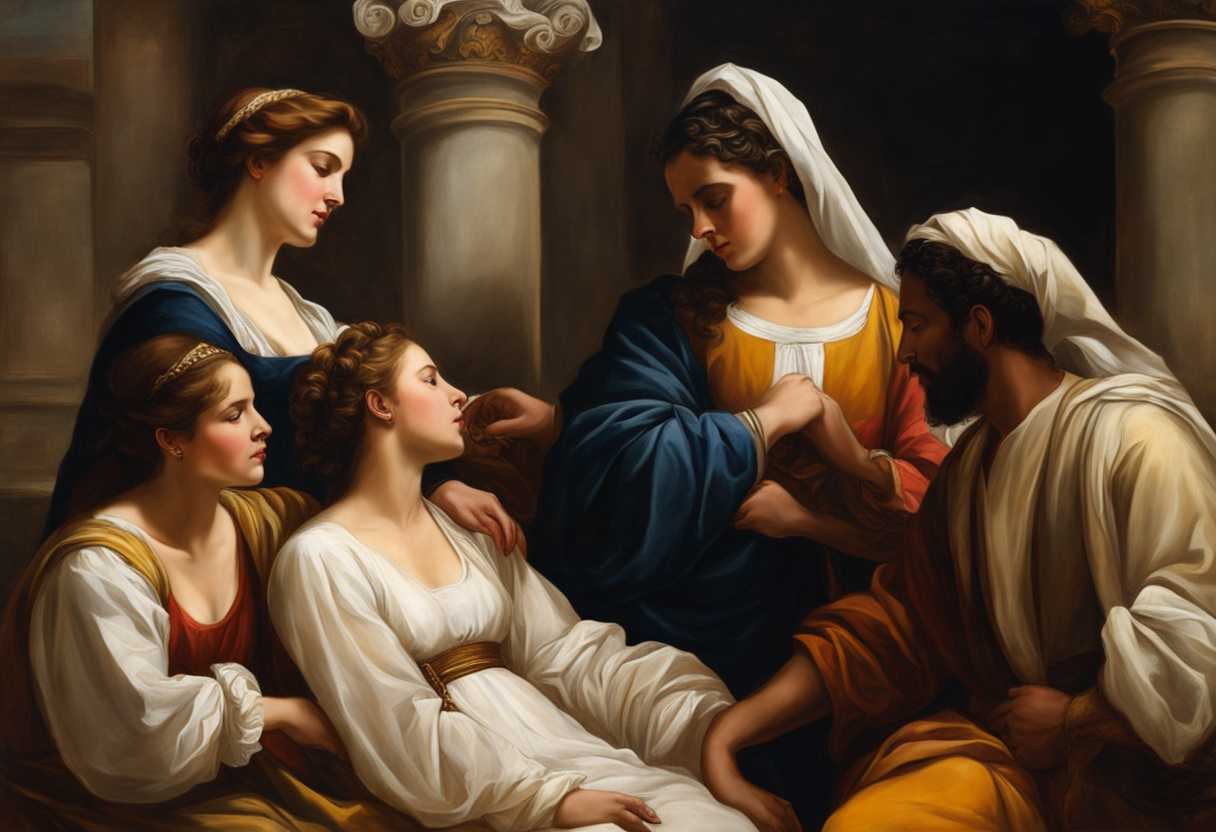
Setting the Scene for Ruth 4:9-17
The scene in Ruth chapter 4 takes place in the gate of the city of Bethlehem. Boaz, a wealthy landowner and relative of Ruth, has gathered ten elders of the city to witness a legal transaction. Also present are Ruth, a Moabite woman who had returned with her mother-in-law Naomi to Bethlehem after her husband’s death, and a closer relative of Naomi’s late husband who has the right to redeem the land and marry Ruth according to the Levirate law.
The surroundings are bustling with activity as the city gate was a central location for legal and business transactions in ancient times. The dusty streets are filled with merchants, travelers, and locals going about their daily routines. The elders, distinguished by their wisdom and experience, are seated in a circle, ready to witness the proceedings. Boaz, dressed in his finest garments, stands before them, prepared to secure Ruth’s future and honor the memory of her deceased husband.
As the transaction unfolds, tension and anticipation fill the air. Boaz presents the closer relative with the opportunity to redeem the land and marry Ruth, but he declines, clearing the way for Boaz to fulfill his duty as the kinsman-redeemer. The elders nod in approval as Boaz publicly declares his commitment to Ruth, symbolized by the exchange of a sandal. The scene concludes with a blessing from the elders, celebrating the union of Boaz and Ruth and foreshadowing the future lineage of King David.
What is Ruth 4:9-17 about?
Boaz acts as a kinsman-redeemer to Ruth in a beautiful moment we witness in Ruth 4:9-17, demonstrating God’s faithfulness and provision in their lives. This act of redemption not only highlights the kindness and generosity of Boaz but also symbolizes God’s unfailing love and care for His people. Boaz fulfills his duty as a kinsman-redeemer and establishes a legacy of love and redemption in their family by marrying Ruth. God weaves together our stories with His grace and mercy as we delve into this verse. Just like Ruth and Boaz, we too can trust in God’s faithfulness to provide for us and guide us through life’s challenges. This verse serves as a powerful testament to the redemptive power of God’s love and His ability to bring beauty out of difficult situations.
So, as we reflect on Ruth 4:9-17, let us be encouraged by the story of Ruth and Boaz, knowing that God is always working behind the scenes, orchestrating His perfect plan for our lives. We should lean into His faithfulness and provision, trusting that He will redeem every broken area of our lives and lead us into a future filled with hope and blessings.
Understanding what Ruth 4:9-17 really means
This passage from the Book of Ruth captures the pivotal moment where Boaz steps forward to redeem Ruth and Naomi’s family line through marriage. It is a poignant display of loyalty, redemption, and the providence of God at work in the lives of ordinary people. Boaz’s public declaration to the elders and the people signifies his commitment to restoring Naomi’s heritage and ensuring the continuation of her family line. His actions as a kinsman-redeemer embody the values of compassion and responsibility towards family members in need.
The blessings bestowed upon Ruth by the elders, likening her to the revered matriarchs Rachel and Leah, highlight the significance of her union with Boaz. This comparison underscores Ruth’s integral role in the lineage of Israel and the hope for a fruitful future. The recognition by the women of the town of God’s provision of a redeemer for Naomi emphasizes the faithfulness and care of God in preserving the family’s legacy. These key phrases in the passage illuminate the depth of relationships, the importance of heritage, and the role of divine intervention in shaping destinies.
Drawing connections to other biblical passages such as Leviticus 25:25, Deuteronomy 25:5-10, and the stories of Rachel and Leah in Genesis 29-30, we see the interconnectedness of themes of redemption, marriage customs, and the building of family legacies throughout Scripture. These parallels enrich our understanding of the cultural and religious context in which Ruth and Boaz’s story unfolds. The timeless themes of loyalty, redemption, and God’s providence resonate with readers today, offering a message of hope and assurance in the midst of life’s challenges.
In a contemporary context, the narrative of Ruth and Boaz serves as a beacon of light, reminding us of the power of kindness, integrity, and trust in God’s plan. Just as Boaz’s actions brought restoration and hope to Naomi and Ruth, our acts of compassion and loyalty can have a transformative impact on those around us. By reflecting on this story, we are inspired to emulate Boaz’s example of faithfulness and to be instruments of God’s redemption in the lives of others.
Consider a modern-day scenario where a family in crisis receives support and shelter from a compassionate relative, mirroring Boaz’s redemptive gesture towards Naomi and Ruth. This anecdote illustrates how acts of kindness and loyalty can bring about not only immediate relief but also a renewed sense of hope and dignity. The narrative of Ruth 4:9-17 challenges us to be agents of God’s grace and mercy in a world that often craves restoration and healing.
In conclusion, the passage from Ruth 4:9-17 encapsulates profound truths about God’s faithfulness, human loyalty, and the transformative power of redemption. It calls us to trust in God’s providence, to embody kindness and integrity in our actions, and to be bearers of hope and restoration in a broken world. May we heed the lessons from Ruth and Boaz’s story, striving to emulate their virtues and to be channels of God’s love and grace to those in need.
How can we see God’s faithfulness in our lives?
We can see God’s faithfulness in our lives through the provision and redemption He brings about in our situations. God can also redeem and restore us when we are in need, just as Boaz redeemed Ruth and Naomi by marrying Ruth and restoring their family line. This can be seen through various blessings, opportunities, and relationships that He graciously provides us with, ultimately leading to our growth and fulfillment. God orchestrates events and circumstances in our lives for His perfect plan to unfold, demonstrating His faithfulness. Despite challenges and uncertainties we may face, God remains steadfast in His promises and purposes for us. We can witness His faithfulness and be assured of His continual presence and care in our lives by looking back at the ways in which He has led us, protected us, and blessed us. God’s faithfulness not only in the past but also in the present and future is reminded to us as we reflect on the account of Ruth and Boaz in the Bible. God stands as our ultimate Redeemer who can bring restoration, healing, and blessings in our lives, just as Boaz stood as a beacon of hope and redemption for Ruth and Naomi. We can experience His steadfast love and faithfulness in all areas of our lives by trusting in His faithfulness and following His guidance.
Application
Witness the remarkable redemption of Ruth and Boaz in Ruth 4:9-17, a testament to God’s unwavering faithfulness in transforming brokenness into hope. As you ponder their tale, reflect on how you can play a role in God’s redemptive work within your own life and beyond. Will you seize the chance to shine as a source of divine love and compassion in the midst of our modern struggles and challenges?

Reverend Michael Johnson is an experienced Church Minister with a profound expertise in spirituality and guidance. With a serene presence and a compassionate heart, he has faithfully served his congregation for over 20 years, leading them on a spiritual journey towards inner peace and enlightenment. Reverend Johnson’s extensive knowledge of religious philosophies and profound understanding of human nature have made him a trusted confidant and mentor to many, as he seamlessly weaves his profound wisdom into life teachings. Reverend Johnson’s calming demeanor and empathetic nature continue to uplift and heal souls, nurturing a sense of unity and tranquility within his community.