
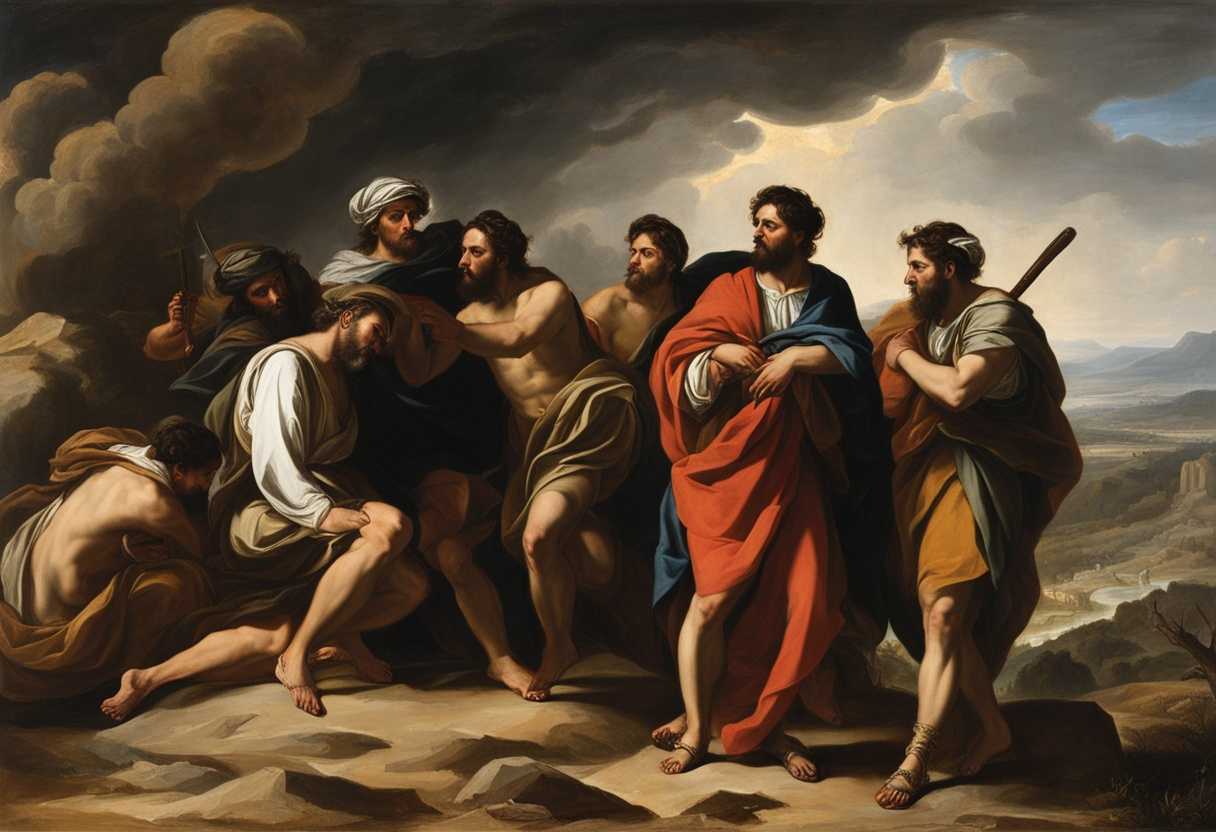
In the Bible, “grumble” refers to expressing dissatisfaction or complaint, often in a manner that reflects a lack of faith or gratitude towards God. An example can be found in Exodus 16:2-3, where the Israelites grumble against Moses and Aaron regarding their hardships in the wilderness.
Scripture
2 And the whole congregation of the people of Israel grumbled against Moses and Aaron in the wilderness,
3 and the people of Israel said to them, “Would that we had died by the hand of the Lord in the land of Egypt, when we sat by the meat pots and ate bread to the full, for you have brought us out into this wilderness to kill this whole assembly with hunger.”
4 Then the Lord said to Moses, “Behold, I am about to rain bread from heaven for you, and the people shall go out and gather a day’s portion every day, that I may test them, whether they will walk in my law or not.
5 On the sixth day they shall prepare what they bring in, and it will be twice as much as they gather daily.”
6 So Moses and Aaron said to all the people of Israel, “At evening you shall know that it was the Lord who brought you out of the land of Egypt,
7 and in the morning you shall see the glory of the Lord, because he has heard your grumbling against the Lord. For what are we, that you grumble against us?”
8 And Moses said, “When the Lord gives you in the evening meat to eat and in the morning bread to the full, because the Lord has heard your grumbling that you grumble against him—what are we? Your grumbling is not against us but against the Lord.”
9 Then Moses said to Aaron, “Say to the whole congregation of the people of Israel, ‘Come near before the Lord, for he has heard your grumbling.’”
10 And as soon as Aaron spoke to the whole congregation of the people of Israel, they looked toward the wilderness, and behold, the glory of the Lord appeared in the cloud.
11 The Lord spoke to Moses, saying,
12 “I have heard the grumbling of the people of Israel. Say to them, ‘At twilight you shall eat meat, and in the morning you shall be filled with bread. Then you shall know that I am the Lord your God.’”
Biblical Meaning of Grumbling
The biblical concept of “grumbling” encapsulates a deeper spiritual and communal dynamic, illustrating a resistance to trust in God’s provision and timing. As seen in Exodus 16:2-3, when the Israelites grumble against Moses and Aaron, their complaint stems from discontentment with their circumstances despite witnessing God’s miraculous deliverance from Egypt. This pattern of grumbling reveals a significant lack of faith; it is not merely a physical hunger they express but a profound spiritual disconnection. In Philippians 2:14, Paul admonishes believers to “do everything without grumbling or arguing,” emphasizing that such attitudes can hinder the collective witness of the church and reflect poorly upon the character of God.
The broader meaning of grumbling in the biblical text highlights the importance of trust and gratitude in the believer’s relationship with God. Grumbling often surfaces during trials, suggesting that it can be a response rooted in fear or doubt rather than reliance on God’s sovereignty. James 5:9 warns, “Do not grumble against one another, brothers and sisters, or you will be judged,” underscoring that grumbling can sow discord within communities and weaken the bond of unity commanded by Christ. Therefore, the biblical understanding of grumbling serves as both a warning and a call to cultivate an attitude of faith, reminding believers to express their concerns with trust in God’s ultimate goodness rather than resorting to dissatisfaction that leads to division and discontent.
The theme of grumbling extends throughout the Scriptures, often illustrating a fundamental tension between human perception of needs and God’s faithful provision. In contrast to the positive practice of lamentation, which can be an earnest expression of sorrow or longing, grumbling tends to signal an attitude of distrust and skepticism about God’s intentions. For example, the Israelites’ exiled period, marked by their complaints about their captivity, underscores how discontent can cultivate a longing for the past rather than an anticipation for God’s promised future. Their cries reflect both the pain of their situation and a forgetfulness of God’s past mercies. This pattern warns believers that ongoing dissatisfaction can lead to spiritual apathy, eroding the memory of God’s faithfulness.
Furthermore, grumbling is viewed as an impediment to spiritual maturity within the New Testament community. For instance, in the letters of Paul and other apostles, there is a consistent exhortation to embrace joy and gratitude. This suggests that grumbling is not merely a social nuisance; rather, it signifies a heart disposition that resists transformation and growth in faith. Grumbling can act as a barrier to experiencing the fullness of life in Christ, obscuring the blessing that comes from acknowledging God’s work in one’s life and the community at large. Instead of languishing in negativity, believers are encouraged to cultivate an attitude of praise and trust, recognizing that true contentment arises from a firm assurance in God’s unfailing character and plans, especially during times of trial. Such a posture not only enriches individual faith but strengthens the collective witness of the church.
The Dangers of Discontentment
Grumbling often reflects a deeper sense of dissatisfaction and discontentment with one’s circumstances. In the biblical context, this attitude can lead to a lack of trust in God’s provision and plan. When individuals grumble, they may be expressing a belief that their needs are not being met, which can foster a spirit of negativity and resentment. This discontentment can hinder spiritual growth and create divisions within communities, as it shifts focus away from gratitude and faith.
The Call for Unity and Harmony
Grumbling can also disrupt the unity and harmony that is essential within a faith community. The act of grumbling often leads to gossip, division, and strife among believers. The Bible encourages followers to maintain a spirit of unity and to support one another, rather than allowing discontent to sow discord. By fostering an attitude of gratitude and encouragement, communities can strengthen their bonds and reflect the love of Christ more effectively.
The Importance of Trusting God
At its core, grumbling signifies a lack of trust in God’s sovereignty and goodness. When individuals grumble, they may be questioning God’s ability to provide for their needs or to guide them through difficult situations. The biblical narrative often emphasizes the importance of faith and reliance on God, encouraging believers to bring their concerns to Him rather than expressing dissatisfaction. Trusting in God’s plan can transform grumbling into prayer and supplication, fostering a deeper relationship with Him.
How to Cultivate Contentment and Strengthen Your Faith
Cultivating contentment is a beautiful journey that can significantly strengthen your faith, and it often begins with gratitude. Take a moment each day to reflect on the blessings in your life, no matter how small they may seem. This practice not only shifts your focus from what you lack to what you have, but it also aligns your heart with God’s abundant grace. Remember Philippians 4:11-13, where Paul speaks of learning to be content in every circumstance through Christ who strengthens him. Embrace the idea that true contentment comes from trusting in God’s plan for you, even when life feels uncertain. Surround yourself with a community of believers who uplift and encourage you, and dive into Scripture regularly to remind yourself of God’s promises. As you nurture a heart of gratitude and trust, you’ll find that your faith deepens, allowing you to face life’s challenges with a sense of peace and assurance that only comes from Him.
Bible References to the Meaning of Grumble:
Numbers 14:1-4: 1 Then all the congregation raised a loud cry, and the people wept that night.
2 And all the people of Israel grumbled against Moses and Aaron. The whole congregation said to them, “Would that we had died in the land of Egypt! Or would that we had died in this wilderness!
3 Why is the Lord bringing us into this land, to fall by the sword? Our wives and our little ones will become a prey. Would it not be better for us to go back to Egypt?”
4 And they said to one another, “Let us choose a leader and go back to Egypt.”
Numbers 16:41-50: 41 But on the next day all the congregation of the people of Israel grumbled against Moses and against Aaron, saying, “You have killed the people of the Lord.”
42 And when the congregation had assembled against Moses and against Aaron, they turned toward the tent of meeting. And behold, the cloud covered it, and the glory of the Lord appeared.
43 And Moses and Aaron came to the front of the tent of meeting,
44 And the Lord spoke to Moses, saying,
45 “Get away from the midst of this congregation, that I may consume them in a moment.” And they fell on their faces.
46 And Moses said to Aaron, “Take your censer, and put fire on it from the altar and lay incense on it and carry it quickly to the congregation and make atonement for them, for wrath has gone out from the Lord; the plague has begun.”
47 So Aaron took it as Moses said and ran into the midst of the assembly. And behold, the plague had already begun among the people. And he put on the incense and made atonement for the people.
48 And he stood between the dead and the living, and the plague was stopped.
49 Now those who died in the plague were 14,700, besides those who died in the affair of Korah.
50 And Aaron returned to Moses at the entrance of the tent of meeting, when the plague was stopped.
Deuteronomy 1:26-33: 26 Yet you would not go up, but rebelled against the command of the Lord your God.
27 And you murmured in your tents and said, ‘Because the Lord hated us he has brought us out of the land of Egypt, to give us into the hand of the Amorites, to destroy us.
28 Where are we going up? Our brothers have made our hearts melt, saying, “The people are greater and taller than we. The cities are great and fortified up to heaven. And besides, we have seen the sons of the Anakim there.”
29 Then I said to you, ‘Do not be in dread or afraid of them.
30 The Lord your God who goes before you will himself fight for you, just as he did for you in Egypt before your eyes,
31 and in the wilderness, where you have seen how the Lord your God carried you, as a man carries his son, all the way that you went until you came to this place.
32 Yet in spite of this word you did not believe the Lord your God,
33 who went before you in the way to seek you out a place to pitch your tents, in fire by night and in the cloud by day, to show you by what way you should go.
Psalm 106:24-27: 24 Then they despised the pleasant land, having no faith in his promise.
25 But grumbled in their tents; they did not obey the voice of the Lord.
26 Therefore he raised his hand and swore to them that he would make them fall in the wilderness,
27 And that he would make their offspring fall among the nations, and scatter them among the lands.
John 6:41-43: 41 So the Jews grumbled about him, because he said, “I am the bread that came down from heaven.”
42 They said, “Is not this Jesus, the son of Joseph, whose father and mother we know? How does he now say, ‘I have come down from heaven’?”
43 Jesus answered them, “Do not grumble among yourselves.
1 Corinthians 10:6-10: 6 Now these things took place as examples for us, that we might not desire evil as they did.
7 Do not be idolaters as some of them were; as it is written, “The people sat down to eat and drink and rose up to play.”
8 We must not indulge in sexual immorality as some of them did, and twenty-three thousand fell in a single day.
9 We must not put Christ to the test, as some of them did and were destroyed by serpents.
10 nor grumble, as some of them did and were destroyed by the Destroyer.
Philippians 2:14-16: 14 Do all things without grumbling or disputing,
15 that you may be blameless and innocent, children of God without blemish in the midst of a crooked and twisted generation, among whom you shine as lights in the world,
16 holding fast to the word of life, so that in the day of Christ I may be proud that I did not run in vain or labor in vain.
James 5:9-11: 9 Do not grumble against one another, brothers, so that you may not be judged; behold, the Judge is standing at the door.
10 As an example of suffering and patience, brothers, take the prophets who spoke in the name of the Lord.
11 Behold, we consider those blessed who remained steadfast. You have heard of the steadfastness of Job, and you have seen the purpose of the Lord, how the Lord is compassionate and merciful.
Jude 1:14-16: 14 It was also about these that Enoch, the seventh from Adam, prophesied, saying, “Behold, the Lord comes with ten thousands of his holy ones,
15 to execute judgment on all and to convict all the ungodly of all their deeds of ungodliness that they have committed in such an ungodly way, and of all the harsh things that ungodly sinners have spoken against him.”
16 These are grumblers, malcontents, following their own sinful desires; they are loud-mouthed boasters, showing favoritism to gain advantage.

Reverend Ogunlade is a seasoned Church Minister with over three decades of experience in guiding and nurturing congregations. With profound wisdom and a serene approach, Reverend Ogunlade has carried out various pastoral duties, including delivering uplifting sermons, conducting religious ceremonies, and offering sage counsel to individuals seeking spiritual guidance. Their commitment to fostering harmony and righteousness within their community is exemplified through their compassionate nature, making them a beloved and trusted figure among the congregation.