
In the Bible, “victuals” refers to provisions or necessary supplies, particularly food, that sustain individuals or groups during their journeys or periods of hardship. The term emphasizes the importance of sustenance for both physical survival and communal fellowship.
Scripture
11 So the enemy took all the possessions of Sodom and Gomorrah, and all their provisions, and went their way.
12 They also took Lot, the son of Abram’s brother, who was dwelling in Sodom, and his possessions, and went their way.
Biblical Significance of Victuals
The concept of “victuals” in the Bible encompasses not just the provision of food but also the deeper significance of sustenance in the context of divine provision and reliance on God. In Matthew 6:11, the Lord’s Prayer, where Jesus teaches his disciples to pray for “our daily bread,” highlights the necessity of depending on God for the essentials of life. This call for daily sustenance signifies not only physical nourishment but also a spiritual plea for the sustenance that God provides through His grace. Moreover, in the account of the Israelites in the wilderness, God provided manna from heaven as sustenance (Exodus 16:15). This miraculous provision illustrated God’s care for His people and established a covenant relationship based on reliance and gratitude.
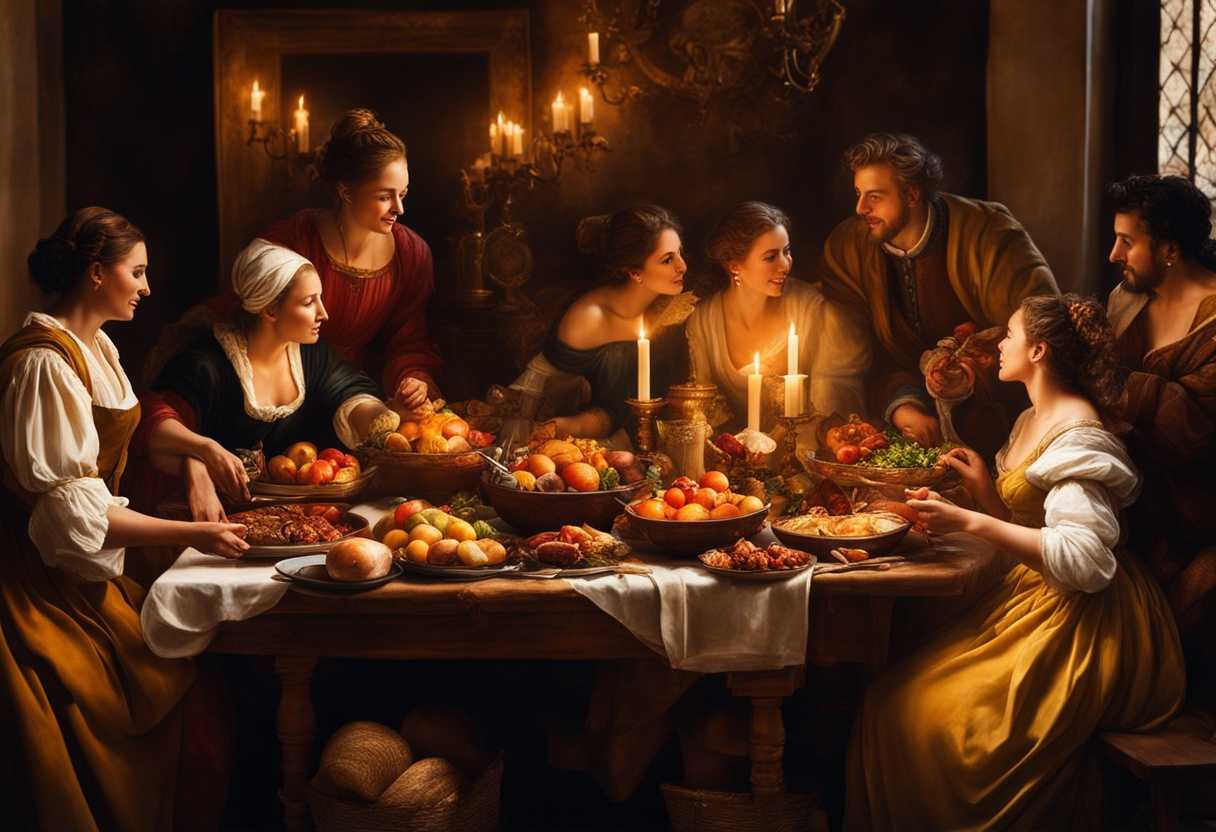
Furthermore, the sharing of victuals fosters communal bonds and reflects God’s abundance. In Acts 2:46, the early Christians broke bread together, underscoring the unifying fellowship that arises from sharing meals, which is emblematic of deeper spiritual communion. The act of sharing victuals is highlighted in the feeding of the 5,000 (John 6:9-14), where the simple offering of loaves and fish brought an abundance that nourished thousands. This miracle serves as a reminder that even the modest provisions we have can be multiplied through faith and communal sharing, embodying the principle that our sustenance is not merely for survival but also a means of fostering community and manifesting God’s grace among us. Thus, victuals in the biblical context extend beyond mere survival to encompass themes of divine trust, communal fellowship, and shared blessings.
The biblical understanding of victuals serves as a poignant reminder of God’s provision throughout the Scriptures, emphasizing how nourishment is intricately linked to His overarching plan for humanity. For instance, in Genesis 1:29, God declares that He has given seed-bearing plants and trees with fruit as food for humankind, establishing nourishment as a part of His creative order. This verse illustrates the divine intention behind sustenance, where victuals represent God’s generosity and His desire for humanity to thrive within His creation. It paints a picture of a God who not only creates but also sustains, further reaffirming the notion that all provisions are gifts from Him meant to be received with gratitude.
Moreover, the concept of victuals also expands into the New Testament, where spiritual sustenance becomes a significant theme. In the Sermon on the Mount, Jesus discusses the importance of prioritizing God’s kingdom over material needs, suggesting that true nourishment transcends physical food (Matthew 6:25-34). This teaching encourages believers to seek spiritual nourishment through faith and reliance on God’s righteousness, positioning victuals not just in terms of physical sustenance but also as an opportunity for spiritual growth. This dual understanding fosters a holistic view of nourishment, where victuals encompass both the physical and spiritual needs of individuals, urging followers to trust in God’s providence and seek the deeper fulfillment that comes from a relationship with Him. Through this lens, victuals serve as a tangible representation of the broader spiritual truths found throughout the biblical narrative, illustrating that while physical food is paramount, it is the spiritual sustenance derived from God that ultimately sustains life.
Provision and Sustenance
In the Bible, victuals symbolize the essential provisions that sustain life. They represent not only physical nourishment but also the spiritual sustenance that God provides to His people. This duality emphasizes the importance of relying on divine provision for both bodily needs and spiritual growth, illustrating the interconnectedness of physical and spiritual well-being.
Community and Sharing
Victuals also carry a broader meaning related to community and fellowship. The sharing of food is often depicted as a means of building relationships and fostering unity among believers. In biblical narratives, communal meals signify the importance of coming together, sharing blessings, and supporting one another, reflecting the communal aspect of faith and the call to love one’s neighbor.
Gratitude and Stewardship
The concept of victuals in the Bible encourages a mindset of gratitude and stewardship. Recognizing that all provisions come from God fosters an attitude of thankfulness and responsibility towards the resources entrusted to individuals. This understanding promotes a lifestyle of generosity, where believers are called to share their abundance with others, reflecting God’s love and care for all creation.
How to Trust God for Provision and Sustenance
Trusting God for provision and sustenance is a journey that requires both faith and action. It’s about recognizing that God is our ultimate provider, as seen in Philippians 4:19, where Paul reassures us that God will meet all our needs according to His riches in glory. Start by reflecting on past instances where God has provided for you, whether in times of financial strain or emotional turmoil. This practice of remembrance can strengthen your faith. Additionally, cultivate a habit of prayer, bringing your needs before God and seeking His guidance in your decisions. Remember, trusting God doesn’t mean sitting back and doing nothing; it involves taking steps of faith, like budgeting wisely or seeking opportunities for work, while remaining open to His leading. Surround yourself with a community of believers who can encourage you and share their own stories of God’s faithfulness. As you lean into this trust, you’ll find that God’s provision often comes in unexpected ways, reminding you that He is always with you, sustaining you through every season of life.
Bible References to the Meaning of Victuals:
Genesis 42:1-3: 1 When Jacob learned that there was grain for sale in Egypt, he said to his sons, “Why do you look at one another?”
2 And he said, “Behold, I have heard that there is grain for sale in Egypt. Go down and buy grain for us there, that we may live and not die.”
3 So ten of Joseph’s brothers went down to buy grain in Egypt.
Genesis 43:1-2: 1 Now the famine was severe in the land.
2 And when they had eaten the grain that they had brought from Egypt, their father said to them, “Go again, buy us a little food.”
Exodus 12:39-41: 39 And they baked unleavened cakes of the dough that they had brought out of Egypt, for it was not leavened, because they were thrust out of Egypt and could not wait, nor had they prepared any provisions for themselves.
40 The time that the people of Israel lived in Egypt was 430 years.
41 At the end of 430 years, on that very day, all the hosts of the Lord went out from the land of Egypt.
Leviticus 11:1-3: 1 And the Lord spoke to Moses and Aaron, saying to them,
2 “Speak to the people of Israel, saying, These are the living things that you may eat among all the animals that are on the earth.”
3 Whatever parts the hoof and is cloven-footed and chews the cud, among the animals, you may eat.
Deuteronomy 2:6-7: 6 You shall purchase food from them with money, that you may eat, and you shall also buy water from them with money, that you may drink.
7 For the Lord your God has blessed you in all the work of your hands. He knows your going through this great wilderness. These forty years the Lord your God has been with you. You have lacked nothing.
Deuteronomy 8:3-4: 3 And he humbled you and let you hunger and fed you with manna, which you did not know, nor did your fathers know, that he might make you know that man does not live by bread alone, but man lives by every word that comes from the mouth of the Lord.
4 Your clothing did not wear out on you and your foot did not swell these forty years.
Joshua 1:10-11: 10 And Joshua commanded the officers of the people,
11 “Pass through the midst of the camp and command the people, ‘Prepare your provisions, for within three days you are to pass over this Jordan to go in to take possession of the land that the Lord your God is giving you to possess.’”
Judges 7:7-8: 7 And the Lord said to Gideon, “With the 300 men who lapped I will save you and give the Midianites into your hand, and let all the others go every man to his home.”
8 So the people took provisions in their hands, and their trumpets. And he sent all the rest of Israel every man to his tent, but retained the three hundred men. And the camp of Midian was below him in the valley.
1 Samuel 17:17-18: 17 And Jesse said to David his son, “Take for your brothers an ephah of this parched grain, and these ten loaves, and carry them quickly to the camp to your brothers.
18 Also take these ten cheeses to the commander of their thousand. See if your brothers are well, and bring some token from them.
1 Kings 4:22-23: 22 The food of his table, the seating of his officials, and the attendance of his servants, and their clothing, his cupbearers, and his burnt offerings that he offered at the house of the Lord, there was no more breath in her.
23 ten fat oxen, and twenty pasture-fed cattle, a hundred sheep, besides deer, gazelles, roebucks, and fattened fowl.
2 Kings 6:25-27: 25 And there was a great famine in Samaria, as they besieged it, until a donkey’s head was sold for eighty shekels of silver, and the fourth part of a kab of dove’s dung for five shekels of silver.
26 Now as the king of Israel was passing by on the wall, a woman cried out to him, saying, “Help, my lord, O king!”
27 And he said, “If the Lord will not help you, how shall I help you? From the threshing floor, or from the winepress?”
Nehemiah 5:3-4: 3 There were also those who said, “We are mortgaging our fields, our vineyards, and our houses to get grain because of the famine.”
4 And there were those who said, “We have borrowed money for the king’s tax on our fields and our vineyards.
Job 23:12-13: 12 I have not departed from the commandment of his lips; I have treasured the words of his mouth more than my portion of food.
13 But he is unchangeable, and who can turn him back? What he desires, that he does.
Psalm 78:24-25: 24 And he rained down on them manna to eat and gave them the grain of heaven.
25 Man ate of the bread of the angels; he sent them food in abundance.
Proverbs 30:8-9: 8 Remove far from me falsehood and lying; give me neither poverty nor riches; feed me with the food that is needful for me,
9 lest I be full and deny you
and say, “Who is the Lord?”
or lest I be poor and steal
and profane the name of my God.
Isaiah 55:1-2: 1 “Come, everyone who thirsts, come to the waters; and he who has no money, come, buy and eat! Come, buy wine and milk without money and without price.”
2 Why do you spend your money for that which is not bread, and your labor for that which does not satisfy? Listen diligently to me, and eat what is good, and delight yourselves in rich food.
Jeremiah 52:6-7: 6 On the ninth day of the fourth month the famine was so severe in the city that there was no food for the people of the land.
7 Then a breach was made in the city, and all the men of war fled and went out from the city by night by the way of a gate between the two walls, by the king’s garden, and the Chaldeans were around the city. And they went in the direction of the Arabah.
Ezekiel 4:9-11: 9 “And you, take wheat and barley, beans and lentils, millet and emmer, and put them into a single vessel and make your bread from them.
10 And your food that you eat shall be by weight, twenty shekels a day; from day to day you shall eat it.
11 You shall drink water by measure, the sixth part of a hin; you shall drink at fixed times.
Daniel 1:5-8: 5 The king assigned them a daily portion of the food that the king ate, and of the wine that he drank. They were to be educated for three years, and at the end of that time they were to stand before the king.
6 Among these were Daniel, Hananiah, Mishael, and Azariah of the tribe of Judah.
7 And the chief of the eunuchs gave them names: Daniel he called Belteshazzar, Hananiah he called Shadrach, Mishael he called Meshach, and Azariah he called Abednego.
8 But Daniel resolved that he would not defile himself with the king’s food, or with the wine that he drank.
Matthew 6:25-26: 25 “Therefore I tell you, do not be anxious about your life, what you will eat or what you will drink, nor about your body, what you will put on. Is not life more than food, and the body more than clothing?
26 Look at the birds of the air: they neither sow nor reap nor gather into barns, and yet your heavenly Father feeds them. Are you not of more value than they?
Matthew 14:15-21: 15 Now when it was evening, the disciples came to him and said, “This is a desolate place, and the day is now over; send the crowds away to go into the villages and buy food for themselves.”
16 But Jesus said, “They need not go away; you give them something to eat.”
17 They said to him, “We have only five loaves here and two fish.”
18 He said, “Bring them here to me.”
19 Then he ordered the crowds to sit down on the grass, and taking the five loaves and the two fish, he looked up to heaven and said a blessing. Then he broke the loaves and gave them to the disciples, and the disciples gave them to the crowds.
20 And they all ate and were satisfied. And they took up twelve baskets full of the broken pieces left over.
21 And those who ate were about five thousand men, besides women and children.
Mark 6:35-44: 35 And when it grew late, his disciples came to him and said, “This is a desolate place, and the hour is now late.
36 Send them away to go into the surrounding countryside and villages and buy themselves something to eat.
37 But he answered them, “You give them something to eat.” And they said to him, “Shall we go and buy two hundred denarii worth of bread and give it to them to eat?”
38 And he said to them, “How many loaves do you have? Go and see.” And when they had found out, they said, “Five, and two fish.”
39 Then he commanded them all to sit down in groups on the green grass.
40 So they sat down in groups, by hundreds and by fifties.
41 And taking the five loaves and the two fish, he looked up to heaven and said a blessing and broke the loaves and gave them to the disciples to set before the people. And he divided the two fish among them all.
42 And they all ate and were satisfied.
43 And they took up twelve baskets full of broken pieces and of the fish.
44 And those who ate the loaves were five thousand men.
Luke 9:12-17: 12 Now the day began to wear away, and the twelve came and said to him, “Send the crowd away to go into the surrounding villages and countryside to find lodging and get provisions, for we are here in a desolate place.”
13 But he said to them, “You give them something to eat.” They said, “We have no more than five loaves and two fish—unless we are to go and buy food for all these people.”
14 For there were about five thousand men. And he said to his disciples, “Have them sit down in groups of about fifty each.”
15 And they did so, and had them all sit down.
16 And taking the five loaves and the two fish, he looked up to heaven and said a blessing over them. Then he broke the loaves and gave them to the disciples to set before the crowd.
17 And they all ate and were satisfied. And what was left over was picked up, twelve baskets of broken pieces.
John 6:26-27: 26 Jesus answered them, “Truly, truly, I say to you, you are seeking me, not because you saw signs, but because you ate your fill of the loaves.
27 Do not work for the food that perishes, but for the food that endures to eternal life, which the Son of Man will give to you. For on him God the Father has set his seal.”
Acts 2:46-47: 46 And day by day, attending the temple together and breaking bread in their homes, they received their food with glad and generous hearts,
47 praising God and having favor with all the people. And the Lord added to their number day by day those who were being saved.
Acts 27:33-36: 33 As day was about to dawn, Paul urged them all to take some food, saying, “Today is the fourteenth day that you have continued in suspense and without food, having taken nothing.
34 Therefore I urge you to take some food. For it will give you strength, for not a hair is to perish from the head of any of you.”
35 And when he had said these things, he took bread, and giving thanks to God in the presence of all he broke it and began to eat.
36 Then they were all encouraged and ate some food themselves.
1 Corinthians 10:3-4: 3 and all ate the same spiritual food,
4 and all drank the same spiritual drink. For they drank from the spiritual Rock that followed them, and the Rock was Christ.
Philippians 4:12-13: 12 I know how to be brought low, and I know how to abound. In any and every circumstance, I have learned the secret of facing plenty and hunger, abundance and need.
13 I can do all things through him who strengthens me.
1 Timothy 6:7-8: 7 for we brought nothing into the world, and we cannot take anything out of the world.
8 But if we have food and clothing, with these we will be content.
Hebrews 13:5-6: Keep your life free from love of money, and be content with what you have, for he has said, “I will never leave you nor forsake you.”
6 So we can confidently say, “The Lord is my helper; I will not fear; what can man do to me?”

Reverend Ogunlade is a seasoned Church Minister with over three decades of experience in guiding and nurturing congregations. With profound wisdom and a serene approach, Reverend Ogunlade has carried out various pastoral duties, including delivering uplifting sermons, conducting religious ceremonies, and offering sage counsel to individuals seeking spiritual guidance. Their commitment to fostering harmony and righteousness within their community is exemplified through their compassionate nature, making them a beloved and trusted figure among the congregation.