
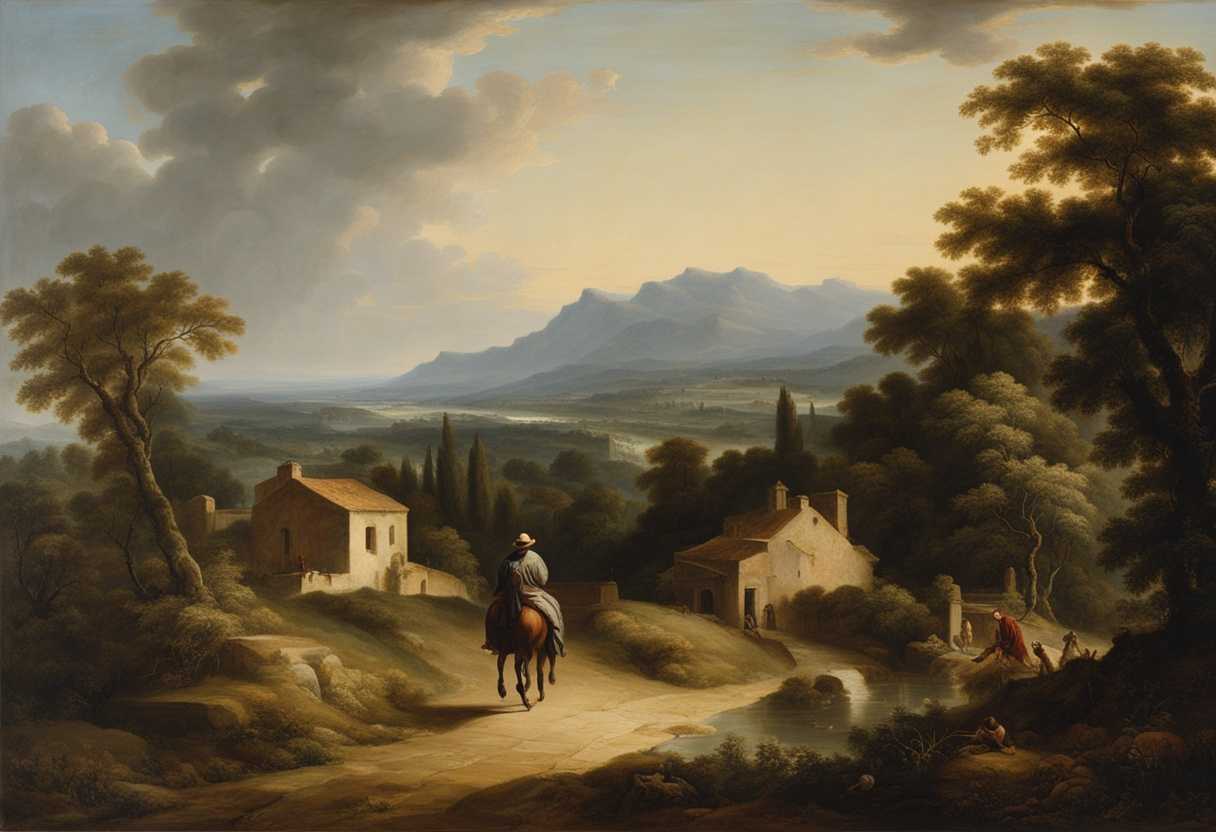
In the Bible, a wayfarer refers to a traveler or sojourner, often symbolizing a person on a journey of life or faith. This term emphasizes the transient nature of human existence and the importance of hospitality and kindness toward those who pass through one’s life, as reflected in scriptures like Hebrews 13:2.
Scripture
1 And the Lord appeared to him by the oaks of Mamre, as he sat at the door of his tent in the heat of the day.
2 He lifted up his eyes and looked, and behold, three men were standing in front of him. When he saw them, he ran from the tent door to meet them and bowed himself to the earth.
3 “My lord, if I have found favor in your sight, do not pass by your servant.”
4 Let a little water be brought, and wash your feet, and rest yourselves under the tree,
5 And I will bring a morsel of bread, that you may refresh yourselves, and after that you may pass on—since you have come to your servant.” So they said, “Do as you have said.”
6 And Abraham went quickly into the tent to Sarah and said, “Quick! Three seahs of fine flour! Knead it, and make cakes.”
7 And Abraham ran to the herd and took a calf, tender and good, and gave it to a young man, who prepared it quickly.
8 He took curds and milk and the calf that he had prepared, and set it before them. And he stood by them under the tree while they ate.
Biblical Meaning of Wayfarer
The concept of a wayfarer in the Bible often serves to illustrate the spiritual journey of individuals navigating through life, reflecting both their physical movements and their relationship with God. This notion is evident in passages such as Psalm 119:19, which states, “I am a stranger on the earth; do not hide your commands from me.” Here, the psalmist recognizes their own transient existence and dependence on divine guidance, portraying life as a pilgrimage where believers are called to seek God’s wisdom amidst their journey. Additionally, the idea of being a wayfarer underscores the relationship between humans and their community, highlighting the need for compassion and hospitality. Hebrews 13:2 poignantly reminds readers that “Do not forget to show hospitality to strangers, for by so doing some people have shown hospitality to angels without knowing it.” This verse encapsulates the biblical ethos of welcoming the wayfarer, thereby forging connections and acknowledging the divine presence in everyday interactions.
From a broader theological perspective, the wayfarer metaphor embodies the imperative to recognize one’s role in a larger narrative of faith and existence. The Biblical narrative often contextualizes individuals as transient travelers, navigating through trials and tribulations to reach a promised hope. For instance, Abraham is frequently referenced as a sojourner in a foreign land (Genesis 12:1-3), embodying faith and trust in God while on his journey. Similarly, in the New Testament, believers are described as “foreigners and exiles” (1 Peter 2:11), suggesting that their true home lies beyond this world. This connects to the broader themes of hope, endurance, and reliance on God’s provision, illustrating the wayfarer’s experience as a mirror of the faithful life, accentuating the ethereal journey toward spiritual fulfillment and ultimate redemption.
The Biblical portrayal of wayfarers also draws attention to themes of divine providence and the necessity of community support in one’s journey. Throughout Scripture, the narrative of Israel’s wandering in the wilderness embodies the trials of a wayfarer in search of a promised land. The Israelites, as nomadic wanderers, relied on God for sustenance, guidance, and protection as they traversed through desolation toward the land promised to them. This illustrates the essential belief that the divine accompanies and provides for those who acknowledge their temporary status, offering tangible support in moments of uncertainty. The concept of manna from heaven further exemplifies how God meets the needs of His people, reinforcing the principle that one’s journey is sustained through faith and trust in divine provision.
Moreover, the call to welcome wayfarers resonates deeply within the community-oriented aspects of biblical living. The Law of Moses includes specific provisions urging the Israelites to care for the sojourner, reinforcing the idea that hospitality is not merely a social nicety but a sacred duty rooted in empathy and shared humanity. Such commandments underscore that the wayfarer’s journey is interlinked with the broader community, reminding believers that each individual’s pilgrimage may be fraught with challenges that require collective support and understanding. This communal aspect serves as a reflection of God’s kingdom, which invites everyone, regardless of their status or background, to partake in the journey of faith together, reinforcing connections that mirror the divine grace and love that underpins the entire biblical story.
The Journey of Faith
In the Bible, the concept of a wayfarer often symbolizes the journey of faith that believers undertake. Just as a wayfarer travels through various landscapes and experiences, so too do individuals navigate the complexities of life and spirituality. This journey is marked by trials, growth, and the pursuit of a deeper relationship with God. The wayfarer’s path reflects the idea that faith is not a destination but a continuous journey filled with learning and transformation.
The Call to Hospitality
Another broader meaning associated with the term wayfarer in the biblical context is the call to hospitality and kindness towards strangers. The Bible frequently emphasizes the importance of welcoming those who are traveling or in need, reflecting God’s love and compassion. This notion encourages believers to extend grace and support to others, recognizing that everyone is on their own journey and may require assistance along the way. The wayfarer serves as a reminder of the interconnectedness of humanity and the moral obligation to care for one another.
The Transience of Life
The wayfarer also represents the transient nature of human existence. In biblical literature, life is often depicted as a fleeting journey, where individuals are merely passing through this world. This perspective encourages believers to focus on eternal values rather than temporary pleasures, reminding them that their true home lies beyond this earthly life. The wayfarer’s experience serves as a metaphor for the spiritual pilgrimage towards eternal life, urging individuals to seek a deeper purpose and connection with the divine.
How to Deepen Your Faith and Walk with Christ
Deepening your faith and walk with Christ is a beautiful journey that requires intentionality and openness. Start by immersing yourself in Scripture; the Bible is not just a book but a living guide that reveals God’s heart and His promises. Set aside time each day for prayer, inviting the Holy Spirit to speak to you and transform your heart. Surround yourself with a community of believers who can encourage and challenge you, as fellowship is vital in our walk with Christ. Don’t shy away from serving others, as acts of love and kindness can deepen your understanding of Christ’s love for us. Lastly, be patient with yourself; faith is a process, and it’s okay to have questions and doubts along the way. Embrace each moment as an opportunity to grow closer to Him, and remember that He is always with you, guiding your steps.
Bible References to the Wayfarer Concept:
Exodus 23:9-12: 9 “You shall not oppress a sojourner. You know the heart of a sojourner, for you were sojourners in the land of Egypt.”
10 “For six years you shall sow your land and gather in its yield,”
11 but the seventh year you shall let it rest and lie fallow, that the poor of your people may eat; and what they leave the beasts of the field may eat. You shall do likewise with your vineyard, and with your olive orchard.
12 “Six days you shall do your work, but on the seventh day you shall rest; that your ox and your donkey may have rest, and the son of your servant woman, and the alien, may be refreshed.
Leviticus 19:33-34: 33 “When a stranger sojourns with you in your land, you shall not do him wrong.
34 You shall treat the stranger who sojourns with you as the native among you, and you shall love him as yourself, for you were strangers in the land of Egypt: I am the Lord your God.
Deuteronomy 10:17-19: 17 For the Lord your God is God of gods and Lord of lords, the great, the mighty, and the awesome God, who is not partial and takes no bribe.
18 He executes justice for the fatherless and the widow, and loves the sojourner, giving him food and clothing.
19 Love the sojourner, therefore, for you were sojourners in the land of Egypt.
Judges 19:15-21: 15 And they turned aside there to go in and spend the night in Gibeah.
16 And behold, an old man was coming from his work in the field at evening. He was from the hill country of Ephraim, and he was sojourning in Gibeah. The men of the place were Benjaminites.
17 And when he lifted up his eyes and saw the traveler in the open square of the city, the old man said, “Where are you going? And where do you come from?”
18 And he said to him, “We are passing from Bethlehem in Judah to the remote parts of the hill country of Ephraim, from which I come. I went to Bethlehem in Judah, and I am going to the house of the Lord, but no one has taken me into his house.
19 We have straw and feed for our donkeys, with bread and wine for me and your female servant and the young man with your servants. There is no lack of anything.”
20 And the old man said, “Peace be to you; I will care for all your wants. Only, do not spend the night in the square.”
21 So he brought him into his house and gave the donkeys feed. And they washed their feet, and ate and drank.
2 Samuel 12:1-4: 1 And the Lord sent Nathan to David. He came to him and said to him, “There were two men in a certain city, the one rich and the other poor.
2 The rich man had very many flocks and herds,
3 But the poor man had nothing but one little ewe lamb, which he had bought. And he brought it up, and it grew up with him and with his children. It used to eat of his morsel and drink from his cup and lie in his arms, and it was like a daughter to him.
4 Now there came a traveler to the rich man, and he was unwilling to take one of his own flock or herd to prepare for the guest who had come to him, but he took the poor man’s lamb and prepared it for the man who had come to him.”
Job 31:32: 32 (For I was in terror of calamity from God, and I could not have faced his majesty.)
Psalm 39:12-13: 12 “Hear my prayer, O Lord, and give ear to my cry; hold not your peace at my tears! For I am a sojourner with you, a guest, like all my fathers.”
13 Look away from me, that I may smile again, before I depart and am no more!
Psalm 119:19-24: 19 I am a sojourner on the earth; hide not your commandments from me!
20 My soul is consumed with longing for your rules at all times.
21 You rebuke the insolent, accursed ones, who wander from your commandments.
22 Take away from me their scorn and contempt, for I have kept your testimonies.
23 Even though princes sit plotting against me, your servant will meditate on your statutes.
24 Your testimonies are my delight; they are my counselors.
Isaiah 58:6-7: 6 “Is not this the fast that I choose:
to loose the bonds of wickedness,
to undo the straps of the yoke,
to let the oppressed go free,
and to break every yoke?
7 Is it not to share your bread with the hungry and bring the homeless poor into your house; when you see the naked, to cover him, and not to hide yourself from your own flesh?
Jeremiah 14:8-9: 8 O you hope of Israel,
its savior in time of trouble,
why should you be like a stranger in the land,
like a traveler who turns aside to tarry for a night?
9 Why should you be like a man confused, like a mighty warrior who cannot save? Yet you, O Lord, are in the midst of us, and we are called by your name; do not leave us.”
Matthew 25:35-40: 35 For I was hungry and you gave me food, I was thirsty and you gave me drink, I was a stranger and you welcomed me,
36 I was naked and you clothed me, I was sick and you visited me, I was in prison and you came to me.
37 Then the righteous will answer him, saying, ‘Lord, when did we see you hungry and feed you, or thirsty and give you drink?
38 Then the righteous will answer him, saying, ‘Lord, when did we see you hungry and feed you, or thirsty and give you drink?
39 And when did we see you sick or in prison and visit you?
40 And the King will answer them, ‘Truly, I say to you, as you did it to one of the least of these my brothers, you did it to me.’
Luke 10:30-37: 30 Jesus replied, “A man was going down from Jerusalem to Jericho, and he fell among robbers, who stripped him and beat him and departed, leaving him half dead.
31 Now by chance a priest was going down that road, and when he saw him he passed by on the other side.
32 So too, a Levite, when he came to the place and saw him, passed by on the other side.
33 But a Samaritan, as he journeyed, came to where he was, and when he saw him, he had compassion.
34 He went to him and bound up his wounds, pouring on oil and wine. Then he set him on his own animal and brought him to an inn and took care of him.
35 And the next day he took out two denarii and gave them to the innkeeper, saying, ‘Take care of him, and whatever more you spend, I will repay you when I come back.’
36 Which of these three, do you think, proved to be a neighbor to the man who fell among the robbers?”
37 He said, “The one who showed him mercy.” And Jesus said to him, “You go, and do likewise.”
Hebrews 13:1-2: Let brotherly love continue.
2 Do not neglect to show hospitality to strangers, for thereby some have entertained angels unawares.

Reverend Michael Johnson is an experienced Church Minister with a profound expertise in spirituality and guidance. With a serene presence and a compassionate heart, he has faithfully served his congregation for over 20 years, leading them on a spiritual journey towards inner peace and enlightenment. Reverend Johnson’s extensive knowledge of religious philosophies and profound understanding of human nature have made him a trusted confidant and mentor to many, as he seamlessly weaves his profound wisdom into life teachings. Reverend Johnson’s calming demeanor and empathetic nature continue to uplift and heal souls, nurturing a sense of unity and tranquility within his community.