
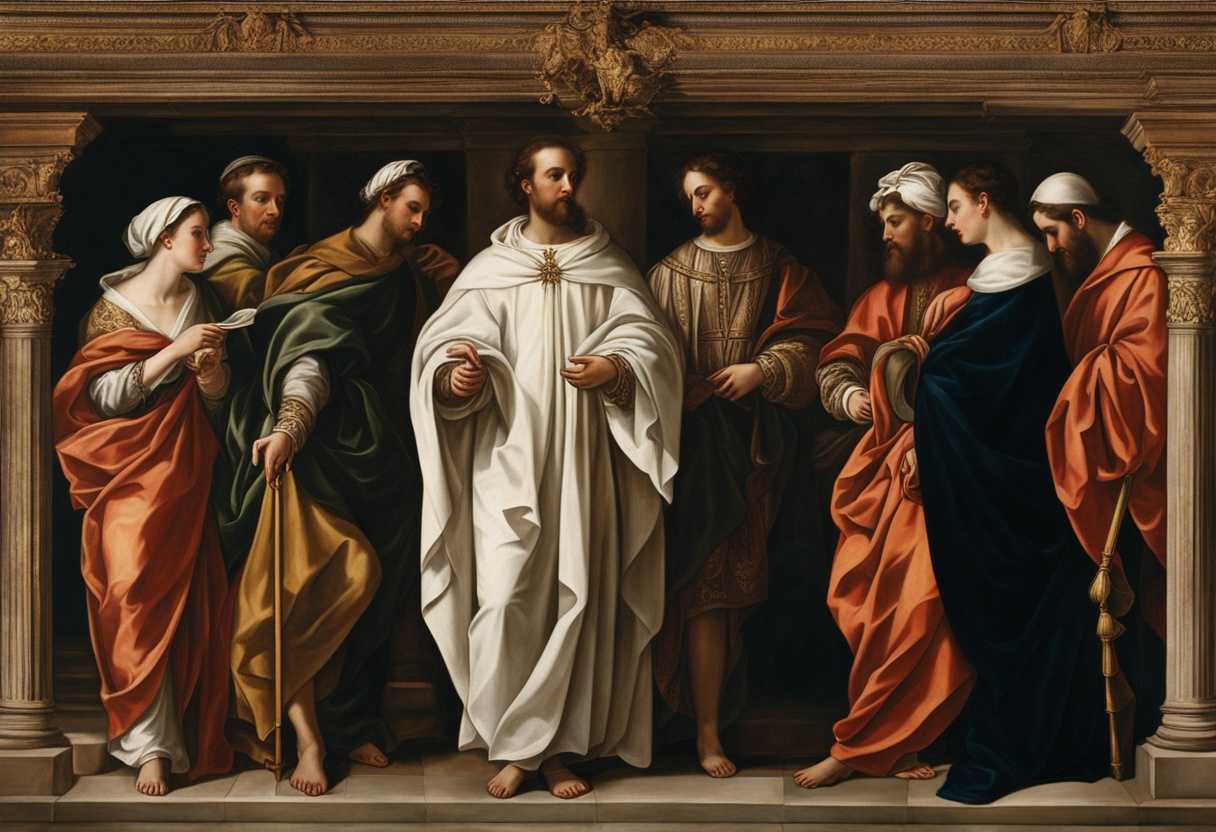
In the Bible, cloth often symbolizes purity and righteousness, as seen in the metaphor of being clothed in the righteousness of Christ (Philippians 3:9). Additionally, cloth has significance in rituals and offerings, such as the garments of the priests (Exodus 28) that represent holiness and set apart for God’s service.
Scripture
1 “Then bring near to you Aaron your brother, and his sons with him, from among the people of Israel, to serve me as priests—Aaron and Aaron’s sons, Nadab and Abihu, Eleazar and Ithamar.”
2 And you shall make holy garments for Aaron your brother, for glory and for beauty.
3 You shall speak to all the skillful, whom I have filled with a spirit of skill, that they make Aaron’s garments to consecrate him for my priesthood.
4 These are the garments that they shall make: a breastpiece, an ephod, a robe, a coat of checker work, a turban, and a sash. They shall make holy garments for Aaron your brother and his sons to serve me as priests.
5 They shall take the gold, blue and purple and scarlet yarns, and fine twined linen.
6 “And they shall make the ephod of gold, of blue and purple and scarlet yarns, and of fine twined linen, skillfully worked.
7 It shall have two shoulder pieces attached to its two edges, so that it may be joined together.
8 And the skillfully woven band on it shall be made like it and be of one piece with it, of gold, blue and purple and scarlet yarns, and fine twined linen.
9 You shall take two onyx stones, and engrave on them the names of the sons of Israel,
10 six of their names on the one stone, and the remaining six on the other stone, in the order of their birth.
11 With the work of an engraver in stone, like the engravings of a signet, you shall engrave the two stones with the names of the sons of Israel. You shall enclose them in settings of gold filigree.
12 And you shall set the two stones on the shoulder pieces of the ephod, as stones of remembrance for the sons of Israel. And Aaron shall bear their names before the Lord on his two shoulders for remembrance.
13 You shall make settings of gold filigree,
14 two chains of pure gold, twisted like cords; and you shall attach the corded chains to the settings.
15 “You shall make a breastpiece of judgment, in skilled work. In the style of the ephod you shall make it—of gold, blue and purple and scarlet yarns, and fine twined linen shall you make it.
16 It shall be square and doubled, a span its length and a span its breadth.
17 You shall set in it four rows of stones. A row of sardius, topaz, and carbuncle shall be the first row;
18 and the second row a turquoise, a sapphire, and an emerald;
19 and the third row a jacinth, an agate, and an amethyst;
20 and the fourth row a beryl, an onyx, and a jasper. They shall be set in gold filigree.
21 There shall be twelve stones with their names according to the names of the sons of Israel. They shall be like signets, each engraved with its name, for the twelve tribes.
22 You shall make on the breastpiece twisted chains like cords, of pure gold.
23 You shall make on the breastpiece two rings of gold, and shall put the two rings on the two edges of the breastpiece.
24 and you shall put the two cords of gold in the two rings at the edges of the breastpiece.
25 And the other two ends of the two cords you shall attach to the two settings of filigree, and so attach it in front to the shoulder pieces of the ephod.
26 And you shall make two rings of gold, and attach them to the two shoulder pieces of the ephod, at its front, above the skillfully woven band of the ephod.
27 And you shall make two rings of gold, and attach them in front to the lower part of the two shoulder pieces of the ephod, at its seam above the skillfully woven band of the ephod.
28 And they shall bind the breastpiece by its rings to the rings of the ephod with a lace of blue, so that it may lie on the skillfully woven band of the ephod, so that the breastpiece shall not come loose from the ephod.
29 So Aaron shall bear the names of the sons of Israel in the breastpiece of judgment on his heart, when he goes into the Holy Place, to bring them to regular remembrance before the Lord.
30 And in the breastpiece of judgment you shall put the Urim and the Thummim, and they shall be on Aaron’s heart, when he goes in before the Lord. Thus Aaron shall bear the judgment of the people of Israel on his heart before the Lord regularly.
31 “You shall make the robe of the ephod all of blue.”
32 It shall have an opening for the head in the middle of it, with a woven binding around the opening, like the opening in a garment, so that it may not tear.
33 On its hem you shall make pomegranates of blue and purple and scarlet yarns, around its hem, with bells of gold between them,
34 A golden bell and a pomegranate, a golden bell and a pomegranate, around the hem of the robe.
35 It shall be on Aaron when he ministers, and its sound shall be heard when he goes into the Holy Place before the Lord, and when he comes out, so that he does not die.
36 “You shall make a plate of pure gold and engrave on it, like the engraving of a signet, ‘Holy to the Lord.’
37 You shall fasten it on a cord of blue and it shall be on the turban; it shall be at the front of the turban.
38 It shall be on Aaron’s forehead, and Aaron shall bear any guilt from the holy things that the people of Israel consecrate as their holy gifts. It shall regularly be on his forehead, that they may be accepted before the Lord.
39 “You shall weave the coat in checker work of fine linen, and you shall make a turban of fine linen, and you shall make a sash embroidered with needlework.
40 “For Aaron’s sons you shall make coats and sashes and caps. You shall make them for glory and beauty.
41 And you shall put them on Aaron your brother, and on his sons with him, and shall anoint them and ordain them and consecrate them, that they may serve me as priests.
42 You shall make for them linen undergarments to cover their naked flesh. They shall reach from the hips to the thighs;
43 They shall be on Aaron and on his sons when they go into the tent of meeting or when they come near the altar to minister in the Holy Place, lest they bear guilt and die. This shall be a statute forever for him and for his offspring after him.
Biblical Significance of Cloth
The symbolism of cloth in the Bible extends beyond mere physical fabric, embodying deeper themes of righteousness, identity, and spiritual readiness. In Philippians 3:9, believers are encouraged to be “clothed in Christ’s righteousness,” highlighting the transformative power of faith that robes individuals in purity and divine approval, contrasting with the shame of sin. This metaphor reflects the importance of inward transformation manifesting as an outward identity, reminding followers that their worth is rooted not in their achievements but in their relationship with Christ. Similarly, in Romans 13:14, the exhortation to “put on the Lord Jesus Christ” reinforces this notion of adopting a lifestyle that reflects His virtues, signifying a commitment to living in accordance with His teachings.
Further, cloth holds ritual significance, particularly in the context of priestly garments as described in Exodus 28. These garments, meticulously crafted, symbolize the holiness required for those serving in sacred roles, setting them apart from the ordinary. The intricate design and specific colors signify purity, authority, and the covenant relationship between God and His people. In a broader sense, the garments represent the idea that God desires His followers to embody holiness in their own lives, transforming their spiritual wardrobe to reflect their commitment to divine values. Ultimately, cloth in the Bible encapsulates the transition from human inadequacy to divine righteousness and the call to live a life that honors God in all aspects, inviting followers to embrace their identity as carriers of His presence and purpose in the world.
Cloth is also seen as a symbol of covenant and commitment, particularly in the narrative of Genesis where Joseph’s coat of many colors carries significant weight. This distinctive garment, gifted by his father Jacob, not only marks Joseph’s favored status but also sets the stage for themes of jealousy, betrayal, and reconciliation among his brothers. The act of stripping Joseph of his coat in Genesis 37 represents a severing of family ties and a rejection of his favored position, highlighting the powerful association between clothing and identity. This narrative illustrates how physical garments can signify deeper familial and covenantal bonds, reminding readers of the responsibilities that come with such relationships.
Moreover, in the context of mourning and repentance, cloth is often employed to indicate the inner state of individuals. The practice of wearing sackcloth is a visible expression of grief and penitence, as seen throughout the Old Testament when people sought to demonstrate their contrition before God, such as during times of national calamity or personal sin. This external manifestation serves as a potent reminder that true repentance cannot be merely an internal feeling but must also be reflected in outward behavior. The act of donning sackcloth thus conveys urgency for spiritual renewal and the desire for reconciliation with God. Through these numerous accounts, the significance of cloth emerges as a multifaceted symbol of identity, relationships, and spiritual condition, illustrating the profound layers of meaning woven throughout the biblical narrative.
Symbol of Righteousness and Purity
In the Bible, cloth often symbolizes righteousness and purity. The imagery of garments is frequently used to represent the moral and spiritual state of individuals. For instance, clean and white garments are associated with holiness and the righteousness bestowed upon believers. This symbolism emphasizes the transformative power of faith, where believers are “clothed” in righteousness through their relationship with God.
Representation of Identity and Status
Cloth also serves as a representation of identity and social status within biblical narratives. Different types of garments can indicate a person’s role, wealth, or position in society. For example, the rich often wore fine linen, while the poor might wear simple or tattered clothing. This distinction highlights the social dynamics of the time and serves as a reminder of the importance of humility and the transient nature of earthly status in the eyes of God.
Metaphor for Spiritual Transformation
Cloth can be seen as a metaphor for spiritual transformation and renewal. The act of putting on new garments can symbolize the shedding of old ways and the embracing of a new life in faith. This concept is often illustrated through the imagery of being “clothed” with new attributes, such as compassion, kindness, and humility, reflecting the inner change that occurs when one follows the teachings of Christ.
How to Embrace Purity and Strengthen Your Christian Identity
Embracing purity is a beautiful journey that not only strengthens your Christian identity but also deepens your relationship with God. Start by immersing yourself in Scripture, allowing the Word to guide your thoughts and actions; verses like Philippians 4:8 remind us to focus on what is true, noble, and pure. Surround yourself with a community of believers who uplift and encourage you, as fellowship can be a powerful source of strength. Remember, purity isn’t just about avoiding sin; it’s about filling your life with things that reflect Christ’s love and grace. Engage in prayer, seeking God’s help to cultivate a heart that desires holiness, and be open to His transformative work in your life. As you strive for purity, you’ll find that your identity as a beloved child of God becomes clearer, and your actions will naturally reflect the light of Christ to those around you.
Bible References to the Significance of Cloth:
Leviticus 16:1-34: 1 The Lord spoke to Moses after the death of the two sons of Aaron, when they drew near before the Lord and died,
2 and the Lord said to Moses, “Tell Aaron your brother not to come at any time into the Holy Place inside the veil, before the mercy seat that is on the ark, so that he may not die. For I will appear in the cloud over the mercy seat.
3 But in this way Aaron shall come into the Holy Place: with a bull from the herd for a sin offering and a ram for a burnt offering.
4 He shall put on the holy linen coat and shall have the linen undergarment on his body, and he shall tie the linen sash around his waist, and wear the linen turban; these are the holy garments. He shall bathe his body in water and then put them on.
5 And he shall take from the congregation of the people of Israel two male goats for a sin offering, and one ram for a burnt offering.
6 “Aaron shall offer the bull as a sin offering for himself and shall make atonement for himself and for his house.
7 Then he shall take the two goats and set them before the Lord at the entrance of the tent of meeting.
8 And Aaron shall cast lots over the two goats, one lot for the Lord and the other lot for Azazel.
9 And Aaron shall present the goat on which the lot fell for the Lord and use it as a sin offering,
10 But the goat on which the lot fell for Azazel shall be presented alive before the Lord to make atonement over it, that it may be sent away into the wilderness to Azazel.
11 “Aaron shall present the bull as a sin offering for himself, and shall make atonement for himself and for his house.
12 And he shall take a censer full of coals of fire from the altar before the Lord, and two handfuls of sweet incense beaten small, and he shall bring it inside the veil
13 and put the incense on the fire before the Lord, that the cloud of the incense may cover the mercy seat that is over the testimony, so that he does not die.
14 And he shall take some of the blood of the bull and sprinkle it with his finger on the front of the mercy seat on the east side, and in front of the mercy seat he shall sprinkle some of the blood with his finger seven times.
15 “Then he shall kill the goat of the sin offering that is for the people and bring its blood inside the veil and do with its blood as he did with the blood of the bull, sprinkling it over the mercy seat and in front of the mercy seat.”
16 Thus he shall make atonement for the Holy Place, because of the uncleannesses of the people of Israel and because of their transgressions, all their sins. And so he shall do for the tent of meeting, which dwells with them in the midst of their uncleannesses.
17 There shall be no man in the tent of meeting when he enters to make atonement in the Holy Place, until he comes out and has made atonement for himself and for his house and for all the assembly of Israel.
18 Then he shall go out to the altar that is before the Lord and make atonement for it, and shall take some of the blood of the bull and some of the blood of the goat, and put it on the horns of the altar all around.
19 He shall sprinkle some of the blood on it with his finger seven times and cleanse it and consecrate it from the uncleannesses of the people of Israel.
20 “And when he has made an end of atoning for the Holy Place and the tent of meeting and the altar, he shall present the live goat.”
21 And Aaron shall lay both his hands on the head of the live goat, and confess over it all the iniquities of the people of Israel, and all their transgressions, all their sins. And he shall put them on the head of the goat and send it away into the wilderness by the hand of a man who is in readiness.
22 And the goat shall bear all their iniquities on itself to a remote area, and he shall let the goat go free in the wilderness.
23 Then Aaron shall come into the tent of meeting and shall take off the linen garments that he put on when he went into the Holy Place and shall leave them there.
24 And he shall bathe his body in water in a holy place and put on his garments and come out and offer his burnt offering and the burnt offering of the people and make atonement for himself and for the people.
25 And the fat of the sin offering he shall burn on the altar.
26 And he who lets the goat go to Azazel shall wash his clothes and bathe his body in water, and afterward he may come into the camp.
27 And the bull for the sin offering and the goat for the sin offering, whose blood was brought in to make atonement in the Holy Place, shall be carried outside the camp.
28 And he who burns them shall wash his clothes and bathe his body in water, and afterward he may come into the camp.
29 “And it shall be a statute to you forever that in the seventh month, on the tenth day of the month, you shall afflict yourselves and shall do no work, either the native or the stranger who sojourns among you.
30 for on this day shall atonement be made for you to cleanse you. You shall be clean before the Lord from all your sins.
31 It is a Sabbath of solemn rest to you, and you shall afflict yourselves; it is a statute forever.
32 And the priest who is anointed and consecrated as priest in his father’s place shall make atonement, wearing the holy linen garments.
33 and make atonement for the holy sanctuary, and he shall make atonement for the tent of meeting and for the altar, and he shall make atonement for the priests and for all the people of the assembly.
34 And this shall be a statute forever for you, that atonement may be made for the people of Israel once in the year because of all their sins.” And Aaron did as the Lord commanded Moses.
Numbers 4:1-33: 1 The Lord spoke to Moses and Aaron, saying,
2 “Take a census of the sons of Kohath from among the sons of Levi, by their clans and their fathers’ houses,
3 from thirty years old up to fifty years old, all who can come on duty, to do the work in the tent of meeting.
4 This is the service of the sons of Kohath in the tent of meeting: the most holy things.
5 When the camp is to set out, Aaron and his sons shall go in and take down the veil of the screen and cover the ark of the testimony with it.
6 Then they shall put on it a covering of goatskin and spread on top of that a cloth all of blue, and shall put in its poles.
7 And over the table of the bread of the Presence they shall spread a cloth of blue and put on it the plates, the dishes for incense, the bowls, and the flagons for the drink offering; the regular showbread also shall be on it.
8 And they shall spread a cloth of blue and cover the lampstand of the light, with its lamps, its tongs, its trays, and all the vessels for oil with which it is supplied.
9 Then they shall take a blue cloth and cover the lampstand for the light, with its lamps, its tongs, its trays, and all the vessels for oil with which it is supplied.
10 And they shall put it with all the utensils of the altar, and they shall spread a cloth of blue over it, and shall put on it the poles.
11 Over the golden altar they shall spread a cloth of blue and cover it with a covering of goatskin and shall put in its poles.
12 And they shall take all the vessels of ministry used for the service in the tabernacle, and they shall put them in a cloth of blue and cover them with a covering of goatskin and put them on the carrying frame.
13 and they shall take away the ashes from the altar and spread a purple cloth over it.
14 And they shall put on it all the utensils of the altar, which are used for the service there, the fire pans, the forks, the shovels, and the basins, all the utensils of the altar; and they shall spread on it a covering of goatskin, and shall put in its poles.
15 And when Aaron and his sons have finished covering the sanctuary and all the furnishings of the sanctuary, as the camp sets out, after that the sons of Kohath shall come to carry these, but they must not touch the holy things, lest they die. These are the things of the tent of meeting that the sons of Kohath are to carry.
16 “And the appointed men shall come and take down the tabernacle of meeting, and they shall cover the ark of the testimony with a veil and put a covering of badger skins on it, and shall insert its poles.”
17 Then the Lord spoke to Moses and to Aaron, saying,
18 But do this to them, that they may live and not die when they come near the most holy things: Aaron and his sons shall go in and appoint them each to his task and to his burden,
19 but deal thus with them, that they may live and not die when they come near to the most holy things: Aaron and his sons shall go in and appoint them each to his task and to his burden,
20 but they shall not go in to look on the holy things even for a moment, lest they die.”
21 Then the Lord spoke to Moses, saying,
22 Take a census of the sons of Gershon also, by their fathers’ houses and by their clans.
23 from thirty years old up to fifty years old, all who can come on duty, to do the work in the tent of meeting.
24 This is the service of the clans of the Gershonites, in serving and bearing burdens.
25 they shall carry the curtains of the tabernacle and the tent of meeting with its covering and the covering of goatskin that is on top of it and the screen for the entrance of the tent of meeting,
26 the hangings of the court, the screen for the entrance of the gate of the court that is around the tabernacle and the altar, and their cords, and all the equipment for their service. And they shall do all that needs to be done with them.
27 And over the table of the bread of the Presence they shall spread a cloth of blue and put on it the plates, the dishes for incense, the bowls, and the flagons for the drink offering; the regular showbread also shall be on it.
28 This is the service of the clans of the Gershonites, in serving and bearing burdens:
29 As for the sons of Merari, you shall list them by their clans and their fathers’ houses.
30 from thirty years old up to fifty years old, everyone who could come on duty, for service in the tent of meeting;
31 This is the service of the clans of the Gershonites in the tent of meeting, and their guard duty is to be under the direction of Ithamar the son of Aaron the priest.
32 and the pillars around the court, with their bases and pegs and cords, with all their equipment and all their accessories. And you shall list by name the objects that they are required to carry.
33 This is the service of the clans of the sons of Merari, the whole of their service in the tent of meeting, under the direction of Ithamar the son of Aaron the priest.”
Deuteronomy 22:5-12: 5 “A woman shall not wear a man’s garment, nor shall a man put on a woman’s cloak, for whoever does these things is an abomination to the Lord your God.
6 “If you come across a bird’s nest in any tree or on the ground, with young ones or eggs and the mother sitting on the young or on the eggs, you shall not take the mother with the young.
7 You shall let the mother go, but the young you may take for yourself, that it may go well with you, and that you may live long.
8 “When you build a new house, you shall make a parapet for your roof, that you may not bring the guilt of blood upon your house, if anyone should fall from it.
9 “You shall not sow your vineyard with two kinds of seed, lest the whole yield be forfeited, the crop that you have sown and the yield of the vineyard.
10 You shall not plow with an ox and a donkey together.
11 You shall not wear cloth of wool and linen mixed together.
12 “You shall make yourself tassels on the four corners of the garment with which you cover yourself.
Judges 16:1-22: 1 Samson went to Gaza, and there he saw a prostitute, and he went in to her.
2 The Gazites were told, “Samson has come here.” And they surrounded the place and set an ambush for him all night at the gate of the city. They kept quiet all night, saying, “Let us wait till the light of the morning; then we will kill him.”
3 But Samson lay till midnight, and at midnight he arose and took hold of the doors of the gate of the city and the two posts, and pulled them up, bar and all, and put them on his shoulders and carried them to the top of the hill that is in front of Hebron.
4 After this he loved a woman in the Valley of Sorek, whose name was Delilah.
5 And the lords of the Philistines came up to her and said to her, “Seduce him, and see where his great strength lies, and by what means we may overpower him, that we may bind him to humble him. And we will each give you 1,100 pieces of silver.”
6 So Delilah said to Samson, “Please tell me where your great strength lies, and how you might be bound, that one could subdue you.”
7 And Samson said to her, “If they bind me with seven fresh bowstrings that have not been dried, then I shall become weak and be like any other man.”
8 Then the lords of the Philistines brought up to her seven fresh bowstrings that had not been dried, and she bound him with them.
9 Now she had men lying in ambush in an inner chamber. And she said to him, “The Philistines are upon you, Samson!” But he snapped the bowstrings, as a thread of flax snaps when it touches the fire. So the secret of his strength was not known.
10 Then Delilah said to Samson, “Behold, you have mocked me and told me lies. Please tell me how you might be bound.”
11 Then Delilah said to Samson, “Behold, you have mocked me and told me lies. Please tell me how you might be bound.”
12 So Delilah took new ropes and bound him with them and said to him, “The Philistines are upon you, Samson!” And the men lying in wait were in an inner chamber. But he snapped the ropes off his arms like a thread.
13 Then Delilah said to Samson, “Until now you have mocked me and told me lies. Tell me how you might be bound.” And he said to her, “If you weave the seven locks of my head with the web and fasten it tight with the pin, then I shall become weak and be like any other man.”
14 So while he slept, Delilah took the seven locks of his head and wove them into the web.
15 And she said to him, “How can you say, ‘I love you,’ when your heart is not with me? You have mocked me these three times, and you have not told me where your great strength lies.”
16 And when she pressed him hard with her words day after day, and urged him, his soul was vexed to death.
17 And he told her all his heart, and said to her, “A razor has never come upon my head, for I have been a Nazirite to God from my mother’s womb. If my head is shaved, then my strength will leave me, and I shall become weak and be like any other man.”
18 When Delilah saw that he had told her all his heart, she sent and called the lords of the Philistines, saying, “Come up again, for he has told me all his heart.” Then the lords of the Philistines came up to her and brought the money in their hands.
19 She made him sleep on her knees. And she called a man and had him shave off the seven locks of his head. Then she began to torment him, and his strength left him.
20 And she said, “The Philistines are upon you, Samson!” And he awoke from his sleep and said, “I will go out as at other times and shake myself free.” But he did not know that the Lord had left him.
21 And the Philistines seized him and gouged out his eyes and brought him down to Gaza and bound him with bronze shackles. And he ground at the mill in the prison.
22 But the hair of his head began to grow again after it had been shaved.
1 Samuel 18:1-4: 1 As soon as he had finished speaking to Saul, the soul of Jonathan was knit to the soul of David, and Jonathan loved him as his own soul.
2 And Saul took him that day and would not let him return to his father’s house.
3 Then Jonathan made a covenant with David, because he loved him as his own soul.
4 And Jonathan stripped himself of the robe that was on him and gave it to David, and his armor, and even his sword and his bow and his belt.
2 Samuel 1:11-12: 11 Then David took hold of his clothes and tore them, and so did all the men who were with him.
12 And they mourned and wept and fasted until evening for Saul and for Jonathan his son and for the people of the Lord and for the house of Israel, because they had fallen by the sword.
2 Kings 2:8-14: 8 Then Elijah took his cloak and rolled it up and struck the water, and the water was parted to the one side and to the other, till the two of them could go over on dry ground.
9 When they had crossed, Elijah said to Elisha, “Ask what I shall do for you, before I am taken from you.” And Elisha said, “Please let there be a double portion of your spirit on me.”
10 And he said, “You have asked a hard thing; yet, if you see me as I am being taken from you, it shall be so for you, but if you do not see me, it shall not be so.”
11 And as they still went on and talked, behold, chariots of fire and horses of fire separated the two of them. And Elijah went up by a whirlwind into heaven.
12 And Elisha saw it and he cried, “My father, my father! The chariots of Israel and its horsemen!” And he saw him no more. Then he took hold of his own clothes and tore them in two pieces.
13 He picked up the cloak of Elijah that had fallen from him and went back and stood on the bank of the Jordan.
14 Then he took the cloak of Elijah that had fallen from him and struck the water, saying, “Where is the Lord, the God of Elijah?” And when he had struck the water, the water was parted to the one side and to the other, and Elisha went over.
Esther 8:15-17: 15 Then Mordecai went out from the presence of the king in royal robes of blue and white, with a great golden crown and a robe of fine linen and purple, and the city of Susa shouted and rejoiced.
16 The Jews had light and gladness and joy and honor.
17 In every province and in every city, wherever the king’s command and his edict reached, there was gladness and joy among the Jews, a feast and a holiday. And many from the peoples of the country declared themselves Jews, for fear of the Jews had fallen on them.
Isaiah 61:1-11: 1 The Spirit of the Lord God is upon me,
because the Lord has anointed me
to bring good news to the poor;
he has sent me to bind up the brokenhearted,
to proclaim liberty to the captives,
and the opening of the prison to those who are bound;
2 to proclaim the year of the Lord’s favor, and the day of vengeance of our God; to comfort all who mourn;
3 to grant to those who mourn in Zion—
to give them a beautiful headdress instead of ashes,
the oil of gladness instead of mourning,
the garment of praise instead of a faint spirit;
that they may be called oaks of righteousness,
the planting of the Lord, that he may be glorified.
4 They shall build up the ancient ruins; they shall raise up the former devastations; they shall repair the ruined cities, the devastations of many generations.
5 Strangers shall stand and tend your flocks; foreigners shall be your plowmen and vinedressers.
6 but you shall be called the priests of the Lord;
they shall speak of you as the ministers of our God;
you shall eat the wealth of the nations,
and in their glory you shall boast.
7 Instead of your shame there shall be a double portion; instead of dishonor they shall rejoice in their lot; therefore in their land they shall possess a double portion; they shall have everlasting joy.
8 For I the Lord love justice;
I hate robbery and wrong;
I will faithfully give them their recompense,
and I will make an everlasting covenant with them.
9 Their offspring shall be known among the nations, and their descendants in the midst of the peoples; all who see them shall acknowledge them, that they are an offspring the Lord has blessed.
10 I will greatly rejoice in the Lord; my soul shall exult in my God, for he has clothed me with the garments of salvation; he has covered me with the robe of righteousness, as a bridegroom decks himself like a priest with a beautiful headdress, and as a bride adorns herself with her jewels.
11 For as the earth brings forth its sprouts,
and as a garden causes what is sown in it to sprout up,
so the Lord God will cause righteousness and praise
to sprout up before all the nations.
Jeremiah 13:1-11: 1 Thus says the Lord to me, “Go and buy a linen loincloth and put it around your waist, and do not dip it in water.”
2 So I bought a loincloth according to the word of the Lord, and put it around my waist.
3 Then the word of the Lord came to me:
4 “Take the loincloth that you have bought, which is around your waist, and arise, go to the Euphrates and hide it there in a cleft of the rock.”
5 So I went and hid it by the Euphrates, as the Lord commanded me.
6 “Can the Ethiopian change his skin
or the leopard his spots?
Then also you can do good
who are accustomed to do evil.
7 Then I went to the Euphrates, and dug, and I took the loincloth from the place where I had hidden it. And behold, the loincloth was spoiled; it was good for nothing.
8 Then the word of the Lord came to me:
9 “Thus says the Lord: Even so will I spoil the pride of Judah and the great pride of Jerusalem.”
10 This evil people, who refuse to hear my words, who stubbornly follow their own heart and have gone after other gods to serve them and worship them, shall be like this loincloth, which is good for nothing.
11 For as the loincloth clings to the waist of a man, so I made the whole house of Israel and the whole house of Judah cling to me, declares the Lord, that they might be for me a people, a name, a praise, and a glory, but they would not listen.
Ezekiel 16:1-14: 1 Again the word of the Lord came to me:
2 “Son of man, make known to Jerusalem her abominations,”
3 and say, Thus says the Lord God to Jerusalem: Your origin and your birth are of the land of the Canaanites; your father was an Amorite and your mother a Hittite.
4 And as for your birth, on the day you were born your cord was not cut, nor were you washed with water to cleanse you, nor rubbed with salt, nor wrapped in swaddling cloths.
5 No eye pitied you, to do any of these things to you out of compassion for you, but you were cast out on the open field, for you were abhorred, on the day that you were born.
6 “And when I passed by you and saw you wallowing in your blood, I said to you in your blood, ‘Live!’ Yes, I said to you in your blood, ‘Live!’”
7 I made you flourish like a plant of the field.
8 “When I passed by you again and saw you, behold, you were at the age for love, and I spread the corner of my garment over you and covered your nakedness; I made my vow to you and entered into a covenant with you, declares the Lord God, and you became mine.”
9 Then I bathed you with water and washed off your blood from you and anointed you with oil.
10 I clothed you also with embroidered cloth and shod you with fine leather. I wrapped you in fine linen and covered you with silk.
11 And I adorned you with ornaments and put bracelets on your wrists and a chain on your neck.
12 And I put a ring on your nose and earrings in your ears and a beautiful crown on your head.
13 Thus you were adorned with gold and silver, and your clothing was of fine linen and silk and embroidered cloth. You ate fine flour and honey and oil. You grew exceedingly beautiful and advanced to royalty.
14 And your renown went forth among the nations because of your beauty, for it was perfect through the splendor that I had bestowed on you, declares the Lord God.
Matthew 9:16-17: 16 No one puts a piece of unshrunk cloth on an old garment, for the patch tears away from the garment, and a worse tear is made.
17 Neither is new wine put into old wineskins. If it is, the skins burst and the wine is spilled and the skins are destroyed. But new wine is put into fresh wineskins, and so both are preserved.
Matthew 27:35-36: 35 And when they had crucified him, they divided his garments among them by casting lots.
36 Then sitting down, they kept watch over him there.
Mark 2:21-22: 21 No one sews a piece of unshrunk cloth on an old garment. If he does, the patch tears away from it, the new from the old, and a worse tear is made.
22 And no one puts new wine into old wineskins. If he does, the wine will burst the skins—and the wine is destroyed, and so are the skins. But new wine is for fresh wineskins.”
Mark 15:24-25: 24 And they crucified him and divided his garments among them, casting lots for them, to decide what each should take.
25 And it was the third hour when they crucified him.
Luke 5:36-39: 36 He also told them a parable: “No one tears a piece from a new garment and puts it on an old garment. If he does, he will tear the new, and the piece from the new will not match the old.
37 And no one puts new wine into old wineskins. If he does, the new wine will burst the skins and it will be spilled, and the skins will be destroyed.
38 But new wine must be put into fresh wineskins.
39 And no one after drinking old wine desires new, for he says, ‘The old is good.’
John 19:23-24: 23 When the soldiers had crucified Jesus, they took his garments and divided them into four parts, one part for each soldier; also his tunic. But the tunic was seamless, woven in one piece from top to bottom.
24 so they said to one another, “Let us not tear it, but cast lots for it to see whose it shall be.” This was to fulfill the Scripture which says, “They divided my garments among them, and for my clothing they cast lots.” So the soldiers did these things,
Acts 9:36-42: 36 Now there was in Joppa a disciple named Tabitha, which, translated, means Dorcas. She was full of good works and acts of charity.
37 In those days she became ill and died, and when they had washed her, they laid her in an upper room.
38 Since Lydda was near Joppa, the disciples, hearing that Peter was there, sent two men to him, urging him, “Please come to us without delay.”
39 So Peter rose and went with them. And when he arrived, they took him to the upper room. All the widows stood beside him weeping and showing tunics and other garments that Dorcas made while she was with them.
40 But Peter put them all outside, and knelt down and prayed; and turning to the body he said, “Tabitha, arise.” And she opened her eyes, and when she saw Peter she sat up.
41 And he gave her his hand and raised her up. Then, calling the saints and widows, he presented her alive.
42 And it became known throughout all Joppa, and many believed in the Lord.
Acts 19:11-12: 11 And God was doing extraordinary miracles by the hands of Paul,
12 so that even handkerchiefs or aprons that had touched his skin were carried away to the sick, and their diseases left them and the evil spirits came out of them.
1 Corinthians 11:4-15: 4 Every man who prays or prophesies with his head covered dishonors his head,
5 but every wife who prays or prophesies with her head uncovered dishonors her head, since it is the same as if her head were shaven.
6 For if a wife will not cover her head, then she should cut her hair short. But since it is disgraceful for a wife to cut off her hair or shave her head, let her cover her head.
7 For a man ought not to cover his head, since he is the image and glory of God, but woman is the glory of man.
8 For man was not made from woman, but woman from man.
9 Neither was man created for woman, but woman for man.
10 That is why a wife ought to have a symbol of authority on her head, because of the angels.
11 Nevertheless, in the Lord woman is not independent of man nor man of woman;
12 For as woman was made from man, so man is now born of woman. And all things are from God.
13 Judge for yourselves: is it proper for a wife to pray to God with her head uncovered?
14 Does not nature itself teach you that if a man wears long hair it is a disgrace for him,
15 but if a woman has long hair, it is her glory? For her hair is given to her for a covering.
Revelation 19:7-8: 7 Let us rejoice and exult and give him the glory, for the marriage of the Lamb has come, and his Bride has made herself ready;
8 it was granted her to clothe herself with fine linen, bright and pure— for the fine linen is the righteous deeds of the saints.

Reverend Ogunlade is a seasoned Church Minister with over three decades of experience in guiding and nurturing congregations. With profound wisdom and a serene approach, Reverend Ogunlade has carried out various pastoral duties, including delivering uplifting sermons, conducting religious ceremonies, and offering sage counsel to individuals seeking spiritual guidance. Their commitment to fostering harmony and righteousness within their community is exemplified through their compassionate nature, making them a beloved and trusted figure among the congregation.