
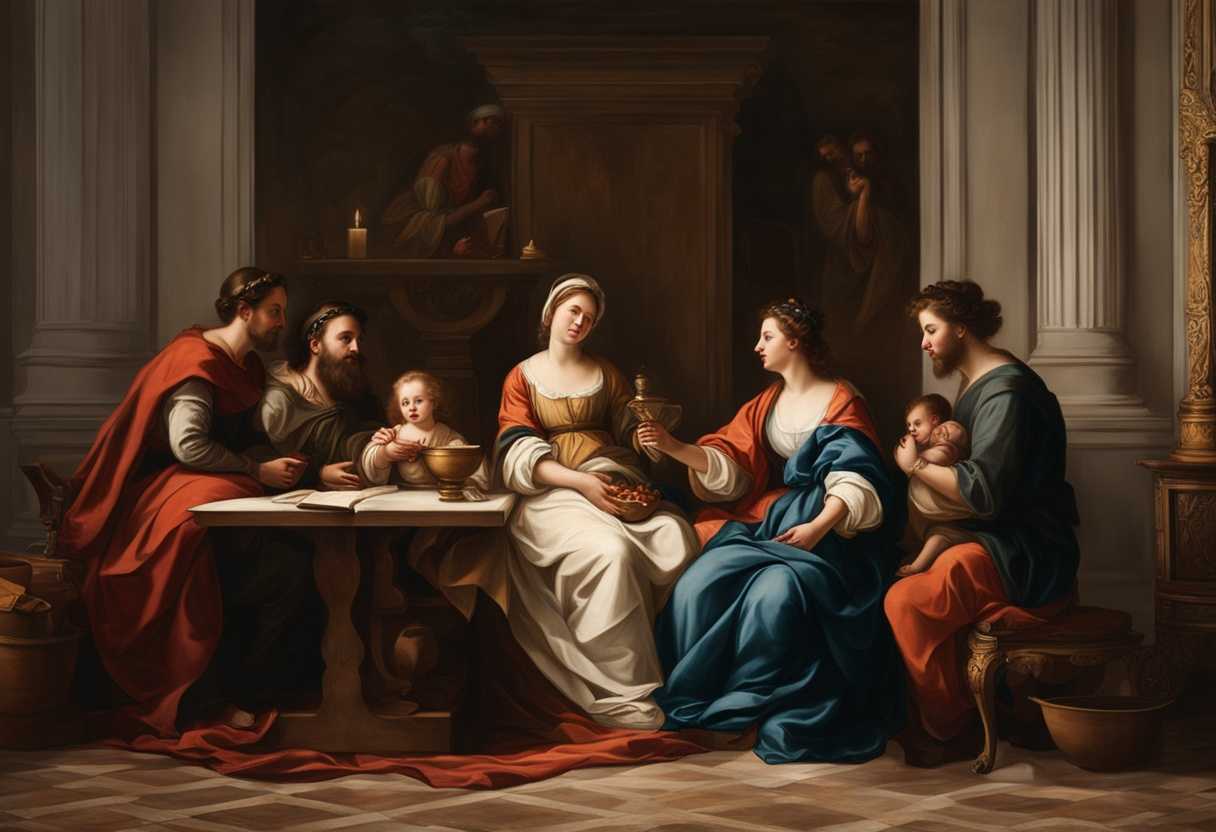
Household codes in the Bible refer to a set of instructions found in passages like Ephesians 5:22-6:9 and Colossians 3:18-4:1 that outline the roles and responsibilities within a Christian household, including directives for wives, husbands, children, and slaves. These codes aim to promote order, respect, and mutual submission in family and social relationships within the context of early Christian communities.
Scripture
22 Wives, submit to your own husbands, as to the Lord.
For the husband is the head of the wife even as Christ is the head of the church, his body, and is himself its Savior.
24 Now as the church submits to Christ, so also wives should submit in everything to their husbands.
25 Husbands, love your wives, as Christ loved the church and gave himself up for her,
26 that he might sanctify her, having cleansed her by the washing of water with the word,
27 so that he might present the church to himself in splendor, without spot or wrinkle or any such thing, that she might be holy and without blemish.
28 In the same way husbands should love their wives as their own bodies. He who loves his wife loves himself.
29 For no one ever hated his own flesh, but nourishes and cherishes it, just as Christ does the church,
30 because we are members of his body.
31 “Therefore a man shall leave his father and mother and hold fast to his wife, and the two shall become one flesh.”
32 This mystery is profound, and I am saying that it refers to Christ and the church.
33 However, let each one of you love his wife as himself, and let the wife see that she respects her husband.
Biblical Definition of Household Codes
The household codes found in the New Testament, particularly in Ephesians 5:22-6:9 and Colossians 3:18-4:1, provide a framework for understanding roles within the family unit and the broader community. These codes primarily emphasize the importance of mutual respect and love as foundational principles for domestic life. For instance, Ephesians 5:25 instructs husbands to love their wives “just as Christ loved the church,” highlighting the sacrificial nature of love expected in Christian marriages. Similarly, Ephesians 6:1-3 urges children to obey their parents “in the Lord,” reinforcing the concept of authority being rooted in moral and spiritual alignment rather than mere power dynamics.
Moreover, these codes counteract cultural norms of the time that often devalued certain family members, such as women and slaves. Colossians 3:11 declares that “there is no Greek or Jew, no circumcised or uncircumcised, no barbarian, Scythian, slave, or free, but Christ is all and in all.” This suggests that all individuals, regardless of their societal status, are equal under Christ and deserve respect and dignity. Consequently, while the household codes reflect the social context of the first-century church, their broader implications urge contemporary readers toward a vision of community built on love, equality, and mutual submission, challenging hierarchical structures and calling for a transformative understanding of relationships that honor the inherent worth of each person.
The concept of household codes extends beyond the immediate familial relationships to encompass the idea of social responsibility and ethical behavior in the broader Christian community. These instructions, while specific in their guidance for the household, also serve as a reflection of surrounding societal norms and the transformative ethos of Christianity. By outlining specific roles and responsibilities, these codes illuminate the importance of living out one’s faith in practical ways, integrating spiritual principles into the daily rhythms of life. The expectations set forth for each family member are intended not merely for the maintenance of order or authority but are deeply rooted in the love and integrity exhibited by Christ.
Furthermore, the household codes encourage an environment where faith is actively demonstrated through interpersonal interactions, fostering a sense of unity that extends beyond the home. This unity is echoed in the early Christian writings, which often stress the significance of treating one another with dignity and honor in all spheres of life. As believers strive to embody these ideals, particularly regarding how they address societal hierarchies and divisions, the household becomes a microcosm of the larger church community. Thus, these codes not only serve to instruct individual behavior but also inspire a collective vision of a faith community that operates on principles of equality, respect, and shared mutual accountability, ultimately cultivating a more just and compassionate society reflective of Christ’s teachings.
The Structure of Authority and Responsibility
Household codes in the Bible reflect a structured approach to authority and responsibility within the family unit. These codes often delineate roles for different members of the household, emphasizing the importance of order and hierarchy. This structure is intended to promote harmony and stability, suggesting that when each member understands their role and responsibilities, the household can function more effectively. The emphasis on authority also highlights the significance of leadership within the family, which is seen as a reflection of divine order.
The Ethical Framework for Relationships
Another broader meaning of household codes is their role in establishing an ethical framework for interpersonal relationships within the family. These codes provide guidelines for how family members should treat one another, promoting values such as love, respect, and mutual submission. By outlining expectations for behavior, the codes encourage a culture of care and support, fostering an environment where individuals can thrive emotionally and spiritually. This ethical dimension underscores the importance of relationships in the biblical narrative, illustrating how familial bonds can reflect broader principles of love and community.
The Cultural Context and Social Dynamics
Household codes also serve as a window into the cultural context and social dynamics of the time in which they were written. They reflect the societal norms and values of ancient communities, providing insight into the roles of men, women, children, and servants within the household. Understanding these codes within their historical context allows for a deeper appreciation of how biblical teachings can be applied to contemporary family life. It also raises questions about the evolution of family structures and the relevance of these codes in modern society, prompting discussions about gender roles, authority, and the nature of family relationships today.
How to Strengthen Family Ties Through Christian Principles
Strengthening family ties through Christian principles is a beautiful journey that begins with love, understanding, and shared faith. As you gather around the dinner table or during family devotions, make it a point to engage in open conversations about your beliefs and values, allowing each member to express their thoughts and feelings. Embrace the teachings of Christ by practicing forgiveness and grace, remembering that no family is perfect and that we all stumble. Incorporate prayer into your daily routine, inviting God into your family life, and seek opportunities to serve together, whether through community outreach or simply helping a neighbor. By prioritizing quality time and nurturing a spirit of gratitude, you’ll create a home that reflects the love of Christ, fostering deeper connections and a sense of belonging that can weather any storm. Remember, it’s not just about being a good Christian; it’s about living out those principles in a way that brings your family closer together.
Bible References to Household Codes:
Ephesians 6:1-9: 1 Children, obey your parents in the Lord, for this is right.
2 “Honor your father and mother” (this is the first commandment with a promise),
3 “that it may go well with you and that you may live long in the land.”
4 Fathers, do not provoke your children to anger, but bring them up in the discipline and instruction of the Lord.
5 Bondservants, obey your earthly masters with fear and trembling, with a sincere heart, as you would Christ,
6 not by the way of eye-service, as people-pleasers, but as bondservants of Christ, doing the will of God from the heart,
7 rendering service with a good will as to the Lord and not to man,
8 knowing that whatever good anyone does, this he will receive back from the Lord, whether he is a slave or free.
9 Masters, do the same to them, and stop your threatening, knowing that he who is both their Master and yours is in heaven, and that there is no partiality with him.
Colossians 3:18-25: 18 Wives, submit to your husbands, as is fitting in the Lord.
19 Husbands, love your wives, and do not be harsh with them.
20 Children, obey your parents in everything, for this pleases the Lord.
21 Fathers, do not provoke your children, lest they become discouraged.
22 Bondservants, obey in everything those who are your earthly masters, not by way of eye-service, as people-pleasers, but with sincerity of heart, fearing the Lord.
23 Whatever you do, work heartily, as for the Lord and not for men,
24 knowing that from the Lord you will receive the inheritance as your reward. You are serving the Lord Christ.
25 For the wrongdoer will be paid back for the wrong he has done, and there is no partiality.
Colossians 4:1: 1 Masters, treat your bondservants justly and fairly, knowing that you also have a Master in heaven.
1 Peter 2:18-25: 18 Servants, be subject to your masters with all respect, not only to the good and gentle but also to the unjust.
19 For this is a gracious thing, when, mindful of God, one endures sorrows while suffering unjustly.
20 For what credit is it if, when you sin and are beaten for it, you endure? But if when you do good and suffer for it you endure, this is a gracious thing in the sight of God.
21 For to this you have been called, because Christ also suffered for you, leaving you an example, so that you might follow in his steps.
22 He committed no sin, neither was deceit found in his mouth.
23 When he was reviled, he did not revile in return; when he suffered, he did not threaten, but continued entrusting himself to him who judges justly.
24 He himself bore our sins in his body on the tree, that we might die to sin and live to righteousness. By his wounds you have been healed.
25 For you were straying like sheep, but have now returned to the Shepherd and Overseer of your souls.
1 Peter 3:1-7: 3 Likewise, wives, be subject to your own husbands, so that even if some do not obey the word, they may be won without a word by the conduct of their wives,
3 Do not let your adorning be external—the braiding of hair and the putting on of gold jewelry, or the clothing you wear—
3 Do not let your adorning be external—the braiding of hair and the putting on of gold jewelry, or the clothing you wear—
3 Do not let your adorning be external—the braiding of hair and the putting on of gold jewelry, or the clothing you wear—
5 For this is how the holy women who hoped in God used to adorn themselves, by submitting to their own husbands,
6 as Sarah obeyed Abraham, calling him lord. And you are her children, if you do good and do not fear anything that is frightening.
7 Likewise, husbands, live with your wives in an understanding way, showing honor to the woman as the weaker vessel, since they are heirs with you of the grace of life, so that your prayers may not be hindered.
Titus 2:1-10: 1 But as for you, teach what accords with sound doctrine.
2 Older men are to be sober-minded, dignified, self-controlled, sound in faith, in love, and in steadfastness.
3 Older women likewise are to be reverent in behavior, not slanderers or slaves to much wine. They are to teach what is good,
4 and so train the young women to love their husbands and children,
5 to be self-controlled, pure, working at home, kind, and submissive to their own husbands, that the word of God may not be reviled.
6 Likewise, urge the younger men to be self-controlled.
7 Show yourself in all respects to be a model of good works, and in your teaching show integrity, dignity,
8 and sound speech that cannot be condemned, so that an opponent may be put to shame, having nothing evil to say about us.
9 Bondservants are to be submissive to their own masters in everything; they are to be well-pleasing, not argumentative,
10 not pilfering, but showing all good faith, so that in everything they may adorn the doctrine of God our Savior.
1 Timothy 2:8-15: 8 I desire then that in every place the men should pray, lifting holy hands without anger or quarreling;
9 likewise also that women should adorn themselves in respectable apparel, with modesty and self-control, not with braided hair and gold or pearls or costly attire,
10 but with what is proper for women who profess godliness—with good works.
11 Let a woman learn quietly with all submissiveness.
12 I do not permit a woman to teach or to exercise authority over a man; rather, she is to remain quiet.
13 For Adam was formed first, then Eve.
14 and Adam was not deceived, but the woman was deceived and became a transgressor.
15 Yet she will be saved through childbearing—if they continue in faith and love and holiness, with self-control.
1 Timothy 5:1-16: 1 Do not rebuke an older man but encourage him as you would a father, younger men as brothers,
2 older women as mothers, younger women as sisters, in all purity.
3 Honor widows who are truly widows.
4 But if a widow has children or grandchildren, let them first learn to show godliness to their own household and to make some return to their parents, for this is pleasing in the sight of God.
5 She who is truly a widow, left all alone, has set her hope on God and continues in supplications and prayers night and day,
6 But she who is self-indulgent is dead even while she lives.
7 Command these things as well, so that they may be without reproach.
8 But if anyone does not provide for his relatives, and especially for members of his household, he has denied the faith and is worse than an unbeliever.
9 Let a widow be enrolled if she is not less than sixty years of age, having been the wife of one husband,
10 and having a reputation for good works: if she has brought up children, has shown hospitality, has washed the feet of the saints, has cared for the afflicted, and has devoted herself to every good work.
11 But refuse to enroll younger widows, for when their passions draw them away from Christ, they desire to marry
12 incurring condemnation, because they have abandoned their former faith.
13 Besides that, they learn to be idlers, going about from house to house, and not only idlers, but also gossips and busybodies, saying what they should not.
14 So I would have younger widows marry, bear children, manage their households, and give the adversary no occasion for slander.
15 For some have already strayed after Satan.
16 If any believing woman has relatives who are widows, let her care for them. Let the church not be burdened, so that it may care for those who are truly widows.

Rev. François Dupont is a dedicated church minister with a wealth of experience in serving spiritual communities. With a calm and serene demeanor, he has been devoted to sharing the message of love, compassion, and tolerance for over two decades. Through his thoughtful sermons, compassionate counseling, and unwavering support, Rev. Dupont has touched the lives of countless individuals, allowing them to find solace and strength during difficult times. His serene presence and deep understanding of the human condition make him a trusted guide for those seeking spiritual nourishment and guidance.