
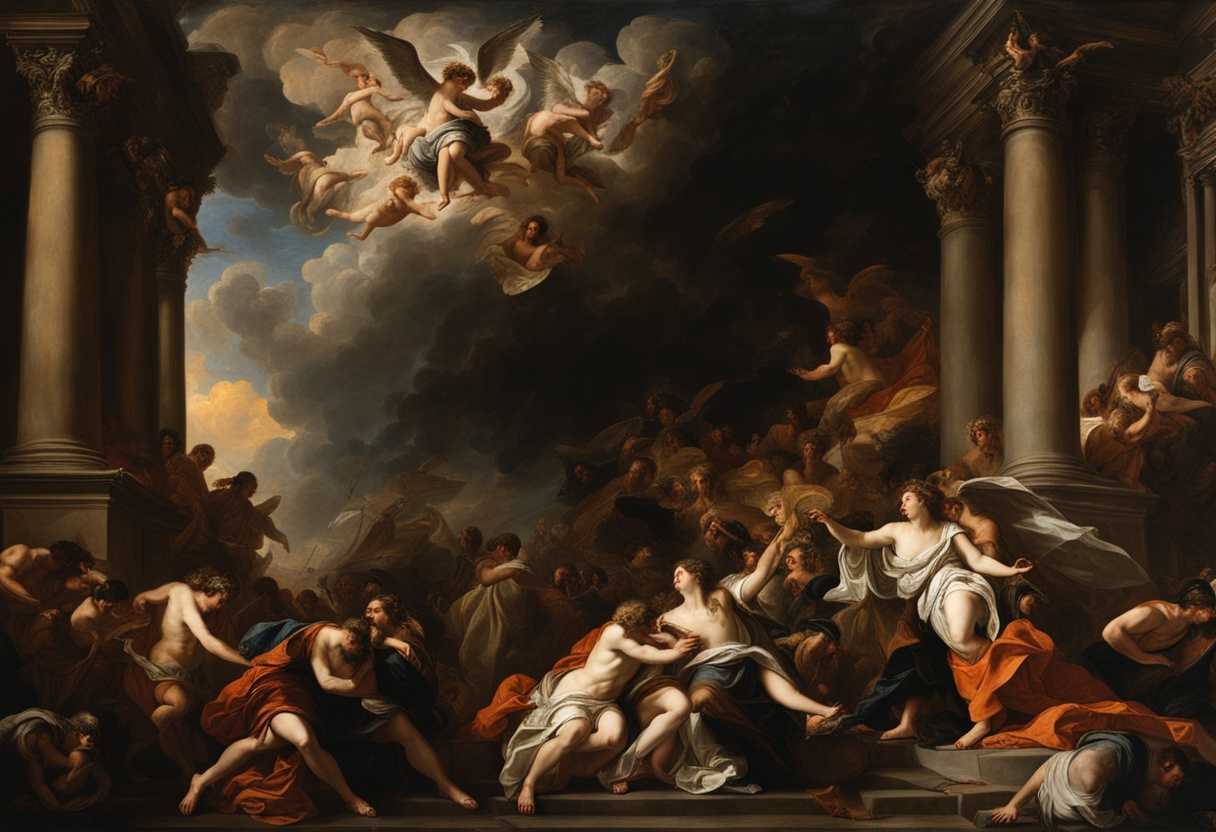
In the Bible, “overthrow” often refers to the act of defeating, destroying, or bringing about the downfall of a kingdom, nation, or individual, frequently as a result of divine judgment or intervention (e.g., the overthrow of Sodom and Gomorrah in Genesis 19:24-25). It symbolizes a significant and often violent change in power or order, indicating God’s sovereignty over human affairs.
Scripture
24 Then the Lord rained on Sodom and Gomorrah sulfur and fire from the Lord out of heaven.
25 And he overthrew those cities, and all the valley, and all the inhabitants of the cities, and what grew on the ground.
Biblical Significance of Overthrow
The concept of “overthrow” in the Bible encapsulates a profound theme of divine sovereignty and the moral order established by God. Instances of overthrow can be seen as manifestations of divine judgment where God intervenes in human affairs to correct injustice or sin. The destruction of Sodom and Gomorrah (Genesis 19:24-25) serves as a poignant example, illustrating how the cities faced annihilation due to their pervasive immorality. In this context, overthrow is not merely about physical destruction but also signifies the reclamation of divine authority over creation. Similarly, the overthrow of Pharaoh’s reign during the Exodus (Exodus 14:30) demonstrates how God can dismantle the mightiest of earthly powers to liberate His people, underscoring the underlying belief in God’s intervention in history for the sake of justice and righteousness.
Furthermore, the theme of overthrow invites reflection on the broader spiritual implications for humanity. Proverbs 11:3 states, “The integrity of the upright guides them, but the crookedness of the treacherous destroys them,” suggesting that divine justice aims to uphold those who align with God’s principles while bringing down the unrepentant. The New Testament also echoes this theme as seen in Revelation, which proclaims the ultimate overthrow of evil at Christ’s return (Revelation 20:10). This eschatological perspective not only serves as a warning but also as a source of hope, providing assurance that God will ultimately establish His kingdom, where righteousness prevails over wickedness. In essence, biblical “overthrow” not only acts as a narrative of judgment but also a declaration of the eventual triumph of God’s justice in the world.
The notion of “overthrow” is intricately tied to the larger biblical narrative where God’s intervention serves as a corrective force against oppression and moral corruption. In the context of Israel’s history, the overthrow of nations that opposed God’s chosen people illustrates a repeated theme of divine favor bestowed upon the faithful while dismantling adversaries. For instance, during the period of the Judges, various oppressors like the Midianites faced divine retribution as God raised up leaders such as Gideon to bring liberation to His people. This act of raising up a deliverer symbolizes an overthrow not just of enemy armies, but of the spiritual forces that sought to enslave God’s people.
Moreover, the prophetic literature of the Old Testament often speaks of a day of reckoning where God will execute justice, leading to the overthrow of unjust rulers and corrupt systems. Texts such as Isaiah and Jeremiah highlight God’s promise to dismantle the oppressive structures established by those who defy divine law. Such proclamations reflect an assurance that God’s sovereignty cannot be undermined by human power and that the moral order established by Him will eventually prevail. In this sense, overthrow becomes a process of restoration, where righteousness and truth are reinstated, paving the way for the fulfillment of God’s promises. The narrative of overthrow thus encompasses a rich tapestry of divine justice aimed at both uplifting the downtrodden and affirming God’s ultimate authority over creation.
Divine Judgment and Justice
In the Bible, the concept of overthrow often signifies divine judgment against wickedness and injustice. It serves as a reminder that God holds authority over nations and individuals, and that He will intervene to correct moral wrongs. This theme is prevalent in narratives where God brings about the downfall of corrupt leaders or societies that have turned away from His commandments. The act of overthrowing is thus seen as a manifestation of God’s justice, ensuring that righteousness prevails over evil.
Transformation and Renewal
Overthrow can also symbolize a transformative process, where old systems or ways of life are dismantled to make way for new beginnings. This can be interpreted as a necessary upheaval that leads to spiritual renewal or societal reform. In this context, overthrow is not merely about destruction but is often associated with the hope of restoration and the establishment of a more just and faithful community. It reflects the biblical principle that through trials and tribulations, believers can emerge stronger and more aligned with God’s will.
Spiritual Warfare and Victory
Another broader meaning of overthrow in the biblical context relates to spiritual warfare. The concept underscores the struggle between good and evil, where the overthrow of adversarial forces signifies victory for God’s kingdom. This theme is prevalent in the New Testament, where the ultimate overthrow of sin, death, and the devil is portrayed through the resurrection of Christ. It emphasizes the belief that through faith and divine intervention, believers can overcome spiritual adversities and experience triumph in their spiritual journey.
How to Embrace Divine Judgment for Spiritual Growth
Embracing divine judgment can feel daunting, but it’s essential for our spiritual growth as Christians. When we view judgment not as a punishment but as a loving correction from our Heavenly Father, we open ourselves to profound transformation. Reflect on Psalm 139:23-24, where David invites God to search his heart and reveal any offensive ways within him. This is a powerful practice for us too; by inviting God into our hearts, we allow Him to illuminate areas that need change. Instead of shying away from discomfort, let’s lean into it, recognizing that God’s judgment is ultimately for our good, guiding us toward a more Christ-like life. Remember, growth often comes through challenges, and by accepting divine judgment, we can cultivate humility, repentance, and a deeper relationship with God. So, let’s embrace this process with open hearts, trusting that every lesson is a step closer to the person God created us to be.
Bible References to the Concept of Overthrow:
Exodus 14:27-28: 27 So Moses stretched out his hand over the sea, and the sea returned to its normal course when the morning appeared.
28 The waters returned and covered the chariots and the horsemen; of all the host of Pharaoh that had followed them into the sea, not one of them remained.
Joshua 6:20-21: 20 So the people shouted, and the trumpets were blown. As soon as the people heard the sound of the trumpet, the people shouted a great shout, and the wall fell down flat, so that the people went up into the city, every man straight before him, and they captured the city.
21 Then they devoted all in the city to destruction, both men and women, young and old, oxen, sheep, and donkeys, with the edge of the sword.
Judges 7:19-22: 19 So Gideon and the hundred men who were with him came to the outskirts of the camp at the beginning of the middle watch, when they had just set the watch.
20 Then the three companies blew the trumpets and broke the jars. They held in their left hands the torches, and in their right hands the trumpets to blow. And they cried out, “A sword for the Lord and for Gideon!”
21 And every man stood in his place around the camp, and all the army ran. They cried out and fled.
22 When they blew the 300 trumpets, the Lord set every man’s sword against his comrade and against all the army. And the army fled as far as Beth-shittah toward Zererah, as far as the border of Abel-meholah, by Tabbath.
1 Samuel 17:49-51: 49 And David put his hand in his bag and took out a stone and slung it and struck the Philistine on his forehead. The stone sank into his forehead, and he fell on his face to the ground.
50 So David prevailed over the Philistine with a sling and with a stone, and struck the Philistine and killed him. There was no sword in the hand of David.
51 Then David ran and stood over the Philistine and took his sword and drew it out of its sheath and killed him and cut off his head with it. When the Philistines saw that their champion was dead, they fled.
2 Samuel 5:6-8: 6 And the king and his men went to Jerusalem against the Jebusites, the inhabitants of the land, who said to David, “You will not come in here, but the blind and the lame will ward you off”—thinking, “David cannot come in here.”
7 Nevertheless, David took the stronghold of Zion, that is, the city of David.
8 And David said on that day, “Whoever would strike the Jebusites, let him get up the water shaft to attack ‘the lame and the blind,’ who are hated by David’s soul.” Therefore it is said, “The blind and the lame shall not come into the house.”
2 Kings 19:35-37: 35 And that night the angel of the Lord went out and struck down 185,000 in the camp of the Assyrians. And when people arose early in the morning, behold, these were all dead bodies.
36 And Sennacherib the king of Assyria departed and went home and lived at Nineveh.
37 And as he was worshiping in the house of Nisroch his god, Adrammelech and Sharezer, his sons, struck him down with the sword. And after they escaped into the land of Ararat, Esarhaddon his son reigned in his place.
Isaiah 14:12-15: 12 “How you are fallen from heaven, O Day Star, son of Dawn! How you are cut down to the ground, you who laid the nations low!”
13 You said in your heart, ‘I will ascend to heaven; above the stars of God I will set my throne on high; I will sit on the mount of assembly in the far reaches of the north;
14 I will ascend above the heights of the clouds;
I will make myself like the Most High.’
15 But you are brought down to Sheol,
to the far reaches of the pit.
Jeremiah 1:10: 10 See, I have set you this day over nations and over kingdoms, to pluck up and to break down, to destroy and to overthrow, to build and to plant.”
Ezekiel 26:3-4: 3 therefore thus says the Lord God: Behold, I am against you, O Tyre, and will bring up many nations against you, as the sea brings up its waves.
4 They shall destroy the walls of Tyre and break down her towers, and I will scrape her soil from her and make her a bare rock.
Daniel 2:44-45: 44 And in the days of those kings the God of heaven will set up a kingdom that shall never be destroyed, nor shall the kingdom be left to another people. It shall break in pieces all these kingdoms and bring them to an end, and it shall stand forever,
45 just as you saw that a stone was cut from a mountain by no human hand, and that it broke in pieces the iron, the bronze, the clay, the silver, and the gold.
Amos 5:2: 2 “Fallen, no more to rise, is the virgin Israel; forsaken on her land, with none to raise her up.”
Jonah 3:4-10: 4 Jonah began to go into the city, going a day’s journey. And he called out, “Yet forty days, and Nineveh shall be overthrown!”
5 And the people of Nineveh believed God. They called for a fast and put on sackcloth, from the greatest of them to the least of them.
6 The word reached the king of Nineveh, and he arose from his throne, removed his robe, covered himself with sackcloth, and sat in ashes.
7 And he issued a proclamation and published through Nineveh, “By the decree of the king and his nobles: Let neither man nor beast, herd nor flock, taste anything. Let them not feed or drink water,
8 but let man and beast be covered with sackcloth, and let them call out mightily to God. Let everyone turn from his evil way and from the violence that is in his hands.
9 Who knows? God may turn and relent and turn from his fierce anger, so that we may not perish.”
10 When God saw what they did, how they turned from their evil way, God relented of the disaster that he had said he would do to them, and he did not do it.
Matthew 21:12-13: 12 And Jesus entered the temple and drove out all who sold and bought in the temple, and he overturned the tables of the money-changers and the seats of those who sold pigeons.
13 He said to them, “It is written, ‘My house shall be called a house of prayer,’ but you make it a den of robbers.”
Mark 11:15-17: 15 And they came to Jerusalem. And he entered the temple and began to drive out those who sold and those who bought in the temple, and he overturned the tables of the money-changers and the seats of those who sold pigeons.
16 and would not allow anyone to carry anything through the temple.
17 And he was teaching them and saying to them, “Is it not written, ‘My house shall be called a house of prayer for all the nations’? But you have made it a den of robbers.”
Luke 1:52: 52 he has brought down the mighty from their thrones
and exalted those of humble estate;
John 2:14-16: 14 In the temple he found those who were selling oxen and sheep and pigeons, and the money-changers sitting there.
15 And making a whip of cords, he drove them all out of the temple, with the sheep and oxen. And he poured out the coins of the money-changers and overturned their tables.
16 And he told those who sold the pigeons, “Take these things away; do not make my Father’s house a house of trade.”
Acts 5:38-39: 38 So in the present case I tell you, keep away from these men and let them alone, for if this plan or this undertaking is of man, it will fail;
39 but if it is of God, you will not be able to overthrow them. You might even be found opposing God!” So they took his advice,
Romans 13:1-2: 1 Let every person be subject to the governing authorities.
2 Therefore whoever resists the authorities resists what God has appointed, and those who resist will incur judgment.
1 Corinthians 10:5-12: 5 Nevertheless, with most of them God was not pleased, for they were overthrown in the wilderness.
6 Now these things took place as examples for us, that we might not desire evil as they did.
7 Do not be idolaters as some of them were; as it is written, “The people sat down to eat and drink and rose up to play.”
8 We must not indulge in sexual immorality as some of them did, and twenty-three thousand fell in a single day.
9 We must not put Christ to the test, as some of them did and were destroyed by serpents.
10 nor grumble, as some of them did and were destroyed by the Destroyer.
11 Now these things happened to them as an example, but they were written down for our instruction, on whom the end of the ages has come.
12 Therefore let anyone who thinks that he stands take heed lest he fall.
2 Corinthians 10:4-5: 4 For the weapons of our warfare are not of the flesh but have divine power to destroy strongholds.
5 We destroy arguments and every lofty opinion raised against the knowledge of God, and take every thought captive to obey Christ,
Hebrews 11:30-31: 30 By faith the walls of Jericho fell down after they had been encircled for seven days.
31 By faith Rahab the prostitute did not perish with those who were disobedient, because she had given a friendly welcome to the spies.
Revelation 12:7-9: 7 Now war arose in heaven, Michael and his angels fighting against the dragon. And the dragon and his angels fought back,
8 but he was defeated, and there was no longer any place for them in heaven.
9 And the great dragon was thrown down, that ancient serpent, who is called the devil and Satan, the deceiver of the whole world—he was thrown down to the earth, and his angels were thrown down with him.

Reverend Ogunlade is a seasoned Church Minister with over three decades of experience in guiding and nurturing congregations. With profound wisdom and a serene approach, Reverend Ogunlade has carried out various pastoral duties, including delivering uplifting sermons, conducting religious ceremonies, and offering sage counsel to individuals seeking spiritual guidance. Their commitment to fostering harmony and righteousness within their community is exemplified through their compassionate nature, making them a beloved and trusted figure among the congregation.