
In the Bible, “tormentors” often refers to those who inflict suffering or distress, both physically and spiritually. They can symbolize forces or individuals that enact punishment or anguish, as seen in parables like the unmerciful servant (Matthew 18:34), where tormentors are sent to punish the unforgiving.
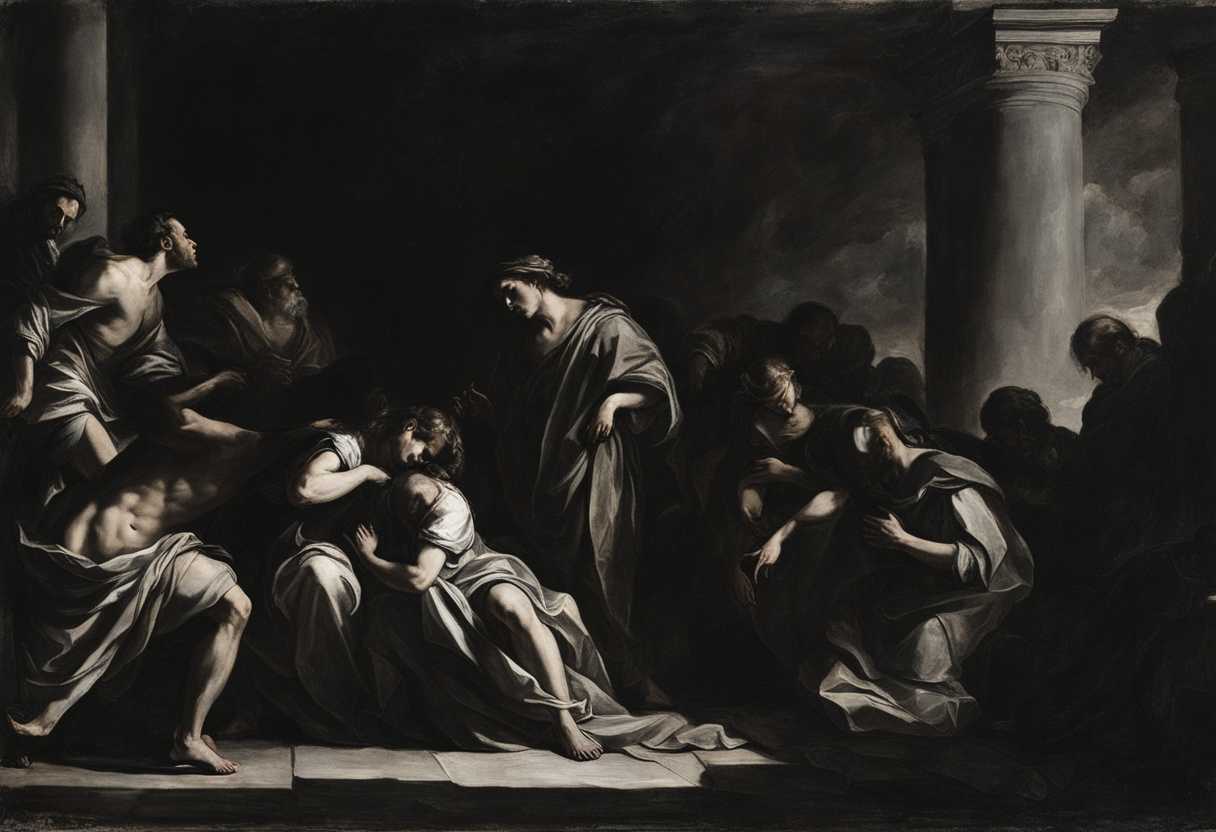
Scripture
23 “Therefore the kingdom of heaven may be compared to a king who wished to settle accounts with his servants.
24 When he began to settle, one was brought to him who owed him ten thousand talents.
25 And since he could not pay, his master ordered him to be sold, with his wife and children and all that he had, and payment to be made.
26 So the servant fell on his knees, imploring him, ‘Have patience with me, and I will pay you.’
27 And out of pity for him, the master of that servant released him and forgave him the debt.
28 But when that same servant went out, he found one of his fellow servants who owed him a hundred denarii, and seizing him, he began to choke him, saying, ‘Pay what you owe.’
29 So his fellow servant fell down and pleaded with him, ‘Have patience with me, and I will pay you.’
30 He refused and went and put him in prison until he should pay the debt.
31 When his fellow servants saw what had taken place, they were greatly distressed, and they went and reported to their master all that had taken place.
32 Then his master summoned him and said to him, ‘You wicked servant! I forgave you all that debt because you pleaded with me.
33 And should not you have had mercy on your fellow servant, as I had mercy on you?’
34 And in anger his master delivered him to the jailers, until he should pay all his debt.
35 So also my heavenly Father will do to every one of you, if you do not forgive your brother from your heart.”
Biblical Meaning of Tormentors
In the biblical context, “tormentors” represent not only physical oppressors but also spiritual agents of punishment often arising from one’s own actions and choices. The parable of the unmerciful servant in Matthew 18:34 underscores this dual aspect of punishment: the unforgiving servant finds himself handed over to tormentors, symbolizing the internal and external consequences of failing to extend grace and mercy to others. This passage illustrates a principle that is repeated throughout scripture: the idea that one’s actions bear consequences, both in the present life and in terms of spiritual accountability before God.
Moreover, the concept of tormentors can also extend to the broader spiritual struggles faced by individuals in their quest for redemption and righteousness. For instance, in 1 John 4:18, it is conveyed that “perfect love casts out fear,” implying that it is often fear—an emotional tormentor—that distances individuals from God and his love. Similarly, in the Book of Job, Job himself experiences profound suffering at the hands of external tormentors while grappling with questions of justice and divine purpose. Thus, tormentors in the biblical narrative not only represent the suffering inflicted by others but also the internal strife and torment that arise from a heart disconnected from divine love and forgiveness, reinforcing the call to embody mercy and to seek reconciliation with God and one another.
The biblical theme of tormentors also invites contemplation regarding the role of demonic influences and spiritual warfare in the lives of believers. In the New Testament, for example, the Apostle Paul discusses the ongoing battle against spiritual forces that oppress and harass individuals. This notion aligns with the understanding that tormentors can manifest as unseen spiritual adversaries seeking to disrupt one’s peace or leading them into despair. Such tormentors can exacerbate the struggles one encounters, creating a cycle of anguish that amplifies feelings of abandonment and helplessness, further distancing the individual from the comfort of God’s presence.
Additionally, the Book of Lamentations serves as a poignant exploration of collective torment as the people of Israel face the consequences of their sin and rebellion against God. Here, tormentors are depicted not only in the form of external enemies but also as an inward realization of guilt and sorrow stemming from their estrangement from divine favor. This narrative highlights the reality that torment can arise from both external circumstances and internal conflicts, emphasizing the need for repentance, community support, and ultimately, restoration through God’s grace. In scripture, these tormenting experiences are meant to draw believers back into reliance on God, showcasing the redemptive arc of scripture that promises healing and liberation from both earthly and spiritual torment.
The Consequences of Unforgiveness
In the biblical context, tormentors often symbolize the internal and external consequences of harboring unforgiveness. When individuals refuse to forgive others, they may find themselves tormented by guilt, bitterness, and emotional distress. This torment can manifest as a spiritual and psychological burden, illustrating the importance of forgiveness in maintaining peace and harmony in one’s life.
Spiritual Warfare and Demonic Influence
Tormentors can also represent the forces of evil that seek to disrupt the lives of believers. In this sense, they are seen as spiritual adversaries that inflict suffering and chaos. The concept of tormentors in this context emphasizes the ongoing spiritual warfare that Christians face, highlighting the need for vigilance, prayer, and reliance on divine strength to overcome these malevolent influences.
The Role of Divine Discipline
Another broader meaning of tormentors in the Bible relates to divine discipline. In certain passages, tormentors may be viewed as instruments of God’s correction, used to bring about repentance and spiritual growth. This perspective underscores the idea that suffering can serve a purpose in the believer’s life, leading to greater faith and reliance on God, ultimately transforming torment into a pathway for spiritual maturity.
How to Embrace Divine Justice in Our Lives
Embracing divine justice in our lives is a transformative journey that calls us to reflect on our actions and attitudes through the lens of God’s love and righteousness. It begins with understanding that divine justice is not merely about punishment but about restoration and reconciliation. As we navigate our daily lives, we can practice this by seeking to treat others with fairness and compassion, recognizing that everyone is made in the image of God. When we encounter injustice, whether in our communities or within ourselves, we can respond with grace, advocating for those who are marginalized and standing firm in our faith. Remember, divine justice invites us to trust in God’s perfect timing and wisdom, allowing us to let go of our need for retribution and instead focus on healing and forgiveness. By embodying these principles, we not only align ourselves with God’s will but also become beacons of hope and love in a world that desperately needs it.
Bible References to Tormentors in Scripture:
Luke 16:19-31: 19 “There was a rich man who was clothed in purple and fine linen and who feasted sumptuously every day.
20 And at his gate was laid a poor man named Lazarus, covered with sores,
21 who desired to be fed with what fell from the rich man’s table. Moreover, even the dogs came and licked his sores.
22 The poor man died and was carried by the angels to Abraham’s side. The rich man also died and was buried.
23 and in Hades, being in torment, he lifted up his eyes and saw Abraham far off and Lazarus at his side.
24 And he called out, ‘Father Abraham, have mercy on me, and send Lazarus to dip the end of his finger in water and cool my tongue, for I am in anguish in this flame.’
25 But Abraham said, ‘Child, remember that you in your lifetime received your good things, and Lazarus in like manner bad things; but now he is comforted here, and you are in anguish.
26 And besides all this, between us and you a great chasm has been fixed, in order that those who would pass from here to you may not be able, and none may cross from there to us.’
27 And he said, ‘Then I beg you, father, to send him to my father’s house—
28 for I have five brothers—so that he may warn them, lest they also come into this place of torment.’
Abraham said to him, ‘They have Moses and the Prophets; let them hear them.’
30 And he said, ‘No, father Abraham, but if someone goes to them from the dead, they will repent.’
31 He said to him, ‘If they do not hear Moses and the Prophets, neither will they be convinced if someone should rise from the dead.’
Revelation 9:1-11: 1 And the fifth angel blew his trumpet, and I saw a star fallen from heaven to earth, and he was given the key to the shaft of the bottomless pit.
2 He opened the shaft of the bottomless pit, and from the shaft rose smoke like the smoke of a great furnace, and the sun and the air were darkened with the smoke from the shaft.
3 Then from the smoke came locusts on the earth, and they were given power like the power of scorpions of the earth.
4 They were told not to harm the grass of the earth or any green plant or any tree, but only those people who do not have the seal of God on their foreheads.
5 They were allowed to torment them for five months, but not to kill them, and their torment was like the torment of a scorpion when it stings someone.
6 And in those days people will seek death and will not find it. They will long to die, but death will flee from them.
7 In appearance the locusts were like horses prepared for battle: on their heads were what looked like crowns of gold; their faces were like human faces,
8 They had hair like women’s hair, and their teeth were like lions’ teeth.
9 And they had breastplates like breastplates of iron, and the noise of their wings was like the noise of many chariots with horses rushing into battle.
10 They have tails and stings like scorpions, and their power to hurt people for five months is in their tails.
11 They have as king over them the angel of the bottomless pit. His name in Hebrew is Abaddon, and in Greek he is called Apollyon.
Revelation 14:9-11: 9 And another angel, a third, followed them, saying with a loud voice, “If anyone worships the beast and its image and receives a mark on his forehead or on his hand,
10 he also will drink the wine of God’s wrath, poured full strength into the cup of his anger, and he will be tormented with fire and sulfur in the presence of the holy angels and in the presence of the Lamb.
11 And the smoke of their torment goes up forever and ever, and they have no rest, day or night, these worshipers of the beast and its image, and whoever receives the mark of its name.
Revelation 20:10-15: 10 and the devil who had deceived them was thrown into the lake of fire and sulfur where the beast and the false prophet were, and they will be tormented day and night forever and ever.
Then I saw a great white throne and him who was seated on it. From his presence earth and sky fled away, and no place was found for them.
12 And I saw the dead, great and small, standing before the throne, and books were opened. Then another book was opened, which is the book of life. And the dead were judged by what was written in the books, according to what they had done.
13 And the sea gave up the dead who were in it, Death and Hades gave up the dead who were in them, and they were judged, each one of them, according to what they had done.
14 Then Death and Hades were thrown into the lake of fire. This is the second death, the lake of fire.
15 And if anyone’s name was not found written in the book of life, he was thrown into the lake of fire.
2 Thessalonians 1:6-10: 6 since indeed God considers it just to repay with affliction those who afflict you,
7 and to grant relief to you who are afflicted as well as to us, when the Lord Jesus is revealed from heaven with his mighty angels
8 in flaming fire, inflicting vengeance on those who do not know God and on those who do not obey the gospel of our Lord Jesus.
9 They will suffer the punishment of eternal destruction, away from the presence of the Lord and from the glory of his might,
10 when he comes on that day to be glorified in his saints, and to be marveled at among all who have believed, because our testimony to you was believed.
Mark 5:1-20: 1 They came to the other side of the sea, to the country of the Gerasenes.
2 And when Jesus had stepped out of the boat, immediately there met him out of the tombs a man with an unclean spirit.
3 He lived among the tombs. And no one could bind him anymore, not even with a chain,
4 for he had often been bound with shackles and chains, but he wrenched the chains apart, and he broke the shackles in pieces. No one had the strength to subdue him.
5 Night and day among the tombs and on the mountains he was always crying out and cutting himself with stones.
6 And when he saw Jesus from afar, he ran and fell down before him.
7 And crying out with a loud voice, he said, “What have you to do with me, Jesus, Son of the Most High God? I adjure you by God, do not torment me.”
8 For he was saying to him, “Come out of the man, you unclean spirit!”
9 And Jesus asked him, “What is your name?” He replied, “My name is Legion, for we are many.”
10 And he begged him earnestly not to send them out of the country.
11 Now a great herd of pigs was feeding there on the hillside.
12 And they begged him, saying, “Send us to the pigs; let us enter them.”
13 So he gave them permission. And the unclean spirits came out and entered the pigs; and the herd, numbering about two thousand, rushed down the steep bank into the sea and drowned in the sea.
14 The herdsmen fled and told it in the city and in the country. And people came to see what it was that had happened.
15 And they came to Jesus and saw the demon-possessed man, the one who had had the legion, sitting there, clothed and in his right mind, and they were afraid.
16 And those who had seen it described to them what had happened to the demon-possessed man and to the pigs.
17 And they began to beg Jesus to depart from their region.
18 As he was getting into the boat, the man who had been possessed with demons begged him that he might be with him.
19 And he did not permit him but said to him, “Go home to your friends and tell them how much the Lord has done for you, and how he has had mercy on you.”
20 And he went away and began to proclaim in the Decapolis how much Jesus had done for him, and everyone marveled.
Isaiah 66:22-24: 22 “For as the new heavens and the new earth that I make shall remain before me, says the Lord, so shall your offspring and your name remain.”
23 From new moon to new moon, and from Sabbath to Sabbath, all flesh shall come to worship before me, declares the Lord.
24 “And they shall go out and look on the dead bodies of the men who have rebelled against me. For their worm shall not die, their fire shall not be quenched, and they shall be an abhorrence to all flesh.”
Psalm 18:4-6: 4 The cords of death encompassed me; the torrents of destruction assailed me;
5 The cords of death encompassed me; the torrents of destruction assailed me;
6 In my distress I called upon the Lord; to my God I cried for help. From his temple he heard my voice, and my cry to him reached his ears.
Job 7:11-21: 11 “Therefore I will not restrain my mouth; I will speak in the anguish of my spirit; I will complain in the bitterness of my soul.”
12 Am I the sea, or a sea monster,
that you set a guard over me?
13 When I say, ‘My bed will comfort me, my couch will ease my complaint,’
14 then you scare me with dreams and terrify me with visions,
15 so that I would choose strangling
and death rather than my bones.
16 I loathe my life; I would not live forever. Leave me alone, for my days are a breath.
17 What is man, that you make so much of him,
and that you set your heart on him,
18 that you visit him every morning
and test him every moment?
19 How long will you not look away from me,
nor leave me alone till I swallow my spit?
20 If I sin, what do I do to you, you watcher of mankind? Why have you made me your mark? Why have I become a burden to you?
21 And why do you not pardon my transgression and take away my iniquity? For now I shall lie in the earth; you will seek me, but I shall not be.”

Rev. François Dupont is a dedicated church minister with a wealth of experience in serving spiritual communities. With a calm and serene demeanor, he has been devoted to sharing the message of love, compassion, and tolerance for over two decades. Through his thoughtful sermons, compassionate counseling, and unwavering support, Rev. Dupont has touched the lives of countless individuals, allowing them to find solace and strength during difficult times. His serene presence and deep understanding of the human condition make him a trusted guide for those seeking spiritual nourishment and guidance.