
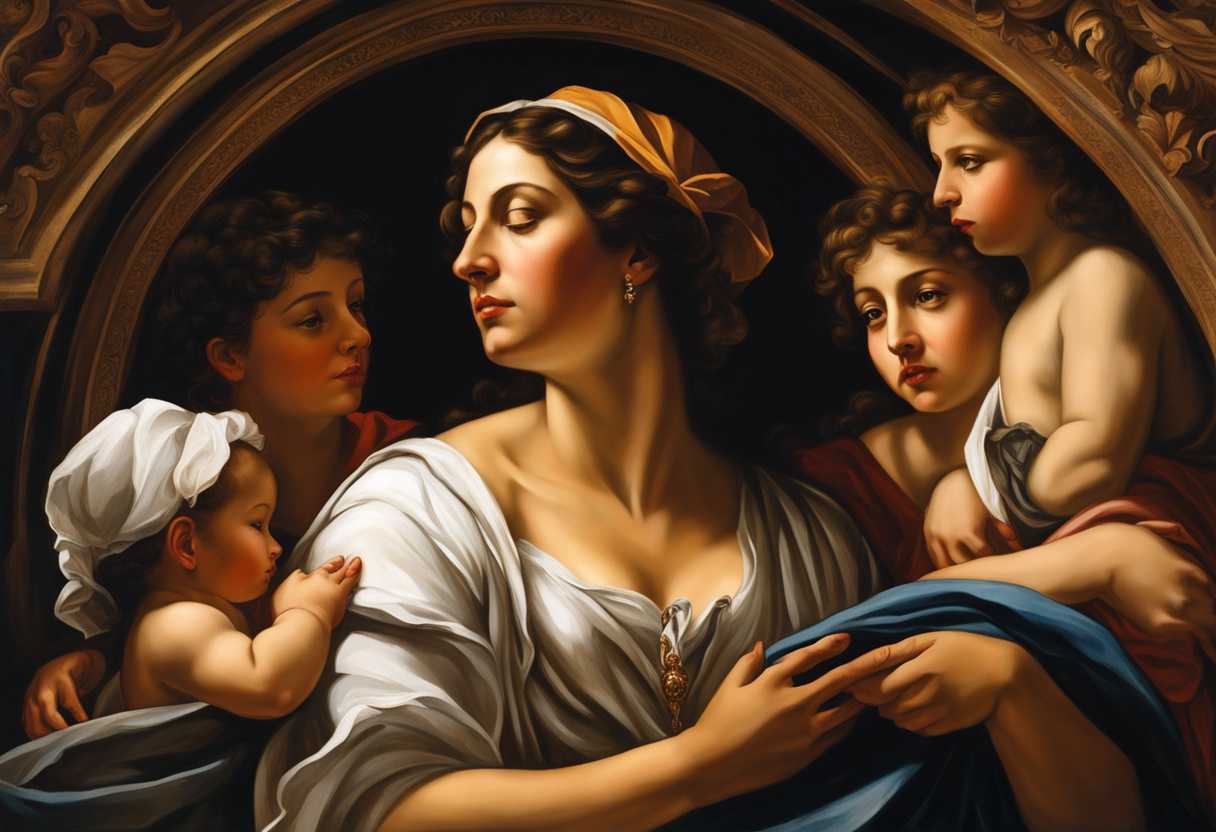
A virtuous woman, as described in Proverbs 31:10-31, is characterized by her strength, wisdom, kindness, and industriousness. She is dedicated to her family, engages in meaningful work, and earns the respect and admiration of those around her.
Scripture
10 An excellent wife who can find?
She is far more precious than jewels.
11 The heart of her husband trusts in her,
and he will have no lack of gain.
12 She does him good, and not harm,
all the days of her life.
13 She seeks wool and flax, and works with willing hands.
14 She is like the ships of the merchant;
she brings her food from afar.
15 She rises while it is yet night and provides food for her household and portions for her maidens.
16 She considers a field and buys it;
with the fruit of her hands she plants a vineyard.
17 She dresses herself with strength
and makes her arms strong.
18 She perceives that her merchandise is profitable. Her lamp does not go out at night.
19 She puts her hands to the distaff,
and her hands hold the spindle.
20 She opens her hand to the poor
and reaches out her hands to the needy.
21 She is not afraid of snow for her household,
for all her household are clothed in scarlet.
22 She makes bed coverings for herself;
her clothing is fine linen and purple.
23 Her husband is known in the gates when he sits among the elders of the land.
24 She makes linen garments and sells them; she delivers sashes to the merchant.
25 Strength and dignity are her clothing,
and she laughs at the time to come.
26 She opens her mouth with wisdom,
and the teaching of kindness is on her tongue.
27 She looks well to the ways of her household
and does not eat the bread of idleness.
28 Her children rise up and call her blessed;
her husband also, and he praises her:
29 “Many women have done excellently,
but you surpass them all.”
30 Charm is deceitful, and beauty is vain, but a woman who fears the Lord is to be praised.
31 Give her of the fruit of her hands,
and let her works praise her in the gates.
Biblical Qualities of a Virtuous Woman
The concept of a virtuous woman in the Bible, particularly illustrated in Proverbs 31:10-31, extends beyond traditional notions of femininity to embody a holistic blend of strength, wisdom, and integrity. This passage defines her as “more precious than rubies” (Proverbs 31:10), highlighting the inherent value she holds—not just within her household but in the broader community. Her industriousness is portrayed through her ability to manage the household effectively, engaging in various activities from sewing to real estate transactions (Proverbs 31:13, 16). Yet, it is her character that truly distinguishes her; she exudes kindness and speaks with wisdom (Proverbs 31:26), acting as a nurturing presence that fosters a supportive environment for her family and beyond.
Moreover, the virtuous woman’s strength is illustrated through both her physical capabilities and moral fortitude. She mirrors the qualities of a godly leader, exemplifying resilience and courage in her daily endeavors (Proverbs 31:17). The respect she earns is not merely from adherence to societal roles but stems from a deep-rooted commitment to her values and her family, enabling her to be “clothed with strength and dignity” (Proverbs 31:25). In essence, the virtuous woman is not defined by her conformity to expectations but rather by her ability to uplift her family while contributing to society, showcasing the multifaceted roles women can embody as they align with divine principles. This biblical portrayal encourages women to aspire not just to be strong and wise within their households but also influences broader societal values centered around respect, integrity, and service.
In addition to the qualities highlighted in Proverbs, other scriptural passages offer a diverse range of virtues that characterize a woman of noble character. For instance, the Book of Ruth presents Ruth as a model of loyalty and dedication. Her commitment to her mother-in-law, Naomi, emphasizes her selflessness and strength of spirit as she chooses to leave her homeland to support Naomi in a foreign land. Ruth’s willingness to glean in the fields signifies her hard work and resourcefulness, reflecting the diligence that is highly esteemed in a virtuous woman’s character. Furthermore, her eventual role in the lineage of King David and ultimately Jesus illustrates how a woman’s faithfulness can lead to significant outcomes that resonate through generations.
Additionally, the narrative of Esther highlights courage and wisdom in the face of adversity. Esther’s decision to approach King Xerxes for her people illustrates not only her bravery but also her strategic thinking and willingness to risk her own safety for the greater good. Her ability to navigate the complexities of her position while maintaining her identity showcases the qualities of grace and resilience. Esther’s story conveys that a virtuous woman embodies not just domestic virtues but also the ability to impact society at large through decisive action and moral conviction. Together, these narratives affirm that the qualities of a virtuous woman are multifaceted, encompassing loyalty, courage, wisdom, and industriousness, thus inspiring women across ages to realize their potential in both personal and societal domains.
The Essence of Strength and Diligence
A virtuous woman embodies strength and diligence, showcasing her ability to manage her responsibilities with grace and resilience. This quality reflects not only physical strength but also emotional and spiritual fortitude. She is proactive in her endeavors, whether in her home, community, or workplace, demonstrating a commitment to her duties and a willingness to face challenges head-on. This diligence serves as an inspiration to those around her, encouraging a culture of hard work and perseverance.
The Importance of Wisdom and Kindness
Wisdom and kindness are foundational qualities of a virtuous woman, highlighting her ability to navigate life’s complexities with discernment and compassion. She approaches situations thoughtfully, offering guidance and support to others while fostering an environment of love and understanding. This duality of wisdom and kindness allows her to build strong relationships and create a nurturing atmosphere, making her a pillar of strength within her family and community.
The Role of Faith and Integrity
A virtuous woman is characterized by her unwavering faith and integrity, which guide her actions and decisions. Her faith serves as a source of strength, providing her with the confidence to uphold her values and principles in the face of adversity. Integrity ensures that she remains true to her commitments and responsibilities, earning the respect and trust of those around her. This combination of faith and integrity not only shapes her character but also influences others, encouraging them to pursue a life of virtue and righteousness.
How to Cultivate Strength and Faith as a Christian
Cultivating strength and faith as a Christian is a deeply personal journey that requires intentionality and a willingness to grow. Start by immersing yourself in Scripture; the Bible is not just a book but a living guide that offers wisdom and encouragement. Make prayer a daily practice, not just as a routine but as a heartfelt conversation with God, where you can express your fears, hopes, and gratitude. Surround yourself with a community of believers who can uplift and challenge you, as fellowship is vital in strengthening our faith. Remember, faith is often tested in trials, so embrace challenges as opportunities to lean on God and witness His faithfulness. Lastly, serve others; acts of kindness and love not only reflect Christ’s heart but also deepen your own faith as you see God at work through you. In this journey, be patient with yourself; growth takes time, and every step you take brings you closer to the strength and faith you seek.
Bible References to Virtuous Woman Qualities:
1 Peter 3:1-6: 3 Likewise, wives, be subject to your own husbands, so that even if some do not obey the word, they may be won without a word by the conduct of their wives,
3 Do not let your adorning be external—the braiding of hair and the putting on of gold jewelry, or the clothing you wear—
3 Do not let your adorning be external—the braiding of hair and the putting on of gold jewelry, or the clothing you wear—
3 Do not let your adorning be external—the braiding of hair and the putting on of gold jewelry, or the clothing you wear—
5 For this is how the holy women who hoped in God used to adorn themselves, by submitting to their own husbands,
6 as Sarah obeyed Abraham, calling him lord. And you are her children, if you do good and do not fear anything that is frightening.
Titus 2:3-5: 3 Older women likewise are to be reverent in behavior, not slanderers or slaves to much wine. They are to teach what is good,
4 and so train the young women to love their husbands and children,
5 to be self-controlled, pure, working at home, kind, and submissive to their own husbands, that the word of God may not be reviled.
1 Timothy 2:9-15: 9 likewise also that women should adorn themselves in respectable apparel, with modesty and self-control, not with braided hair and gold or pearls or costly attire,
10 but with what is proper for women who profess godliness—with good works.
11 Let a woman learn quietly with all submissiveness.
12 I do not permit a woman to teach or to exercise authority over a man; rather, she is to remain quiet.
13 For Adam was formed first, then Eve.
14 and Adam was not deceived, but the woman was deceived and became a transgressor.
15 Yet she will be saved through childbearing—if they continue in faith and love and holiness, with self-control.
1 Timothy 5:9-10: 9 Let a widow be enrolled if she is not less than sixty years of age, having been the wife of one husband,
10 and having a reputation for good works: if she has brought up children, has shown hospitality, has washed the feet of the saints, has cared for the afflicted, and has devoted herself to every good work.
Ephesians 5:22-24: 22 Wives, submit to your own husbands, as to the Lord.
For the husband is the head of the wife even as Christ is the head of the church, his body, and is himself its Savior.
24 Now as the church submits to Christ, so also wives should submit in everything to their husbands.
Colossians 3:18-19: 18 Wives, submit to your husbands, as is fitting in the Lord.
19 Husbands, love your wives, and do not be harsh with them.
1 Corinthians 11:3-16: 3 But I want you to understand that the head of every man is Christ, the head of a wife is her husband, and the head of Christ is God.
4 Every man who prays or prophesies with his head covered dishonors his head,
5 but every wife who prays or prophesies with her head uncovered dishonors her head, since it is the same as if her head were shaven.
6 For if a wife will not cover her head, then she should cut her hair short. But since it is disgraceful for a wife to cut off her hair or shave her head, let her cover her head.
7 For a man ought not to cover his head, since he is the image and glory of God, but woman is the glory of man.
8 For man was not made from woman, but woman from man.
9 Neither was man created for woman, but woman for man.
10 That is why a wife ought to have a symbol of authority on her head, because of the angels.
11 Nevertheless, in the Lord woman is not independent of man nor man of woman;
12 For as woman was made from man, so man is now born of woman. And all things are from God.
13 Judge for yourselves: is it proper for a wife to pray to God with her head uncovered?
14 Does not nature itself teach you that if a man wears long hair it is a disgrace for him,
15 but if a woman has long hair, it is her glory? For her hair is given to her for a covering.
16 If anyone is inclined to be contentious, we have no such practice, nor do the churches of God.
Ruth 3:11-18: 11 And now, my daughter, do not fear. I will do for you all that you ask, for all my fellow townsmen know that you are a worthy woman.
12 And now it is true that I am a redeemer.
13 Remain tonight, and in the morning, if he will redeem you, good; let him do it. But if he is not willing to redeem you, then, as the Lord lives, I will redeem you. Lie down until the morning.”
14 So she lay at his feet until the morning, but arose before one could recognize another. And he said, “Let it not be known that the woman came to the threshing floor.”
15 And he said, “Bring the garment you are wearing and hold it out.” So she held it, and he measured out six measures of barley and put it on her. Then she went into the city.
16 And when she came to her mother-in-law, she said, “How did you fare, my daughter?” Then she told her all that the man had done for her,
17 She replied, “These six measures of barley he gave to me, for he said to me, ‘You must not go back empty-handed to your mother-in-law.’”
18 She replied, “Wait, my daughter, until you learn how the matter turns out, for the man will not rest but will settle the matter today.”
Genesis 24:15-21: 15 Before he had finished speaking, behold, Rebekah, who was born to Bethuel the son of Milcah, the wife of Nahor, Abraham’s brother, came out with her water jar on her shoulder.
16 The young woman was very attractive in appearance, a maiden whom no man had known.
17 The servant ran to meet her and said, “Please give me a little water to drink from your jar.”
18 She said, “Drink, my lord.” And she quickly let down her jar upon her hand and gave him a drink.
19 After she had given him a drink, she said, “I will draw water for your camels also, until they have finished drinking.”
20 and quickly emptied her jar into the trough and ran again to the well to draw water, and she drew for all his camels.
21 The man gazed at her in silence to learn whether the Lord had prospered his journey or not.
1 Samuel 25:18-35: 18 Then Abigail made haste and took two hundred loaves and two skins of wine and five sheep already prepared and five seahs of parched grain and a hundred clusters of raisins and two hundred cakes of figs, and laid them on donkeys.
19 And she said to her young men, “Go on before me; behold, I come after you.” But she did not tell her husband Nabal.
20 And as she rode on the donkey and came down under cover of the mountain, behold, David and his men came down toward her, and she met them.
21 Now David had said, “Surely in vain have I guarded all that this fellow has in the wilderness, so that nothing was missed of all that belonged to him, and he has returned me evil for good.
22 God do so to the enemies of David and more also, if by morning I leave so much as one male of all who belong to him.”
23 When Abigail saw David, she hurried and got down from the donkey and fell before David on her face and bowed to the ground.
24 She fell at his feet and said, “On me alone, my lord, be the guilt. Please let your servant speak in your ears, and hear the words of your servant.
25 Please let not my lord regard this worthless fellow, Nabal, for as his name is, so is he. Nabal is his name, and folly is with him. But I your servant did not see the young men of my lord, whom you sent.
26 Now then, my lord, as the Lord lives, and as your soul lives, because the Lord has restrained you from bloodguilt and from saving with your own hand, now then let your enemies and those who seek to do evil to my lord be as Nabal.
27 And now this present that your servant has brought to my lord, let it be given to the young men who follow my lord.
28 Please forgive the trespass of your servant.
29 If men rise up to pursue you and to seek your life, the life of my lord shall be bound in the bundle of the living in the care of the Lord your God. And the lives of your enemies he shall sling out as from the hollow of a sling.
30 And when the Lord has done to my lord according to all the good that he has spoken concerning you and has appointed you prince over Israel,
31 that this shall be no grief to you or pangs of heart to my lord, either that you have shed blood without cause or that my lord has avenged himself. And when the Lord has dealt well with my lord, then remember your servant.”
32 And David said to Abigail, “Blessed be the Lord, the God of Israel, who sent you this day to meet me!
33 Blessed be your discretion, and blessed be you, who have kept me this day from bloodguilt and from working salvation with my own hand.
34 Nevertheless, as your soul lives, the Lord, the God of Israel, who has restrained me from hurting you, unless you had hurried and come to meet me, truly by morning there had not been left to Nabal so much as one male.”
35 So David received from her hand what she had brought him and said to her, “Go up in peace to your house. See, I have obeyed your voice and granted your petition.”
Acts 9:36-42: 36 Now there was in Joppa a disciple named Tabitha, which, translated, means Dorcas. She was full of good works and acts of charity.
37 In those days she became ill and died, and when they had washed her, they laid her in an upper room.
38 Since Lydda was near Joppa, the disciples, hearing that Peter was there, sent two men to him, urging him, “Please come to us without delay.”
39 So Peter rose and went with them. And when he arrived, they took him to the upper room. All the widows stood beside him weeping and showing tunics and other garments that Dorcas made while she was with them.
40 But Peter put them all outside, and knelt down and prayed; and turning to the body he said, “Tabitha, arise.” And she opened her eyes, and when she saw Peter she sat up.
41 And he gave her his hand and raised her up. Then, calling the saints and widows, he presented her alive.
42 And it became known throughout all Joppa, and many believed in the Lord.
Luke 1:26-38: 26 In the sixth month the angel Gabriel was sent from God to a city of Galilee named Nazareth,
27 to a virgin betrothed to a man whose name was Joseph, of the house of David. And the virgin’s name was Mary.
28 And he came to her and said, “Greetings, O favored one, the Lord is with you!”
29 But she was greatly troubled at the saying, and tried to discern what sort of greeting this might be.
30 And the angel said to her, “Do not be afraid, Mary, for you have found favor with God.
31 And behold, you will conceive in your womb and bear a son, and you shall call his name Jesus.
32 He will be great and will be called the Son of the Most High. And the Lord God will give to him the throne of his father David,
33 and he will reign over the house of Jacob forever, and of his kingdom there will be no end.”
34 And Mary said to the angel, “How will this be, since I am a virgin?”
35 And the angel answered her, “The Holy Spirit will come upon you, and the power of the Most High will overshadow you; therefore the child to be born will be called holy—the Son of God.
36 And behold, your relative Elizabeth in her old age has also conceived a son, and this is the sixth month with her who was called barren.
37 For nothing will be impossible with God.
38 And Mary said, “Behold, I am the servant of the Lord; let it be to me according to your word.” And the angel departed from her.
Luke 10:38-42: 38 Now as they went on their way, Jesus entered a village. And a woman named Martha welcomed him into her house.
39 And she had a sister called Mary, who sat at the Lord’s feet and listened to his teaching.
40 But Martha was distracted with much serving. And she went up to him and said, “Lord, do you not care that my sister has left me to serve alone? Tell her then to help me.”
41 But the Lord answered her, “Martha, Martha, you are anxious and troubled about many things,
42 but one thing is necessary. Mary has chosen the good portion, which will not be taken away from her.
Philippians 4:2-3: 2 I entreat Euodia and I entreat Syntyche to agree in the Lord.
3 Yes, I ask you also, true companion, help these women, who have labored side by side with me in the gospel together with Clement and the rest of my fellow workers, whose names are in the book of life.

Reverend Ogunlade is a seasoned Church Minister with over three decades of experience in guiding and nurturing congregations. With profound wisdom and a serene approach, Reverend Ogunlade has carried out various pastoral duties, including delivering uplifting sermons, conducting religious ceremonies, and offering sage counsel to individuals seeking spiritual guidance. Their commitment to fostering harmony and righteousness within their community is exemplified through their compassionate nature, making them a beloved and trusted figure among the congregation.