
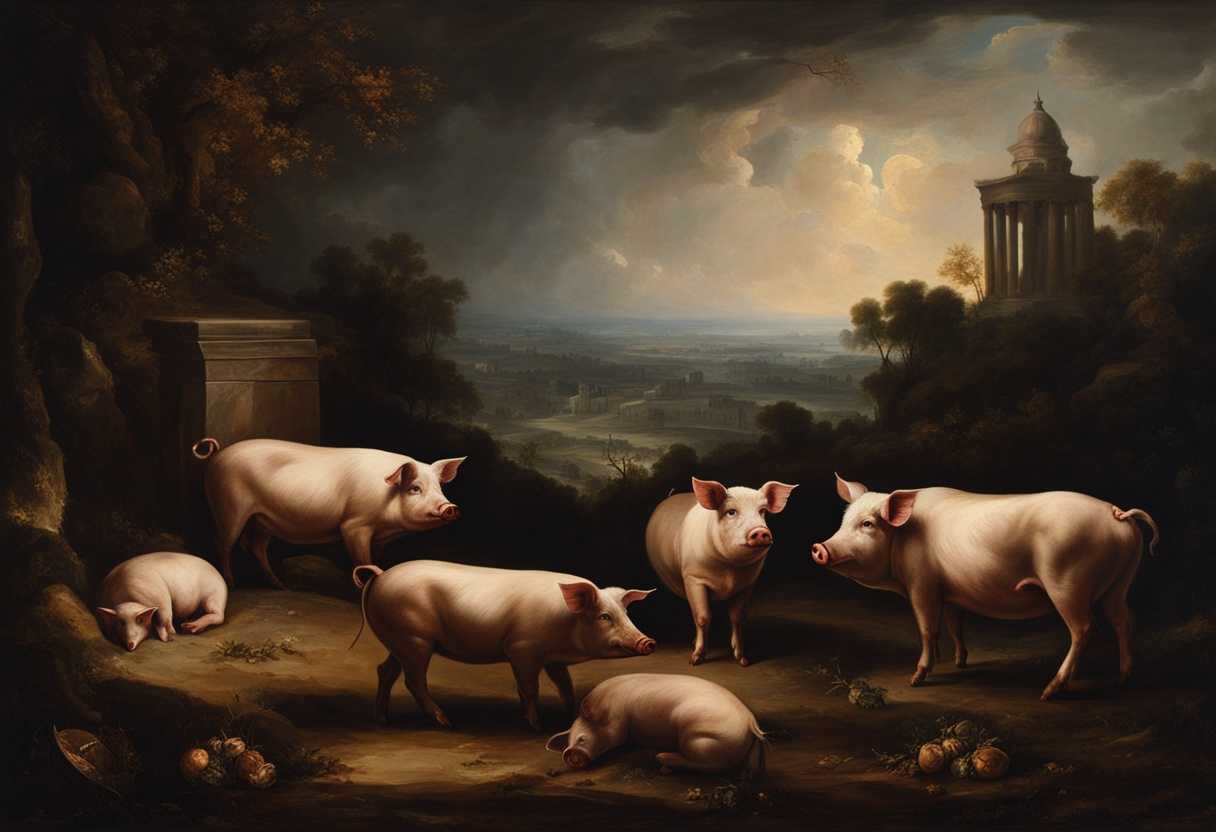
In the Bible, pigs are often considered unclean animals, symbolizing ritual impurity and representing gentile nations or those outside of the covenant community (Leviticus 11:7; Isaiah 66:17). Notably, in the New Testament, the story of the Gerasene demoniac features a herd of pigs, illustrating the rejection of the sacred and the destructive influence of evil (Mark 5:1-20).
Scripture
7 And the pig, because it parts the hoof and is cloven-footed but does not chew the cud, is unclean to you.
8 You shall not eat any of their flesh, and you shall not touch their carcasses; they are unclean to you.
Biblical Significance of Pigs
In the Bible, pigs serve as a potent symbol of ceremonial uncleanliness and spiritual defilement, reflecting broader themes of purity and separation. Leviticus 11:7 explicitly marks the pig as unclean, stating that “the swine, though it divides the hoof, having cloven hooves and chewing the cud, is unclean to you.” This categorization highlights the importance of dietary laws in maintaining ritual purity among the Israelites. Pigs, often associated with the gentile nations, reiterate the boundaries that were established between the covenant community and those considered outsiders, emphasizing the call for holiness and separation from paganistic practices. Isaiah 66:17 further reinforces this notion, as it describes those who consume pork as partaking in abominable acts, reinforcing the idea of judgment tied to national and spiritual identity.
The New Testament shifts this understanding slightly, as illustrated in the narrative of the Gerasene demoniac (Mark 5:1-20). Here, the presence of a herd of pigs, which are named in association with demonic forces, serves to highlight the radical nature of Christ’s authority over evil. When Jesus casts out the demons into the pigs, the resulting chaos – with the herd rushing down the cliff into the sea – reflects not only the destructive influence of evil but also God’s power to redeem and reclaim what is deemed unclean. This act symbolizes a profound truth: the breaking down of barriers between Jews and Gentiles and the inclusive reach of the Gospel. Thus, while pigs represent the unclean and otherness in the Old Testament, their role in the New Testament signifies the defeat of evil and the potential for redemption for all people, bridging the gap between the covenant community and those outside it.
Beyond their explicit designation as unclean animals, pigs also carry a metaphorical significance throughout scripture, symbolizing moral and spiritual decay. In the parable of the Prodigal Son (Luke 15:11-32), the younger son descends into a life of reckless living, ultimately finding himself in the company of pigs, yearning to eat their food. This moment serves as a powerful illustration of the depths of his degradation and the consequences of straying from one’s heritage and values. The image of the son feeding pigs underscores his fallen state and highlights the theme of repentance and the journey back to the Father—a return to purity and acceptance. Here, the pig becomes a representation of despair and disconnection, leading to a deep spiritual awakening and subsequent redemption.
Additionally, pigs are also referenced within the context of spiritual instruction, particularly in terms of discernment and the nature of sinful actions. In Matthew 7:6, Jesus advises, “Do not give dogs what is holy; and do not throw your pearls before pigs, lest they trample them underfoot and turn to attack you.” This statement warns against the futility of sharing sacred truths with those who are unprepared or unwilling to appreciate their value, likening the rejection of divine wisdom to the behavior of pigs. By using pigs in this teaching moment, Jesus encapsulates a broader lesson about the importance of recognizing receptiveness in others, warning that not all will understand or honor the spiritual truths being presented. This connection emphasizes the need for discernment in spiritual matters, underscoring the significant distinction between the sacred and the profane within interpersonal engagements and evangelistic efforts.
Symbol of Uncleanliness
In biblical texts, pigs are often associated with concepts of ritual impurity and uncleanliness. This symbolism reflects the broader theme of holiness and separation from what is deemed impure or sinful. Pigs, as animals that do not fit the dietary laws established in the Hebrew Bible, serve as a reminder of the importance of adhering to divine commandments and maintaining spiritual purity. This association with uncleanliness extends beyond dietary restrictions, representing a broader moral and ethical stance against behaviors and practices that deviate from God’s laws.
Representation of Gentile Nations
Pigs also serve as a metaphor for Gentile nations in certain biblical contexts. The portrayal of pigs can symbolize the cultural and spiritual differences between the Israelites and surrounding nations. This distinction highlights the theme of separation and the call for the Israelites to remain distinct in their practices and beliefs. The use of pigs in this manner underscores the tension between the chosen people and those outside the covenant community, emphasizing the need for vigilance in maintaining one’s identity and faith amidst external influences.
Emblem of Destruction and Judgment
In some narratives, pigs are associated with destruction and divine judgment. The imagery of pigs can evoke a sense of chaos and loss, particularly in stories where they are involved in catastrophic events. This symbolism serves to illustrate the consequences of sin and disobedience, reinforcing the idea that turning away from God’s ways can lead to dire outcomes. The presence of pigs in these contexts acts as a stark reminder of the need for repentance and the importance of aligning one’s life with divine principles to avoid judgment.
How to Embrace Purity and Holiness in Faith
Embracing purity and holiness in your faith journey is a deeply personal and transformative process that begins with a sincere desire to draw closer to God. Start by immersing yourself in Scripture, allowing the Word to illuminate your path and guide your thoughts and actions. Reflect on passages like 1 Peter 1:16, which calls us to be holy as God is holy, and let that challenge inspire you to cultivate a heart that seeks righteousness. Surround yourself with a community of believers who encourage and uplift you, sharing in the struggles and victories of living a pure life. Remember, it’s not about perfection but about progress; each day is an opportunity to turn away from distractions and sin, and to turn towards grace and love. Pray earnestly for strength and wisdom, and be open to the Holy Spirit’s leading in your life. As you commit to this journey, you’ll find that purity and holiness are not just goals to achieve, but a beautiful way of living that reflects the heart of Christ.
Bible References to Pigs and Their Significance:
Deuteronomy 14:8: 8 And the pig, because it parts the hoof and is cloven-footed but does not chew the cud, is unclean to you.
Isaiah 65:2-4: 2 I spread out my hands all the day to a rebellious people,
who walk in a way that is not good,
following their own devices;
3 a people who provoke me to my face continually,
sacrificing in gardens
and making offerings on bricks;
4 who sit in tombs, and spend the night in secret places; who eat pig’s flesh, and broth of tainted meat is in their vessels;
Isaiah 66:3-4: 3 “He who slaughters an ox is like one who kills a man; he who sacrifices a lamb, like one who breaks a dog’s neck; he who presents a grain offering, like one who offers pig’s blood; he who makes a memorial offering of frankincense, like one who blesses an idol. These have chosen their own ways, and their soul delights in their abominations;”
4 So I also will choose harsh treatment for them and bring their fears upon them, because when I called, no one answered, when I spoke, they did not listen; but they did what was evil in my eyes and chose that in which I did not delight.”
Matthew 7:6: 6 “Do not give dogs what is holy, and do not throw your pearls before pigs, lest they trample them underfoot and turn to attack you.”
Matthew 8:28-34: 28 And when he came to the other side, to the country of the Gadarenes, two demon-possessed men met him, coming out of the tombs, so fierce that no one could pass that way.
29 And behold, they cried out, “What have you to do with us, O Son of God? Have you come here to torment us before the time?”
30 Now a herd of many pigs was feeding at some distance from them.
31 And the demons begged him, saying, “If you cast us out, send us away into the herd of pigs.”
32 And he said to them, “Go.” So they came out and went into the pigs, and behold, the whole herd rushed down the steep bank into the sea and drowned in the waters.
33 And the herdsmen fled, and going into the city they told everything, especially what had happened to the demon-possessed men.
34 And behold, all the city came out to meet Jesus, and when they saw him, they begged him to leave their region.
Mark 5:1-20: 1 They came to the other side of the sea, to the country of the Gerasenes.
2 And when Jesus had stepped out of the boat, immediately there met him out of the tombs a man with an unclean spirit.
3 He lived among the tombs. And no one could bind him anymore, not even with a chain,
4 for he had often been bound with shackles and chains, but he wrenched the chains apart, and he broke the shackles in pieces. No one had the strength to subdue him.
5 Night and day among the tombs and on the mountains he was always crying out and cutting himself with stones.
6 And when he saw Jesus from afar, he ran and fell down before him.
7 And crying out with a loud voice, he said, “What have you to do with me, Jesus, Son of the Most High God? I adjure you by God, do not torment me.”
8 For he was saying to him, “Come out of the man, you unclean spirit!”
9 And Jesus asked him, “What is your name?” He replied, “My name is Legion, for we are many.”
10 And he begged him earnestly not to send them out of the country.
11 Now a great herd of pigs was feeding there on the hillside.
12 And they begged him, saying, “Send us to the pigs; let us enter them.”
13 So he gave them permission. And the unclean spirits came out and entered the pigs; and the herd, numbering about two thousand, rushed down the steep bank into the sea and drowned in the sea.
14 The herdsmen fled and told it in the city and in the country. And people came to see what it was that had happened.
15 And they came to Jesus and saw the demon-possessed man, the one who had had the legion, sitting there, clothed and in his right mind, and they were afraid.
16 And those who had seen it described to them what had happened to the demon-possessed man and to the pigs.
17 And they began to beg Jesus to depart from their region.
18 As he was getting into the boat, the man who had been possessed with demons begged him that he might be with him.
19 And he did not permit him but said to him, “Go home to your friends and tell them how much the Lord has done for you, and how he has had mercy on you.”
20 And he went away and began to proclaim in the Decapolis how much Jesus had done for him, and everyone marveled.
Luke 8:26-39: 26 Then they sailed to the country of the Gerasenes, which is opposite Galilee.
27 When Jesus had stepped out on land, there met him a man from the city who had demons.
28 When he saw Jesus, he cried out and fell down before him and said with a loud voice, “What have you to do with me, Jesus, Son of the Most High God? I beg you, do not torment me.”
29 For he had commanded the unclean spirit to come out of the man. (For many a time it had seized him. He was kept under guard and bound with chains and shackles, but he would break the bonds and be driven by the demon into the desert.)
30 Jesus then asked him, “What is your name?” And he said, “Legion,” for many demons had entered him.
31 And they begged him not to command them to depart into the abyss.
32 Now a large herd of pigs was feeding there on the hillside, and they begged him to let them enter these. So he gave them permission.
33 Then the demons came out of the man and entered the pigs, and the herd rushed down the steep bank into the lake and drowned.
34 When the herdsmen saw what had happened, they fled and told it in the city and in the country.
35 Then people went out to see what had happened, and they came to Jesus and found the man from whom the demons had gone, sitting at the feet of Jesus, clothed and in his right mind, and they were afraid.
36 Then those who had seen it told them how the demon-possessed man had been healed.
37 Then all the people of the surrounding country of the Gerasenes asked him to depart from them, for they were seized with great fear. So he got into the boat and returned.
38 The man from whom the demons had gone begged that he might be with him, but Jesus sent him away, saying,
39 “Return to your home, and declare how much God has done for you.” And he went away, proclaiming throughout the whole city how much Jesus had done for him.
Luke 15:11-32: 11 And he said, “There was a man who had two sons.
12 And the younger of them said to his father, ‘Father, give me the share of property that is coming to me.’ And he divided his property between them.
13 Not many days later, the younger son gathered all he had and took a journey into a far country, and there he squandered his property in reckless living.
14 And when he had spent everything, a severe famine arose in that country, and he began to be in need.
And he went and hired himself out to one of the citizens of that country, who sent him into his fields to feed pigs.
16 And he was longing to be fed with the pods that the pigs ate, and no one gave him anything.
17 “But when he came to himself, he said, ‘How many of my father’s hired servants have more than enough bread, but I perish here with hunger!
18 I will arise and go to my father, and I will say to him, “Father, I have sinned against heaven and before you.
19 I am no longer worthy to be called your son.
20 And he arose and came to his father. But while he was still a long way off, his father saw him and felt compassion, and ran and embraced him and kissed him.
21 And the son said to him, ‘Father, I have sinned against heaven and before you. I am no longer worthy to be called your son.’
22 But the father said to his servants, ‘Bring quickly the best robe, and put it on him, and put a ring on his hand, and shoes on his feet.
23 And bring the fattened calf and kill it, and let us eat and celebrate.
24 For this my son was dead, and is alive again; he was lost, and is found.’ And they began to celebrate.
25 “Now his older son was in the field, and as he came and drew near to the house, he heard music and dancing.”
26 And he called one of the servants and asked what these things meant.
27 And he said to him, ‘Your brother has come, and your father has killed the fattened calf, because he has received him back safe and sound.’
28 But he was angry and refused to go in. His father came out and entreated him.
29 but he answered his father, ‘Look, these many years I have served you, and I never disobeyed your command, yet you never gave me a young goat, that I might celebrate with my friends.
30 But when this son of yours came, who has devoured your property with prostitutes, you killed the fattened calf for him!’
31 And he said to him, ‘Son, you are always with me, and all that is mine is yours.
32 It was fitting to celebrate and be glad, for this your brother was dead, and is alive; he was lost, and is found.’”

Rev. François Dupont is a dedicated church minister with a wealth of experience in serving spiritual communities. With a calm and serene demeanor, he has been devoted to sharing the message of love, compassion, and tolerance for over two decades. Through his thoughtful sermons, compassionate counseling, and unwavering support, Rev. Dupont has touched the lives of countless individuals, allowing them to find solace and strength during difficult times. His serene presence and deep understanding of the human condition make him a trusted guide for those seeking spiritual nourishment and guidance.