
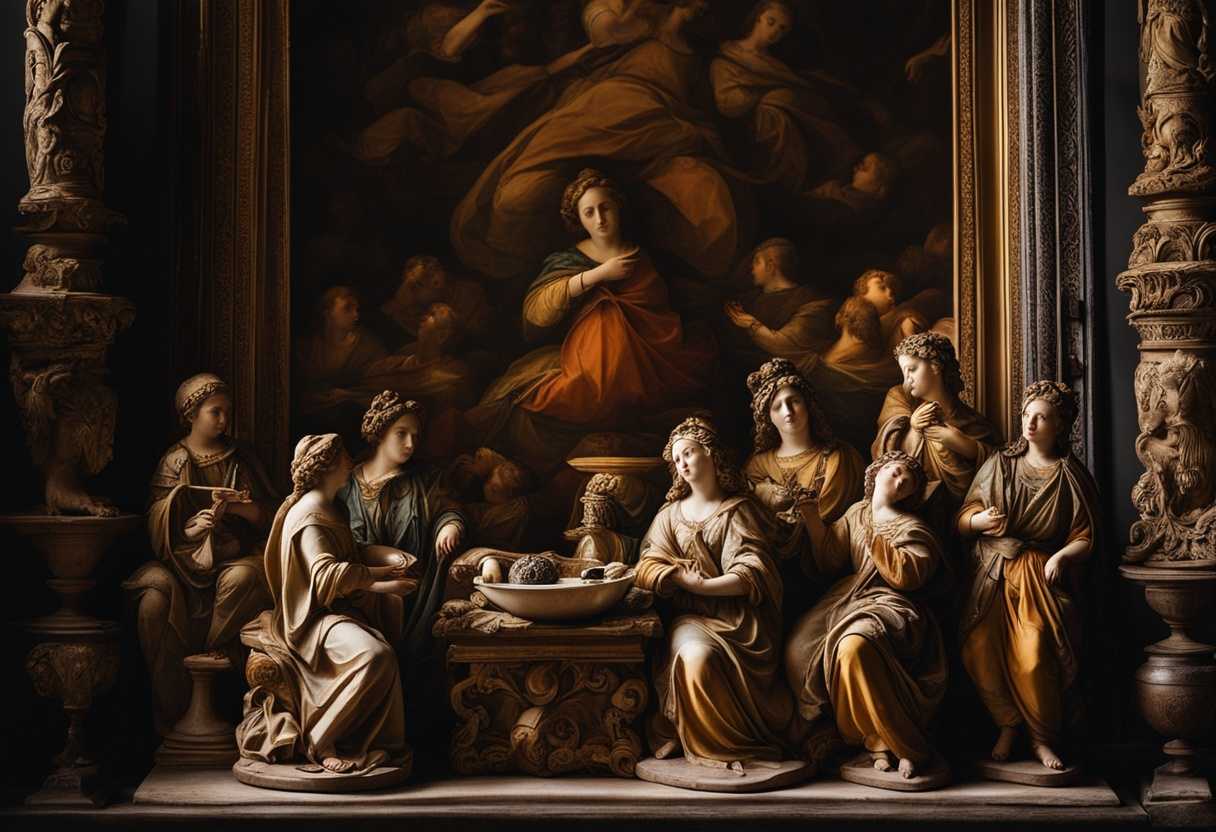
Household idols, often referred to as teraphim in the Bible, are small figurines or objects used for worship or divination within a household, representing a form of idolatry that detracts from worshiping the one true God. They are mentioned in contexts such as Genesis 31:19, where Rachel steals her father’s idols, illustrating the pervasive nature of idol worship in ancient Israelite culture.
Scripture
19 Laban had gone to shear his sheep, and Rachel stole her father’s household gods.
20 And Jacob tricked Laban the Aramean, by not telling him that he intended to flee.
21 So he fled with all that he had and arose and crossed the Euphrates, and set his face toward the hill country of Gilead.
22 When it was told Laban on the third day that Jacob had fled,
23 he took his kinsmen with him and pursued him for seven days and followed close after him into the hill country of Gilead.
24 But God came to Laban the Aramean in a dream by night and said to him, “Be careful not to say anything to Jacob, either good or bad.”
25 And Laban overtook Jacob.
26 And Laban said to Jacob, “What have you done, that you have tricked me and driven away my daughters like captives of the sword?
27 Why did you flee secretly and trick me, and did not tell me, so that I might have sent you away with mirth and songs, with tambourine and lyre?
28 And why did you not permit me to kiss my sons and my daughters farewell? Now you have done foolishly.
29 It is in my power to do you harm. But the God of your father spoke to me last night, saying, ‘Be careful not to say anything to Jacob, either good or bad.’
30 And now you have gone away because you longed greatly for your father’s house, but why did you steal my gods?”
31 Jacob answered and said to Laban, “Because I was afraid, for I thought that you would take your daughters from me by force.
32 Anyone with whom you find your gods shall not live. In the presence of our kinsmen point out what I have that is yours, and take it.” Now Jacob did not know that Rachel had stolen them.
33 So Laban went into Jacob’s tent and into Leah’s tent and into the tent of the two female servants, but he did not find them. And he went out of Leah’s tent and entered Rachel’s.
34 Now Rachel had taken the household gods and put them in the camel’s saddle and sat on them. Rachel said to her father, “Let not my lord be angry that I cannot rise before you, for the way of women is upon me.” So he searched but did not find the household gods.
35 And she said to her father, “Let not my lord be angry that I cannot rise before you, for the way of women is upon me.” So he searched but did not find the household gods.
Household Idols in the Bible Explained
The concept of household idols, or teraphim, in the Bible serves as a powerful symbol of the human inclination to seek tangible representations of the divine, often leading to idolatry. In Genesis 31:19, Rachel’s theft of her father Laban’s household idols exemplifies not only the personal and familial attachments associated with these objects but also highlights the complex relationships between religion, identity, and cultural practices within families and communities. These figurines were commonly associated with ancestral worship and divination, practices that were at odds with Israel’s covenantal relationship with Yahweh. The presence of teraphim in the household signifies a departure from exclusive fidelity to God, showcasing the tension between the worship of Yahweh and the allure of pagan customs infiltrating Israelite life.
Moreover, household idols serve as metaphors for the broader issue of distraction from authentic worship, which remains relevant today. In Ezekiel 14:3 and Hosea 3:4, the prophets convey God’s discontent with the Israelites for allowing such idols to occupy their hearts and homes, indicating a desire for repentance and a return to pure worship. This reflects the Bible’s overarching theme of calling believers to recognize and abandon any “idols” in their own lives—whether they be material possessions, relationships, or other distractions that can interfere with their devotion to God. The warning against household idols encourages readers to critically examine their own practices and priorities, ensuring that their worship remains undivided and focused on the one true God, thereby reinforcing the idea that faith must be both a personal and communal commitment free from the allure of idolatry.
The topic of household idols extends beyond specific instances to reveal a pervasive cultural challenge throughout various narratives in the Bible. In archaeological contexts, teraphim have often been understood as objects used not only for worship but also for seeking guidance and protection from ancestral spirits. This concern reflects a broader societal tendency to blend indigenous practices with emerging monotheistic beliefs. In this light, household idols often stood as a physical reminder of the Israelite struggle to navigate their identity amidst surrounding nations that practiced polytheism. The persistent presence of these idols signifies an ongoing battle within Hebrew society to remain steadfast in their covenant with God, emphasizing the allure of familiarity and tradition over divine command.
In the prophetic literature, the condemnation of idolatry frequently encompasses a warning against allowing household idols to shape the collective identity of the covenant community. Their presence is criticized not just as individual transgression but as a communal failing that leads to national consequences. The dramatic language used by prophets reveals a deep-seated desire for spiritual purity among the people of Israel, illustrating that the reliance on physical idols detracts from the understanding of God’s omnipresence and sovereignty. Thus, the treatment of household idols in the biblical narrative serves to underline broader themes of faith, loyalty, and communal integrity, urging believers to prioritize their relationship with God above all material or ancestral influences, which ultimately distort the essence of true worship.
Symbol of Idolatry and False Worship
Household idols in the Bible often represent the broader theme of idolatry, where individuals or families place their trust and devotion in physical objects rather than in the one true God. These idols serve as a reminder of the temptation to seek security and guidance from created things instead of the Creator. This practice reflects a fundamental misunderstanding of divine authority and the nature of true worship, leading to spiritual disconnection and moral compromise.
Reflection of Cultural Practices
The presence of household idols also highlights the cultural practices and beliefs of ancient societies. These idols were often integrated into daily life, symbolizing the blending of faith and cultural traditions. This integration can lead to syncretism, where elements of different religious beliefs are combined, often diluting the purity of worship and leading to a departure from the teachings of the faith. The existence of household idols serves as a cautionary tale about the dangers of allowing cultural influences to overshadow spiritual truths.
Indicator of Familial and Societal Values
Household idols can also be seen as indicators of the values and priorities within a family or community. The choice to keep and venerate these idols often reflects the underlying beliefs and practices that shape a household’s identity. This can reveal a reliance on ancestral traditions or a desire for protection and prosperity, showcasing how familial and societal values can influence individual faith practices. The presence of such idols can thus serve as a lens through which to examine the spiritual health and direction of a community.
How to Cultivate Genuine Faith and Family Worship
Cultivating genuine faith and family worship is a beautiful journey that begins with intentionality and openness. Start by creating a sacred space in your home where everyone feels comfortable to share and explore their beliefs. Set aside regular times for family worship—this could be through prayer, reading scripture, or singing hymns together. Encourage each family member to participate, sharing their thoughts and feelings about the passages you read or the prayers you offer. Remember, it’s not about perfection but about connection; be honest about your struggles and doubts, as this vulnerability can deepen your faith and strengthen your bonds. Lastly, make it a point to live out your faith in everyday actions, demonstrating love, kindness, and forgiveness within your family. This holistic approach not only nurtures your spiritual growth but also creates a loving environment where faith can flourish together.
Bible References to Household Idols:
Judges 17:1-6: 1 There was a man of the hill country of Ephraim, whose name was Micah.
2 And he said to his mother, “The eleven hundred pieces of silver that were taken from you, about which you uttered a curse, and also spoke it in my ears, behold, the silver is with me; I took it.” And his mother said, “Blessed be my son by the Lord.”
3 Then he restored the 1,100 pieces of silver to his mother. And his mother said, “I dedicate the silver to the Lord from my hand for my son, to make a carved image and a metal image. Now therefore I will restore it to you.”
4 So he restored the money to his mother. And his mother took two hundred pieces of silver and gave them to the silversmith, who made them into a carved image and a metal image. And it was in the house of Micah.
5 And the man Micah had a shrine, and he made an ephod and household gods, and ordained one of his sons, who became his priest.
6 In those days there was no king in Israel. Everyone did what was right in his own eyes.
1 Samuel 19:11-17: 11 Saul sent messengers to David’s house to watch him, that he might kill him in the morning. But Michal, David’s wife, told him, “If you do not escape with your life tonight, tomorrow you will be killed.”
12 So Michal let David down through the window, and he fled away and escaped.
13 Michal took an image and laid it on the bed and put a pillow of goats’ hair at its head and covered it with the clothes.
14 And when David fled and escaped, he came to Samuel at Ramah and told him all that Saul had done to him. And he and Samuel went and lived at Naioth.
15 Then Saul sent the messengers to see David, saying, “Bring him up to me in the bed, that I may kill him.”
16 And when the messengers came in, behold, the image was in the bed, with the pillow of goats’ hair at its head.
17 And Saul said to Michal, “Why have you deceived me so and let my enemy go, so that he has escaped?” Michal answered Saul, “He said to me, ‘Let me go. Why should I kill you?’”
2 Kings 23:4-14: 4 And the king commanded Hilkiah the high priest and the priests of the second order and the keepers of the threshold to bring out of the temple of the Lord all the vessels made for Baal, for Asherah, and for all the host of heaven. He burned them outside Jerusalem in the fields of the Kidron and carried their ashes to Bethel.
5 And he deposed the priests whom the kings of Judah had ordained to make offerings in the high places at the cities of Judah and around Jerusalem; those also who burned incense to Baal, to the sun and the moon and the constellations and all the host of the heavens.
6 And he brought out the Asherah from the house of the Lord, outside Jerusalem, to the brook Kidron, and burned it at the brook Kidron and beat it to dust and cast the dust of it upon the graves of the common people.
7 And he broke down the houses of the male cult prostitutes who were in the house of the Lord, where the women wove hangings for the Asherah.
8 And he brought all the priests out of the cities of Judah, and defiled the high places where the priests had made offerings, from Geba to Beersheba. And he broke down the high places of the gates that were at the entrance of the gate of Joshua the governor of the city, which were on one’s left at the gate of the city.
9 Yet the priests of the high places did not come up to the altar of the Lord in Jerusalem, but they ate unleavened bread among their brothers.
10 And he defiled Topheth, which is in the Valley of the Son of Hinnom, that no one might burn his son or his daughter as an offering to Molech.
11 And he removed the horses that the kings of Judah had dedicated to the sun, at the entrance to the house of the Lord, by the chamber of Nathan-melech the chamberlain, which was in the precincts. And he burned the chariots of the sun with fire.
12 And the altars on the roof of the upper chamber of Ahaz, which the kings of Judah had made, and the altars that Manasseh had made in the two courts of the house of the Lord, he pulled down and broke in pieces and cast the dust of them into the brook Kidron.
13 And the king defiled the high places that were east of Jerusalem, to the south of the mount of corruption, which Solomon the king of Israel had built for Ashtoreth the abomination of the Sidonians, and for Chemosh the abomination of Moab, and for Milcom the abomination of the Ammonites.
14 And he broke in pieces the pillars and cut down the Asherim and filled their places with the bones of men.
Ezekiel 21:21-23: 21 For the king of Babylon stands at the parting of the way, at the head of the two ways, to use divination. He shakes the arrows; he consults the teraphim; he looks at the liver.
22 Into his right hand comes the portent for Jerusalem— to set battering rams, to open the mouth with murder, to lift up the voice with shouting, to set battering rams against the gates, to cast up mounds, to build siege towers.
23 And it shall be to them like a false divination in their eyes. They have sworn solemn oaths, but he brings their guilt to remembrance, that they may be taken.
Hosea 3:1-5: 1 And the Lord said to me, “Go again, love a woman who is loved by another man and is an adulteress, even as the Lord loves the children of Israel, though they turn to other gods and love cakes of raisins.”
2 So I bought her for fifteen shekels of silver and a homer and a lethech of barley.
3 And I said to her, “You must dwell as mine for many days. You shall not play the whore, or belong to another man; so will I also be to you.”
4 For the people of Israel shall dwell many days without king or prince, without sacrifice or pillar, without ephod or household gods.
5 Afterward the children of Israel shall return and seek the Lord their God, and David their king, and they shall come in fear to the Lord and to his goodness in the latter days.
Zechariah 10:1-2: 1 Ask rain from the Lord in the season of the spring rain, from the Lord who makes the storm clouds, and he will give them showers of rain, to everyone the vegetation in the field.
2 For the household gods utter nonsense, and the diviners see lies; they tell false dreams and give empty consolation. Therefore the people wander like sheep; they are afflicted for lack of a shepherd.

Reverend Michael Johnson is an experienced Church Minister with a profound expertise in spirituality and guidance. With a serene presence and a compassionate heart, he has faithfully served his congregation for over 20 years, leading them on a spiritual journey towards inner peace and enlightenment. Reverend Johnson’s extensive knowledge of religious philosophies and profound understanding of human nature have made him a trusted confidant and mentor to many, as he seamlessly weaves his profound wisdom into life teachings. Reverend Johnson’s calming demeanor and empathetic nature continue to uplift and heal souls, nurturing a sense of unity and tranquility within his community.