
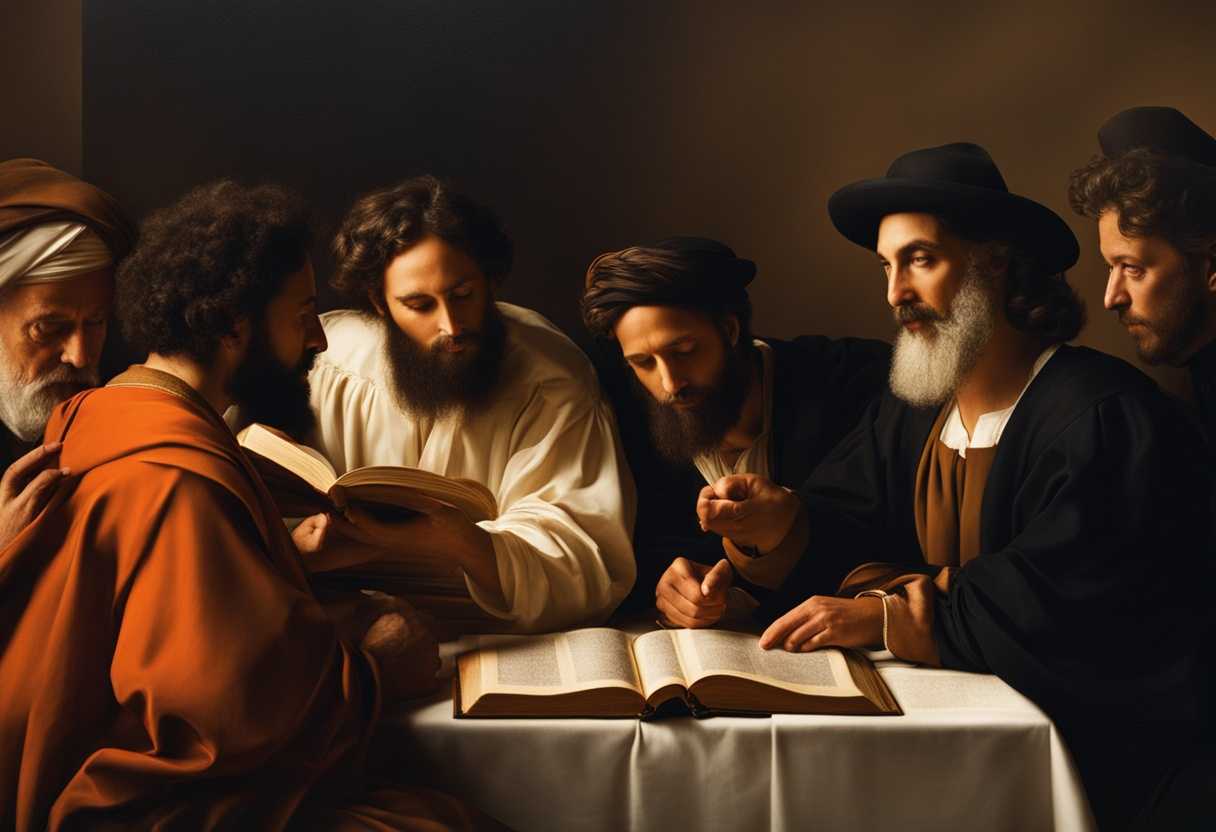
In the Bible, the term “People of the Book” is commonly associated with Jews and Christians, who are seen as followers of the Scriptures (the Hebrew Bible and the New Testament). This concept emphasizes their shared foundation in holy texts and divine revelation, particularly in the context of interfaith relations.
Scripture
1 “And now, O Israel, listen to the statutes and the rules that I am teaching you, and do them, that you may live, and go in and take possession of the land that the Lord, the God of your fathers, is giving you.
2 You shall not add to the word that I command you, nor take from it, that you may keep the commandments of the Lord your God that I command you.
3 Your eyes have seen what the Lord did at Baal-peor, for the Lord your God destroyed from among you all the men who followed the Baal of Peor.
4 But you who held fast to the Lord your God are all alive today.
5 See, I have taught you statutes and rules, as the Lord my God commanded me, that you should do them in the land that you are entering to take possession of it.
6 Keep them and do them, for that will be your wisdom and your understanding in the sight of the peoples, who, when they hear all these statutes, will say, ‘Surely this great nation is a wise and understanding people.’
7 For what great nation is there that has a god so near to it as the Lord our God is to us, whenever we call upon him?
8 And what great nation is there, that has statutes and rules so righteous as all this law that I set before you today?
9 “Only take care, and keep your soul diligently, lest you forget the things that your eyes have seen, and lest they depart from your heart all the days of your life. Make them known to your children and your children’s children—”
10 how on the day that you stood before the Lord your God at Horeb, the Lord said to me, ‘Gather the people to me, that I may let them hear my words, so that they may learn to fear me all the days that they live on the earth, and that they may teach their children so.’
11 And you came near and stood at the foot of the mountain, while the mountain burned with fire to the heart of heaven, wrapped in darkness, cloud, and gloom.
12 Then the Lord spoke to you out of the midst of the fire. You heard the sound of words, but saw no form; there was only a voice.
13 And he declared to you his covenant, which he commanded you to perform, that is, the Ten Commandments, and he wrote them on two tablets of stone.
14 And the Lord commanded me at that time to teach you statutes and rules, that you might do them in the land that you are going over to possess.
“People of the Book” in the Bible
The term “People of the Book” underlines the significance of sacred texts in establishing a common identity among Jews and Christians as communities grounded in divine revelation. In the New Testament, for instance, Jesus frequently references the Hebrew Scriptures, affirming their authority and showing the continuity of God’s message (e.g., Luke 24:27, where He explains to His disciples what was said in all the Scriptures concerning Himself). This underscores a shared spiritual heritage, framing the understanding that both Judaism and Christianity find their roots in the same divine narrative, which emphasizes the importance of adhering to God’s teachings.
This idea is also echoed in the way both communities are portrayed in the Bible as recipients of God’s covenant and guidance. For instance, in Romans 1:16, Paul speaks of the Gospel as being “the power of God that brings salvation to everyone who believes: first to the Jew, then to the Gentile.” This illustrates a recognition of the Jew’s precedence in faith and Scripture. Further, in John 15:25, Jesus reflects on the hostility that can arise when truth is revealed, highlighting how those who cherish the Scriptures may often face opposition. The “People of the Book” concept, therefore, serves as a reminder of both the unity and the distinctiveness of these faith traditions as they navigate their relationships with each other and the world, fostering dialogue and understanding rooted in their shared texts.
In exploring the term “People of the Book” further, it is essential to acknowledge how both the Old and New Testaments serve as a testament to God’s continuous interaction with humanity. The foundational texts of the Hebrew Bible reveal early instances of divine instruction and covenant, as seen in the call of Israel in Exodus. God establishes a unique relationship with the Israelites, who are tasked to reflect His holiness and convey His truths to the nations. This calling is reiterated throughout the Scriptures, emphasizing that their identity is intricately linked to the divine laws and teachings they receive. Thus, the notion of being a “People of the Book” is not merely an acknowledgment of their written scrolls but a recognition of their responsibility to live out those teachings in every aspect of life.
Moreover, within the New Testament context, the recognition of faithful individuals who are immersed in the teachings of the Scriptures serves to reinforce the idea of a community rooted in sacred texts. For example, the frequent references to prophecy and fulfillment underscore a continuity and fulfillment of God’s promises through Jesus Christ. Additionally, the early Christian church relied heavily on the Hebrew Scriptures to validate their beliefs, resulting in an environment where the followers were compelled to cherish and uphold the sacred texts that shaped their faith. The idea of being a “People of the Book” inherently involves the commitment to an ongoing interpretation and application of these Scriptures, guiding communities toward a deeper understanding of divine revelation and their place in the unfolding story of faith.
Theological Significance
The term “People of the Book” refers to those who adhere to the scriptures and teachings of their faith. In a broader theological context, it emphasizes the importance of divine revelation and the role of sacred texts in guiding the moral and spiritual lives of believers. This concept underscores the belief that God has communicated with humanity through written scripture, which serves as a foundation for faith and practice.
Interfaith Relations
The designation “People of the Book” also highlights the shared heritage and commonalities among different religious traditions, particularly Judaism, Christianity, and Islam. This broader meaning fosters a sense of respect and dialogue among these faiths, as it acknowledges the significance of their respective scriptures and the values they promote. It encourages interfaith understanding and cooperation, recognizing that despite doctrinal differences, there is a shared commitment to the pursuit of truth and righteousness.
Identity and Community
In a sociocultural context, being labeled as “People of the Book” can also signify a collective identity among believers who find unity in their adherence to scripture. This identity fosters a sense of belonging and community, as individuals come together around shared beliefs, rituals, and practices derived from their sacred texts. It reinforces the idea that faith is not just a personal journey but also a communal experience, where the teachings of the scriptures shape the values and norms of the community.
How to Grow Together in Faith and Understanding
Growing together in faith and understanding is a beautiful journey that requires intentionality and openness. Start by engaging in regular, meaningful conversations with fellow believers—whether it’s through a small group, a Bible study, or simply over coffee. Share your thoughts, doubts, and experiences, and listen actively to others; this exchange can deepen your understanding of Scripture and reveal new perspectives. Don’t shy away from asking questions, as curiosity is a vital part of faith. Additionally, consider serving together in your community, as acts of service can strengthen bonds and provide practical lessons in love and humility. Remember, growth in faith is not a solo endeavor; it flourishes in the rich soil of shared experiences, prayer, and mutual encouragement. Embrace the journey together, and watch how your faith blossoms in ways you never imagined!
Bible References to “People of the Book”:
Deuteronomy 6:1-9: 1 “Now this is the commandment—the statutes and the rules—that the Lord your God commanded me to teach you, that you may do them in the land to which you are going over, to possess it,”
2 that you may fear the Lord your God, you and your son and your son’s son, by keeping all his statutes and his commandments, which I command you, all the days of your life, and that your days may be long.
3 Hear therefore, O Israel, and be careful to do them, that it may go well with you, and that you may multiply greatly, as the Lord, the God of your fathers, has promised you, in a land flowing with milk and honey.
4 “Hear, O Israel: The Lord our God, the Lord is one.
5 You shall love the Lord your God with all your heart and with all your soul and with all your might.
6 And these words that I command you today shall be on your heart.
7 You shall teach them diligently to your children, and shall talk of them when you sit in your house, and when you walk by the way, and when you lie down, and when you rise.
8 You shall bind them as a sign on your hand, and they shall be as frontlets between your eyes.
9 You shall write them on the doorposts of your house and on your gates.
Deuteronomy 31:9-13: 9 Then Moses wrote this law and gave it to the priests, the sons of Levi, who carried the ark of the covenant of the Lord, and to all the elders of Israel.
10 And he commanded them, “At the end of every seven years, at the set time in the year of release, at the Feast of Booths,
11 when all Israel comes to appear before the Lord your God at the place that he will choose, you shall read this law before all Israel in their hearing.
12 Assemble the people, men, women, and little ones, and the sojourner within your towns, that they may hear and learn to fear the Lord your God, and be careful to do all the words of this law,
13 and that their children, who have not known it, may hear and learn to fear the Lord your God, as long as you live in the land that you are going over the Jordan to possess.
Joshua 1:7-8: 7 Only be strong and very courageous, being careful to do according to all the law that Moses my servant commanded you. Do not turn from it to the right hand or to the left, that you may have good success wherever you go.
8 This Book of the Law shall not depart from your mouth, but you shall meditate on it day and night, so that you may be careful to do according to all that is written in it. For then you will make your way prosperous, and then you will have good success.
2 Kings 22:8-13: 8 And Hilkiah the high priest said to Shaphan the secretary, “I have found the Book of the Law in the house of the Lord.” And Hilkiah gave the book to Shaphan, and he read it.
9 And Shaphan the secretary came to the king, and reported to the king, “Your servants have emptied out the money that was found in the house and have delivered it into the hand of the workmen who have the oversight of the house of the Lord.”
10 Then Shaphan the secretary told the king, “Hilkiah the priest has given me a book.” And Shaphan read it before the king.
11 When the king heard the words of the Book of the Law, he tore his clothes.
12 And the king commanded Hilkiah the priest, and Ahikam the son of Shaphan, and Achbor the son of Micaiah, and Shaphan the secretary, and Asaiah the king’s servant, saying,
13 “Go, inquire of the Lord for me, and for the people, and for all Judah, concerning the words of this book that has been found. For great is the wrath of the Lord that is kindled against us, because our fathers have not obeyed the words of this book, to do according to all that is written concerning us.”
Nehemiah 8:1-8: 1 And all the people gathered as one man into the square before the Water Gate. And they told Ezra the scribe to bring the Book of the Law of Moses that the Lord had commanded Israel.
2 So Ezra the priest brought the Law before the assembly, both men and women and all who could understand what they heard, on the first day of the seventh month.
3 And he read from it facing the square before the Water Gate from early morning until midday, in the presence of the men and the women and those who could understand. And the ears of all the people were attentive to the Book of the Law.
4 And Ezra the scribe stood on a wooden platform that they had made for the purpose.
5 And Ezra opened the book in the sight of all the people, for he was above all the people, and as he opened it all the people stood.
6 And Ezra blessed the Lord, the great God, and all the people answered, “Amen, Amen,” lifting up their hands. And they bowed their heads and worshiped the Lord with their faces to the ground.
7 Also Jeshua, Bani, Sherebiah, Jamin, Akkub, Shabbethai, Hodiah, Maaseiah, Kelita, Azariah, Jozabad, Hanan, Pelaiah, the Levites, helped the people to understand the Law, while the people remained in their places.
8 They read from the book, from the Law of God, clearly, and they gave the sense, so that the people understood the reading.
Psalm 119:1-16: 1 Blessed are those whose way is blameless, who walk in the law of the Lord!
2 Blessed are those who keep his testimonies, who seek him with their whole heart.
3 They do not walk in the way of the wicked.
4 You have commanded your precepts to be kept diligently.
5 Oh that my ways may be steadfast in keeping your statutes!
6 Then I shall not be put to shame, having my eyes fixed on all your commandments.
7 I will praise you with an upright heart, when I learn your righteous rules.
8 I will keep your statutes; do not utterly forsake me!
9 How can a young man keep his way pure? By guarding it according to your word.
10 With my whole heart I seek you;
let me not wander from your commandments!
11 I have stored up your word in my heart,
that I might not sin against you.
12 Blessed are you, O Lord; teach me your statutes!
13 With my lips I declare all the rules of your mouth.
14 In the way of your testimonies I delight as much as in all riches.
15 I will meditate on your precepts and fix my eyes on your ways.
16 I will delight in your statutes; I will not forget your word.
Isaiah 34:16-17: 16 Seek and read from the book of the Lord:
Not one of these shall be missing;
none shall be without her mate.
For the mouth of the Lord has commanded,
and his Spirit has gathered them.
17 He has cast the lot for them; his hand has portioned it out to them with the line; they shall possess it forever; from generation to generation they shall dwell in it.
Jeremiah 31:31-34: 31 “Behold, the days are coming, declares the Lord, when I will make a new covenant with the house of Israel and the house of Judah,
32 not like the covenant that I made with their fathers on the day when I took them by the hand to bring them out of the land of Egypt, my covenant that they broke, though I was their husband, declares the Lord.
33 For this is the covenant that I will make with the house of Israel after those days, declares the Lord: I will put my law within them, and I will write it on their hearts. And I will be their God, and they shall be my people.
34 And no longer shall each one teach his neighbor and each his brother, saying, ‘Know the Lord,’ for they shall all know me, from the least of them to the greatest, declares the Lord.
Matthew 5:17-20: 17 “Do not think that I have come to abolish the Law or the Prophets; I have not come to abolish them but to fulfill them.”
18 For truly, I say to you, until heaven and earth pass away, not an iota, not a dot, will pass from the Law until all is accomplished.
19 Therefore whoever relaxes one of the least of these commandments and teaches others to do the same will be called least in the kingdom of heaven, but whoever does them and teaches them will be called great in the kingdom of heaven.
20 For I tell you, unless your righteousness exceeds that of the scribes and Pharisees, you will never enter the kingdom of heaven.
Luke 4:16-21: 16 And he came to Nazareth, where he had been brought up. And as was his custom, he went to the synagogue on the Sabbath day, and he stood up to read.
17 And the scroll of the prophet Isaiah was given to him. He unrolled the scroll and found the place where it was written:
18 “The Spirit of the Lord is upon me,
because he has anointed me
to proclaim good news to the poor.
He has sent me to proclaim liberty to the captives
and recovering of sight to the blind,
to set at liberty those who are oppressed,
19 to proclaim the year of the Lord’s favor.
20 And he rolled up the scroll and gave it back to the attendant and sat down. And the eyes of all in the synagogue were fixed on him.
21 And he began to say to them, “Today this Scripture has been fulfilled in your hearing.”
John 5:39-47: 39 You search the Scriptures because you think that in them you have eternal life; and it is they that bear witness about me,
40 yet you refuse to come to me that you may have life.
41 I do not receive glory from people.
42 But I know that you do not have the love of God within you.
43 I have come in my Father’s name, and you do not receive me. If another comes in his own name, you will receive him.
44 How can you believe, when you receive glory from one another and do not seek the glory that comes from the only God?
45 Do not think that I will accuse you to the Father. There is one who accuses you: Moses, on whom you have set your hope.
46 For if you believed Moses, you would believe me; for he wrote of me.
47 But if you do not believe his writings, how will you believe my words?”
Acts 17:10-12: 10 The brothers immediately sent Paul and Silas away by night to Berea, and when they arrived they went into the Jewish synagogue.
11 Now these Jews were more noble than those in Thessalonica; they received the word with all eagerness, examining the Scriptures daily to see if these things were so.
12 Many of them therefore believed, with not a few Greek women of high standing as well as men.
Romans 15:4-6: 4 For whatever was written in former days was written for our instruction, that through endurance and through the encouragement of the Scriptures we might have hope.
5 May the God of endurance and encouragement grant you to live in such harmony with one another, in accord with Christ Jesus,
6 that together you may with one voice glorify the God and Father of our Lord Jesus Christ.
2 Timothy 3:14-17: 14 But as for you, continue in what you have learned and have firmly believed, knowing from whom you learned it,
15 and how from childhood you have been acquainted with the sacred writings, which are able to make you wise for salvation through faith in Christ Jesus.
16 All Scripture is breathed out by God and profitable for teaching, for reproof, for correction, and for training in righteousness,
17 that the man of God may be complete, equipped for every good work.
Hebrews 4:12-13: 12 For the word of God is living and active, sharper than any two-edged sword, piercing to the division of soul and of spirit, of joints and of marrow, and discerning the thoughts and intentions of the heart.
And no creature is hidden from his sight, but all are naked and exposed to the eyes of him to whom we must give account.
James 1:22-25: 22 But be doers of the word, and not hearers only, deceiving yourselves.
23 For if anyone is a hearer of the word and not a doer, he is like a man who looks intently at his natural face in a mirror.
24 for he looks at himself and goes away and at once forgets what he was like.
25 But the one who looks into the perfect law, the law of liberty, and perseveres, being no hearer who forgets but a doer who acts, he will be blessed in his doing.
1 Peter 1:23-25: 23 since you have been born again, not of perishable seed but of imperishable, through the living and abiding word of God;
24 for “All flesh is like grass and all its glory like the flower of grass. The grass withers, and the flower falls,
25 but the word of the Lord remains forever.” And this word is the good news that was preached to you.

Reverend Michael Johnson is an experienced Church Minister with a profound expertise in spirituality and guidance. With a serene presence and a compassionate heart, he has faithfully served his congregation for over 20 years, leading them on a spiritual journey towards inner peace and enlightenment. Reverend Johnson’s extensive knowledge of religious philosophies and profound understanding of human nature have made him a trusted confidant and mentor to many, as he seamlessly weaves his profound wisdom into life teachings. Reverend Johnson’s calming demeanor and empathetic nature continue to uplift and heal souls, nurturing a sense of unity and tranquility within his community.