
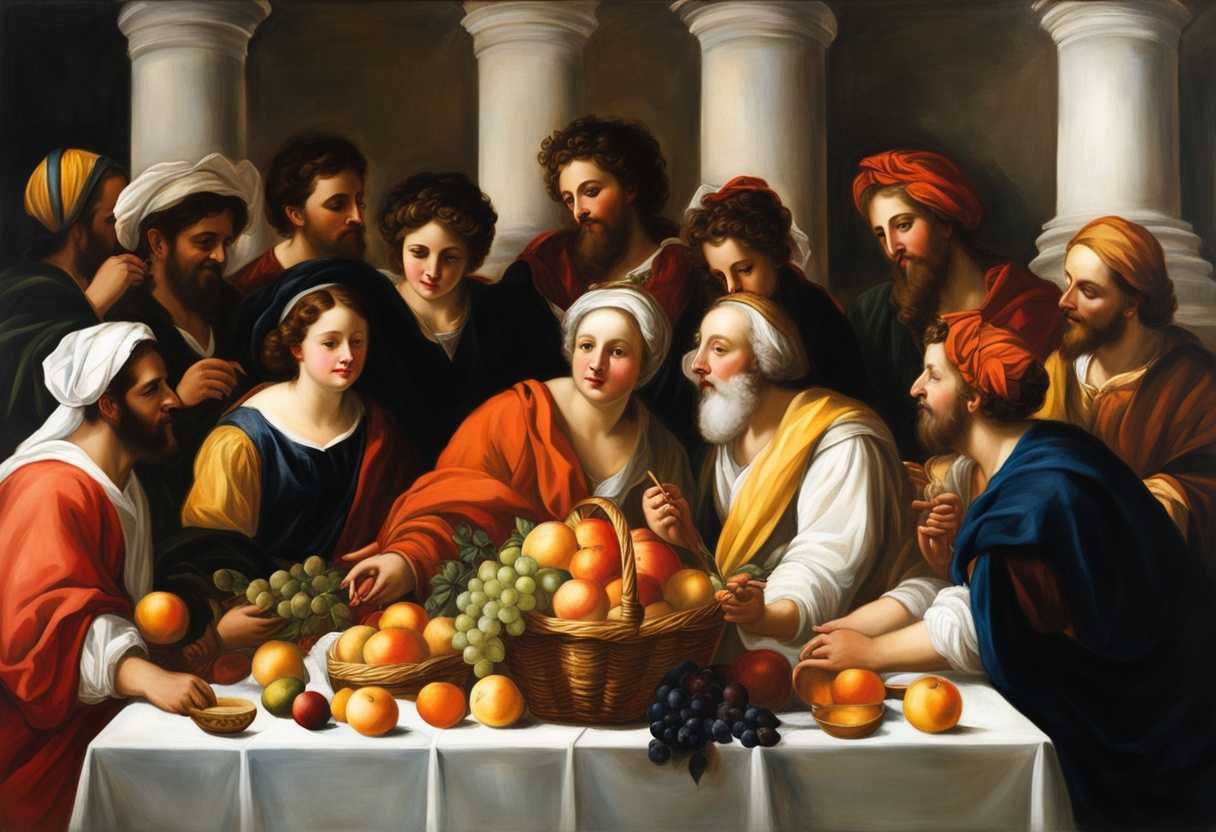
The Feast of Weeks, also known as Shavuot or Pentecost, is a Jewish festival celebrated seven weeks after Passover, symbolizing the giving of the Torah at Sinai. In the Bible, it is also a time to offer the first fruits of the harvest to God, as described in Leviticus 23:15-22.
Scripture
22 You shall observe the Feast of Weeks, the firstfruits of wheat harvest, and the Feast of Ingathering at the year’s end.
23 Three times in the year shall all your males appear before the Lord God, the God of Israel.
24 For I will cast out nations before you and enlarge your borders; no one shall covet your land, when you go up to appear before the Lord your God three times in the year.
Meaning of Feast of Weeks in Scripture
The Feast of Weeks, or Shavuot, holds significant theological implications in the biblical narrative, extending beyond its agricultural origins. As defined in Leviticus 23:15-22, this festival is celebrated seven weeks after Passover, reflecting both joy and gratitude for the bringing in of the harvest. The act of offering first fruits serves as a reminder of God’s provision, as He instructed the Israelites to remember their dependency on Him for sustenance. In Exodus 34:22, this celebration is linked with the acknowledgment of God’s covenant, as it was during this time that He provided the Law to Moses at Mount Sinai, marking a pivotal moment in the development of Israel’s identity as a chosen people under divine guidance and moral law.
Moreover, the Feast of Weeks assumes a christological significance in the New Testament context, particularly in Acts 2. Here, the outpouring of the Holy Spirit at Pentecost occurs on this very day, symbolizing the fulfillment of Jesus’ promise to empower His disciples. The gathered crowd hears the apostles speaking in various tongues, which signifies the universal mission of the Church and the inclusion of Gentiles into the fold of God’s people. Thus, Shavuot becomes a dual celebration of both the giving of the Law and the gift of the Holy Spirit, illustrating the transition from the Old Covenant to the New Covenant. This interplay between law and grace invites believers to reflect on God’s continuous call to relationship and obedience, underscoring the significance of spiritual harvest and the empowerment to fulfill God’s commandments in the life of every Christian.
The Feast of Weeks is not only a time of physical harvest but also embodies a spiritual harvest, inviting further reflection on communal and individual transformation within the biblical context. In Deuteronomy 16:9-12, the festival is framed as an occasion for community and joy, emphasizing the collective aspect of Israel’s relationship with God and each other. By instructing the Israelites to gather, rejoice, and bring offerings, the emphasis is placed on inclusiveness—encouraging participation from each member of society, including the less fortunate. This reflects a foundational principle of ancient Israelite society: that communal feasts foster unity and a shared sense of God’s abundance, reinforcing social bonds and collective responsibility towards one another.
In a prophetic dimension, the Feast of Weeks is also associated with the promise of restoration and hope. The books of the Prophets convey visions of a future when God would pour out His Spirit on all people (as exemplified in Joel 2:28-32), anticipating a time when the barriers separating people would be dismantled and transformation would occur in both individual hearts and the broader community. This vision culminates in the New Testament as believers experience the fulfillment of these prophecies at Pentecost. Hence, Shavuot serves as both a historical reminder of God’s faithfulness and a prophetic symbol of future hope, inviting believers to engage actively in ushering in the Kingdom of God through acts of love, justice, and reconciliation in the world around them, further deepening the significance of this pivotal festival in the biblical narrative.
Celebration of Harvest and Abundance
The Feast of Weeks, also known as Shavuot, signifies the celebration of the harvest season in ancient Israel. It marks the end of the grain harvest, particularly the wheat harvest, and serves as a time for the community to come together to express gratitude for the abundance provided by God. This festival emphasizes the importance of agricultural cycles and the reliance on divine provision, reminding the faithful of the blessings that come from hard work and God’s generosity.
Spiritual Renewal and Covenant
Beyond its agricultural significance, the Feast of Weeks also represents a time of spiritual renewal and reflection on the covenant between God and His people. Traditionally, it is associated with the giving of the Torah at Mount Sinai, symbolizing the establishment of a sacred relationship and the responsibilities that come with it. This aspect of the feast encourages individuals to recommit themselves to their faith, study the scriptures, and engage in acts of kindness and community service, reinforcing the moral and ethical dimensions of their covenantal relationship with God.
Unity and Community
The Feast of Weeks serves as a unifying event for the Israelite community, bringing together people from various regions to celebrate and worship. It fosters a sense of belonging and collective identity among the participants, as they share in the joy of the harvest and the blessings of their faith. This communal aspect highlights the importance of fellowship, cooperation, and support within the community, encouraging individuals to work together in gratitude and service to one another, thereby strengthening social bonds and communal ties.
How to Cultivate Gratitude in Your Christian Journey
Cultivating gratitude in your Christian journey is a transformative practice that can deepen your faith and enhance your daily life. Start by intentionally setting aside time each day to reflect on the blessings in your life, no matter how small they may seem. Consider keeping a gratitude journal where you jot down things you are thankful for, allowing you to see God’s hand at work in your life. Scripture encourages us to “give thanks in all circumstances” (1 Thessalonians 5:18), reminding us that gratitude is not just for the good times but also for the challenges that shape us. Engage in prayer, expressing your thanks to God for His unwavering love and grace, and share your gratitude with others—whether through acts of kindness or simply telling someone how much they mean to you. As you practice gratitude, you’ll find that it not only shifts your perspective but also draws you closer to God, helping you to see His goodness in every moment.
Bible References to the Feast of Weeks:
Leviticus 23:15-21: 15 “You shall count seven full weeks from the day after the Sabbath, from the day that you brought the sheaf of the wave offering.”
16 You shall count fifty days to the day after the seventh Sabbath. Then you shall present a grain offering of new grain to the Lord.
17 You shall bring from your dwelling places two loaves of bread to be waved, made of two tenths of an ephah. They shall be of fine flour, and they shall be baked with leaven, as firstfruits to the Lord.
18 And you shall present with the bread seven lambs a year old without blemish, one bull from the herd and two rams. They shall be a burnt offering to the Lord, with their grain offering and their drink offerings, a food offering with a pleasing aroma to the Lord.
19 You shall offer one male goat for a sin offering, and two male lambs a year old as a sacrifice of peace offerings.
20 And the priest shall wave them with the bread of the firstfruits as a wave offering before the Lord, with the two lambs. They shall be holy to the Lord for the priest.
21 And you shall make proclamation on the same day. You shall hold a holy convocation. You shall not do any ordinary work. It is a statute forever in all your dwelling places throughout your generations.
Deuteronomy 16:9-12: 9 You shall count seven weeks. Begin to count the seven weeks from the time the sickle is first put to the standing grain.
10 Then you shall keep the Feast of Weeks to the Lord your God with the tribute of a freewill offering from your hand, which you shall give as the Lord your God blesses you.
11 You shall rejoice before the Lord your God, you and your son and your daughter, your male servant and your female servant, the Levite who is within your towns, the sojourner, the fatherless, and the widow who are among you, at the place that the Lord your God will choose, to make his name dwell there.
12 You shall remember that you were a slave in Egypt; and you shall be careful to observe these statutes.
Numbers 28:26-31: 26 “On the day of the firstfruits, when you offer a grain offering of new grain to the Lord at your Feast of Weeks, you shall have a holy convocation. You shall not do any ordinary work,”
27 But you shall offer a burnt offering, a pleasing aroma to the Lord: two bulls from the herd, one ram, seven male lambs a year old;
28 And their grain offering shall be of fine flour mixed with oil, three tenths of an ephah for each bull of the thirteen bulls, two tenths for each ram of the two rams,
29 Their grain offering shall be two-tenths of an ephah of fine flour mixed with oil, a food offering to the Lord with a pleasing aroma, and the drink offering with it shall be of wine, a fourth of a hin.
30 And one male goat for a sin offering, besides the regular burnt offering, its grain offering, and its drink offering.
31 You shall offer them in addition to the regular burnt offering and its grain offering.
Acts 2:1-13: 1 When the day of Pentecost arrived, they were all together in one place.
2 And suddenly there came from heaven a sound like a mighty rushing wind, and it filled the entire house where they were sitting.
3 And divided tongues as of fire appeared to them and rested on each one of them.
4 And they were all filled with the Holy Spirit and began to speak in other tongues as the Spirit gave them utterance.
5 Now there were dwelling in Jerusalem Jews, devout men from every nation under heaven.
6 And at this sound the multitude came together, and they were bewildered, because each one was hearing them speak in his own language.
7 And they were amazed and astonished, saying, “Are not all these who are speaking Galileans?
8 And how is it that we hear, each of us in his own native language?
9 Parthians and Medes and Elamites and residents of Mesopotamia, Judea and Cappadocia, Pontus and Asia,
10 Phrygia and Pamphylia, Egypt and the parts of Libya belonging to Cyrene, and visitors from Rome,
11 both Jews and proselytes, Cretans and Arabians—we hear them telling in our own tongues the mighty works of God.”
12 And all were amazed and perplexed, saying to one another, “What does this mean?”
13 But others mocking said, “They are filled with new wine.”
2 Chronicles 8:12-13: 12 Then Solomon offered up burnt offerings to the Lord on the altar of the Lord that he had built before the vestibule,
13 According to the commandment of David his father, he appointed the divisions of the priests for their service, and the Levites for their offices of praise and ministry before the priests as the duty of each day required, and the gatekeepers in their divisions at each gate, for so David the man of God had commanded.

Reverend Ogunlade is a seasoned Church Minister with over three decades of experience in guiding and nurturing congregations. With profound wisdom and a serene approach, Reverend Ogunlade has carried out various pastoral duties, including delivering uplifting sermons, conducting religious ceremonies, and offering sage counsel to individuals seeking spiritual guidance. Their commitment to fostering harmony and righteousness within their community is exemplified through their compassionate nature, making them a beloved and trusted figure among the congregation.