
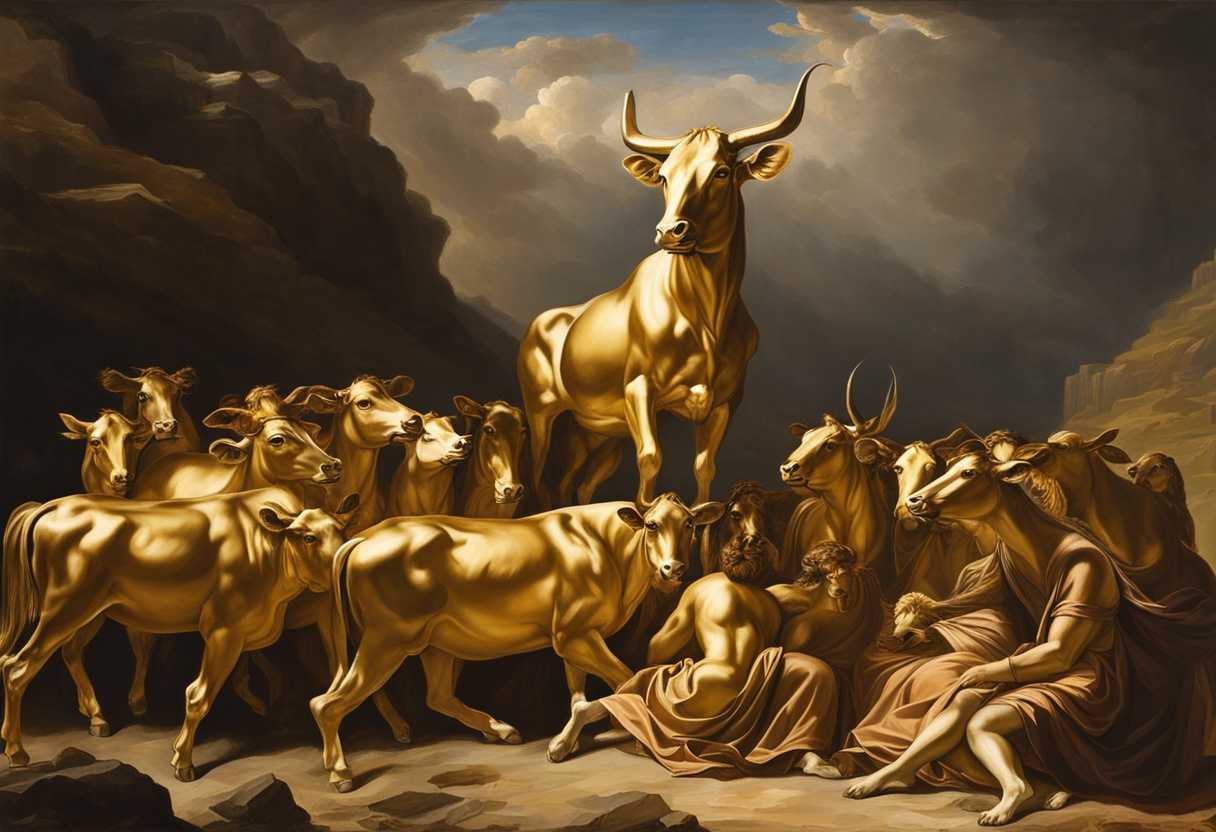
The golden calf represents idolatry and the abandonment of faith in God, as seen in Exodus 32. It symbolizes the Israelites’ desire for a tangible object of worship while they awaited Moses’ return, reflecting their lack of trust in God.
Scripture
1 When the people saw that Moses delayed to come down from the mountain, the people gathered themselves together to Aaron and said to him, “Up, make us gods who shall go before us. As for this Moses, the man who brought us up out of the land of Egypt, we do not know what has become of him.”
2 So Aaron said to them, “Take off the rings of gold that are in the ears of your wives, your sons, and your daughters, and bring them to me.”
3 So all the people took off the rings of gold that were in their ears and brought them to Aaron.
4 And he received the gold from their hand and fashioned it with a graving tool and made a golden calf. And they said, “These are your gods, O Israel, who brought you up out of the land of Egypt!”
5 When Aaron saw this, he built an altar before it. And Aaron made a proclamation and said, “Tomorrow shall be a feast to the Lord.”
6 And they rose up early the next day and offered burnt offerings and brought peace offerings. And the people sat down to eat and drink and rose up to play.
7 And the Lord said to Moses, “Go down, for your people, whom you brought up out of the land of Egypt, have corrupted themselves.
8 They have turned aside quickly out of the way that I commanded them.
9 And the Lord said to Moses, “I have seen this people, and behold, it is a stiff-necked people.
10 Now therefore let me alone, that my wrath may burn hot against them and I may consume them, in order that I may make a great nation of you.
11 But Moses implored the Lord his God and said, “O Lord, why does your wrath burn hot against your people, whom you have brought out of the land of Egypt with great power and with a mighty hand?
12 Why should the Egyptians say, ‘With evil intent did he bring them out, to kill them in the mountains and to consume them from the face of the earth’? Turn from your burning anger and relent from this disaster against your people.
13 Remember Abraham, Isaac, and Israel, your servants, to whom you swore by your own self, and said to them, ‘I will multiply your offspring as the stars of heaven, and all this land that I have promised I will give to your offspring, and they shall inherit it forever.’”
14 And the Lord relented from the disaster that he had spoken of bringing on his people.
15 Then Moses turned and went down from the mountain with the two tablets of the testimony in his hand, tablets that were written on both sides; on the front and on the back they were written.
16 The tablets were the work of God, and the writing was the writing of God, engraved on the tablets.
17 Now when Joshua heard the noise of the people as they shouted, he said to Moses, “There is a noise of war in the camp.”
18 But he said, “It is not the sound of shouting for victory, or the sound of the cry of defeat, but the sound of singing that I hear.”
19 And as soon as he came near the camp and saw the calf and the dancing, Moses’ anger burned hot, and he threw the tablets out of his hands and broke them at the foot of the mountain.
20 He took the calf that they had made and burned it with fire and ground it to powder and scattered it on the water and made the people of Israel drink it.
21 And Moses said to Aaron, “What did this people do to you that you have brought such a great sin upon them?”
22 And Aaron said, “Let not the anger of my lord burn hot. You know the people, that they are set on evil.
23 For they said to me, ‘Make us gods who shall go before us. As for this Moses, the man who brought us up out of the land of Egypt, we do not know what has become of him.’
24 So I said to them, ‘Let any who have gold take it off.’ So they gave it to me, and I threw it into the fire, and out came this calf.”
25 And when Moses saw that the people had broken loose (for Aaron had let them break loose, to the derision of their enemies),
26 then Moses stood in the gate of the camp and said, “Who is on the Lord’s side? Come to me.” And all the sons of Levi gathered around him.
27 And he said to them, “Thus says the Lord God of Israel, ‘Put your sword on your side each of you, and go to and fro from gate to gate throughout the camp, and each of you kill his brother and his companion and his neighbor.’”
28 And the sons of Levi did according to the word of Moses. And that day about three thousand men of the people fell.
29 And Moses said, “Today you have been ordained for the service of the Lord, each one at the cost of his son and of his brother, so that he might bestow a blessing upon you this day.”
30 The next day Moses said to the people, “You have sinned a great sin. And now I will go up to the Lord; perhaps I can make atonement for your sin.”
32 Then Moses returned to the Lord, and said, “Alas, this people has sinned a great sin. They have made for themselves gods of gold.
32 But now, if you will forgive their sin—but if not, please blot me out of your book that you have written.”
33 But the Lord said to Moses, “Whoever has sinned against me, I will blot out of my book.
34 But now go, lead the people to the place about which I have spoken to you; behold, my angel shall go before you. But on the day when I visit, I will visit their sin upon them.”
35 Then the Lord sent a plague on the people, because they made the calf, the one that Aaron made.
Meaning of the Golden Calf in the Bible
The golden calf, as recounted in Exodus 32, serves as a profound symbol of idolatry and the spiritual disarray that can arise when faith wavers. After the Israelites escaped from Egypt, they found themselves at the foot of Mount Sinai, waiting for Moses to return with God’s commandments. In his absence, they grew restless and demanded a visual representation of their deity, leading Aaron to fashion a calf from their jewelry (Exodus 32:1-4). This act not only demonstrates their impatience but starkly reveals their desire for a physical embodiment of divinity, contrasting their earlier commitments to trust in an unseen God who had delivered them from slavery. The transformation of their faith into a tangible idol exemplifies humanity’s propensity to seek control and certainty in a world that often feels chaotic and overwhelming.
The episode underscores a deeper theological meaning about the nature of worship and fidelity to God. The Israelites’ actions represent a breach of the covenant, as articulated in the First Commandment: “You shall have no other gods before me” (Exodus 20:3). When Moses sees the people’s revelry around the calf, he is incensed, and God tells him, “They have turned aside quickly out of the way that I commanded them” (Exodus 32:8). This signifies not only their rebellion but a fundamental misunderstanding of who God is—one who cannot be contained or represented by mere physical objects. Through the narrative, the gold calf stands as a cautionary symbol warning against the dangers of misplaced worship and the human tendency to substitute true faith with more relatable, yet ultimately hollow, idols. The aftermath of the incident, leading to the Levites’ execution of those who had participated (Exodus 32:27-28), further illustrates the serious consequences of turning away from God and the call for purity in worship.
The golden calf narrative illuminates the complexities of faith, loyalty, and the human inclination to revert to familiar patterns in times of crisis. Throughout the Old Testament, this event echoes as a warning against syncretism—the blending of true worship with the practices of surrounding cultures. The Israelites, fresh from their liberation and covenant with God, chose to revert to an idol representing the gods of Egypt, reflecting a deep-seated fear and the temptation to settle for what is visible and controllable rather than uphold their commitment to the divine. This act of idolatry serves as a historical point of reflection within the community and ultimately shapes future generations’ understanding of fidelity to God, as they grappled with the implications of their ancestors’ choices.
Further exploration of the golden calf motif can be found later in the prophetic literature, where the Israelites are chastised for their continued idolatry. Prophets like Hosea and Jeremiah reference the nation’s tendencies to worship false gods, emphasizing their betrayal of the God who had established a covenant with them. The calf becomes a metaphor for spiritual unfaithfulness—it represents a tangible history of rebellion against divine guidance, one that perpetuates the cycle of breaking the covenant. Additionally, this event foreshadows later calls to repentance and restoration, as the community is challenged to examine its loyalty and realign itself with God’s will. Thus, the golden calf serves not only as an isolated moment of disobedience but as a recurring theme throughout biblical history, illustrating the persistent struggle between faith and the alluring temptation of idolatry.
Idolatry and Human Rebellion
The golden calf symbolizes the tendency of humanity to turn away from divine authority and seek tangible representations of worship. This act of creating an idol reflects a deeper spiritual rebellion against God’s commandments and a desire for control over one’s faith. It serves as a reminder of the human inclination to replace the divine with the familiar and the physical, often leading to moral and spiritual decline.
The Consequences of Apostasy
The narrative surrounding the golden calf illustrates the severe consequences of turning away from God. It highlights the dangers of apostasy, where individuals or communities abandon their faith for false beliefs. The aftermath of this event serves as a cautionary tale about the repercussions of disobedience and the loss of divine favor, emphasizing the importance of fidelity to spiritual commitments.
The Search for Assurance and Leadership
The creation of the golden calf also reflects a deeper human need for assurance and leadership, especially in times of uncertainty. When faced with the absence of their leader, the people sought a physical representation of security and guidance. This act underscores the struggle between faith in the unseen and the desire for visible signs of divine presence, illustrating the challenges of maintaining faith in difficult circumstances.
How to Foster Faithfulness and Avoid Idolatry
Fostering faithfulness and avoiding idolatry is a journey that requires intentionality and reflection in our daily lives. To cultivate a deeper faithfulness to God, start by examining what occupies your thoughts and affections—are there distractions or priorities that take precedence over your relationship with Him? Regular prayer and scripture reading can help realign your heart with God’s will, reminding you of His promises and love. Surround yourself with a community of believers who encourage you to stay focused on Christ, as fellowship can strengthen your resolve against the subtle temptations of modern-day idols, whether they be material possessions, status, or even relationships. Remember, idolatry often creeps in unnoticed, so be vigilant and ask God to reveal any areas where you may be placing something above Him. By nurturing a heart of gratitude and worship, you can cultivate a faithfulness that not only honors God but also enriches your life and the lives of those around you.
Bible References to the Golden Calf:
Deuteronomy 9:7-21: 7 Remember and do not forget how you provoked the Lord your God to wrath in the wilderness. From the day you came out of the land of Egypt until you came to this place, you have been rebellious against the Lord.
8 Even at Horeb you provoked the Lord to wrath, and the Lord was so angry with you that he was ready to destroy you.
9 When I went up the mountain to receive the tablets of stone, the tablets of the covenant that the Lord made with you, I remained on the mountain forty days and forty nights. I neither ate bread nor drank water.
10 And the Lord gave me the two tablets of stone written with the finger of God, and on them were all the words that the Lord had spoken with you on the mountain out of the midst of the fire on the day of the assembly.
11 And at the end of forty days and forty nights the Lord gave me the two tablets of stone, the tablets of the covenant.
12 Then the Lord said to me, ‘Arise, go down quickly from here, for your people whom you have brought from Egypt have acted corruptly. They have turned aside quickly out of the way that I commanded them; they have made themselves a metal image.’
13 “Furthermore, the Lord said to me, ‘I have seen this people, and behold, it is a stubborn people.”
14 Let me alone, that I may destroy them and blot out their name from under heaven. And I will make of you a nation mightier and greater than they.’
15 “So I turned and came down from the mountain, and the mountain was burning with fire. And the two tablets of the covenant were in my two hands.”
16 And I looked, and behold, you had sinned against the Lord your God. You had made yourselves a golden calf.
17 And I took hold of the two tablets and threw them out of my two hands and broke them before your eyes.
18 Then I lay prostrate before the Lord as before, forty days and forty nights.
19 For I was afraid of the anger and hot displeasure that the Lord bore against you, so that he was ready to destroy you. But the Lord listened to me that time also.
20 And the Lord was so angry with Aaron that he was ready to destroy him. And I prayed for Aaron also at the same time.
21 And I took the sinful thing, the calf that you had made, and burned it with fire and crushed it, grinding it very small, until it was as fine as dust. And I threw the dust of it into the brook that ran down from the mountain.
Nehemiah 9:16-18: 16 “But they and our fathers acted presumptuously and stiffened their neck and did not obey your commandments.”
17 They refused to obey and were not mindful of the wonders that you performed among them, but they stiffened their neck and appointed a leader to return to their slavery in Egypt. But you are a God ready to forgive, gracious and merciful, slow to anger and abounding in steadfast love, and did not forsake them.
18 Even when they had made for themselves a golden calf and said, ‘This is your God who brought you up out of Egypt,’ and had committed great blasphemies,
Psalm 106:19-23: 19 They made a calf in Horeb and worshiped a metal image.
20 They exchanged the glory of God for the image of an ox that eats grass.
21 They forgot God, their Savior, who had done great things in Egypt,
22 Wondrous works in the land of Ham, and awesome deeds by the Red Sea.
23 Therefore he said he would destroy them, had not Moses, his chosen one, stood in the breach before him, to turn away his wrath from destroying them.
Acts 7:39-43: 39 Our fathers refused to obey him, but thrust him aside, and in their hearts they turned to Egypt,
40 saying to Aaron, ‘Make for us gods who will go before us. As for this Moses who led us out from the land of Egypt, we do not know what has become of him.’
41 And they made a calf in those days, and offered a sacrifice to the idol and were rejoicing in the works of their hands.
42 But God turned away and gave them over to worship the host of heaven, as it is written in the book of the prophets: “Did you bring to me slain beasts and sacrifices, during the forty years in the wilderness, O house of Israel?
43 You took up the tent of Moloch
and the star of your god Rephan,
the images that you made to worship;
and I will send you into exile beyond Babylon.’

Reverend Ogunlade is a seasoned Church Minister with over three decades of experience in guiding and nurturing congregations. With profound wisdom and a serene approach, Reverend Ogunlade has carried out various pastoral duties, including delivering uplifting sermons, conducting religious ceremonies, and offering sage counsel to individuals seeking spiritual guidance. Their commitment to fostering harmony and righteousness within their community is exemplified through their compassionate nature, making them a beloved and trusted figure among the congregation.