
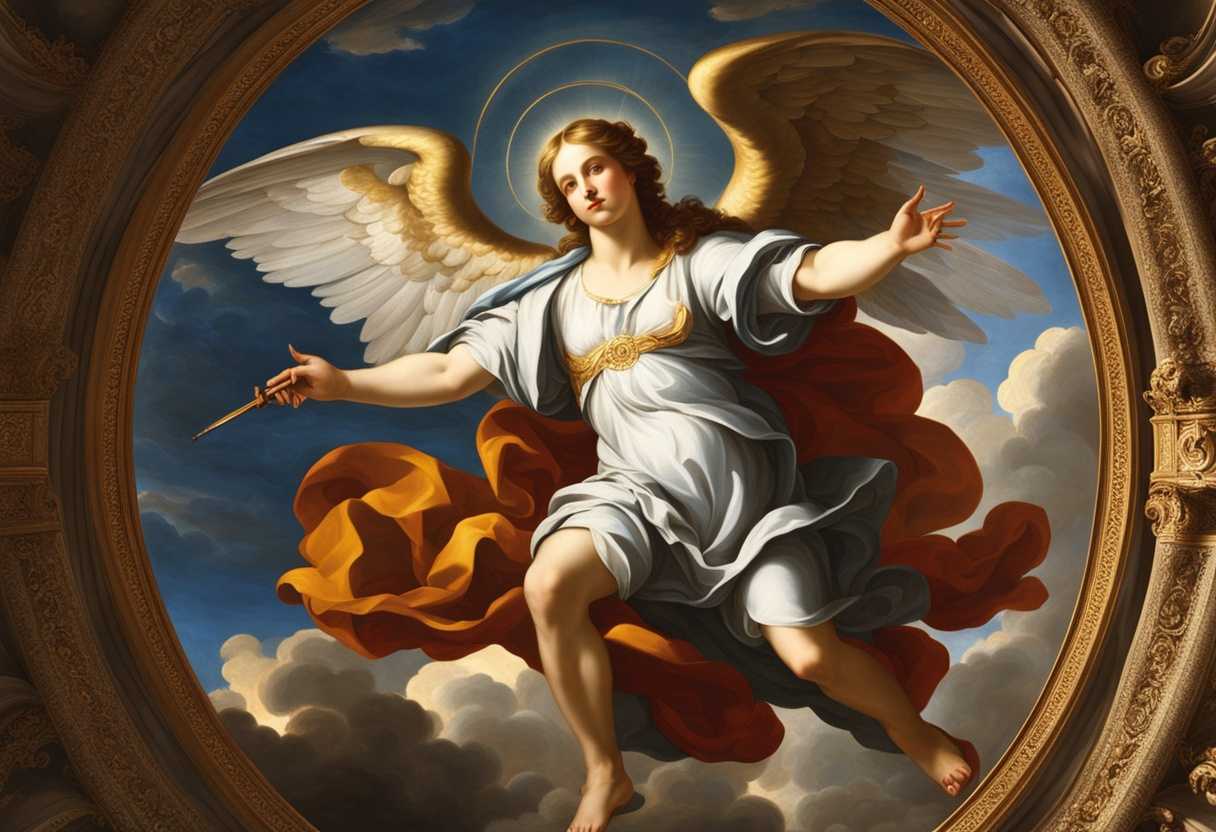
In the Bible, Gabriel is an archangel who serves as a messenger of God. His name means “God is my strength,” and he appears in key passages, notably in the announcements of the births of John the Baptist and Jesus Christ (Luke 1:11-38).
Scripture
15 When I, Daniel, had seen the vision, I sought to understand it. And behold, there stood before me one having the appearance of a man.
16 And I heard a man’s voice between the banks of the Ulai, and it called, “Gabriel, make this man understand the vision.”
17 So he came near where I stood. And when he came, I was frightened and fell on my face. But he said to me, “Understand, O son of man, that the vision is for the time of the end.”
18 And when he had spoken to me, I fell into a deep sleep with my face to the ground. But he touched me and made me stand up.
19 He said, “Behold, I am making known to you what shall happen later in the period of wrath, for it refers to the appointed time of the end.
20 As for the ram that you saw with the two horns, these are the kings of Media and Persia.
21 And the goat is the king of Greece, and the great horn between his eyes is the first king.
22 As for the horn that was broken, in place of which four others arose, four kingdoms shall arise from his nation, but not with his power.
23 And at the latter end of their kingdom, when the transgressors have reached their limit, a king of bold face, one who understands riddles, shall arise.
24 His power shall be great—but not by his own power; and he shall cause fearful destruction and shall succeed in what he does, and destroy mighty men and the people who are the saints.
25 By his cunning he shall make deceit prosper under his hand, and in his own mind he shall become great. Without warning he shall destroy many. And he shall even rise up against the Prince of princes, and he shall be broken—but by no human hand.
26 The vision of the evenings and the mornings that has been told is true, but seal up the vision, for it refers to many days from now.
27 And I was appalled at the vision, but no one understood it.
Gabriel in the Bible: Meaning and Significance
Gabriel serves as one of the most significant angelic figures in the Bible, embodying the role of God’s messenger. His name, “Gabriel,” derived from Hebrew meaning “God is my strength,” underscores his divine purpose and the power bestowed upon him by God to convey vital news and declarations. In the New Testament, Gabriel’s appearances are pivotal moments that set the stage for the fulfillment of God’s promises. In Luke 1:11-13, he appears to Zechariah to announce the birth of John the Baptist, signifying the beginning of the messianic era. Subsequently, in Luke 1:26-38, he delivers the momentous news to Mary that she will conceive Jesus, establishing him not just as a harbinger of hope but as an integral participant in God’s redemptive plan for humanity.
Beyond his role as a messenger, Gabriel represents the broader biblical theme of divine intervention in human history. His visitations reveal God’s active involvement in shaping events according to His will, highlighting the connection between the heavenly and earthly realms. This theme resonates throughout the Bible, as seen in Daniel 8:16-17 where Gabriel is also sent to provide understanding and clarity regarding visions, reflecting God’s desire to guide His people with wisdom. Therefore, Gabriel’s appearances are not just isolated events but are emblematic of God’s constant communication and relationship with His creation, reinforcing the belief that He equips His servants—both heavenly and earthly—with the strength and courage needed to fulfill their destinies in accordance with His divine plan.
In addition to being a messenger, Gabriel also serves as a symbol of divine revelation and interpretation, particularly in the prophetic texts of the Bible. His role as an interpreter of visions illustrates a profound aspect of biblical prophecy: the need for understanding spiritual truths that are often cloaked in mystery. This is notably evident in the Book of Daniel, where Gabriel is tasked with elucidating complex visions that depict the future and God’s overarching sovereignty over human kingdoms. His presence serves to reassure believers that God’s purpose will ultimately prevail, highlighting the angel’s role not merely as a herald of good news, but as a source of divine wisdom imparted through God’s appointed emissaries.
Moreover, Gabriel’s appearances can be seen as a bridge between the Old and New Testaments, emphasizing the continuity of God’s plan throughout biblical history. As both an angel of the Old Testament and a bearer of critical announcements in the New Testament, Gabriel embodies the transitioning of covenantal promises from one phase to the next. His communications serve to prepare hearts and minds for the transformative events that are to unfold in the narrative of salvation. In understanding Gabriel’s significance, one recognizes that his role extends beyond mere announcements; he becomes an emblem of hope and divine assurance, reminding believers of God’s faithfulness and the unfolding of His providential will through all generations.
The Messenger of God
Gabriel is primarily recognized as a messenger of God, tasked with delivering important announcements and revelations. His role emphasizes the divine communication between God and humanity, highlighting the significance of God’s messages in guiding and shaping the lives of individuals and nations. This aspect of Gabriel underscores the belief that God actively engages with His creation, providing direction and insight through His chosen messengers.
The Symbol of Hope and Promise
Gabriel also embodies hope and promise, particularly in the context of the announcements he delivers. His appearances often coincide with pivotal moments in biblical history, such as the foretelling of significant births and the unfolding of God’s redemptive plan. This association with hope serves to reassure believers of God’s faithfulness and the fulfillment of His promises, reinforcing the idea that divine intervention is always possible, even in seemingly impossible situations.
The Role in Spiritual Warfare
In addition to being a messenger, Gabriel is sometimes viewed as a figure involved in spiritual warfare. His presence in the scriptures suggests a connection to the broader cosmic struggle between good and evil. This interpretation highlights the belief that angels, including Gabriel, play an active role in the spiritual realm, assisting in the fight against darkness and advocating for God’s purposes on Earth. This aspect of Gabriel’s character encourages believers to recognize the unseen battles that occur in their lives and the divine support available to them.
How to Embrace Divine Guidance for a Better Faith
Embracing divine guidance is a transformative journey that can deepen your faith and enrich your daily life. Start by cultivating a habit of prayer, inviting God into your thoughts and decisions, and seeking His wisdom in every situation. As you read the Scriptures, allow the words to resonate within you, reflecting on how they apply to your life and circumstances. Surround yourself with a community of believers who can offer support and share their own experiences of divine guidance, reminding you that you are not alone on this path. Be open to the gentle nudges of the Holy Spirit, whether through a feeling, a thought, or even the counsel of a friend, and trust that God is always leading you toward His perfect will. Remember, faith is not just about knowing the right answers; it’s about developing a relationship with God that allows you to listen, learn, and grow in His love.
Bible References to Gabriel’s Meaning:
Daniel 9:20-27: 20 While I was speaking and praying, confessing my sin and the sin of my people Israel, and presenting my plea before the Lord my God for the holy hill of my God,
21 while I was speaking in prayer, the man Gabriel, whom I had seen in the vision at the first, came to me in swift flight at the time of the evening sacrifice.
22 He made me understand, speaking with me and saying, “O Daniel, I have now come out to give you insight and understanding.
23 At the beginning of your pleas for mercy a word went out, and I have come to tell it to you, for you are greatly loved. Therefore consider the word and understand the vision.
24 “Seventy weeks are decreed about your people and your holy city, to finish the transgression, to put an end to sin, and to atone for iniquity, to bring in everlasting righteousness, to seal both vision and prophet, and to anoint a most holy place.”
25 Know therefore and understand that from the going out of the word to restore and build Jerusalem to the coming of an anointed one, a prince, there shall be seven weeks.
26 And after the sixty-two weeks, an anointed one shall be cut off and shall have nothing. And the people of the prince who is to come shall destroy the city and the sanctuary. Its end shall come with a flood, and to the end there shall be war. Desolations are decreed.
27 And he shall make a strong covenant with many for one week, and for half of the week he shall put an end to sacrifice and offering. And on the wing of abominations shall come one who makes desolate, until the decreed end is poured out on the desolator.
Luke 1:5-25: 5 In the days of Herod, king of Judea, there was a priest named Zechariah, of the division of Abijah. And he had a wife from the daughters of Aaron, and her name was Elizabeth.
6 And they were both righteous before God, walking blamelessly in all the commandments and statutes of the Lord.
7 But they had no child, because Elizabeth was barren, and both were advanced in years.
8 Now while he was serving as priest before God when his division was on duty,
9 according to the custom of the priesthood, he was chosen by lot to enter the temple of the Lord and burn incense.
10 And the whole multitude of the people were praying outside at the hour of incense.
11 And there appeared to him an angel of the Lord standing on the right side of the altar of incense.
12 And Zechariah was troubled when he saw him, and fear fell upon him.
13 But the angel said to him, “Do not be afraid, Zechariah, for your prayer has been heard, and your wife Elizabeth will bear you a son, and you shall call his name John.
14 And you will have joy and gladness, and many will rejoice at his birth.
15 for he will be great before the Lord. And he must not drink wine or strong drink, and he will be filled with the Holy Spirit, even from his mother’s womb.
16 And he will turn many of the children of Israel to the Lord their God,
17 and he will go before him in the spirit and power of Elijah, to turn the hearts of the fathers to the children, and the disobedient to the wisdom of the just, to make ready for the Lord a people prepared.”
18 And Zechariah said to the angel, “How shall I know this? For I am an old man, and my wife is advanced in years.”
19 And the angel answered him, “I am Gabriel. I stand in the presence of God, and I was sent to speak to you and to bring you this good news.
20 And behold, you will be silent and unable to speak until the day that these things take place, because you did not believe my words, which will be fulfilled in their time.”
21 And the people were waiting for Zechariah, and they were wondering at his delay in the temple.
22 And when he came out, he was unable to speak to them, and they realized that he had seen a vision in the temple. And he kept making signs to them and remained mute.
23 And when his time of service was ended, he went to his home.
24 After these days his wife Elizabeth conceived, and for five months she kept herself hidden, saying,
25 “Thus the Lord has done for me in the days when he looked on me, to take away my reproach among people.”
Luke 1:26-38: 26 In the sixth month the angel Gabriel was sent from God to a city of Galilee named Nazareth,
27 to a virgin betrothed to a man whose name was Joseph, of the house of David. And the virgin’s name was Mary.
28 And he came to her and said, “Greetings, O favored one, the Lord is with you!”
29 But she was greatly troubled at the saying, and tried to discern what sort of greeting this might be.
30 And the angel said to her, “Do not be afraid, Mary, for you have found favor with God.
31 And behold, you will conceive in your womb and bear a son, and you shall call his name Jesus.
32 He will be great and will be called the Son of the Most High. And the Lord God will give to him the throne of his father David,
33 and he will reign over the house of Jacob forever, and of his kingdom there will be no end.”
34 And Mary said to the angel, “How will this be, since I am a virgin?”
35 And the angel answered her, “The Holy Spirit will come upon you, and the power of the Most High will overshadow you; therefore the child to be born will be called holy—the Son of God.
36 And behold, your relative Elizabeth in her old age has also conceived a son, and this is the sixth month with her who was called barren.
37 For nothing will be impossible with God.
38 And Mary said, “Behold, I am the servant of the Lord; let it be to me according to your word.” And the angel departed from her.

Rev. François Dupont is a dedicated church minister with a wealth of experience in serving spiritual communities. With a calm and serene demeanor, he has been devoted to sharing the message of love, compassion, and tolerance for over two decades. Through his thoughtful sermons, compassionate counseling, and unwavering support, Rev. Dupont has touched the lives of countless individuals, allowing them to find solace and strength during difficult times. His serene presence and deep understanding of the human condition make him a trusted guide for those seeking spiritual nourishment and guidance.