
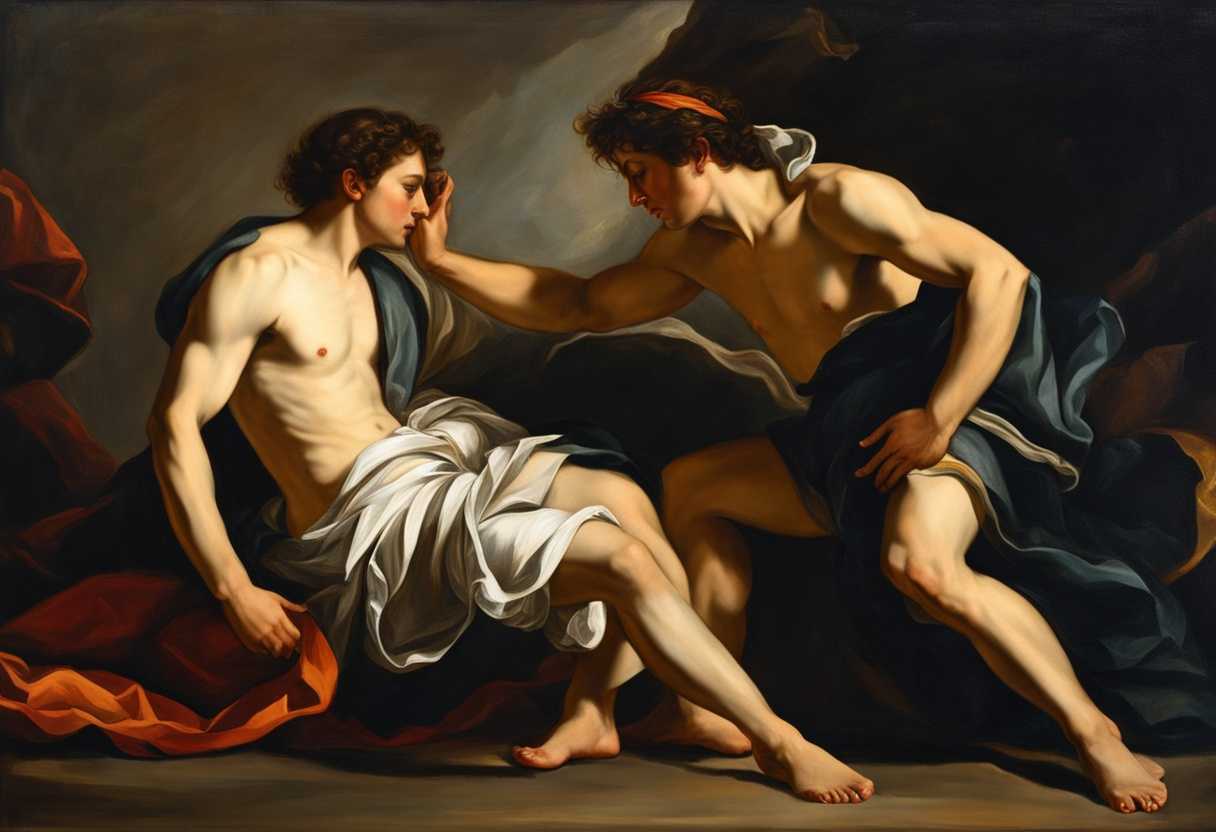
In the Bible, Jacob means “supplanter” or “heel-grabber,” reflecting his birth as he emerged holding onto his twin brother Esau’s heel (Genesis 25:26). He is also a key patriarch in the Israelite lineage, later named Israel after wrestling with God (Genesis 32:28).
Scripture
19 These are the generations of Isaac, Abraham’s son: Abraham fathered Isaac.
20 and Isaac was forty years old when he took Rebekah, the daughter of Bethuel the Aramean of Paddan-aram, the sister of Laban the Aramean, to be his wife.
21 And Isaac prayed to the Lord for his wife, because she was barren. And the Lord granted his prayer, and Rebekah his wife conceived.
22 The children struggled together within her, and she said, “If it is thus, why is this happening to me?” So she went to inquire of the Lord.
23 And the Lord said to her, “Two nations are in your womb, and two peoples from within you shall be divided; the one shall be stronger than the other, the older shall serve the younger.”
24 When her days to give birth were completed, behold, there were twins in her womb.
25 The first came out red, all his body like a hairy cloak, so they called his name Esau.
26 Afterward his brother came out with his hand holding Esau’s heel, so his name was called Jacob.
27 When the boys grew up, Esau was a skillful hunter, a man of the field, while Jacob was a quiet man, dwelling in tents.
28 Isaac loved Esau because he ate of his game, but Rebekah loved Jacob.
29 Once when Jacob was cooking stew, Esau came in from the field, and he was exhausted.
30 And Esau said to Jacob, “Let me eat some of that red stew, for I am exhausted!” (Therefore his name was called Edom.)
31 Jacob said, “Sell me your birthright now.”
32 Esau said, “Behold, I am about to die; of what use is a birthright to me?”
33 Then Jacob said, “Swear to me now.” So he swore to him and sold his birthright to Jacob.
34 Then Jacob gave Esau bread and lentil stew, and he ate and drank and rose and went his way. So Esau despised his birthright.
Meaning of Jacob in the Bible
The significance of Jacob in the Bible extends far beyond his name’s literal meaning of “supplanter.” His life narrative embodies themes of struggle, redemption, and divine purpose. Jacob’s early life is marked by a series of cunning and controversial actions, including deceiving his brother Esau to obtain the birthright (Genesis 25:29-34) and later tricking their father Isaac into giving him the blessing meant for Esau (Genesis 27). These episodes reflect the complexities of human nature and the lengths individuals might go to secure their fortunes—a theme that resonates throughout the biblical text. However, despite his morally ambiguous beginnings, Jacob becomes a vessel for God’s promises. His eventual transformation, culminating in his wrestling match with God, symbolizes his struggle for a deeper relationship with the Divine, resulting in his new name, Israel, which means “he struggles with God” (Genesis 32:28).
Moreover, Jacob’s life demonstrates the interplay of human agency and divine sovereignty. Despite his flawed character, God’s covenant promises remain steadfast, as seen in Genesis 28:13-15, where God reiterates the Abrahamic promise to Jacob. Jacob’s descendants become the Twelve Tribes of Israel, thus highlighting the importance of his legacy within the biblical narrative and the Jewish faith. His experiences reflect a journey of growth, where the once deceitful supplanter evolves into a patriarch whose trials and tribulations ultimately lead to the fulfillment of God’s covenant with humanity. In this way, Jacob serves not only as a significant historical figure in the lineage of Israel but also as a symbol of the potential for transformation and redemption inherent in all people.
Jacob’s journey is also marked by profound familial dynamics that illustrate themes of loyalty, rivalry, and forgiveness. The tension between him and Esau is emblematic of intergenerational strife, echoing the larger narrative of family conflict found throughout Scripture. This sibling rivalry does not end with their initial discord; it continues to reverberate in the lives of their descendants, the Edomites and Israelites. When Jacob eventually reconciles with Esau, it represents a pivotal moment of healing and forgiveness, illustrating God’s power to transform relationships and restore brokenness. The reconciliation emphasizes the importance of humility and the willingness to seek peace, which are central virtues within the biblical framework.
Additionally, Jacob’s role in the unfolding of Israel’s history is underscored by his relationships with his wives Leah and Rachel, and their handmaidens, Bilhah and Zilpah. The complex family structure that emerges from these unions reflects the broader theme of God using imperfect circumstances for a greater purpose. Jacob’s experiences raise questions about identity, belonging, and the nature of divine blessing. His twelve sons, born from these women, symbolize the diverse and often tumultuous journey of the people of Israel. Jacob’s story serves as a prelude to the challenges and triumphs that the Israelites will face as a nation, reinforcing the notion that divine providence often operates through flawed human stories. Thus, Jacob’s legacy encompasses not only his individual transformation but also the intricate tapestry of Israel’s identity and God’s unwavering commitment to His covenant people.
The Significance of the Name “Jacob”
The name “Jacob” is derived from the Hebrew word “Ya’aqov,” which means “to follow” or “to supplant.” This etymology reflects Jacob’s role in biblical narratives, particularly in relation to his brother Esau. Jacob’s actions, including his acquisition of Esau’s birthright and blessing, symbolize the complexities of human relationships, ambition, and the pursuit of divine favor. The name serves as a reminder of the struggles and rivalries that can exist within families and the lengths to which individuals may go to secure their destinies.
The Transformation of Identity
Jacob’s journey throughout the biblical text illustrates a profound transformation of identity. Initially depicted as a cunning and ambitious figure, Jacob undergoes significant personal growth, particularly after his encounter with the divine. This transformation is emblematic of the broader theme of redemption and the possibility of change. Jacob’s later renaming to Israel signifies not only a new identity but also a deeper relationship with God, highlighting the potential for individuals to evolve and embrace their spiritual calling.
The Legacy of the Twelve Tribes
Jacob is a pivotal figure in the establishment of the twelve tribes of Israel, which are named after his sons. This aspect of his story underscores the importance of lineage, heritage, and the fulfillment of divine promises. Jacob’s role as a patriarch signifies the continuity of God’s covenant with humanity, illustrating how individual lives can have far-reaching implications for future generations. The tribes’ formation reflects themes of community, identity, and the collective journey of faith that shapes the history of the Israelite people.
How to Embrace Truth in Your Christian Journey
Embracing truth in your Christian journey is a deeply personal and transformative process that requires both humility and courage. Start by immersing yourself in Scripture, allowing the Word of God to illuminate your path and challenge your assumptions. Remember, truth is not just a set of doctrines to be memorized; it’s a living relationship with Jesus, who said, “I am the way, the truth, and the life” (John 14:6). Engage in prayer and reflection, asking the Holy Spirit to reveal areas in your life where you may be holding onto falsehoods or misconceptions. Surround yourself with a community of believers who encourage honesty and accountability, as iron sharpens iron (Proverbs 27:17). Finally, be open to the uncomfortable truths that may arise, for it is often in these moments of vulnerability that we grow closer to God and become more authentic in our faith. Embrace the journey, knowing that truth, while sometimes challenging, ultimately leads to freedom and deeper intimacy with Christ.
Bible References to the Meaning of Jacob:
Genesis 27:1-45: 27 When Isaac was old and his eyes were dim so that he could not see, he called Esau his older son and said to him, “My son”; and he answered, “Here I am.”
2 And he said, “Behold, I am old; I do not know the day of my death.
3 Now then, take your weapons, your quiver and your bow, and go out to the field and hunt game for me,
4 and prepare for me delicious food, such as I love, and bring it to me so that I may eat, that my soul may bless you before I die.”
5 Now Rebekah was listening when Isaac spoke to his son Esau. So when Esau went to the field to hunt for game and bring it,
6 Rebekah said to her son Jacob, “I heard your father speak to your brother Esau, saying,
7 ‘Bring me game and prepare for me delicious food, that I may eat it and bless you before the Lord before I die.’
8 Now therefore, my son, obey my voice as I command you.
9 Go to the flock and bring me two good young goats, so that I may prepare from them delicious food for your father, such as he loves.
10 Then you shall bring it to your father, that he may eat, so that he may bless you before he dies.”
11 But Jacob said to Rebekah his mother, “Behold, my brother Esau is a hairy man, and I am a smooth man.
12 Perhaps my father will feel me, and I shall seem to be mocking him and bring a curse upon myself and not a blessing.”
13 Now therefore, my son, obey my voice. Go to the flock and bring me two good young goats, so that I may prepare from them delicious food for your father, such as he loves.
14 So he went and took them and brought them to his mother, and his mother prepared delicious food, such as his father loved.
15 Then Rebekah took the best garments of Esau her older son, which were with her in the house, and put them on Jacob her younger son.
16 And she put the skins of the young goats on his hands and on the smooth part of his neck.
17 Then she gave the savory food and the bread, which she had prepared, into the hand of her son Jacob.
18 So he went in to his father and said, “My father.” And he said, “Here I am. Who are you, my son?”
19 Jacob said to his father, “I am Esau your firstborn. I have done as you told me; now sit up and eat of my game, that your soul may bless me.”
20 Then Isaac said to his son, “How is it that you have found it so quickly, my son?” He answered, “Because the Lord your God granted me success.”
21 Then Isaac said to Jacob, “Please come near, that I may feel you, my son, to know whether you are really my son Esau or not.”
22 So Jacob went near to Isaac his father, who felt him and said, “The voice is Jacob’s voice, but the hands are the hands of Esau.”
23 Then he did not recognize him, because his hands were hairy like his brother Esau’s hands. So he blessed him.
24 Then he said, “Are you really my son Esau?” He answered, “I am.”
25 Then he said, “Bring it near to me, that I may eat of my son’s game and bless you.” So he brought it near to him, and he ate; and he brought him wine, and he drank.
26 Then his father Isaac said to him, “Come near and kiss me, my son.”
27 So he came near and kissed him. And Isaac smelled the smell of his garments and blessed him and said, “See, the smell of my son is as the smell of a field that the Lord has blessed!
28 May God give you of the dew of heaven
and of the fatness of the earth
and plenty of grain and wine.
29 Let peoples serve you, and nations bow down to you. Be lord over your brothers, and may your mother’s sons bow down to you. Cursed be everyone who curses you, and blessed be everyone who blesses you!
30 As soon as Isaac had finished blessing Jacob, when Jacob had scarcely gone out from the presence of Isaac his father, Esau his brother came in from his hunting.
31 As soon as Isaac had finished blessing Jacob, when Jacob had scarcely gone out from the presence of Isaac his father, Esau his brother came in from his hunting.
32 His father Isaac said to him, “Who are you?” He answered, “I am your son, your firstborn, Esau.”
33 Then Isaac trembled very violently and said, “Who was it then that hunted game and brought it to me, and I ate it all before you came, and I have blessed him? Yes, and he shall be blessed.”
34 As soon as Esau heard the words of his father, he cried out with an exceedingly great and bitter cry and said to his father, “Bless me, even me also, O my father!”
35 But he said, “Your brother came deceitfully, and he has taken away your blessing.”
36 Then he said, “Is he not rightly named Jacob? For he has cheated me these two times. He took away my birthright, and behold, now he has taken away my blessing.” And he said, “Have you not reserved a blessing for me?”
37 Isaac answered and said to Esau, “Behold, I have made him lord over you, and all his brothers I have given to him for servants, and with grain and wine I have sustained him. What then can I do for you, my son?”
38 Esau said to his father, “Have you but one blessing, my father? Bless me, even me also, O my father.” And Esau lifted up his voice and wept.
39 Then Isaac his father answered and said to him: “Behold, away from the fatness of the earth shall your dwelling be, and away from the dew of heaven on high.
40 By your sword you shall live, and you shall serve your brother; but when you grow restless you shall break his yoke from your neck.
41 Now Esau hated Jacob because of the blessing with which his father had blessed him, and Esau said to himself, “The days of mourning for my father are approaching; then I will kill my brother Jacob.”
42 But the words of Esau her older son were told to Rebekah. So she sent and called Jacob her younger son and said to him, “Behold, your brother Esau comforts himself about you by planning to kill you.
43 Now therefore, my son, obey my voice. Arise, flee to Laban my brother in Haran,
44 Stay with him a while, until your brother’s fury turns away,
45 until your brother’s anger turns away from you, and he forgets what you have done to him. Then I will send and bring you from there. Why should I be bereft of you both in one day?”
Genesis 28:10-22: 10 Jacob left Beersheba and went toward Haran.
11 And he came to a certain place and stayed there that night, because the sun had set. Taking one of the stones of the place, he put it under his head and lay down in that place to sleep.
12 And he dreamed, and behold, there was a ladder set up on the earth, and the top of it reached to heaven. And behold, the angels of God were ascending and descending on it!
28 And behold, the Lord stood above it and said, “I am the Lord, the God of Abraham your father and the God of Isaac.
14 Your offspring shall be like the dust of the earth, and you shall spread abroad to the west and to the east and to the north and to the south, and in you and your offspring shall all the families of the earth be blessed.
15 Behold, I am with you and will keep you wherever you go, and will bring you back to this land. For I will not leave you until I have done what I have promised you.”
16 Then Jacob awoke from his sleep and said, “Surely the Lord is in this place, and I did not know it.”
17 And he was afraid and said, “How awesome is this place! This is none other than the house of God, and this is the gate of heaven.”
18 So early in the morning Jacob took the stone that he had put under his head and set it up for a pillar and poured oil on the top of it.
19 He called the name of that place Bethel, but the name of the city was Luz at the first.
20 Then Jacob made a vow, saying, “If God will be with me and will keep me in this way that I go, and will give me bread to eat and clothing to wear,
21 so that I come again to my father’s house in peace, then the Lord shall be my God,
22 And this stone, which I have set up for a pillar, shall be God’s house. And of all that you give me I will give a full tenth to you.”
Genesis 32:22-32: 24 And Jacob was left alone. And a man wrestled with him until the breaking of the day.
23 The same night he arose and took his two wives, his two female servants, and his eleven children, and crossed the ford of the Jabbok.
24 And Jacob was left alone. And a man wrestled with him until the breaking of the day.
25 When he saw that he did not prevail against him, he touched his hip socket, and Jacob’s hip was put out of joint as he wrestled with him.
26 Then he said, “Let me go, for the day has broken.” But Jacob said, “I will not let you go unless you bless me.”
27 And he said to him, “What is your name?” And he said, “Jacob.”
28 Then he said, “Your name shall no longer be called Jacob, but Israel, for you have striven with God and with men, and have prevailed.”
29 Then Jacob asked him, “Please tell me your name.” But he said, “Why is it that you ask my name?” And there he blessed him.
30 So Jacob called the name of the place Peniel, saying, “For I have seen God face to face, and yet my life has been delivered.”
31 The sun rose upon him as he passed Penuel, limping because of his hip.
32 Therefore to this day the people of Israel do not eat the sinew of the thigh that is on the hip socket, because he touched the socket of Jacob’s hip on the sinew of the thigh.
Genesis 35:9-15: 9 God appeared to Jacob again when he came from Paddan-aram and blessed him.
10 And God said to him, “Your name is Jacob; no longer shall your name be called Jacob, but Israel shall be your name.” So he called his name Israel.
11 And God said to him, “I am God Almighty: be fruitful and multiply. A nation and a company of nations shall come from you, and kings shall come from your own body.
12 And the land that I gave to Abraham and Isaac I will give to you, and I will give the land to your offspring after you.
13 And God went up from him in the place where he had spoken with him.
14 And Jacob set up a pillar in the place where he had spoken with him, a pillar of stone. He poured out a drink offering on it and poured oil on it.
15 So Jacob called the name of the place where God had spoken with him Bethel.
Genesis 46:1-7: 1 So Israel took his journey with all that he had and came to Beersheba, and offered sacrifices to the God of his father Isaac.
2 And God spoke to Israel in visions of the night and said, “Jacob, Jacob.” And he said, “Here I am.”
3 Then he said, “I am God, the God of your father. Do not be afraid to go down to Egypt, for there I will make you into a great nation.
4 I myself will go down with you to Egypt, and I will also bring you up again, and Joseph’s hand shall close your eyes.”
5 Then Jacob set out from Beersheba. The sons of Israel carried Jacob their father, their little ones, and their wives, in the wagons that Pharaoh had sent to carry him.
6 They also took their livestock and their goods, which they had gained in the land of Canaan, and came into Egypt, Jacob and all his offspring with him,
7 his sons and his sons’ sons with him, his daughters, and his sons’ daughters. All his offspring he brought with him to Egypt.
Genesis 49:1-28: 2 “Assemble and listen, O sons of Jacob,
listen to Israel your father.
2 “Assemble and listen, O sons of Jacob,
listen to Israel your father.
3 Reuben, you are my firstborn,
my might, and the firstfruits of my strength,
preeminent in dignity and preeminent in power.
4 Unstable as water, you shall not have preeminence,
because you went up to your father’s bed;
then you defiled it—he went up to my couch!
5 “Simeon and Levi are brothers; weapons of violence are their swords.
6 Let my soul come not into their council; O my glory, be not joined to their company. For in their anger they killed men, and in their willfulness they hamstrung oxen.
7 Cursed be their anger, for it is fierce,
and their wrath, for it is cruel!
I will divide them in Jacob
and scatter them in Israel.
8 “Judah, your brothers shall praise you;
your hand shall be on the neck of your enemies;
your father’s sons shall bow down before you.
9 Judah is a lion’s cub; from the prey, my son, you have gone up. He stooped down; he crouched as a lion and as a lioness; who dares rouse him?
10 The scepter shall not depart from Judah, nor the ruler’s staff from between his feet, until tribute comes to him; and to him shall be the obedience of the peoples.
11 Binding his foal to the vine
and his donkey’s colt to the choice vine,
he has washed his garments in wine
and his vesture in the blood of grapes.
12 His eyes are darker than wine,
and his teeth whiter than milk.
13 “Zebulun shall dwell at the shore of the sea; he shall become a haven for ships, and his border shall be at Sidon.
14 “Issachar is a strong donkey, lying down between the sheepfolds.
15 He saw that a resting place was good, and that the land was pleasant, so he bowed his shoulder to bear, and became a servant at forced labor.
16 “Dan shall judge his people
as one of the tribes of Israel.
17 Dan shall be a serpent in the way, a viper by the path, that bites the horse’s heels so that his rider falls backward.
18 I wait for your salvation, O Lord.
19 “Raiders shall raid Gad,
but he shall raid at their heels.
20 “Asher’s food shall be rich,
and he shall yield royal delicacies.
21 Naphtali is a doe let loose that bears beautiful fawns.
22 “Joseph is a fruitful bough, a fruitful bough by a spring; his branches run over the wall.”
23 The archers bitterly attacked him, shot at him, and harassed him severely,
24 yet his bow remained unmoved;
his arms were made agile
by the hands of the Mighty One of Jacob
(from there is the Shepherd, the Stone of Israel),
25 by the God of your father who will help you, by the Almighty who will bless you with blessings of heaven above, blessings of the deep that crouches beneath, blessings of the breasts and of the womb.
26 The blessings of your father are mighty beyond the blessings of my parents, up to the bounties of the everlasting hills. May they be on the head of Joseph, and on the brow of him who was set apart from his brothers.
27 “Benjamin is a ravenous wolf,
in the morning devouring the prey
and at evening dividing the spoil.”
28 All these are the twelve tribes of Israel. This is what their father said to them as he blessed them, blessing each with the blessing suitable to him.
Hosea 12:2-6: 2 The Lord has an indictment against Judah
and will punish Jacob according to his ways;
he will repay him according to his deeds.
3 In the womb he took his brother by the heel, and in his manhood he strove with God.
4 He strove with the angel and prevailed; he wept and sought his favor. He met God at Bethel, and there God spoke with us—
5 the Lord, the God of hosts, the Lord is his memorial name,
6 “So you, by the help of your God, return, hold fast to love and justice, and wait continually for your God.”
Romans 9:10-13: 10 And not only so, but also when Rebekah had conceived children by one man, our forefather Isaac,
11 though they were not yet born and had done nothing either good or bad—in order that God’s purpose of election might continue, not because of works but because of him who calls—
12 she was told, “The older will serve the younger.”
13 As it is written, “Jacob I loved, but Esau I hated.”
Hebrews 11:20-21: 20 By faith Isaac invoked future blessings on Jacob and Esau.
By faith Jacob, when dying, blessed each of the sons of Joseph, bowing in worship over the head of his staff.

Reverend Ogunlade is a seasoned Church Minister with over three decades of experience in guiding and nurturing congregations. With profound wisdom and a serene approach, Reverend Ogunlade has carried out various pastoral duties, including delivering uplifting sermons, conducting religious ceremonies, and offering sage counsel to individuals seeking spiritual guidance. Their commitment to fostering harmony and righteousness within their community is exemplified through their compassionate nature, making them a beloved and trusted figure among the congregation.