
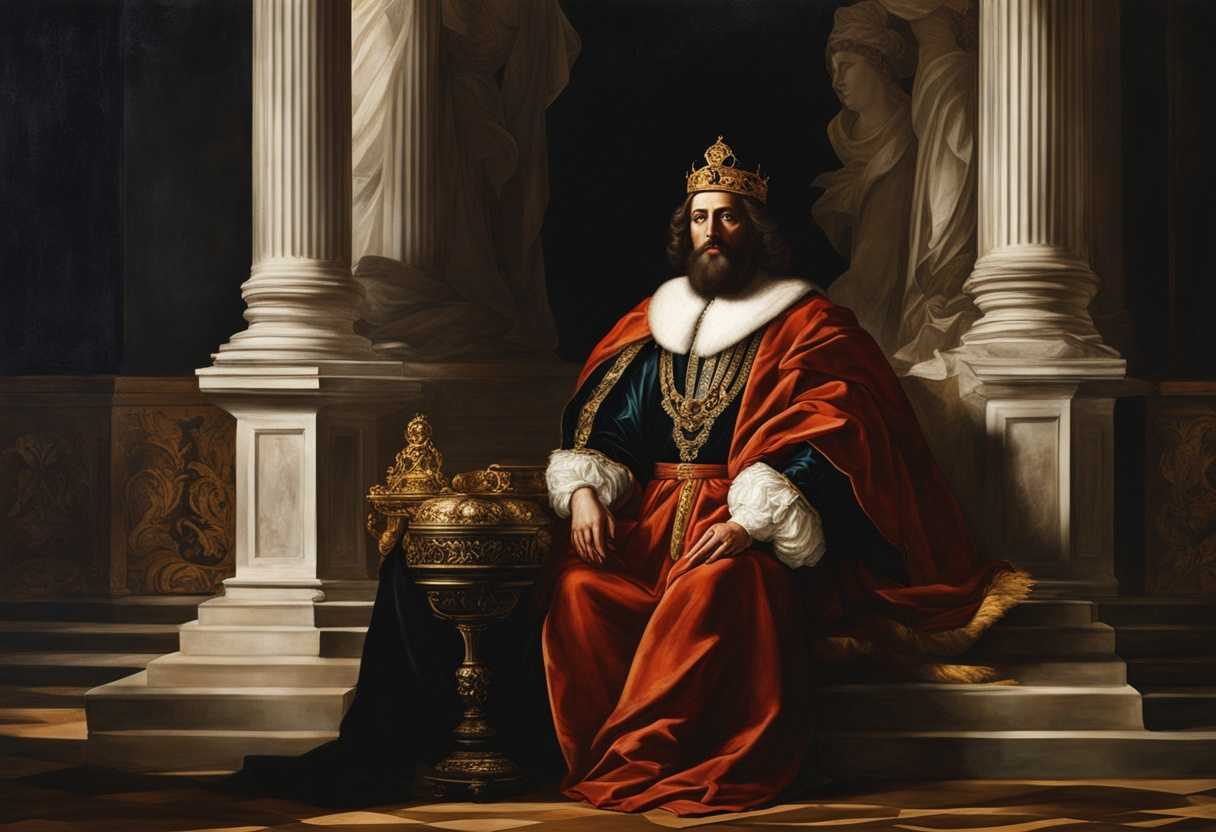
Jehoiakim, whose name means “Yahweh will establish,” was a king of Judah who reigned from 609 to 598 BC. He is often portrayed negatively in the Bible for his disobedience to God and for his role in the events leading to the Babylonian exile.
Scripture
34 And Pharaoh Neco made Eliakim the son of Josiah king in the place of Josiah his father, and changed his name to Jehoiakim. But he took Jehoahaz away, and he came to Egypt and died there.
35 And Jehoiakim gave the silver and the gold to Pharaoh, but he taxed the land to give the money according to the command of Pharaoh. He exacted the silver and the gold of the people of the land, from everyone according to his assessment, to give it to Pharaoh Neco.
36 Jehoiakim was twenty-five years old when he began to reign, and he reigned eleven years in Jerusalem. His mother’s name was Zebidah the daughter of Pedaiah of Rumah.
37 And he did what was evil in the sight of the Lord, according to all that his fathers had done.
Meaning of Jehoiakim in the Bible
Jehoiakim, whose name translates to “Yahweh will establish,” embodies a complex interplay between divine sovereignty and human agency in the context of Israel’s history. His reign is chronicled in the books of 2 Kings and 2 Chronicles, where he is depicted as a king who strayed from the path prescribed by Yahweh, succumbing to the political pressures and moral decay of his times. For instance, 2 Kings 23:37 states, “And he did evil in the sight of the LORD, according to all that his fathers had done.” This disobedience not only reflects a personal failing but also symbolizes a broader failure of leadership in Judah to uphold the covenant with God, ultimately leading to disastrous consequences such as the Babylonian invasion and exile, as prophesied by Jeremiah (Jeremiah 26:6).
In a larger theological context, Jehoiakim’s story reinforces the notion of divine judgment and the tragedy of turning away from God’s commandments. His name, which implies that God will establish, stands in stark contrast to his actions which lead to instability and destruction. This dichotomy resonates with the theme of hope amidst judgment in the biblical narrative; even when the people forsake their covenant, God’s promises endure. Jeremiah 22:30 prophesizes a curse upon Jehoiakim, stating, “Write this man down as childless, a man who shall not succeed in his days,” highlighting the irrevocable consequences of his actions and emphasizing that leadership grounded in disobedience leads to spiritual and national desolation. Thus, Jehoiakim’s reign serves as both a cautionary tale and a reminder of the enduring hope in God’s ultimate plan for restoration.
Jehoiakim’s legacy extends beyond the immediate historical accounts, serving as a lens through which to examine themes of kingship, fidelity to God’s will, and the cyclical nature of sin and punishment within Israel’s narrative. His reign coincides with a period of sociopolitical turmoil marked by the encroachment of Babylonian power. Theological reflections on Jehoiakim highlight the tension between temporal authority and divine purpose; despite being anointed as king, his failure to live out his title’s implication—of being established by Yahweh—culminates in the tragic consequences that befall Judah. As noted in prophetic literature, his prioritizing of self-interest and alliance with foreign powers over covenant faithfulness ultimately promotes a national ethos that denies divine wisdom, emphasizing how individual choices can resonate through the collective fate of a nation.
Further commentary surrounding Jehoiakim raises discussions on the nature of repentance and the possibility of redemption within a covenant framework. While his disobedience leads to national calamity, figures like Jeremiah stand as intermediaries, serving not only as critics but also as instruments of hope. Through prophecies, they reveal that God’s steadfastness is not entirely dependent on human actions; rather, God’s call for repentance is constant, even for the most disobedient rulers. This interplay illustrates a critical theological theme: God’s sovereignty can utilize human disobedience for a larger purpose in the unfolding story of redemption. In the shadow of Jehoiakim’s failures, scriptures remind future generations that while leaders can falter, the invitation to return to God remains a foundational promise, affirming that restoration is always a possibility for those who turn back to Him.
The Significance of Leadership and Authority
Jehoiakim’s reign as king of Judah highlights the complexities of leadership and the responsibilities that come with authority. His actions and decisions reflect the moral and spiritual state of the nation, serving as a reminder that leaders are often held accountable for the welfare of their people. The narrative surrounding Jehoiakim illustrates the consequences of straying from divine guidance and the impact of leadership on national identity and faith.
The Consequences of Disobedience
Jehoiakim’s story serves as a cautionary tale about the repercussions of disobedience to God’s commands. His choices led to significant turmoil for Judah, emphasizing the theme that turning away from divine instruction can result in dire consequences. This aspect of his narrative encourages readers to reflect on the importance of faithfulness and the dangers of neglecting spiritual responsibilities.
The Role of Prophecy and Divine Judgment
The account of Jehoiakim is intertwined with prophetic messages that underscore the theme of divine judgment. His interactions with prophets, particularly Jeremiah, illustrate the tension between human authority and divine will. This dynamic emphasizes the belief that God communicates through prophets to guide nations, and the rejection of such guidance can lead to judgment and downfall, reinforcing the importance of heeding spiritual counsel.
How to Strengthen Your Faith and Walk with God
Strengthening your faith and deepening your walk with God is a beautiful journey that requires intentionality and openness. Start by immersing yourself in Scripture; the Bible is not just a book, but a living guide that speaks to our hearts and circumstances. Set aside time each day for prayer, allowing it to be a two-way conversation where you not only speak but also listen for God’s gentle whispers. Surround yourself with a community of believers who can encourage and challenge you, as fellowship is vital in our spiritual growth. Don’t shy away from serving others, as acts of kindness can profoundly deepen your understanding of God’s love and purpose for your life. Remember, faith is not about perfection but about progress; embrace the journey, trust in God’s timing, and be open to the transformative work He is doing in you.
Bible References to Jehoiakim’s Meaning:
2 Kings 24:1-7: 2 And the Lord sent against him bands of the Chaldeans and bands of the Syrians and bands of the Moabites and bands of the Ammonites, and sent them against Judah to destroy it, according to the word of the Lord that he spoke by his servants the prophets.
2 And the Lord sent against him bands of the Chaldeans and bands of the Syrians and bands of the Moabites and bands of the Ammonites, and sent them against Judah to destroy it, according to the word of the Lord that he spoke by his servants the prophets.
3 Surely this came upon Judah at the command of the Lord, to remove them out of his sight, for the sins of Manasseh, according to all that he had done,
4 And also for the innocent blood that he had shed. For he filled Jerusalem with innocent blood, and the Lord would not pardon.
5 Now the rest of the deeds of Jehoiakim and all that he did, are they not written in the Book of the Chronicles of the Kings of Judah?
6 So Jehoiakim slept with his fathers, and Jehoiachin his son reigned in his place.
7 And the king of Egypt did not come again out of his land, for the king of Babylon had taken all that belonged to the king of Egypt from the Brook of Egypt to the river Euphrates.
2 Kings 24:8-17: 8 Jehoiachin was eighteen years old when he became king, and he reigned three months in Jerusalem. His mother’s name was Nehushta the daughter of Elnathan of Jerusalem.
9 And he did what was evil in the sight of the Lord, according to all that his father had done.
10 At that time the servants of Nebuchadnezzar king of Babylon came up to Jerusalem, and the city was besieged.
11 And Nebuchadnezzar king of Babylon came to the city while his servants were besieging it.
12 and Jehoiachin the king of Judah gave himself up to the king of Babylon, himself and his mother and his servants and his officials and his palace officials. The king of Babylon took him prisoner in the eighth year of his reign,
13 And he carried off all the treasures of the house of the Lord and the treasures of the king’s house, and cut in pieces all the vessels of gold in the temple of the Lord, which Solomon king of Israel had made, as the Lord had foretold.
14 He carried away all Jerusalem and all the officials and all the mighty men of valor, 10,000 captives, and all the craftsmen and the smiths. None remained, except the poorest people of the land.
15 And he carried away Jehoiachin to Babylon. The king’s mother, the king’s wives, his officials, and the chief men of the land he took into captivity from Jerusalem to Babylon.
16 All the men of valor, seven thousand, and the craftsmen and the smiths, one thousand, all of them strong and fit for war, the king of Babylon brought captive to Babylon.
17 And the king of Babylon made Mattaniah, Jehoiachin’s uncle, king in his place, and changed his name to Zedekiah.
2 Chronicles 36:4-8: 4 Then the king of Egypt made Eliakim his brother king over Judah and Jerusalem, and changed his name to Jehoiakim. But Neco took Jehoahaz his brother and carried him to Egypt.
5 Jehoiakim was twenty-five years old when he began to reign, and he reigned eleven years in Jerusalem. He did what was evil in the sight of the Lord his God.
6 Against him came up Nebuchadnezzar king of Babylon and bound him in chains to take him to Babylon.
7 Nebuchadnezzar also carried part of the vessels of the house of the Lord to Babylon and put them in his palace in Babylon.
8 Now the rest of the acts of Jehoiakim, and the abominations that he did, and what was found against him, behold, they are written in the Book of the Kings of Israel and Judah. And Jehoiachin his son reigned in his place.
Jeremiah 22:13-19: 13 “Woe to him who builds his house by unrighteousness, and his upper rooms by injustice, who makes his neighbor serve him for nothing and does not give him his wages,”
14 Who says, ‘I will build myself a great house
with spacious upper rooms,’
who cuts out windows for it,
paneling it with cedar
and painting it with vermilion.
15 Do you think you are a king because you compete in cedar? Did not your father eat and drink and do justice and righteousness? Then it was well with him.
16 He judged the cause of the poor and needy; then it was well. Is not this to know me? declares the Lord.
17 But your eyes and your heart are only for your dishonest gain, for shedding innocent blood, and for practicing oppression and violence.
18 Therefore thus says the Lord concerning Jehoiakim the son of Josiah, king of Judah: “They shall not lament for him, saying, ‘Ah, my brother!’ or ‘Ah, sister!’ They shall not lament for him, saying, ‘Ah, lord!’ or ‘Ah, his majesty!’
19 He shall be buried with the burial of a donkey, dragged and dumped beyond the gates of Jerusalem.”
Jeremiah 26:1-24: 1 In the beginning of the reign of Jehoiakim the son of Josiah, king of Judah, this word came from the Lord:
2 “Thus says the Lord: Stand in the court of the Lord’s house, and speak to all the cities of Judah that come to worship in the house of the Lord all the words that I command you to speak to them; do not hold back a word.”
3 It may be they will listen, and every one turn from his evil way, that I may relent of the disaster that I intend to do to them because of their evil deeds.
4 You shall say to them, ‘Thus says the Lord: If you will not listen to me, to walk in my law that I have set before you,
5 saying, ‘If you will not listen to me, to walk in my law that I have set before you,
6 then I will make this house like Shiloh, and I will make this city a curse for all the nations of the earth.”
7 The priests and the prophets and all the people heard Jeremiah speaking these words in the house of the Lord.
8 And when Jeremiah had finished speaking all that the Lord had commanded him to speak to all the people, then the priests and the prophets and all the people laid hold of him, saying, “You shall die.
9 Why have you prophesied in the name of the Lord, saying, ‘This house shall be like Shiloh, and this city shall be desolate, without inhabitant’?” And all the people gathered around Jeremiah in the house of the Lord.
10 When the officials of Judah heard these things, they came up from the king’s house to the house of the Lord and took their seat in the entry of the New Gate of the house of the Lord.
11 Then the priests and the prophets said to the officials and to all the people, “This man deserves the sentence of death, because he has prophesied against this city, as you have heard with your own ears.”
12 Then Jeremiah spoke to all the officials and all the people, saying, “The Lord sent me to prophesy against this house and this city all the words you have heard.
13 Now therefore mend your ways and your deeds, and obey the voice of the Lord your God, and the Lord will relent of the disaster that he has pronounced against you.
14 But as for me, behold, I am in your hands. Do with me as seems good and right to you.
15 But know for certain that if you put me to death, you will bring innocent blood upon yourselves and upon this city and its inhabitants, for in truth the Lord sent me to you to speak all these words in your ears.”
16 Then the officials and all the people said to the priests and the prophets, “This man does not deserve the sentence of death, for he has spoken to us in the name of the Lord our God.”
17 Then certain of the elders of the land arose and spoke to all the assembled people, saying:
18 “Micah of Moresheth prophesied in the days of Hezekiah king of Judah, and said to all the people of Judah: ‘Thus says the Lord of hosts, “Zion shall be plowed as a field; Jerusalem shall become a heap of ruins, and the mountain of the house a wooded height.”’
19 Did Hezekiah king of Judah and all Judah put him to death? Did he not fear the Lord and entreat the favor of the Lord, and did not the Lord relent of the disaster that he had pronounced against them?
20 There was another man who prophesied in the name of the Lord, Uriah the son of Shemaiah from Kiriath-jearim. He prophesied against this city and against this land in words like those of Jeremiah.
21 And when Jehoiakim the king, with all his warriors and all the officials, heard his words, the king sought to put him to death. But when Uriah heard of it, he was afraid and fled and escaped to Egypt.
22 But King Jehoiakim sent men to Egypt, Elnathan the son of Achbor and others with him,
23 And when Jehoiakim the king, with all his warriors and all the officials, heard his words, the king sought to put him to death. But when Uriah heard of it, he was afraid and fled and escaped to Egypt.
24 But the hand of Ahikam the son of Shaphan was with Jeremiah so that he was not given over to the people to be put to death.
Jeremiah 35:1-19: 1 The word that came to Jeremiah from the Lord in the days of Jehoiakim the son of Josiah, king of Judah:
2 Go to the house of the Rechabites and speak with them and bring them to the house of the Lord, into one of the chambers; then offer them wine to drink.”
3 Then I took Jaazaniah the son of Jeremiah, son of Habazziniah, and his brothers and all his sons and the whole house of the Rechabites.
4 I brought them into the house of the Lord, into the chamber of the sons of Hanan the son of Igdaliah, the man of God, which was near the chamber of the officials, above the chamber of Maaseiah the son of Shallum, keeper of the threshold.
5 I set before the sons of the house of the Rechabites pitchers full of wine, and cups, and I said to them, “Drink wine.”
6 But they answered, “We will drink no wine, for Jonadab the son of Rechab, our father, commanded us, ‘You shall not drink wine, you or your sons forever.
7 You shall not build a house; you shall not sow seed; you shall not plant or have a vineyard; but you shall live in tents all your days, that you may live many days in the land where you sojourn.’
8 We have obeyed the voice of Jonadab the son of Rechab, our father, in all that he commanded us, to drink no wine all our days, ourselves, our wives, our sons, or our daughters,
9 I have not planted or sown or have gotten anything from the ground, but when Nebuchadnezzar king of Babylon came up against this land, we said, ‘Come, and let us go to Jerusalem for fear of the army of the Chaldeans and the army of the Syrians.’ So we are living in Jerusalem.”
10 We have lived in tents and have obeyed and done all that Jonadab our father commanded us.
11 But when Nebuzaradan, the captain of the guard, left in the land of Judah some of the poor people who owned nothing, and gave them vineyards and fields at the same time.
12 Then the word of the Lord came to Jeremiah:
13 Thus says the Lord of hosts, the God of Israel: Go and say to the people of Judah and the inhabitants of Jerusalem, Will you not receive instruction and listen to my words? declares the Lord.
14 The command that Jonadab the son of Rechab gave to his sons, to drink no wine, has been kept, and they drink none to this day, for they have obeyed their father’s command. But I have spoken to you persistently, and you have not listened to me.
15 I have sent to you all my servants the prophets, sending them persistently, saying, ‘Turn now every one of you from his evil way, and amend your deeds, and do not go after other gods to serve them, and then you shall dwell in the land that I gave to you and your fathers.’ But you did not incline your ear or listen to me.
16 Because the sons of Jonadab the son of Rechab have kept the command that their father gave them, but this people has not obeyed me.
17 Therefore, thus says the Lord, the God of hosts, the God of Israel: Behold, I am bringing upon Judah and all the inhabitants of Jerusalem all the disaster that I have pronounced against them, because I have spoken to them and they have not listened, I have called to them and they have not answered.
18 But to the house of the Rechabites Jeremiah said, “Thus says the Lord of hosts, the God of Israel: Because you have obeyed the command of Jonadab your father and kept all his precepts and done all that he commanded you,
19 Therefore thus says the Lord of hosts, the God of Israel: Jonadab the son of Rechab shall never lack a man to stand before me.”
Jeremiah 36:1-32: 1 In the fourth year of Jehoiakim the son of Josiah, king of Judah, this word came to Jeremiah from the Lord:
2 “Take a scroll and write on it all the words that I have spoken to you against Israel and Judah and all the nations, from the day I spoke to you, from the days of Josiah until today.”
3 It may be that the house of Judah will hear all the disaster that I intend to do to them, so that every one may turn from his evil way, and that I may forgive their iniquity and their sin.
4 Then Jeremiah called Baruch the son of Neriah, and Baruch wrote on a scroll at the dictation of Jeremiah all the words of the Lord that he had spoken to him.
5 And Jeremiah ordered Baruch, saying, “I am banned from going to the house of the Lord.
6 So you go, and on a day of fasting in the hearing of all the people in the Lord’s house you shall read the words of the Lord from the scroll that you have written at my dictation. You shall read them also in the hearing of all the men of Judah who come out of their cities.
7 It may be that their plea for mercy will come before the Lord, and that every one will turn from his evil way, for great is the anger and wrath that the Lord has pronounced against this people.”
8 Baruch the son of Neriah did all that Jeremiah the prophet commanded him about reading from the scroll the words of the Lord in the Lord’s house.
9 In the fifth year of Jehoiakim the son of Josiah, king of Judah, in the ninth month, all the people in Jerusalem and all the people who came from the cities of Judah to Jerusalem proclaimed a fast before the Lord.
10 Then, in the hearing of all the people, Baruch read the words of Jeremiah from the scroll, in the house of the Lord, in the chamber of Gemariah the son of Shaphan the secretary, which was in the upper court, at the entry of the New Gate of the Lord’s house.
11 When Micaiah the son of Gemariah, son of Shaphan, heard all the words of the Lord from the scroll,
12 he went down to the king’s house, into the secretary’s chamber, and all the officials were sitting there: Elishama the secretary, Delaiah the son of Shemaiah, Elnathan the son of Achbor, Gemariah the son of Shaphan, Zedekiah the son of Hananiah, and all the officials.
13 And Micaiah told them all the words that he had heard, when Baruch read the scroll in the hearing of the people.
14 Therefore all the officials sent Jehudi the son of Nethaniah, son of Shelemiah, son of Cushi, to say to Baruch, “Take in your hand the scroll that you read in the hearing of the people, and come.” So Baruch the son of Neriah took the scroll in his hand and came to them.
15 In their hearing all the officials sent Jehudi the son of Nethaniah, son of Shelemiah, son of Cushi, to say to Baruch, “Take in your hand the scroll that you read in the hearing of the people, and come.”
16 When they heard all the words, they turned one to another in fear. And they said to Baruch, “We must report all these words to the king.”
17 And they asked Baruch, “Tell us, please, how did you write all these words? Is it at his dictation?”
18 Baruch said to them, “He dictated all these words to me, while I wrote them with ink on the scroll.”
19 Then the officials said to Baruch, “Go and hide, you and Jeremiah, and let no one know where you are.”
20 So they went into the court to the king, having put the scroll in the chamber of Elishama the secretary, and they reported all the words to the king.
21 Then the king sent Jehudi to get the scroll, and he took it from the chamber of Elishama the secretary. And Jehudi read it to the king and all the officials who stood beside the king.
22 It was the ninth month, and the king was sitting in the winter house, and there was a fire burning in the fire pot before him.
23 As Jehudi read three or four columns, the king would cut them off with a knife and throw them into the fire in the fire pot, until the entire scroll was consumed in the fire that was in the fire pot.
24 Yet neither the king nor any of his servants who heard all these words was afraid, nor did they tear their garments.
25 Even when Elnathan and Delaiah and Gemariah urged the king not to burn the scroll, he would not listen to them.
26 And the king commanded Jerahmeel the king’s son and Seraiah the son of Azriel and Shelemiah the son of Abdeel to seize Baruch the secretary and Jeremiah the prophet, but the Lord hid them.
27 Now after the king had burned the scroll with the words that Baruch wrote at Jeremiah’s dictation, the word of the Lord came to Jeremiah:
28 “Take another scroll and write on it all the former words that were in the first scroll, which Jehoiakim the king of Judah has burned.”
29 And concerning Jehoiakim king of Judah you shall say, ‘Thus says the Lord, You have burned this scroll, saying, “Why have you written in it that the king of Babylon will certainly come and destroy this land, and will cut off from it man and beast”?
30 Therefore thus says the Lord concerning Jehoiakim king of Judah: He shall have none to sit on the throne of David, and his dead body shall be cast out to the heat by day and the frost by night.
31 And I will punish him and his offspring and his servants for their iniquity. I will bring upon them and upon the inhabitants of Jerusalem and upon the people of Judah all the disaster that I have pronounced against them, but they would not hear.’”
32 Then Jeremiah took another scroll and gave it to Baruch the scribe, the son of Neriah, who wrote on it at the dictation of Jeremiah all the words of the scroll that Jehoiakim king of Judah had burned in the fire. And many similar words were added to them.
Jeremiah 45:1-5: 1 The word that Jeremiah the prophet spoke to Baruch the son of Neriah, when he wrote these words in a book at the dictation of Jeremiah, in the fourth year of Jehoiakim the son of Josiah, king of Judah:
2 “Thus says the Lord, the God of Israel, to you, O Baruch:”
3 You said, ‘Woe is me! For the Lord has added sorrow to my pain. I am weary with my groaning, and I find no rest.’
4 Thus shall you say to him, Thus says the Lord: Behold, what I have built I am breaking down, and what I have planted I am plucking up—that is, the whole land.
5 And do you seek great things for yourself? Seek them not, for behold, I am bringing disaster upon all flesh, declares the Lord. But I will give you your life as a prize of war in all places to which you may go.”
Jeremiah 46:1-2: 1 The word of the Lord that came to Jeremiah the prophet concerning the nations.
2 About Egypt. Concerning the army of Pharaoh Neco, king of Egypt, which was by the river Euphrates at Carchemish, and which Nebuchadnezzar king of Babylon defeated in the fourth year of Jehoiakim the son of Josiah, king of Judah.
Daniel 1:1-2: 1 In the third year of the reign of Jehoiakim king of Judah, Nebuchadnezzar king of Babylon came to Jerusalem and besieged it.
2 And the Lord gave Jehoiakim king of Judah into his hand, with some of the vessels of the house of God. And he brought them to the land of Shinar, to the house of his god, and placed the vessels in the treasury of his god.

Rev. François Dupont is a dedicated church minister with a wealth of experience in serving spiritual communities. With a calm and serene demeanor, he has been devoted to sharing the message of love, compassion, and tolerance for over two decades. Through his thoughtful sermons, compassionate counseling, and unwavering support, Rev. Dupont has touched the lives of countless individuals, allowing them to find solace and strength during difficult times. His serene presence and deep understanding of the human condition make him a trusted guide for those seeking spiritual nourishment and guidance.