
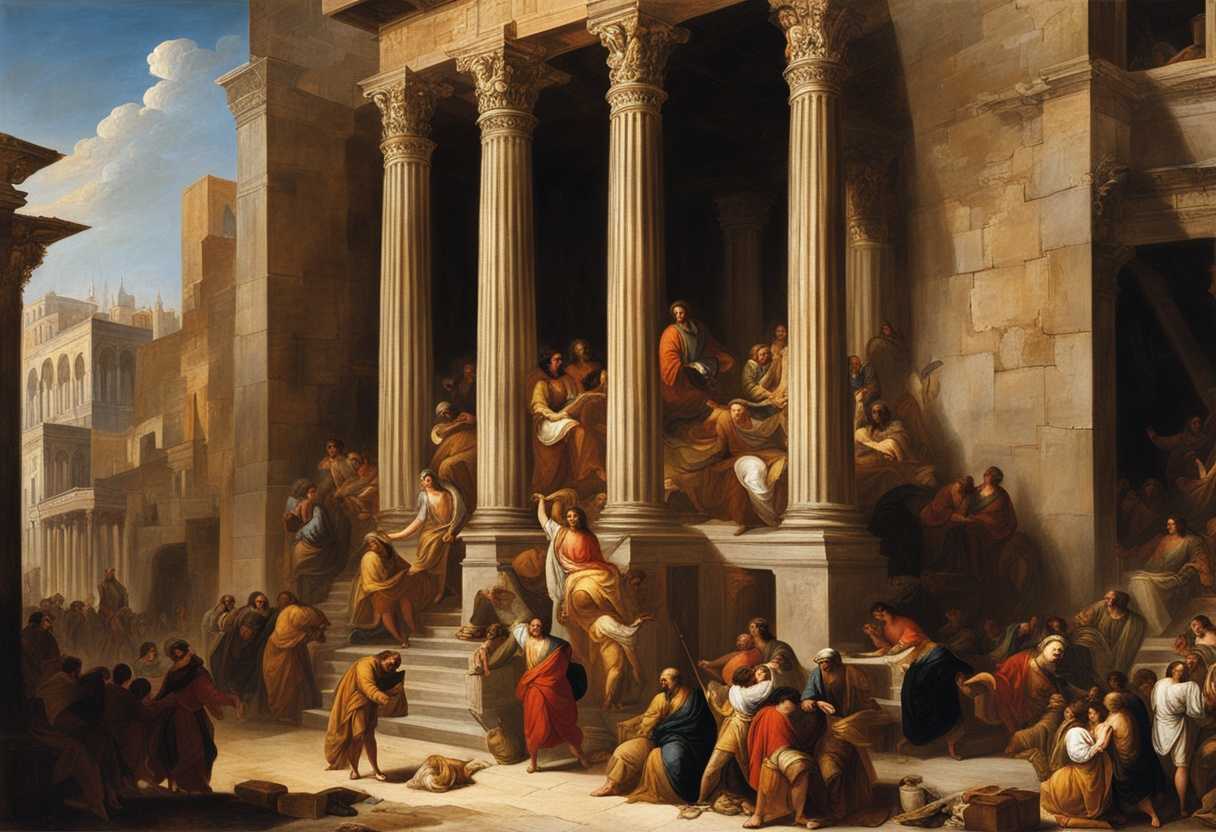
Zerubbabel, in the Bible, means “sown in Babylon” and is known as a leader of the Jewish people who returned from Babylonian exile to help rebuild the Temple in Jerusalem. He is also recognized as a key figure in the lineage leading to Jesus Christ, as mentioned in the Gospels.
Scripture
1 In the second year of Darius the king, in the sixth month, on the first day of the month, the word of the Lord came by the hand of Haggai the prophet to Zerubbabel the son of Shealtiel, governor of Judah, and to Joshua the son of Jehozadak, the high priest:
2 “Thus says the Lord of hosts: These people say the time has not yet come to rebuild the house of the Lord.”
3 Then the word of the Lord came by the hand of Haggai the prophet,
4 “Is it a time for you yourselves to dwell in your paneled houses, while this house lies in ruins?”
5 Now, therefore, thus says the Lord of hosts: Consider your ways.
6 You have sown much, and harvested little. You eat, but you never have enough; you drink, but you never have your fill. You clothe yourselves, but no one is warm. And he who earns wages does so to put them into a bag with holes.
7 “Thus says the Lord of hosts: Consider your ways.”
8 Go up to the hills and bring wood and build the house, that I may take pleasure in it and that I may be glorified, says the Lord.
9 You looked for much, and behold, it came to little. And when you brought it home, I blew it away. Why? declares the Lord of hosts. Because of my house that lies in ruins, while each of you busies himself with his own house.
10 Therefore the heavens above you have withheld the dew, and the earth has withheld its produce.
11 And I have called for a drought on the land and the hills, on the grain, the new wine, the oil, on what the ground brings forth, on man and beast, and on all their labors.
12 Then Zerubbabel the son of Shealtiel, and Joshua the son of Jehozadak, the high priest, with all the remnant of the people, obeyed the voice of the Lord their God, and the words of Haggai the prophet, as the Lord their God had sent him. And the people feared the Lord.
13 Then Haggai, the messenger of the Lord, spoke to the people with the Lord’s message, “I am with you, declares the Lord.”
14 And the Lord stirred up the spirit of Zerubbabel the son of Shealtiel, governor of Judah, and the spirit of Joshua the son of Jehozadak, the high priest, and the spirit of all the remnant of the people. And they came and worked on the house of the Lord of hosts, their God,
15 On the twenty-fourth day of the sixth month, in the second year of Darius the king.
Meaning of Zerubbabel in the Bible
Zerubbabel, whose name means “sown in Babylon,” encapsulates significant themes of restoration and hope within the biblical narrative. After the Babylonian exile, Zerubbabel emerged as a prominent leader, tasked with the monumental responsibility of guiding the Jewish people back to their homeland and spearheading the rebuilding of the Temple in Jerusalem (Ezra 3:8-13). His leadership symbolizes not only the physical restoration of Jewish worship and identity but also the spiritual renewal of a people longing for divine connection. This act of rebuilding is historically and symbolically profound, as it reestablishes Jerusalem as the center of Jewish faith and national identity following a period of profound displacement and despair.
Furthermore, Zerubbabel holds a critical place in the genealogy of Jesus Christ, as outlined in the Gospels of Matthew (1:12) and Luke (3:27). This connection enhances his significance within the biblical narrative, as it links the anticipated Messiah to the themes of fulfillment and promise inherent in the Jewish faith. The lineage of Zerubbabel not only points to the continuity of God’s covenant with His people but also highlights the hope for redemption through Christ, who embodies the ultimate restoration that Zerubbabel’s Temple foreshadowed. Thus, Zerubbabel stands as a figure emblematic of both physical restoration and spiritual promise, bridging the exile’s despair with the hope of future redemption, which resonates throughout the framework of biblical theology.
Zerubbabel’s role extends beyond his leadership in the physical reconstruction of the Temple; he is also pivotal in the prophetic literature of the Old Testament. The prophet Haggai, who ministered during Zerubbabel’s time, emphasizes God’s presence with Zerubbabel and assures him of divine support in the daunting task of rebuilding. Haggai 2:23 mentions Zerubbabel as God’s chosen signet ring, signifying his important role in God’s plans. This imagery not only highlights Zerubbabel’s authority but also serves as a testament to God’s unwavering commitment to His people amid their restoration process. His leadership is thus recognized as divinely ordained, reinforcing the belief that restoration is part of God’s overarching plan for Israel.
In addition, Zechariah’s prophecies concerning Zerubbabel reveal deeper theological implications of his work. Zechariah 4 offers a vision where the rebuilding of the Temple is likened to a monumental endeavor achieved not by might nor by power, but by the Spirit of the Lord. This underscores a critical aspect of Zerubbabel’s journey: the recognition that spiritual renewal cannot be achieved through human effort alone, but through reliance on divine assistance. The imagery of the lampstands and the olive trees in this passage symbolizes the sustaining grace of God that fuels the restoration efforts. Thus, Zerubbabel not only serves as a literal leader in rebuilding but also as a spiritual figure representing reliance on God, further enhancing his integral place within the redemptive narrative of the Old Testament and its fulfillment in the New Testament.
Restoration and Leadership
Zerubbabel represents the theme of restoration in the post-exilic period of Israel’s history. As a leader who played a crucial role in the return of the Jewish people from Babylonian captivity, his name signifies hope and renewal. He was instrumental in the rebuilding of the Temple in Jerusalem, symbolizing the restoration of worship and the re-establishment of the Jewish community. His leadership reflects the importance of guidance and vision in times of national crisis, emphasizing that true restoration requires both spiritual and physical rebuilding.
Messianic Significance
Zerubbabel is also seen as a significant figure in the Messianic lineage. His genealogy connects him to King David, which is important in the context of biblical prophecy regarding the coming Messiah. This connection highlights the continuity of God’s covenant with His people and the promise of a future king who would restore Israel. In this sense, Zerubbabel serves as a foreshadowing of Christ, representing the fulfillment of God’s promises and the hope of redemption for humanity.
Faithfulness Amidst Adversity
Zerubbabel’s story illustrates the theme of faithfulness amidst adversity. Leading the people back to Jerusalem and undertaking the monumental task of rebuilding the Temple was fraught with challenges, including opposition from surrounding nations and internal discouragement. His perseverance in the face of these obstacles serves as a powerful reminder of the importance of faith and commitment to God’s calling, encouraging believers to remain steadfast in their own journeys despite difficulties.
How to Embrace Faith and Lead with Integrity
Embracing faith and leading with integrity is a beautiful journey that requires both introspection and action. Start by grounding yourself in prayer and scripture, allowing God’s word to shape your values and decisions. Reflect on the teachings of Jesus, who exemplified integrity through His unwavering commitment to truth and love. As you navigate your daily life, strive to align your actions with your beliefs, treating others with kindness and respect, even in challenging situations. Remember, integrity isn’t just about being honest; it’s about being consistent in your character, whether in public or private. Surround yourself with a community of fellow believers who encourage you to grow and hold you accountable. By living out your faith authentically, you not only honor God but also inspire those around you to do the same.
Bible References to Zerubbabel’s Meaning:
Haggai 2:1-9: 1 In the seventh month, on the twenty-first day of the month, the word of the Lord came by the hand of Haggai the prophet:
2 “Speak now to Zerubbabel the son of Shealtiel, governor of Judah, and to Joshua the son of Jehozadak, the high priest, and to all the remnant of the people, and say,
3 ‘Who is left among you who saw this house in its former glory? How do you see it now? Is it not as nothing in your eyes?
4 Yet now be strong, O Zerubbabel, declares the Lord. Be strong, O Joshua, son of Jehozadak, the high priest. Be strong, all you people of the land, declares the Lord. Work, for I am with you, declares the Lord of hosts,
5 According to the covenant that I made with you when you came out of Egypt. My Spirit remains in your midst. Fear not.
6 For thus says the Lord of hosts: Yet once more, in a little while, I will shake the heavens and the earth and the sea and the dry land.
7 And I will shake all nations, so that the treasures of all nations shall come in, and I will fill this house with glory, says the Lord of hosts.
8 The silver is mine, and the gold is mine, declares the Lord of hosts.
9 The latter glory of this house shall be greater than the former, says the Lord of hosts. And in this place I will give peace, declares the Lord of hosts.
Haggai 2:20-23: 20 The word of the Lord came a second time to Haggai on the twenty-fourth day of the month,
21 “Speak to Zerubbabel, governor of Judah, saying, I am about to shake the heavens and the earth,
22 And I will overthrow the throne of kingdoms. I will destroy the strength of the kingdoms of the nations, and overthrow the chariots and their riders. And the horses and their riders shall go down, every one by the sword of his brother.
23 On that day, declares the Lord of hosts, I will take you, O Zerubbabel my servant, the son of Shealtiel, declares the Lord, and make you like a signet ring, for I have chosen you, declares the Lord of hosts.
Zechariah 4:1-14: 1 And the angel who talked with me came again and woke me, like a man who is awakened out of his sleep.
2 And he said to me, “What do you see?” I said, “I see, and behold, a lampstand all of gold, with a bowl on the top of it, and seven lamps on it, with seven lips on each of the lamps that are on the top of it.
3 And there are two olive trees by it, one on the right of the bowl and the other on its left.”
4 Then I said to the angel who talked with me, “What are these, my lord?”
5 Then the angel who talked with me answered and said to me, “Do you not know what these are?” And I said, “No, my lord.”
6 Then he said to me, “This is the word of the Lord to Zerubbabel: Not by might, nor by power, but by my Spirit, says the Lord of hosts.
7 Who are you, O great mountain? Before Zerubbabel you shall become a plain. And he shall bring forward the top stone amid shouts of ‘Grace, grace to it!’”
4 Then the word of the Lord came to me, saying:
9 “The hands of Zerubbabel have laid the foundation of this house; his hands shall also complete it. Then you will know that the Lord of hosts has sent me to you.”
10 For whoever has despised the day of small things shall rejoice, and shall see the plumb line in the hand of Zerubbabel.
4 Then I said to him, “What are these two olive trees on the right and the left of the lampstand?”
12 And I said to him, “What are these two olive branches that are beside the two golden pipes from which the golden oil is poured out?”
13 He said to me, “Do you not know what these are?” I said, “No, my lord.”
14 Then he said, “These are the two anointed ones who stand by the Lord of the whole earth.”
Ezra 2:1-2: 1 Now these were the people of the province who came up out of the captivity of those exiles whom Nebuchadnezzar the king of Babylon had carried captive to Babylonia.
2 They came with Zerubbabel, Jeshua, Nehemiah, Seraiah, Reelaiah, Mordecai, Bilshan, Mispar, Bigvai, Rehum, and Baanah.
Ezra 3:1-13: 3 When the seventh month came, and the children of Israel were in the towns, the people gathered as one man to Jerusalem.
2 Then Jeshua the son of Jozadak and his fellow priests arose and built the altar of the God of Israel, to offer burnt offerings on it, as it is written in the Law of Moses the man of God.
3 They set the altar in its place, for fear was on them because of the peoples of the lands, and they offered burnt offerings on it to the Lord, burnt offerings morning and evening.
4 And they kept the Feast of Booths, as it is written, and offered the daily burnt offerings by number according to the rule, as each day required,
5 and after that the regular burnt offerings, the offerings at the new moon and at all the appointed feasts of the Lord, and the offerings of everyone who made a freewill offering to the Lord.
6 From the first day of the seventh month they began to offer burnt offerings to the Lord. But the foundation of the temple of the Lord was not yet laid.
7 And they gave money to the masons and the carpenters, and food, drink, and oil to the Sidonians and the Tyrians to bring cedar trees from Lebanon to the sea, to Joppa, according to the grant that they had from Cyrus king of Persia.
8 Now in the second year after their coming to the house of God at Jerusalem, in the second month, Zerubbabel the son of Shealtiel and Jeshua the son of Jozadak made a beginning, together with the rest of their kinsmen, the priests and the Levites and all who had come to Jerusalem from the captivity. They appointed the Levites, from twenty years old and upward, to supervise the work of the house of the Lord.
9 And Jeshua with his sons and his brothers, and Kadmiel and his sons, the sons of Judah, together supervised the workmen in the house of God, along with the sons of Henadad and the Levites, their sons and brothers.
10 And when the builders laid the foundation of the temple of the Lord, the priests in their vestments came forward with trumpets, and the Levites, the sons of Asaph, with cymbals, to praise the Lord, according to the directions of David king of Israel.
11 And they sang responsively, praising and giving thanks to the Lord, “For he is good, for his steadfast love endures forever toward Israel.” And all the people shouted with a great shout when they praised the Lord, because the foundation of the house of the Lord was laid.
12 But many of the priests and Levites and heads of fathers’ houses, old men who had seen the first house, wept with a loud voice when they saw the foundation of this house being laid, though many shouted aloud for joy,
13 so that the people could not distinguish the sound of the joyful shout from the sound of the people’s weeping, for the people shouted with a great shout, and the sound was heard far away.
Ezra 4:1-5: 1 Now when the adversaries of Judah and Benjamin heard that the returned exiles were building a temple to the Lord, the God of Israel,
2 they approached Zerubbabel and the heads of fathers’ houses and said to them, “Let us build with you, for we worship your God as you do, and we have been sacrificing to him ever since the days of Esarhaddon king of Assyria who brought us here.”
3 But Zerubbabel, Jeshua, and the rest of the heads of fathers’ houses in Israel said to them, “You have nothing to do with us in building a house to our God; but we alone will build to the Lord, the God of Israel, as King Cyrus the king of Persia has commanded us.”
4 Then the people of the land discouraged the people of Judah and made them afraid to build
5 and hired counselors against them to frustrate their purpose, all the days of Cyrus king of Persia, even until the reign of Darius king of Persia.
Ezra 5:1-2: 1 Now the prophets, Haggai the prophet and Zechariah the son of Iddo, prophesied to the Jews who were in Judah and Jerusalem, in the name of the God of Israel who was over them.
2 Then Zerubbabel the son of Shealtiel and Jeshua the son of Jozadak arose and began to rebuild the house of God that is in Jerusalem, and the prophets of God were with them, supporting them.
Ezra 5:14-16: 14 And the vessels that have been given you for the service of the house of your God, you shall deliver before the God of Jerusalem.
15 They delivered it into the hands of the workmen, the officials, and the elders of the Jews, who built for us the house of our God as we rebuilt the house that was destroyed many years ago.
16 Then this Sheshbazzar came and laid the foundations of the house of God that is in Jerusalem, and from that time until now it has been in building, and it is not yet finished.
Ezra 6:1-15: 1 Then Darius the king made a decree, and search was made in Babylonia, in the house of the archives where the documents were stored.
2 And in Ecbatana, the citadel that is in the province of Media, a scroll was found on which this was written: “A record.
3 In the first year of Cyrus the king, Cyrus the king issued a decree: Concerning the house of God at Jerusalem, let the house be rebuilt, the place where sacrifices were offered, and let its foundations be retained. Its height shall be sixty cubits and its breadth sixty cubits,
4 with three layers of great stones and one layer of timber. And let the cost be paid from the royal treasury.
5 And also let the gold and silver vessels of the house of God, which Nebuchadnezzar took out of the temple that is in Jerusalem and brought to Babylon, be restored and brought back to the temple that is in Jerusalem, each to its place. You shall put them in the house of God.”
6 Now therefore, Tattenai, governor of the province Beyond the River, Shethar-bozenai, and your associates the governors who are in the province Beyond the River, keep away.
7 Let the work on this house of God alone. Let the governor of the Jews and the elders of the Jews rebuild this house of God on its site.
8 Moreover, I make a decree regarding what you shall do for these elders of the Jews for the rebuilding of this house of God. The cost is to be paid to these men in full and without delay from the royal revenue, the tribute of the province from Beyond the River.
9 And whatever is needed—bulls, rams, or sheep for burnt offerings to the God of heaven, wheat, salt, wine, or oil, as the priests in Jerusalem require—let that be given to them day by day without fail,
10 that they may offer pleasing sacrifices to the God of heaven and pray for the life of the king and his sons.
11 Also I make a decree that if anyone alters this edict, a beam shall be pulled out of his house, and he shall be impaled on it, and his house shall be made a dunghill.
12 May the God who has caused his name to dwell there overthrow any king or people who shall put out a hand to alter this, or to destroy this house of God that is in Jerusalem. I Darius make a decree; let it be done with all diligence.”
13 Then, according to the word sent by Darius the king, Tattenai, the governor of the province Beyond the River, Shethar-bozenai, and their associates did with all diligence what Darius the king had ordered.
14 And the elders of the Jews built and prospered through the prophesying of Haggai the prophet and Zechariah the son of Iddo. They finished their building by decree of the God of Israel and by decree of Cyrus and Darius and Artaxerxes king of Persia.
15 And this house was finished on the third day of the month of Adar, in the sixth year of the reign of Darius the king.
Nehemiah 7:6-7: 6 These were the people of the province who came up out of the captivity of those exiles whom Nebuchadnezzar the king of Babylon had carried captive to Babylonia. They returned to Jerusalem and Judah, each to his town.
7 who came with Zerubbabel, Jeshua, Nehemiah, Azariah, Raamiah, Nahamani, Mordecai, Bilshan, Mispereth, Bigvai, Nehum, Baanah.
1 Chronicles 3:17-19: 17 And the sons of Jeconiah, the captive: Shealtiel his son,
18 Malchiram, Pedaiah, Shenazzar, Jekamiah, Hoshama, and Nedabiah.
19 The sons of Pedaiah: Zerubbabel and Shimei.
Matthew 1:12-13: 12 And after the deportation to Babylon: Jechoniah was the father of Shealtiel, and Shealtiel the father of Zerubbabel.
13 and Zerubbabel the father of Abiud, and Abiud the father of Eliakim, and Eliakim the father of Azor,
Luke 3:27: 27 …the son of Joanan, the son of Rhesa, the son of Zerubbabel, the son of Shealtiel, the son of Neri,

Reverend Michael Johnson is an experienced Church Minister with a profound expertise in spirituality and guidance. With a serene presence and a compassionate heart, he has faithfully served his congregation for over 20 years, leading them on a spiritual journey towards inner peace and enlightenment. Reverend Johnson’s extensive knowledge of religious philosophies and profound understanding of human nature have made him a trusted confidant and mentor to many, as he seamlessly weaves his profound wisdom into life teachings. Reverend Johnson’s calming demeanor and empathetic nature continue to uplift and heal souls, nurturing a sense of unity and tranquility within his community.