
Ham, one of the sons of Noah, is often regarded as the progenitor of various nations and peoples, particularly those associated with Africa and parts of the Near East. His lineage is noted in the Bible, particularly in Genesis 10, where it describes the descendants of Noah after the Flood and their spread across the earth.
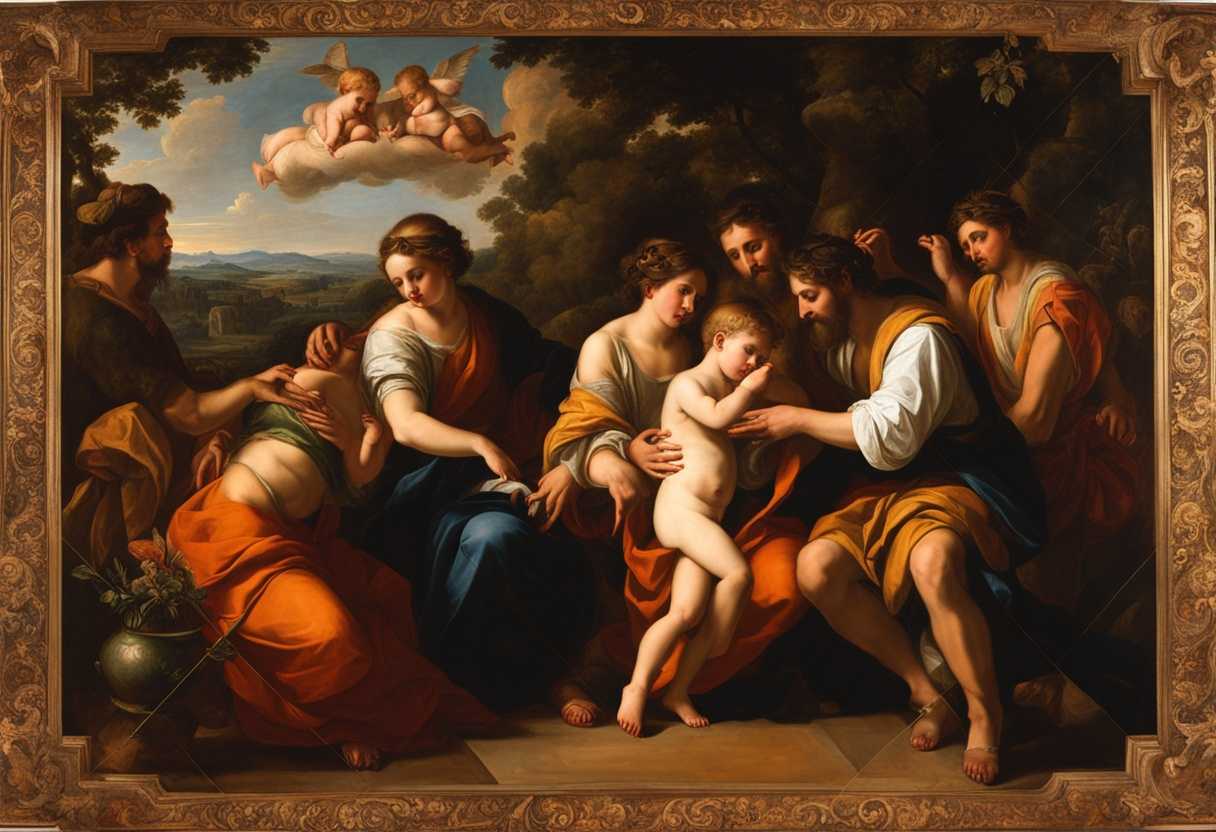
Scripture
18 The sons of Noah who went forth from the ark were Shem, Ham, and Japheth. Ham was the father of Canaan.
19 These three were the sons of Noah, and from these the people of the whole earth were dispersed.
20 Noah began to be a man of the soil, and he planted a vineyard.
21 He drank of the wine and became drunk and lay uncovered in his tent.
22 And Ham, the father of Canaan, saw the nakedness of his father and told his two brothers outside.
23 Then Shem and Japheth took a garment, laid it on both their shoulders, and walked backward and covered the nakedness of their father. Their faces were turned backward, and they did not see their father’s nakedness.
24 When Noah awoke from his wine and knew what his youngest son had done to him,
25 he said, “Cursed be Canaan;
a servant of servants shall he be to his brothers.”
26 He also said, “Blessed be the Lord, the God of Shem; and let Canaan be his servant.”
27 May God enlarge Japheth, and let him dwell in the tents of Shem, and let Canaan be his servant.”
28 And Noah lived after the flood three hundred and fifty years.
29 All the days of Noah were nine hundred and fifty years, and he died.
Ham in the Bible: Definition and Significance
The biblical character of Ham, one of Noah’s three sons, serves as a significant figure in various theological and historical interpretations of the Old Testament. Ham’s lineage is expounded upon in Genesis 10, where his descendants—Cush, Mizraim, Put, and Canaan—become associated with regions in Africa and parts of the Near East. For instance, Cush is often linked to the people of Nubia and Ethiopia, while Mizraim is recognized as a reference to Egypt. The nations arising from Ham are traditionally viewed as symbolizing a broader spectrum of diversity and cultural complexity in the world post-Flood, emphasizing that God’s creation is not monolithic but rich in variety.
Moreover, the narrative surrounding Ham incorporates deeper theological implications, particularly in the context of the “Curse of Ham” related to Noah’s drunkenness in Genesis 9:20-27. This episode has historically been misinterpreted in ways that have led to racial and cultural stigmatization, particularly against African people. However, this interpretation neglects the theological foundation of dignity and worth inherent in all peoples, as expressed in Genesis 1:27, which states that humanity is created in the image of God. Understanding Ham’s role and the subsequent generations is critical for recognizing the collaborative narrative of humanity that transcends divisions and encourages unity, calling all peoples to acknowledge their shared origins and the commandment to steward the Earth in peace and justice. Thus, Ham’s story invites reflection on how we view ancestry, identity, and the sacredness of all human life.
Ham’s role in biblical narratives invites further exploration through the lens of various traditions and historical contexts. Beyond the immediate genealogical associations found in Genesis, interpretations of Ham have influenced cultural and philosophical discussions through the centuries. For instance, in several ancient Jewish texts and later writings from church fathers, Ham’s descendants become emblematic of nations viewed as outsiders or “the other.” This was often influenced by the greater historical context of Babylonian and Egyptian civilizations, with Ham’s progeny associated with powerful empires that both fascinated and intimidated the Israelites. Such associations complicate Ham’s legacy, showcasing how cultural perceptions can shape religious interpretations and deepen narratives of conflict and cooperation among nations.
Additionally, the discussion of Ham has persisted in modern theological discourse, often reexamined regarding contemporary issues of race, ethics, and identity. While early interpretations stumbled into problematic racial theories, modern biblical scholarship emphasizes a return to the hermeneutical approach that recognizes cultural contexts. This allows for an understanding of Ham not as a figure of condemnation, but as an intrinsic part of God’s diverse creation narrative. The stories of his descendants reflect a mosaic of cultures, languages, and practices that reveal the richness of human experience. By acknowledging the complexity surrounding Ham, scholars and theologians invite a move towards reconciliation and mutual respect among different peoples, seeking to dismantle long-standing misconceptions while celebrating the inherent worth of every nationality and ethnicity. Thus, Ham’s legacy can inspire a more nuanced dialogue on unity, diversity, and the shared mission of humanity to reflect divine creativity.
The Legacy of Ham in Biblical Narratives
Ham, one of Noah’s sons, represents a significant figure in the biblical narrative, often associated with themes of disobedience and the consequences of sin. His actions and the subsequent curse placed upon his descendants have been interpreted as a reflection of the complexities of human behavior and the moral lessons that can be drawn from familial relationships. This legacy serves as a cautionary tale about the importance of respect and honor within family dynamics.
The Symbolism of Ham’s Descendants
The descendants of Ham are often viewed as embodying various nations and peoples, which can lead to discussions about cultural identity and the diversity of humanity. This aspect of Ham’s lineage highlights the interconnectedness of different cultures and the biblical perspective on the spread of humanity across the earth. It invites reflection on how these narratives shape our understanding of race, ethnicity, and the divine plan for all nations.
Theological Implications of Ham’s Role
Ham’s role in the biblical account raises important theological questions regarding sin, judgment, and redemption. His story prompts discussions about the nature of divine justice and mercy, as well as the implications of human actions on future generations. This aspect encourages deeper exploration of how biblical narratives inform contemporary understandings of morality and the human condition in relation to divine expectations.
How to Embrace Your Christian Heritage and Legacy
Embracing your Christian heritage and legacy is a beautiful journey that invites you to reflect on the rich tapestry of faith that has shaped your life and the lives of those before you. Start by immersing yourself in the stories of the Bible, allowing the narratives of faith, struggle, and redemption to resonate within you. Consider the traditions and practices passed down through your family or community—these are not just rituals, but living expressions of faith that connect you to a larger story. Engage with your church community, sharing experiences and learning from one another, as this fellowship can deepen your understanding and commitment. Finally, take time to pray and seek God’s guidance, asking how you can honor your heritage by living out its values in your daily life. Remember, your legacy is not just about the past; it’s about how you choose to embody and share your faith today, inspiring future generations to walk in the light of Christ.
Bible References to Ham in Scripture:
Genesis 10:6-20: 6 The sons of Ham: Cush, Egypt, Put, and Canaan.
7 The sons of Cush: Seba, Havilah, Sabtah, Raamah, and Sabteca. The sons of Raamah: Sheba and Dedan.
8 Cush fathered Nimrod; he was the first on earth to be a mighty man.
9 He was a mighty hunter before the Lord. So it is said, “Like Nimrod a mighty hunter before the Lord.”
10 The beginning of his kingdom was Babel, Erech, Accad, and Calneh, in the land of Shinar.
11 From that land he went into Assyria and built Nineveh, Rehoboth-Ir, Calah,
12 and Resen between Nineveh and Calah; that is the great city.
13 Egypt fathered Ludim, Anamim, Lehabim, Naphtuhim,
14 Pathrusim, Casluhim (from whom the Philistines came), and Caphtorim.
15 Canaan fathered Sidon his firstborn and Heth,
16 the Jebusites, the Amorites, the Girgashites,
17 the Hivites, the Arkites, the Sinites,
18 the Arvadite, the Zemarite, and the Hamathite. Afterward the clans of the Canaanites spread abroad.
19 And the territory of the Canaanites extended from Sidon in the direction of Gerar as far as Gaza, and in the direction of Sodom, Gomorrah, Admah, and Zeboiim, as far as Lasha.
20 These are the sons of Ham, by their clans, their languages, their lands, and their nations.
1 Chronicles 1:8-16: 8 The sons of Ham: Cush, Egypt, Put, and Canaan.
9 The sons of Cush: Seba, Havilah, Sabta, Raamah, and Sabteca. The sons of Raamah: Sheba and Dedan.
10 Cush fathered Nimrod. He was the first on earth to be a mighty man.
11 (The sons of Eliphaz were Teman, Omar, Zepho, Gatam, and Kenaz.)
12 Ophir, Havilah, and Jobab. All these were the sons of Joktan.
13 Canaan fathered Sidon his firstborn and Heth,
14 The sons of Abraham: Isaac and Ishmael.
15 The sons of Pharaoh’s daughter: his daughter Attai, and his daughter Attaliah, and his daughter Attaliah.
16 the sons of Ishmael: Nebaioth, Kedar, Adbeel, Mibsam,
Psalms 78:51-52: 51 He struck down every firstborn in Egypt,
the firstfruits of their strength in the tents of Ham.
52 Then he led out his people like sheep
and guided them in the wilderness like a flock.
Psalms 105:23-27: 23 Then Israel came to Egypt;
Jacob sojourned in the land of Ham.
24 And the Lord made his people very fruitful
and made them stronger than their foes.
25 He turned their hearts to hate his people,
to deal craftily with his servants.
26 He sent Moses, his servant,
and Aaron, whom he had chosen.
27 They performed his signs among them
and miracles in the land of Ham.
Psalms 106:21-22: 21 They forgot God, their Savior,
who had done great things in Egypt,
22 wondrous works in the land of Ham, and awesome deeds by the Red Sea.

Reverend Michael Johnson is an experienced Church Minister with a profound expertise in spirituality and guidance. With a serene presence and a compassionate heart, he has faithfully served his congregation for over 20 years, leading them on a spiritual journey towards inner peace and enlightenment. Reverend Johnson’s extensive knowledge of religious philosophies and profound understanding of human nature have made him a trusted confidant and mentor to many, as he seamlessly weaves his profound wisdom into life teachings. Reverend Johnson’s calming demeanor and empathetic nature continue to uplift and heal souls, nurturing a sense of unity and tranquility within his community.