
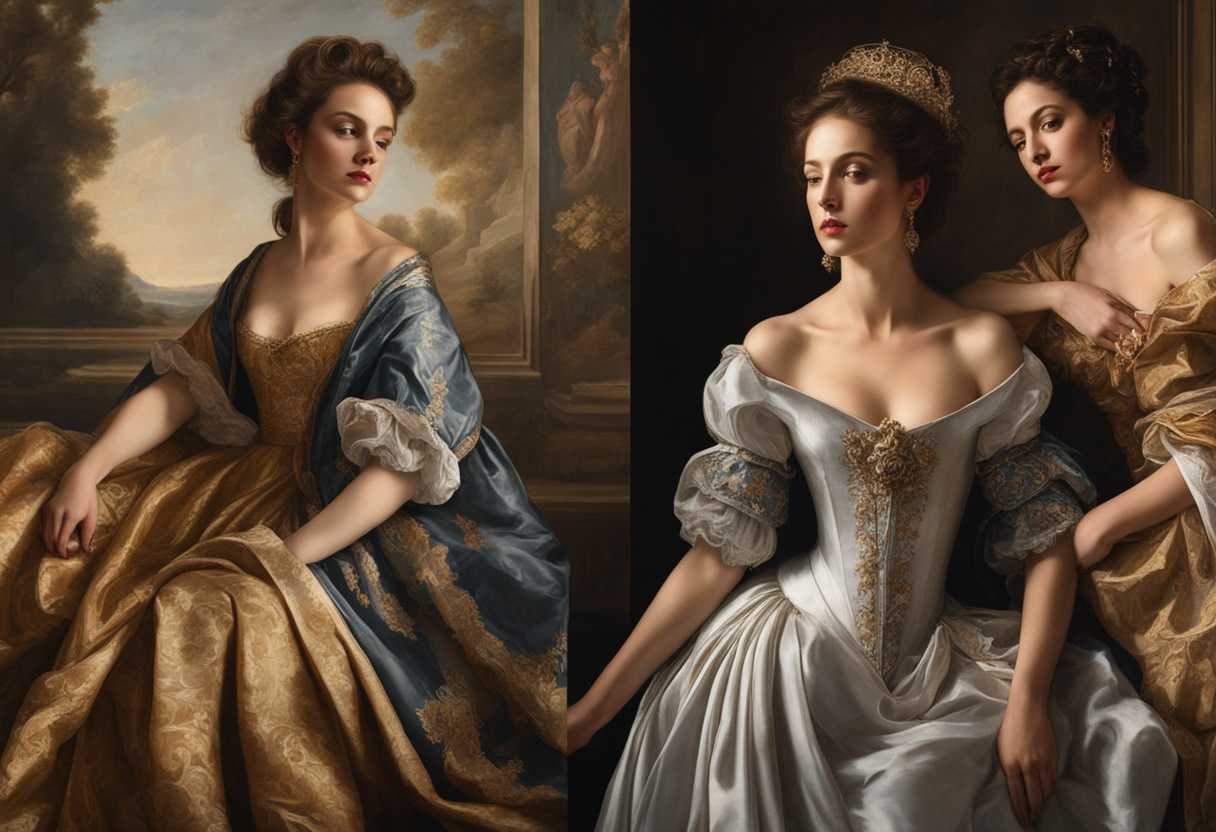
In the Bible, “apparel” refers to clothing or garments worn by individuals, which can symbolize status, modesty, or righteousness. It is often mentioned in contexts highlighting the importance of inner virtue over outward appearance (1 Peter 3:3-4).
Scripture
7 Then the eyes of both were opened, and they knew that they were naked. And they sewed fig leaves together and made themselves loincloths.
8 And they heard the sound of the Lord God walking in the garden in the cool of the day, and the man and his wife hid themselves from the presence of the Lord God among the trees of the garden.
9 But the Lord God called to the man and said to him, “Where are you?”
10 And he said, “I heard the sound of you in the garden, and I was afraid, because I was naked, and I hid myself.”
11 He said, “Who told you that you were naked? Have you eaten of the tree of which I commanded you not to eat?”
12 The man said, “The woman whom you gave to be with me, she gave me fruit of the tree, and I ate.”
13 Then the Lord God said to the woman, “What is this that you have done?” The woman said, “The serpent deceived me, and I ate.”
14 The Lord God said to the serpent, “Because you have done this, cursed are you above all livestock and above all beasts of the field; on your belly you shall go, and dust you shall eat all the days of your life.
15 I will put enmity between you and the woman,
and between your offspring and her offspring;
he shall bruise your head,
and you shall bruise his heel.”
16 To the woman he said, “I will surely multiply your pain in childbearing; in pain you shall bring forth children. Your desire shall be contrary to your husband, but he shall rule over you.”
17 And to Adam he said, “Because you have listened to the voice of your wife and have eaten of the tree of which I commanded you, ‘You shall not eat of it,’ cursed is the ground because of you; in pain you shall eat of it all the days of your life;
18 thorns and thistles it shall bring forth for you; and you shall eat the plants of the field.
19 By the sweat of your face you shall eat bread, till you return to the ground, for out of it you were taken; for you are dust, and to dust you shall return.
20 The man called his wife’s name Eve, because she was the mother of all living.
21 And the Lord God made for Adam and for his wife garments of skins and clothed them.
Biblical Significance of Apparel
The concept of apparel in the Bible transcends mere physical clothing, symbolizing deeper spiritual truths and human virtues. For example, Proverbs 31:25 describes a “woman of noble character” as being clothed with strength and dignity, indicating that true worth is found not in external adornments but in the character and virtues one embodies. Similarly, in Matthew 6:28-30, Jesus encourages His followers to consider the lilies of the field, clothed in splendor yet not anxious about their appearance. This underscores the idea that God values the heart and soul over material possessions.
Additionally, there are instances in Scripture where apparel serves as a marker of identity and purpose, such as in the parable of the wedding feast in Matthew 22:11-14, where a guest who is not properly attired is cast out, symbolizing the need for righteousness and readiness in God’s kingdom. The New Testament further emphasizes spiritual garments, as seen in Galatians 3:27, where believers are said to be “clothed with Christ.” This metaphor implies that true transformation and acceptance before God depend not on our outward appearance but on our alignment with Christ’s righteousness. Therefore, biblical apparel serves as a multifaceted symbol pointing to the importance of inner virtue, righteousness, and the transformative power of faith.
In addition to the virtues of strength and dignity embodied in clothing, the Bible often uses apparel as a metaphor for spiritual coverings that signify one’s relationship with God. For instance, Isaiah speaks of the concept of garments of salvation and robes of righteousness (Isaiah 61:10), illustrating how believers are adorned with divine grace and righteousness bestowed by God. This imagery reflects the transformative process in which God not only redeems individuals but also empowers them to live in accordance with His will. The attire, in this sense, becomes a representation of one’s new identity as a member of God’s covenant community, highlighting the beauty of salvation that envelops the believer.
Moreover, the Apostle Paul employs the concept of wardrobe to instruct the faithful on how to conduct themselves in their Christian walk. In Colossians 3:12-14, he implores believers to “put on” compassion, kindness, humility, gentleness, and patience, alongside the crowning piece of love that binds them together in perfect unity. Through this metaphorical garment, Paul emphasizes that spiritual attire is an active choice reflecting the character of Christ, promoting a lifestyle that honors God and cultivates harmony within the community. This focus on inner qualities as the essence of a believer’s character serves to reinforce the notion that true apparel in the biblical sense is not merely about physical garments but is ultimately about reflecting a Christ-like nature in our relationships and actions.
Symbol of Identity and Status
In biblical times, apparel often served as a reflection of one’s identity and social status. Different garments could signify wealth, profession, or even moral standing. For instance, the rich were often depicted in fine linen and luxurious fabrics, while the poor might wear simpler, more modest clothing. This distinction in apparel not only indicated economic status but also played a role in how individuals were perceived within their communities. Thus, clothing became a powerful symbol of one’s place in society and their relationship with God.
Representation of Spiritual Condition
Apparel in the Bible also carries a deeper spiritual significance, often representing one’s inner condition or relationship with God. For example, the act of putting on certain garments can symbolize the adoption of virtues or the rejection of sin. The imagery of “putting on” righteousness or “clothing oneself” in humility illustrates how external appearances can reflect internal spiritual realities. This connection emphasizes the importance of aligning one’s outward expressions with their spiritual beliefs and values.
Call to Modesty and Humility
The biblical perspective on apparel frequently emphasizes the virtues of modesty and humility. Rather than focusing on extravagant or ostentatious clothing, the scriptures encourage believers to prioritize simplicity and decency in their attire. This call to modesty serves as a reminder that true worth is not found in outward appearances but in one’s character and actions. By promoting humility in dress, the Bible encourages individuals to seek a deeper relationship with God rather than seeking validation through material possessions or societal approval.
How to Embrace Identity and Morality in Faith
Embracing your identity and morality in faith is a deeply personal journey that invites you to reflect on who you are in Christ and how that shapes your actions in the world. Start by immersing yourself in Scripture, allowing the Word to illuminate your understanding of your worth as a beloved child of God. Remember that your identity is not defined by societal standards or past mistakes, but by the grace and love that God extends to you. As you grow in this understanding, let it guide your moral compass—strive to embody the teachings of Jesus in your daily life, treating others with kindness, compassion, and integrity. Surround yourself with a community of believers who encourage you to live out your faith authentically, and don’t shy away from seeking guidance through prayer and reflection. Ultimately, embracing your identity and morality in faith is about aligning your heart with God’s will, allowing His love to transform you from the inside out.
Bible References to the Meaning of Apparel:
Exodus 28:2-43: 2 And you shall make holy garments for Aaron your brother, for glory and for beauty.
3 You shall speak to all the skillful, whom I have filled with a spirit of skill, that they make Aaron’s garments to consecrate him for my priesthood.
4 These are the garments that they shall make: a breastpiece, an ephod, a robe, a coat of checker work, a turban, and a sash. They shall make holy garments for Aaron your brother and his sons to serve me as priests.
5 They shall take the gold, blue and purple and scarlet yarns, and fine twined linen.
6 “And they shall make the ephod of gold, of blue and purple and scarlet yarns, and of fine twined linen, skillfully worked.
7 It shall have two shoulder pieces attached to its two edges, so that it may be joined together.
8 And the skillfully woven band on it shall be made like it and be of one piece with it, of gold, blue and purple and scarlet yarns, and fine twined linen.
9 You shall take two onyx stones, and engrave on them the names of the sons of Israel,
10 six of their names on the one stone, and the remaining six on the other stone, in the order of their birth.
11 With the work of an engraver in stone, like the engravings of a signet, you shall engrave the two stones with the names of the sons of Israel. You shall enclose them in settings of gold filigree.
12 And you shall set the two stones on the shoulder pieces of the ephod, as stones of remembrance for the sons of Israel. And Aaron shall bear their names before the Lord on his two shoulders for remembrance.
13 You shall make settings of gold filigree,
14 two chains of pure gold, twisted like cords; and you shall attach the corded chains to the settings.
15 “You shall make a breastpiece of judgment, in skilled work. In the style of the ephod you shall make it—of gold, blue and purple and scarlet yarns, and fine twined linen shall you make it.
16 It shall be square and doubled, a span its length and a span its breadth.
17 You shall set in it four rows of stones. A row of sardius, topaz, and carbuncle shall be the first row;
18 and the second row a turquoise, a sapphire, and an emerald;
19 and the third row a jacinth, an agate, and an amethyst;
20 and the fourth row a beryl, an onyx, and a jasper. They shall be set in gold filigree.
21 There shall be twelve stones with their names according to the names of the sons of Israel. They shall be like signets, each engraved with its name, for the twelve tribes.
22 You shall make on the breastpiece twisted chains like cords, of pure gold.
23 You shall make on the breastpiece two rings of gold, and shall put the two rings on the two edges of the breastpiece.
24 and you shall put the two cords of gold in the two rings at the edges of the breastpiece.
25 And the other two ends of the two cords you shall attach to the two settings of filigree, and so attach it in front to the shoulder pieces of the ephod.
26 And you shall make two rings of gold, and attach them to the two shoulder pieces of the ephod, at its front, above the skillfully woven band of the ephod.
27 And you shall make two rings of gold, and attach them in front to the lower part of the two shoulder pieces of the ephod, at its seam above the skillfully woven band of the ephod.
28 And they shall bind the breastpiece by its rings to the rings of the ephod with a lace of blue, so that it may lie on the skillfully woven band of the ephod, so that the breastpiece shall not come loose from the ephod.
29 So Aaron shall bear the names of the sons of Israel in the breastpiece of judgment on his heart, when he goes into the Holy Place, to bring them to regular remembrance before the Lord.
30 And in the breastpiece of judgment you shall put the Urim and the Thummim, and they shall be on Aaron’s heart, when he goes in before the Lord. Thus Aaron shall bear the judgment of the people of Israel on his heart before the Lord regularly.
31 “You shall make the robe of the ephod all of blue.”
32 It shall have an opening for the head in the middle of it, with a woven binding around the opening, like the opening in a garment, so that it may not tear.
33 On its hem you shall make pomegranates of blue and purple and scarlet yarns, around its hem, with bells of gold between them,
34 A golden bell and a pomegranate, a golden bell and a pomegranate, around the hem of the robe.
35 It shall be on Aaron when he ministers, and its sound shall be heard when he goes into the Holy Place before the Lord, and when he comes out, so that he does not die.
36 “You shall make a plate of pure gold and engrave on it, like the engraving of a signet, ‘Holy to the Lord.’
37 You shall fasten it on a cord of blue and it shall be on the turban; it shall be at the front of the turban.
38 It shall be on Aaron’s forehead, and Aaron shall bear any guilt from the holy things that the people of Israel consecrate as their holy gifts. It shall regularly be on his forehead, that they may be accepted before the Lord.
39 “You shall weave the coat in checker work of fine linen, and you shall make a turban of fine linen, and you shall make a sash embroidered with needlework.
40 “For Aaron’s sons you shall make coats and sashes and caps. You shall make them for glory and beauty.
41 And you shall put them on Aaron your brother, and on his sons with him, and shall anoint them and ordain them and consecrate them, that they may serve me as priests.
42 You shall make for them linen undergarments to cover their naked flesh. They shall reach from the hips to the thighs;
43 They shall be on Aaron and on his sons when they go into the tent of meeting or when they come near the altar to minister in the Holy Place, lest they bear guilt and die. This shall be a statute forever for him and for his offspring after him.
Leviticus 19:19: 19 “You shall keep my statutes. You shall not let your cattle breed with a different kind. You shall not sow your field with two kinds of seed, nor shall you wear a garment of cloth made of two kinds of material.
Deuteronomy 22:5: 5 “A woman shall not wear a man’s garment, nor shall a man put on a woman’s cloak, for whoever does these things is an abomination to the Lord your God.
2 Samuel 13:18-19: 18 Now she was wearing a long robe with sleeves, for thus were the virgin daughters of the king dressed. So his servant put her out and bolted the door after her.
19 And Tamar put ashes on her head and tore the long robe that she wore. And she laid her hand on her head and went away, crying aloud as she went.
Proverbs 31:21-22: 21 She is not afraid of snow for her household,
for all her household are clothed in scarlet.
22 She makes bed coverings for herself;
her clothing is fine linen and purple.
Isaiah 3:16-24: 16 The Lord said: Because the daughters of Zion are haughty and walk with outstretched necks, glancing wantonly with their eyes, mincing along as they go, tinkling with their feet,
17 therefore the Lord will strike with a scab the heads of the daughters of Zion, and the Lord will lay bare their secret parts.
18 In that day the Lord will take away the finery of the anklets, the headbands, and the crescents;
19 the festal robes, the mantles, the cloaks, and the handbags;
20 the headdresses, the armlets, the sashes, the perfume boxes, and the amulets;
21 the signet rings and the nose rings;
22 the festal robes, the mantles, the cloaks, and the handbags;
23 who make their anklets jingle, and disclose the amulets under their veils;
24 Instead of perfume there will be rottenness; and instead of a belt, a rope; and instead of well-set hair, baldness; and instead of a rich robe, a skirt of sackcloth; and branding instead of beauty.
Isaiah 61:10: 10 I will greatly rejoice in the Lord; my soul shall exult in my God, for he has clothed me with the garments of salvation; he has covered me with the robe of righteousness, as a bridegroom decks himself like a priest with a beautiful headdress, and as a bride adorns herself with her jewels.
Ezekiel 16:10-14: 10 I clothed you also with embroidered cloth and shod you with fine leather. I wrapped you in fine linen and covered you with silk.
11 And I adorned you with ornaments and put bracelets on your wrists and a chain on your neck.
12 And I put a ring on your nose and earrings in your ears and a beautiful crown on your head.
13 Thus you were adorned with gold and silver, and your clothing was of fine linen and silk and embroidered cloth. You ate fine flour and honey and oil. You grew exceedingly beautiful and advanced to royalty.
14 And your renown went forth among the nations because of your beauty, for it was perfect through the splendor that I had bestowed on you, declares the Lord God.
Matthew 6:28-30: 28 And why are you anxious about clothing? Consider the lilies of the field, how they grow: they neither toil nor spin,
29 yet I tell you, even Solomon in all his glory was not arrayed like one of these.
30 But if God so clothes the grass of the field, which today is alive and tomorrow is thrown into the oven, will he not much more clothe you, O you of little faith?
Matthew 22:11-12: 11 “But when the king came in to look at the guests, he saw there a man who had no wedding garment.
12 And he said to him, ‘Friend, how did you get in here without a wedding garment?’ And he was speechless.
Luke 12:22-28: 22 And he said to his disciples, “Therefore I tell you, do not be anxious about your life, what you will eat, nor about your body, what you will put on.
23 For life is more than food, and the body more than clothing.
Consider the ravens: they neither sow nor reap, they have neither storehouse nor barn, and yet God feeds them. How much more valuable are you than the birds!
25 And which of you by being anxious can add a single hour to his span of life?
26 If then you are not able to do as small a thing as that, why are you anxious about the rest?
27 Consider the lilies, how they grow: they neither toil nor spin, yet I tell you, even Solomon in all his glory was not arrayed like one of these.
28 But if God so clothes the grass, which is alive in the field today, and tomorrow is thrown into the oven, how much more will he clothe you, O you of little faith!
1 Timothy 2:9-10: 9 likewise also that women should adorn themselves in respectable apparel, with modesty and self-control, not with braided hair and gold or pearls or costly attire,
10 but with what is proper for women who profess godliness—with good works.
1 Peter 3:3-4: 3 Do not let your adorning be external—the braiding of hair and the putting on of gold jewelry, or the clothing you wear—
3 Do not let your adorning be external—the braiding of hair and the putting on of gold jewelry, or the clothing you wear—
Revelation 3:4-5: 4 Yet you have still a few names in Sardis, people who have not soiled their garments, and they will walk with me in white, for they are worthy.
5 The one who conquers will be clothed thus in white garments, and I will never blot his name out of the book of life. I will confess his name before my Father and before his angels.
Revelation 19:7-8: 7 Let us rejoice and exult and give him the glory, for the marriage of the Lamb has come, and his Bride has made herself ready;
8 it was granted her to clothe herself with fine linen, bright and pure— for the fine linen is the righteous deeds of the saints.

Rev. François Dupont is a dedicated church minister with a wealth of experience in serving spiritual communities. With a calm and serene demeanor, he has been devoted to sharing the message of love, compassion, and tolerance for over two decades. Through his thoughtful sermons, compassionate counseling, and unwavering support, Rev. Dupont has touched the lives of countless individuals, allowing them to find solace and strength during difficult times. His serene presence and deep understanding of the human condition make him a trusted guide for those seeking spiritual nourishment and guidance.