
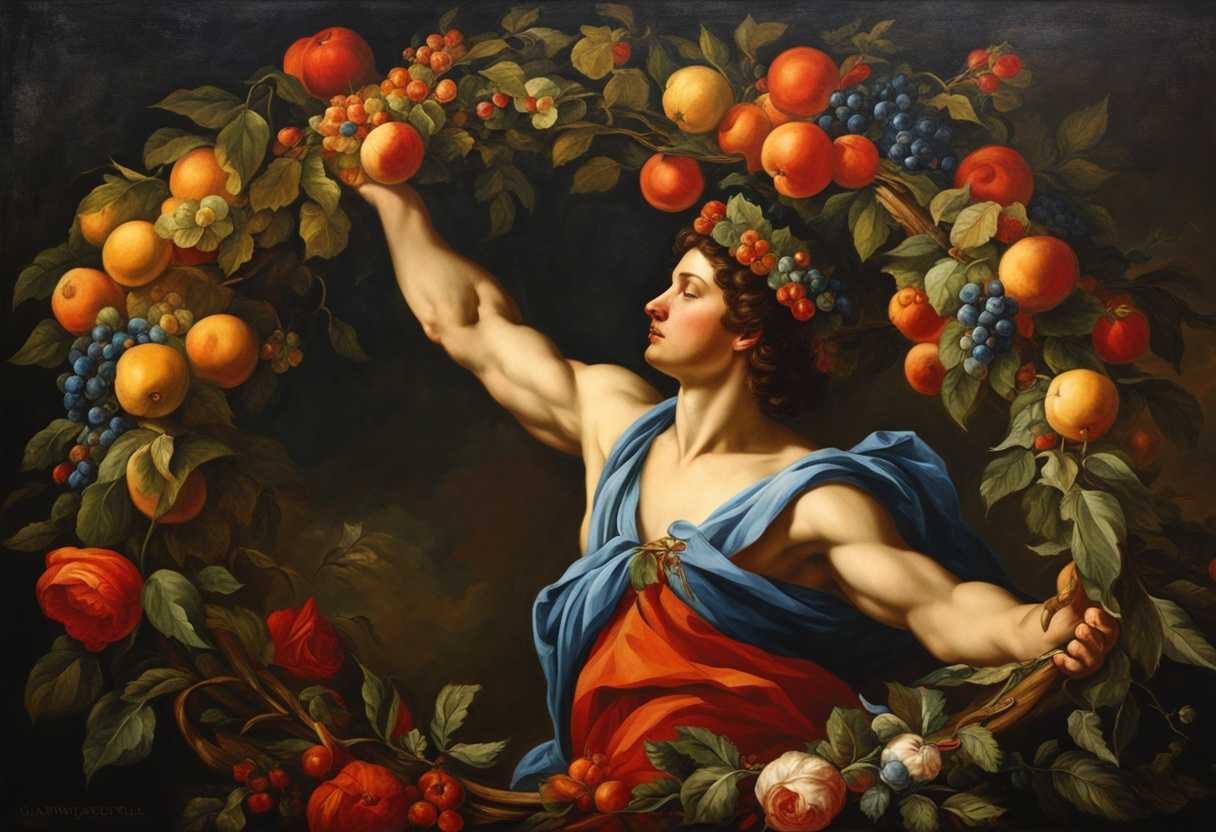
In the Bible, wreaths often symbolize victory, honor, and beauty. They were used in ancient times to crown winners of races or competitions, reflecting the spiritual victory believers aspire to achieve in their faith (1 Corinthians 9:24-25).
Scripture
1 Ah, the proud crown of the drunkards of Ephraim, and the fading flower of its glorious beauty, which is on the head of the rich valley of those overcome with wine!
2 Behold, the Lord has one who is mighty and strong; like a storm of hail, a destroying tempest, like a storm of mighty, overflowing waters, he casts down to the earth with his hand.
3 The proud crown of the drunkards of Ephraim will be trodden underfoot.
4 and the fading flower of its glorious beauty, which is on the head of the rich valley, will be like a first-ripe fig before the summer: when someone sees it, he swallows it as soon as it is in his hand.
5 In that day the Lord of hosts will be a crown of glory, and a diadem of beauty, to the remnant of his people,
Biblical Significance of Wreaths
In the Bible, wreaths are rich in symbolism, representing not only victory and honor but also the culmination of hard work and dedication in one’s spiritual journey. The Apostle Paul likens the Christian life to a race, where believers strive toward the prize of eternal life, akin to athletes receiving a perishable crown for their efforts (1 Corinthians 9:24-25). This imagery conveys a broader message about the transient nature of earthly accolades compared to the everlasting rewards God promises to those who triumph over spiritual challenges. The wreath symbolizes the ultimate recognition from God, akin to a crown of righteousness, as noted in 2 Timothy 4:8, where Paul speaks of the “crown of righteousness” awaiting him and all who love Christ’s appearing.
Furthermore, wreaths can also be viewed as symbols of beauty and life, echoing themes of resurrection and renewal found throughout scripture. In Revelation 2:10, there is a promise of a “crown of life” for those who endure trials. These verses collectively illuminate the deeper reality of living a life committed to Christ—where earthly struggles are transformed into a testament of faith, and the wreath represents not just victory over sin, but the promise of everlasting life and hope in God’s plan. Thus, wreaths serve as powerful emblems of the Christian faith, encouraging believers to persevere and remain steadfast, as they look forward to their eternal reward.
The biblical significance of wreaths extends beyond mere symbolism of victory; they also encapsulate themes of divine grace and community. In ancient cultures, wreaths were often given as tokens of honor during communal celebrations. This can be paralleled with the biblical portrayal of unity within the body of Christ, where believers are encouraged to uplift one another towards spiritual maturity, much like athletes who support one another in competition. The wreath can symbolize this communal encouragement—where the faith of one believer nurtures the strength and perseverance of another, thus reinforcing the idea that individual victories in the faith journey contribute to the greater communal glory of God.
Additionally, wreaths reflect the Christian’s journey towards holiness and the development of character through endurance. Throughout the New Testament, believers are frequently reminded that trials and tribulations serve to refine their faith, much like gold is purified through fire. This refining process is integral to the formation of virtuous qualities such as patience, perseverance, and love, which can be seen as the ‘leaves’ of the wreath. Thus, when Christians wear the metaphorical wreath of faith, it signifies their commitment to growth in Christ, embodying the fruits of the Spirit in their lives. Ultimately, wreaths serve not only as reminders of their personal triumphs but also as symbols of the collective journey of believers towards spiritual completeness and unity in purpose under God, reflecting the profound interconnectedness of their faith journeys.
Symbol of Victory and Achievement
In biblical contexts, wreaths often symbolize victory and achievement, particularly in the realm of spiritual and moral triumphs. The imagery of a wreath can be associated with the rewards that come from living a life of faith and obedience to God. Just as athletes in ancient times were crowned with laurel wreaths for their victories, believers are reminded that their perseverance in faith leads to spiritual rewards and recognition from God.
Representation of Eternal Life
Wreaths also carry the connotation of eternal life and the cyclical nature of existence. The circular shape of a wreath signifies eternity, with no beginning or end, reflecting the promise of everlasting life that is central to Christian belief. This symbolism serves as a reminder of the hope of resurrection and the eternal life that believers are promised through their faith in Christ.
Emblem of Celebration and Joy
In many biblical narratives, wreaths are associated with celebration and joy. They are often used in festive occasions, symbolizing the joy of life and the blessings that come from God. This aspect of wreaths highlights the importance of rejoicing in the Lord and celebrating the gifts of life, community, and faith, encouraging believers to embrace a spirit of gratitude and joy in their spiritual journey.
How to Embrace Victory in Christian Living
Embracing victory in Christian living is about cultivating a heart that is anchored in faith and a mind that is renewed by the Word of God. It starts with recognizing that our victories are not solely based on our own strength but are rooted in the grace and power of Christ. To truly live in victory, we must daily surrender our worries and struggles to Him, trusting that He has already overcome the world (John 16:33). This means actively engaging in prayer, immersing ourselves in Scripture, and surrounding ourselves with a community of believers who uplift and encourage us. Remember, victory is not the absence of challenges but the assurance that we are never alone in facing them. As you walk this journey, let your heart be filled with gratitude for the small victories and the lessons learned along the way, knowing that each step brings you closer to the abundant life He promises.
Bible References to the Significance of Wreaths:
1 Corinthians 9:24-27: 24 Do you not know that in a race all the runners run, but only one receives the prize? So run that you may obtain it.
25 Every athlete exercises self-control in all things. They do it to receive a perishable wreath, but we an imperishable.
26 So I do not run aimlessly; I do not box as one beating the air.
27 But I discipline my body and keep it under control, lest after preaching to others I myself should be disqualified.
James 1:12-15: 12 Blessed is the man who remains steadfast under trial, for when he has stood the test he will receive the crown of life, which God has promised to those who love him.
13 Let no one say when he is tempted, “I am being tempted by God,” for God cannot be tempted with evil, and he himself tempts no one.
14 But each person is tempted when he is lured and enticed by his own desire.
15 Then desire when it has conceived gives birth to sin, and sin when it is fully grown brings forth death.
1 Peter 5:1-4: 5 So I exhort the elders among you, as a fellow elder and a witness of the sufferings of Christ, as well as a partaker in the glory that is going to be revealed:
2 shepherd the flock of God that is among you, exercising oversight, not under compulsion, but willingly, as God would have you; not for shameful gain, but eagerly;
3 not domineering over those in your charge, but being examples to the flock.
4 And when the chief Shepherd appears, you will receive the unfading crown of glory.
Revelation 4:1-4: 1 After this I looked, and behold, a door standing open in heaven! And the first voice, which I had heard speaking to me like a trumpet, said, “Come up here, and I will show you what must take place after this.”
2 At once I was in the Spirit, and behold, a throne stood in heaven, with one seated on the throne.
3 And he who sat there had the appearance of jasper and carnelian, and around the throne was a rainbow that had the appearance of an emerald.
4 Around the throne were twenty-four thrones, and seated on the thrones were twenty-four elders, clothed in white garments, with golden crowns on their heads.
Revelation 6:1-2: 1 Now I watched when the Lamb opened one of the seven seals, and I heard one of the four living creatures say with a voice like thunder, “Come!”
2 And I looked, and behold, a white horse! And its rider had a bow, and a crown was given to him, and he came out conquering, and to conquer.
2 Timothy 4:6-8: 6 For I am already being poured out as a drink offering, and the time of my departure has come.
7 I have fought the good fight, I have finished the race, I have kept the faith.
8 Henceforth there is laid up for me the crown of righteousness, which the Lord, the righteous judge, will award to me on that day, and not only to me but also to all who have loved his appearing.
Zechariah 6:9-14: 9 And the word of the Lord came to me:
10 “Take from the exiles Heldai, Tobijah, and Jedaiah, who have arrived from Babylon, and go the same day to the house of Josiah, the son of Zephaniah.”
11 Take from them silver and gold, and make a crown, and set it on the head of Joshua, the son of Jehozadak, the high priest.
12 And say to him, ‘Thus says the Lord of hosts, “Behold, the man whose name is the Branch: for he shall branch out from his place, and he shall build the temple of the Lord.
13 It is he who shall build the temple of the Lord and shall bear royal honor, and shall sit and rule on his throne. And there shall be a priest on his throne, and the counsel of peace shall be between them both.”
14 “And the crown shall be in the temple of the Lord as a reminder to Helem, Tobijah, Jedaiah, and Hen the son of Zephaniah.”
1 Thessalonians 2:17-20: But since we were torn away from you, brothers, for a short time, in person not in heart, we endeavored the more eagerly and with great desire to see you face to face,
Therefore we wanted to come to you—even I, Paul, time and again—but Satan hindered us.
For what is our hope or joy or crown of boasting before our Lord Jesus at his coming? Is it not you?
20 For you are our glory and joy.
Philippians 4:1-3: 1 Therefore, my brothers, whom I love and long for, my joy and crown, stand firm thus in the Lord, my beloved.
2 I entreat Euodia and I entreat Syntyche to agree in the Lord.
3 Yes, I ask you also, true companion, help these women, who have labored side by side with me in the gospel together with Clement and the rest of my fellow workers, whose names are in the book of life.

Reverend Ogunlade is a seasoned Church Minister with over three decades of experience in guiding and nurturing congregations. With profound wisdom and a serene approach, Reverend Ogunlade has carried out various pastoral duties, including delivering uplifting sermons, conducting religious ceremonies, and offering sage counsel to individuals seeking spiritual guidance. Their commitment to fostering harmony and righteousness within their community is exemplified through their compassionate nature, making them a beloved and trusted figure among the congregation.