
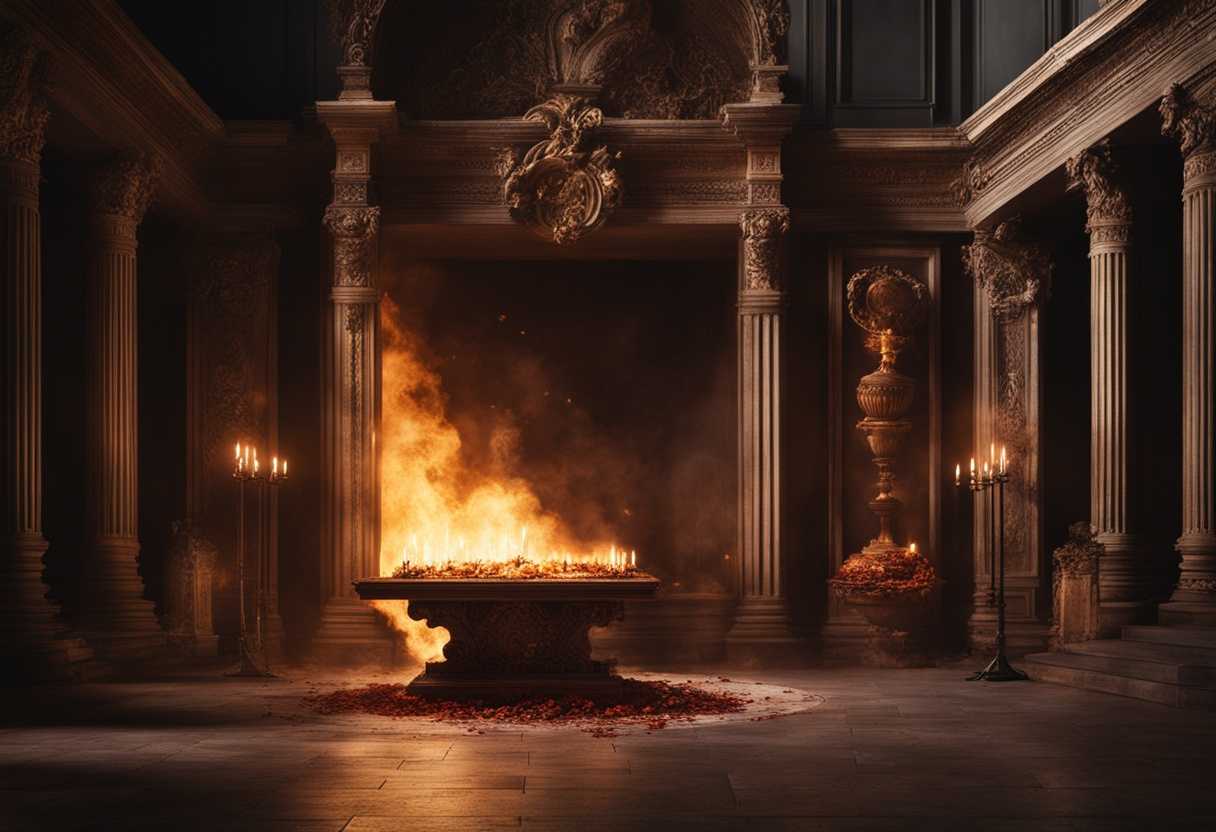
The Brazen Altar, also known as the Altar of Burnt Offering, is described in the Bible as a significant structure in the Tabernacle where sacrifices were made to atone for sin and express devotion to God (Exodus 27:1-8). It symbolizes the necessity of sacrifice and the means through which the Israelites sought reconciliation with God.
Scripture
1 “You shall make the altar of acacia wood, five cubits long and five cubits broad. The altar shall be square, and its height shall be three cubits.
2 And you shall make horns for it on its four corners; its horns shall be of one piece with it, and you shall overlay it with bronze.
3 Five cubits shall be the length of the one curtain, and five cubits the breadth of the one curtain for the first set of curtains, and five cubits the length of the one curtain, and five cubits the breadth of the one curtain for the second set of curtains.
4 You shall make for it a grating of network of bronze, and on the net you shall make four bronze rings at its four corners.
5 You shall put it under the ledge of the altar so that the net shall extend halfway down the altar.
6 You shall make poles for the altar, a net of bronze network, to be set halfway up the altar.
7 And you shall put it under the ledge of the altar so that the net shall extend halfway down the altar.
8 It shall be made with cherubim skillfully worked into it.
Definition of the Brazen Altar in Scripture
The Brazen Altar, or Altar of Burnt Offering, holds profound significance within the biblical narrative, particularly as a symbol of atonement and the covenant relationship between God and His people. According to Exodus 27:1-8, this altar was crafted from acacia wood and overlaid with bronze, reflecting both its utilitarian purpose and its sacred nature. It was the first structure encountered upon entering the outer court of the Tabernacle, emphasizing the prerequisite of sacrifice for approaching God’s holy presence. The act of offering burnt sacrifices, as outlined in Leviticus 1, represents not merely a ritualistic observance but a deep acknowledgment of human sin and the need for divine forgiveness. The continual sacrifices at the altar also foreshadow the ultimate sacrifice of Jesus Christ, underscoring the New Testament theme of redemption through His one-time offering (Hebrews 10:10).
In a broader theological context, the Brazen Altar signifies the concept of substitutionary atonement, where the life of an innocent animal serves as a substitute for the sinner, allowing a restoration of the relationship with God. This practice not only points to the seriousness of sin but also highlights God’s mercy and grace in providing a way for people to be reconciled to Him. Furthermore, as seen in Romans 12:1, the New Testament believers are called to present their bodies as living sacrifices, which reflects the ongoing response of devotion and holiness, echoing the sacrificial themes of the Old Testament. The Brazen Altar, therefore, serves as a bridge between the ancient practices of the Israelites and the spiritual realities faced by Christians today, reinforcing the continual need for sacrifice — not just in ritual, but as a lifestyle of worship and service.
The Brazen Altar also finds mention in the context of worship and community engagement, as described in the regulations surrounding the festivals and sacrifices in the Old Testament. For instance, Leviticus 3 elaborates on the peace offerings, which were intended to express gratitude and maintain fellowship with God. The communal aspect of these offerings emphasized the importance of restoring and maintaining relationships within the community, centering around the altar as a physical representation of God’s presence and participation in the lives of His people. Such practices not only depicted a response to God’s blessings but also reflected a societal understanding of communal sin and collective responsibility.
Moreover, the Brazen Altar is tied intricately to the themes of purification and consecration in the priestly rituals described in the Book of Exodus and Leviticus. Sacrifices offered at this altar were a precursor to the priests entering the Holy Place, symbolizing the need for cleansing before approaching the divine. The blood of the sacrifices played a crucial role in this purification process, reinforcing the biblical principle that access to holiness requires acknowledgment of sin and the necessity of atonement. These elements collectively illustrate how the Brazen Altar was not simply a functional object, but a central institution interwoven with the laws, rituals, and overarching narrative of redemption that permeates the entirety of scripture. Through it, we can understand God’s desire for relationship, reconciliation, and the continuous call for His people to recognize their need for His holiness in their lives.
Symbol of Sacrifice and Atonement
The Brazen Altar serves as a powerful symbol of sacrifice and atonement in the biblical narrative. It represents the necessity of offering something valuable to God as a means of seeking forgiveness and reconciliation. The act of sacrifice at the altar signifies the acknowledgment of sin and the desire for purification, illustrating the principle that atonement requires a cost. This concept is foundational in understanding the relationship between humanity and the divine, emphasizing the importance of repentance and the need for a mediator.
Foreshadowing of Christ’s Sacrifice
The Brazen Altar also foreshadows the ultimate sacrifice of Jesus Christ. In the Old Testament, the altar was a place where animals were offered to atone for the sins of the people, pointing towards the future fulfillment of God’s redemptive plan through Christ’s death on the cross. This connection highlights the continuity of God’s plan for salvation throughout scripture, illustrating how the sacrificial system established in the Old Testament finds its culmination in the New Testament. The Brazen Altar thus serves as a prophetic symbol of the grace and mercy that would be fully realized in Christ.
Call to Holiness and Dedication
Furthermore, the Brazen Altar represents a call to holiness and dedication among believers. It signifies the importance of setting apart one’s life for God, as the act of sacrifice requires a commitment to living in accordance with His will. The altar serves as a reminder that true worship involves not only the act of offering but also a lifestyle of devotion and service. This theme encourages individuals to reflect on their own lives and consider how they can dedicate themselves to God, embodying the principles of love, service, and obedience in their daily actions.
How to Embrace Sacrifice for a Deeper Faith
Embracing sacrifice as a pathway to a deeper faith can be both challenging and transformative. It often requires us to step outside our comfort zones, whether that means giving up our time to serve others, letting go of material possessions, or even enduring personal hardships for the sake of our beliefs. I’ve found that when we willingly make these sacrifices, we create space for God to work in our lives in profound ways. It’s in those moments of surrender that we often experience a deeper connection with Christ, who exemplified ultimate sacrifice through His love for us. Remember, it’s not about the size of the sacrifice but the heart behind it; even small acts of selflessness can lead to significant spiritual growth. So, as you navigate your faith journey, consider what you might be called to let go of, and trust that in doing so, you’ll find a richer, more vibrant relationship with God.
Bible References to the Brazen Altar:
Exodus 38:1-7: 1 He made the altar of burnt offering of acacia wood.
2 And he made horns for it on its four corners. Its horns were of one piece with it, and he overlaid it with bronze.
3 And he made all the utensils of the altar, the pots, the shovels, the basins, the forks, and the fire pans. He made all its utensils of bronze.
4 He made for the altar a grating, a network of bronze, under its ledge, extending halfway down.
5 They made the altar of acacia wood. It was square, five cubits long, five cubits wide, and three cubits high.
6 He made the poles of acacia wood and overlaid them with bronze.
7 And he put the poles through the rings on the sides of the altar to carry it with them. He made it hollow, with boards.
Leviticus 4:7-10: 7 And the priest shall put some of the blood on the horns of the altar of fragrant incense before the Lord that is in the tent of meeting, and all the rest of the blood of the bull he shall pour out at the base of the altar of burnt offering that is at the entrance of the tent of meeting.
8 And he shall take from it all the fat of the bull of the sin offering; the fat that covers the entrails and all the fat that is on the entrails,
9 And the two kidneys with the fat that is on them at the loins, and the long lobe of the liver that he shall remove with the kidneys.
10 But the bull he shall carry outside the camp and burn it up as he burned the first bull; it is the sin offering for the assembly.
Leviticus 6:8-13: 8 The Lord spoke to Moses, saying:
9 “Command Aaron and his sons, saying, This is the law of the burnt offering. The burnt offering shall be on the hearth on the altar all night until the morning, and the fire of the altar shall be kept burning on it.
10 And the priest shall put on his linen garment and put his linen undergarment on his body, and he shall take up the ashes to which the fire has reduced the burnt offering on the altar and put them beside the altar.
11 Then he shall take off his garments and put on other garments and carry the ashes outside the camp to a clean place.
12 The fire on the altar shall be kept burning on it; it shall not go out. The priest shall burn wood on it every morning, and he shall arrange the burnt offering on it and shall burn on it the fat of the peace offerings.
13 Fire shall be kept burning on the altar continually; it shall not go out.
Leviticus 9:7-24: 7 Then Moses said to Aaron, “Draw near to the altar and offer your sin offering and your burnt offering and make atonement for yourself and for the people, and bring the offering of the people and make atonement for them, as the Lord has commanded.”
8 So Aaron drew near to the altar and killed the calf of the sin offering, which was for himself.
9 And the sons of Aaron presented the blood to him, and he dipped his finger in the blood and put it on the horns of the altar and poured out the blood at the base of the altar.
10 But the fat and the kidneys and the long lobe of the liver from the sin offering he burned on the altar, as the Lord commanded Moses.
11 And the flesh and the skin he burned with fire outside the camp.
12 Then he killed the burnt offering, and Aaron’s sons handed him the blood, and he threw it against the sides of the altar.
13 And they handed the burnt offering to him, piece by piece, and the head, and he burned them on the altar.
14 Then he washed the entrails and the legs and burned them with the burnt offering on the altar.
15 Then he presented the people’s offering and took the goat of the sin offering that was for the people and killed it and offered it as a sin offering, like the first one.
16 And he washed the entrails and the legs and burned them with the burnt offering on the altar.
17 Then he presented the grain offering, took a handful of it, and burned it on the altar, besides the burnt offering of the morning.
18 Then he slaughtered the ox and the ram, the sacrifice of peace offerings for the people. And Aaron’s sons handed him the blood, and he threw it against the sides of the altar.
19 And the fat of the bull and of the ram, the fat tail, and that which covers the entrails and the kidneys and the long lobe of the liver.
20 And they put the fat pieces on the breasts, and he burned the fat pieces on the altar,
21 And the breasts and the right thigh Aaron waved for a wave offering before the Lord, as Moses commanded.
22 Then Aaron lifted up his hands toward the people and blessed them, and he came down from offering the sin offering and the burnt offering and the peace offerings.
23 And Moses and Aaron went into the tent of meeting, and when they came out they blessed the people, and the glory of the Lord appeared to all the people.
24 And fire came out from before the Lord and consumed the burnt offering and the pieces of fat on the altar, and when all the people saw it, they shouted and fell on their faces.
Numbers 16:36-40: 36 Then the Lord spoke to Moses, saying,
37 “Tell Eleazar the son of Aaron the priest to take up the censers out of the blaze. Then scatter the fire far and wide, for they have become holy.
38 The censers of these men who have sinned at the cost of their lives shall be made into hammered plates as a covering for the altar, for they offered them before the Lord, and they became holy. Thus they shall be a sign to the people of Israel.”
39 So Eleazar the priest took the bronze censers, which those who were burned had offered, and they were hammered out as a covering for the altar,
40 to be a reminder to the people of Israel, so that no outsider, who is not of the descendants of Aaron, should draw near to burn incense before the Lord, lest he become like Korah and his company—as the Lord said to him through Moses.
2 Chronicles 4:1-5: 1 He made an altar of bronze, twenty cubits long and twenty cubits wide and ten cubits high.
2 And he cast a round molding, half a cubit high, around the top of it.
3 Now figures like oxen were under it, and all around it. And the second row of oxen was below the first row.
4 He also made a sea of cast metal ten cubits from brim to brim, circular in form, and five cubits high, and a line of thirty cubits measured its circumference.
5 It was a handbreadth thick, and its brim was made like the brim of a cup, like the flower of a lily. It held 3,000 baths.

Reverend Ogunlade is a seasoned Church Minister with over three decades of experience in guiding and nurturing congregations. With profound wisdom and a serene approach, Reverend Ogunlade has carried out various pastoral duties, including delivering uplifting sermons, conducting religious ceremonies, and offering sage counsel to individuals seeking spiritual guidance. Their commitment to fostering harmony and righteousness within their community is exemplified through their compassionate nature, making them a beloved and trusted figure among the congregation.