
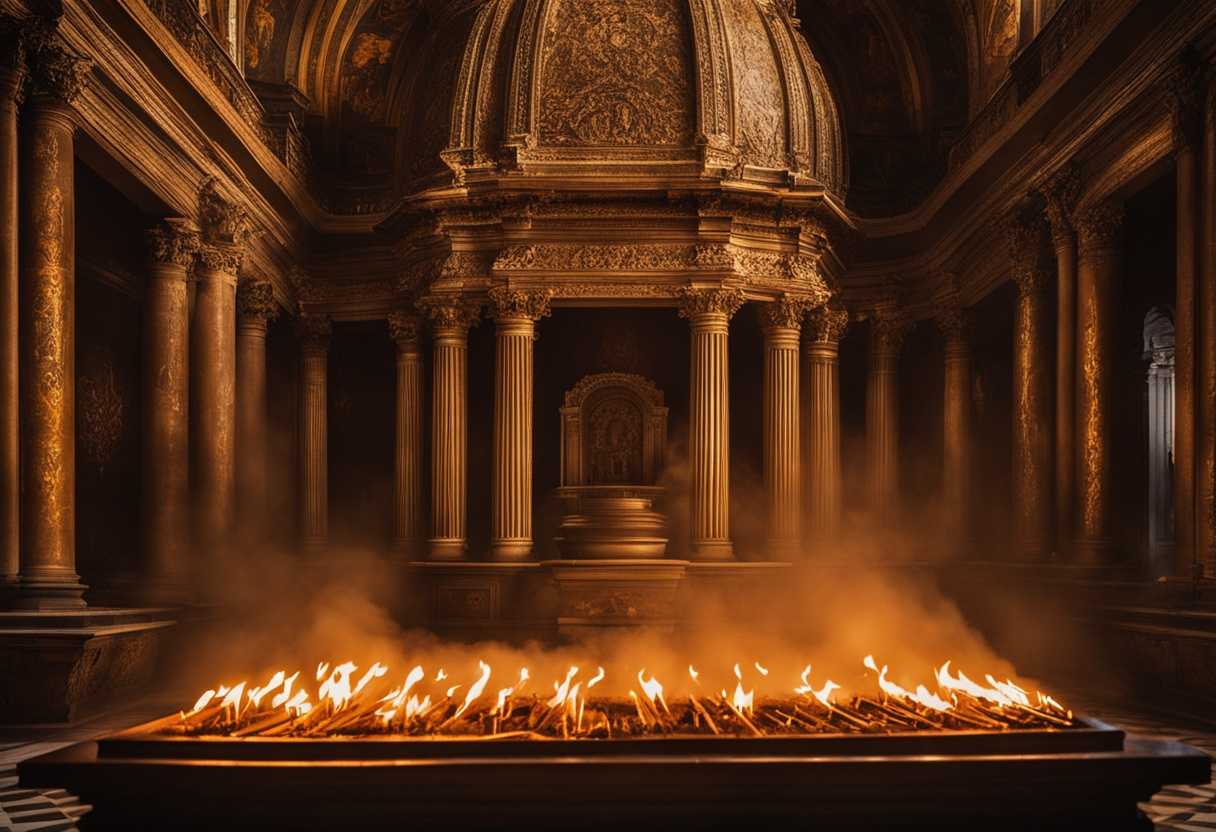
In the Bible, particularly in the King James Version, incense symbolizes prayers and worship, often used in temple rituals to create a pleasing aroma before God. It represents the communication and devotion of believers as it rises, as seen in passages like Psalm 141:2 and Revelation 5:8.
Scripture
1 “You shall make an altar on which to burn incense; you shall make it of acacia wood.
2 A cubit shall be its length, and a cubit its breadth. It shall be square, and two cubits shall be its height. Its horns shall be of one piece with it.
3 You shall overlay it with pure gold, its top and around its sides and its horns. And you shall make a molding of gold around it.
4 A golden altar, a holy anointing oil, and a fragrant incense.
5 And you shall make the poles of acacia wood and overlay them with gold.
6 And you shall put it in front of the veil that is above the ark of the testimony, in front of the mercy seat that is above the testimony, where I will meet with you.
7 And Aaron shall burn fragrant incense on it. Every morning when he dresses the lamps he shall burn it,
8 And when Aaron sets up the lamps at twilight, he shall burn it, a regular incense offering before the Lord throughout your generations.
9 You shall not offer unauthorized incense on it, or a burnt offering, or a grain offering, and you shall not pour a drink offering on it.
10 Aaron shall make atonement on its horns once a year. With the blood of the sin offering of atonement, he shall make atonement for it once in the year throughout your generations. It is most holy to the Lord.”
Incense in the Bible: KJV Meaning
In the Bible, incense serves as a profound emblem of prayer, worship, and the divine means of communication between humanity and God. The practice of burning incense is prevalent in both the Old and New Testaments, highlighting its significance in worship settings. For instance, Psalm 141:2 states, “Let my prayer be set forth before thee as incense; and the lifting up of my hands as the evening sacrifice.” This verse epitomizes the metaphorical connection between the act of praying and the fragrant rising of incense, suggesting that just as incense ascends to the heavens, so too do the prayers of the faithful ascend to God, striving to be pleasing in His sight. Additionally, in Revelation 5:8, the elders present golden vials full of incense, which are identified as the prayers of the saints, further emphasizing the notion that incense symbolizes the worshipful expressions of believers in the heavenly realm.
Moreover, incense plays a crucial role in the Levitical sacrificial system, where it was burned on the altar in the Tabernacle and later in the Temple. Exodus 30:7-8 instructs Aaron to maintain the burning of incense every morning and evening, signifying a continual offering of worship and devotion. The use of incense underscores the importance of presenting oneself and one’s supplications to God with reverence and sincerity. It also reflects the transformational journey of believers, as their prayers are purified and accepted by God through the mediation of Christ, akin to the sweet aroma of incense that delights Him. Overall, the symbolism of incense in the Scriptures highlights the intimate relationship between God and His people, where prayer becomes an integral part of worship that transcends the physical realm into spiritual communion.
The role of incense in the Bible extends beyond its physical manifestation; it encapsulates deeper themes of purification, devotion, and the presence of God among His people. In the construction of the Tabernacle, specific instructions were provided regarding the composition of sacred incense. In Exodus 30:34-36, God commanded that a distinct blend of spices be used, underscoring the idea that worship requires not just any offering, but one that is particularly crafted to honor Him. This divine specification reflects the necessity of approaching God with a heart and spirit that are reflective of His holiness, suggesting that prayer and worship must be intentional and genuine.
In addition to its sacrificial significance, incense represents a spiritual fragrance that is pleasing to God. In 2 Corinthians 2:15, the Apostle Paul conveys the idea that believers are to God the sweet savor of Christ, implying that their lives, much like incense, should rise as an offering of worship to the Lord. This connection highlights the concept that as Christians embody Christ-like attributes and live out their faith authentically, they create an environment where their prayers and actions are perceived as delightful to God. Thus, the biblical imagery of incense evolves into a broader metaphor that calls for believers to live lives that are fragrant and pleasing, reflecting their devotion and the transformative power of their prayers in communion with God.
Symbol of Prayer and Worship
In the Bible, incense serves as a powerful symbol of prayer and worship. It represents the heartfelt offerings of believers ascending to God, illustrating the connection between the divine and humanity. The fragrant smoke of incense is often seen as a metaphor for the prayers of the faithful, rising to the heavens and pleasing to God. This connection emphasizes the importance of sincere worship and the desire for communion with the Creator.
Representation of Holiness and Purity
Incense is also associated with holiness and purity in biblical texts. The specific ingredients and preparation methods for incense were prescribed by God, highlighting its sacred nature. This emphasis on purity reflects the idea that worship must be conducted in a manner that honors God’s holiness. The use of incense in religious rituals signifies the need for believers to approach God with reverence and a pure heart, acknowledging His divine nature.
Symbol of God’s Presence
Furthermore, incense symbolizes the presence of God among His people. In various biblical contexts, the burning of incense is linked to the manifestation of God’s glory and His nearness to His followers. It serves as a reminder that God is actively involved in the lives of His people, and that worship, accompanied by the sweet aroma of incense, invites His presence into their midst. This aspect underscores the relational dynamic between God and humanity, emphasizing His desire to dwell among His creation.
How to Deepen Your Faith Through Worship and Prayer
Deepening your faith through worship and prayer is a beautiful journey that invites you to connect more intimately with God. Start by setting aside dedicated time each day for prayer, where you can pour out your heart, express gratitude, and seek guidance. Consider incorporating worship music into your routine; let the melodies and lyrics draw you closer to the divine, creating a space for reflection and praise. Attend church services regularly, not just as a ritual, but as a community where you can share in the joy of collective worship and learn from others. Remember, worship isn’t confined to Sundays; it can be found in the quiet moments of your day, whether you’re in nature, at home, or even during your commute. As you cultivate this practice, you’ll find that your faith deepens, your worries lessen, and your heart opens to the profound love that God has for you. Embrace this journey with an open heart, and watch how it transforms your life.
Bible References to Incense in Scripture:
Exodus 30:34-38: 34 The Lord said to Moses, “Take sweet spices, stacte, and onycha, and galbanum, sweet spices with pure frankincense (of each shall there be an equal part),
35 You shall make of these a sacred anointing oil blended as by the perfumer; it shall be a holy anointing oil.
36 You shall beat some of it very small, and put part of it before the testimony in the tent of meeting where I shall meet with you. It shall be most holy to you.
37 And the incense that you shall make according to its composition, you shall not make for yourselves. It shall be for you holy to the Lord.
38 Whoever makes any like it to use as perfume shall be cut off from his people.
Leviticus 16:12-13: 12 And he shall take a censer full of coals of fire from the altar before the Lord, and two handfuls of sweet incense beaten small, and he shall bring it inside the veil
13 and put the incense on the fire before the Lord, that the cloud of the incense may cover the mercy seat that is over the testimony, so that he does not die.
Numbers 16:46-48: 46 And Moses said to Aaron, “Take your censer, and put fire on it from the altar and lay incense on it and carry it quickly to the congregation and make atonement for them, for wrath has gone out from the Lord; the plague has begun.”
47 So Aaron took it as Moses said and ran into the midst of the assembly. And behold, the plague had already begun among the people. And he put on the incense and made atonement for the people.
48 And he stood between the dead and the living, and the plague was stopped.
1 Kings 9:25: 25 Three times a year Solomon used to offer up burnt offerings and peace offerings on the altar that he built to the Lord, making offerings with it before the Lord. So he finished the house.
2 Chronicles 2:4: 4 Behold, I am about to build a house for the name of the Lord my God and dedicate it to him for the burning of incense of sweet spices before him, and for the regular arrangement of the showbread, and for burnt offerings morning and evening, on the Sabbaths and the new moons and the appointed feasts of the Lord our God, as ordained forever for Israel.
2 Chronicles 13:10-11: 10 But as for us, the Lord is our God, and we have not forsaken him. We have priests ministering to the Lord who are sons of Aaron, and Levites for their service.
11 They offer to the Lord every morning and every evening burnt offerings and incense of sweet spices, set out the showbread on the table of pure gold, and care for the golden lampstand that its lamps may burn every evening. For we keep the charge of the Lord our God, but you have forsaken him.
Psalm 141:1-2: 1 O Lord, I call upon you; hasten to me! Give ear to my voice when I call to you!
2 Let my prayer be counted as incense before you, and the lifting up of my hands as the evening sacrifice!
Isaiah 6:1-4: 1 In the year that King Uzziah died I saw the Lord sitting upon a throne, high and lifted up; and the train of his robe filled the temple.
2 Above him stood the seraphim. Each had six wings: with two he covered his face, and with two he covered his feet, and with two he flew.
3 And one called to another and said: “Holy, holy, holy is the Lord of hosts; the whole earth is full of his glory!”
4 And the foundations of the thresholds shook at the voice of him who called, and the house was filled with smoke.
Jeremiah 6:20: 20 What use to me is frankincense that comes from Sheba, or sweet cane from a distant land? Your burnt offerings are not acceptable, nor your sacrifices pleasing to me.
Jeremiah 44:21-23: 21 “As for the offerings that you offered in the cities of Judah and in the streets of Jerusalem, you and your fathers, your kings and your officials, and the people of the land, did not the Lord remember them? Did it not come into his mind?
22 The Lord could no longer bear your evil deeds and the abominations that you committed. Therefore your land has become a desolation and a waste, and a curse, without inhabitant, as it is this day.
23 Because you have made offerings and because you have sinned against the Lord and have not obeyed the voice of the Lord or walked in his law and in his statutes and in his testimonies.
Ezekiel 8:10-11: 10 So I went in and saw. And there, engraved on the wall all around, was every form of creeping things and loathsome beasts, and all the idols of the house of Israel.
11 And before them stood seventy men of the elders of the house of Israel, with Jaazaniah the son of Shaphan standing among them. Each had his censer in his hand, and the smoke of the cloud of incense went up.
Malachi 1:11: 11 For from the rising of the sun to its setting my name will be great among the nations, and in every place incense will be offered to my name, and a pure offering. For my name will be great among the nations, says the Lord of hosts.
Luke 1:8-11: 8 Now while he was serving as priest before God when his division was on duty,
9 according to the custom of the priesthood, he was chosen by lot to enter the temple of the Lord and burn incense.
10 And the whole multitude of the people were praying outside at the hour of incense.
11 And there appeared to him an angel of the Lord standing on the right side of the altar of incense.
Revelation 5:8: 8 And when he had taken the scroll, the four living creatures and the twenty-four elders fell down before the Lamb, each holding a harp, and golden bowls full of incense, which are the prayers of the saints.
Revelation 8:3-4: 3 And another angel came and stood at the altar with a golden censer, and he was given much incense to offer with the prayers of all the saints on the golden altar before the throne,
4 And the smoke of the incense, with the prayers of the saints, rose before God from the hand of the angel.

Reverend Michael Johnson is an experienced Church Minister with a profound expertise in spirituality and guidance. With a serene presence and a compassionate heart, he has faithfully served his congregation for over 20 years, leading them on a spiritual journey towards inner peace and enlightenment. Reverend Johnson’s extensive knowledge of religious philosophies and profound understanding of human nature have made him a trusted confidant and mentor to many, as he seamlessly weaves his profound wisdom into life teachings. Reverend Johnson’s calming demeanor and empathetic nature continue to uplift and heal souls, nurturing a sense of unity and tranquility within his community.