
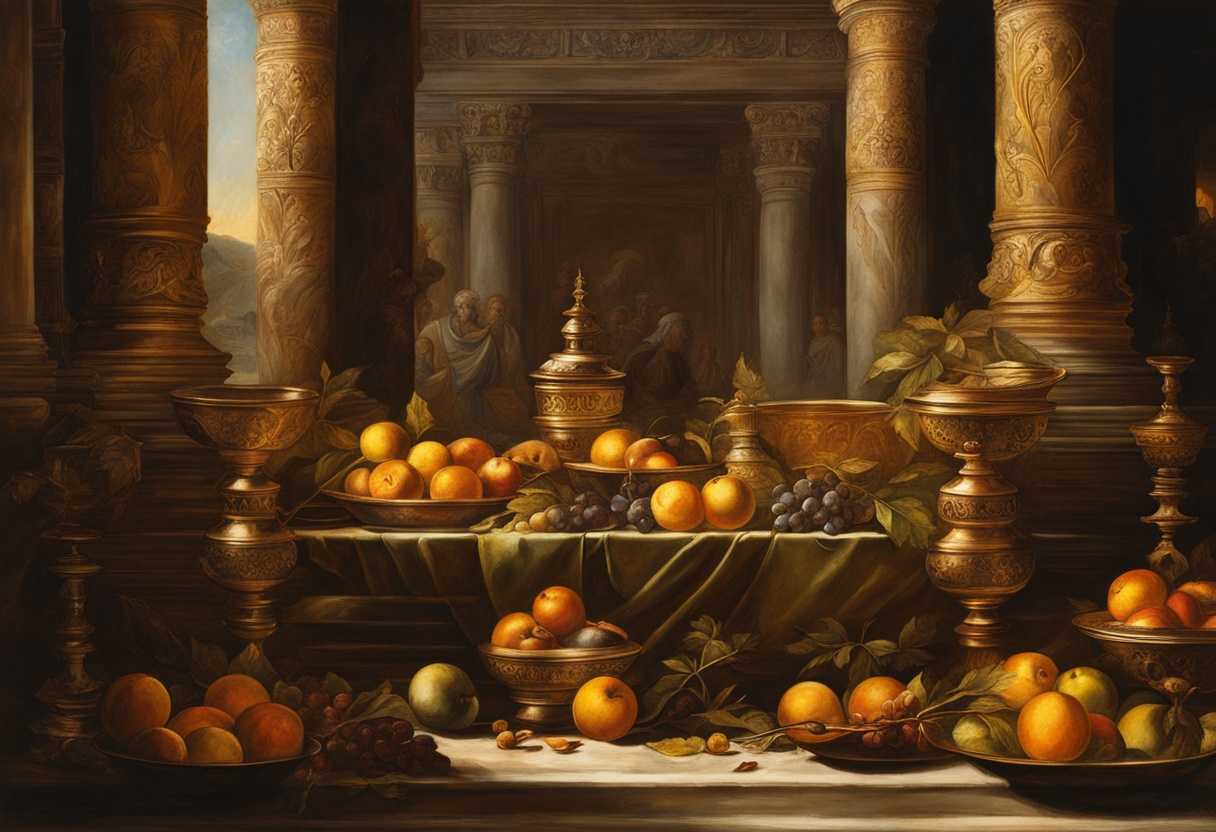
In the Bible, the term “plate” often refers to a flat, shallow dish or vessel used for various purposes, such as serving food or holding offerings. For example, in the context of temple service, plates were used to collect contributions or offerings from the people (Exodus 25:29).
Scripture
36 “You shall make a plate of pure gold and engrave on it, like the engraving of a signet, ‘Holy to the Lord.’
37 You shall fasten it on a cord of blue and it shall be on the turban; it shall be at the front of the turban.
38 It shall be on Aaron’s forehead, and Aaron shall bear any guilt from the holy things that the people of Israel consecrate as their holy gifts. It shall regularly be on his forehead, that they may be accepted before the Lord.
Biblical Meaning of “Plate” Explained
In the Bible, the term “plate” can symbolize more than just a physical vessel; it embodies themes of sacrifice, community, and divine provision. For instance, in Exodus 25:29, the plates crafted for the tabernacle illustrate God’s intimate involvement in the lives of His people, as these holy vessels were used for both utilitarian and sacred purposes. They were designed to hold the offerings brought by the Israelites, representing not just material contributions but also their devotion and willingness to participate in God’s covenant. Similarly, the concept of plates can parallel the idea of stewardship, where believers are called to offer their resources and themselves in service to God and community (2 Corinthians 9:7).
Moreover, plates serve as a metaphor for the heart and the intentions behind giving. In Mark 12:41-44, the story of the widow’s offering highlights how the value of a gift is determined not by its monetary worth but by the sincerity and sacrifice behind it. Just as plates carry contributions to God, our actions and offerings reflect the condition of our hearts. The broader meaning of “plate” in biblical contexts thus extends to a call for meaningful participation in faith communities, urging believers to engage generously and thoughtfully in honoring God with what they possess, both physically and spiritually.
The symbolism of “plate” in the Bible can extend to the idea of fulfillment and nourishment, both physical and spiritual. In ancient times, plates were central to communal meals and rituals, fostering a sense of unity and shared experience among worshippers. This communal aspect mirrors the early Christians’ practice of breaking bread together, where the plate not only held food but also represented the body of Christ and the fellowship of believers. This underscores an important theme in the New Testament where believers are called to gather in solidarity, reflecting the notion that such meals are sacred moments that deepen relationships with God and each other.
Additionally, the use of plates in the context of offerings aligns with the broader biblical principle of Divine provision. Just as plates were used to present the first fruits and sacrifices to God in ancient worship practices, they also symbolize the acknowledgment of God’s sustained blessings. This is echoed throughout various scriptures, where offerings made on plates are not merely transactions but acts of faith that express gratitude for God’s bounty. Consequently, the meaning of “plate” encompasses the call to recognize and partake in the gracious gifts of God, urging believers to respond with generous hearts in every aspect of their lives. Ultimately, plates serve as a reminder that the act of giving—whether of time, resources, or talents—reflects a deeper understanding of stewardship and a commitment to living out one’s faith within the community.
Symbol of Offering and Sacrifice
In biblical contexts, a “plate” often represents a vessel for offerings and sacrifices. It serves as a physical manifestation of devotion and commitment to God. The act of placing offerings on a plate symbolizes the believer’s willingness to give back to God what has been received, reflecting themes of gratitude and stewardship.
Representation of Abundance and Provision
A plate can also signify abundance and God’s provision. In various narratives, the presence of food on a plate illustrates God’s generosity and care for His people. This imagery reinforces the idea that God provides for both physical and spiritual needs, encouraging believers to trust in His sufficiency.
Tool for Community and Fellowship
Additionally, a plate can symbolize community and fellowship among believers. Sharing a meal from a plate fosters connection and unity, reflecting the communal aspects of faith. This notion emphasizes the importance of gathering together in worship and support, highlighting the relational aspect of the Christian experience.
How to Honor God Through Your Offerings and Service
Honoring God through your offerings and service is a beautiful way to express your faith and gratitude for all He has done in your life. It starts with a heart of generosity—consider what you can give, whether it’s your time, talents, or resources, and remember that it’s not about the amount but the intention behind it. Reflect on 2 Corinthians 9:7, which reminds us that God loves a cheerful giver. When you serve others, whether in your church, community, or even in small acts of kindness, you are embodying Christ’s love and compassion. Look for opportunities to volunteer, support those in need, or simply lend a listening ear to someone who is struggling. As you engage in these acts, pray for guidance and let the Holy Spirit lead you in how best to serve. Ultimately, it’s about building a relationship with God and others, allowing your offerings and service to be a reflection of His love shining through you.
Bible References to the Meaning of “Plate”:
Exodus 39:30-31: 30 They made the plate of the holy crown of pure gold, and wrote on it an inscription, like the engraving of a signet, “Holy to the Lord.”
31 And they fastened a blue cord to it to attach it to the turban above, as the Lord had commanded Moses.
Leviticus 8:8-9: 8 And he placed the breastpiece on him, and in the breastpiece he put the Urim and the Thummim.
9 And he set the turban on his head, and on the turban, in front, he set the golden plate, the holy crown, as the Lord commanded Moses.
Numbers 16:37-39: 37 “Tell Eleazar the son of Aaron the priest to take up the censers out of the blaze. Then scatter the fire far and wide, for they have become holy.
38 The censers of these men who have sinned at the cost of their lives shall be made into hammered plates as a covering for the altar, for they offered them before the Lord, and they became holy. Thus they shall be a sign to the people of Israel.”
39 So Eleazar the priest took the bronze censers, which those who were burned had offered, and they were hammered out as a covering for the altar,
1 Kings 7:30-32: 30 And each stand had four bronze wheels and axles of bronze, and at the four corners were supports for a basin. The supports were cast with wreaths at the side of each.
31 Its opening was within a crown that projected upward one cubit from it. Its opening was round, as a pedestal is made, a cubit and a half deep. And also on its opening there were engravings, and their panels were square, not round.
32 And the four wheels were underneath the panels. The axles of the wheels were of one piece with the stands, and the height of a wheel was a cubit and a half.
2 Chronicles 4:19-22: 19 Solomon also made all the vessels that were in the house of God, the golden altar, the tables for the bread of the Presence,
20 the lampstands and their lamps of pure gold to burn before the inner sanctuary, as prescribed;
21 the flowers, the lamps, and the tongs, of purest gold.
22 the snuffers, basins, dishes for incense, and fire pans, of pure gold, and the sockets of the temple for the inner doors to the Most Holy Place and for the doors of the nave of the temple were of gold.
Ezekiel 27:19-21: 19 Vedan and Javan traded with yarn for your wares; wrought iron, cassia, and calamus were bartered for your merchandise.
20 Dedan traded with you in saddlecloths for riding.
21 Arabia and all the princes of Kedar were your favored dealers in lambs, rams, and goats; in these they did business with you.
Ezekiel 28:13-15: 13 You were in Eden, the garden of God; every precious stone was your covering, sardius, topaz, and diamond, beryl, onyx, and jasper, sapphire, emerald, and carbuncle; and crafted in gold were your settings and your engravings. On the day that you were created they were prepared.
14 You were an anointed guardian cherub.
15 You were blameless in your ways from the day you were created, till unrighteousness was found in you.
Revelation 1:12-16: 12 Then I turned to see the voice that was speaking to me, and on turning I saw seven golden lampstands,
13 and in the midst of the lampstands one like a son of man, clothed with a long robe and with a golden sash around his chest.
14 The hairs of his head were white, like white wool, like snow. His eyes were like a flame of fire,
15 his feet were like burnished bronze, refined in a furnace, and his voice was like the roar of many waters.
16 In his right hand he held seven stars, from his mouth came a sharp two-edged sword, and his face was like the sun shining in full strength.

Reverend Ogunlade is a seasoned Church Minister with over three decades of experience in guiding and nurturing congregations. With profound wisdom and a serene approach, Reverend Ogunlade has carried out various pastoral duties, including delivering uplifting sermons, conducting religious ceremonies, and offering sage counsel to individuals seeking spiritual guidance. Their commitment to fostering harmony and righteousness within their community is exemplified through their compassionate nature, making them a beloved and trusted figure among the congregation.