
In the Bible, bronze often symbolizes strength, durability, and judgment. It is frequently associated with judgment as seen in the bronze altar used in the tabernacle and the bronze serpent in the wilderness, representing both the severity of God’s judgment and His provision for salvation.
Scripture
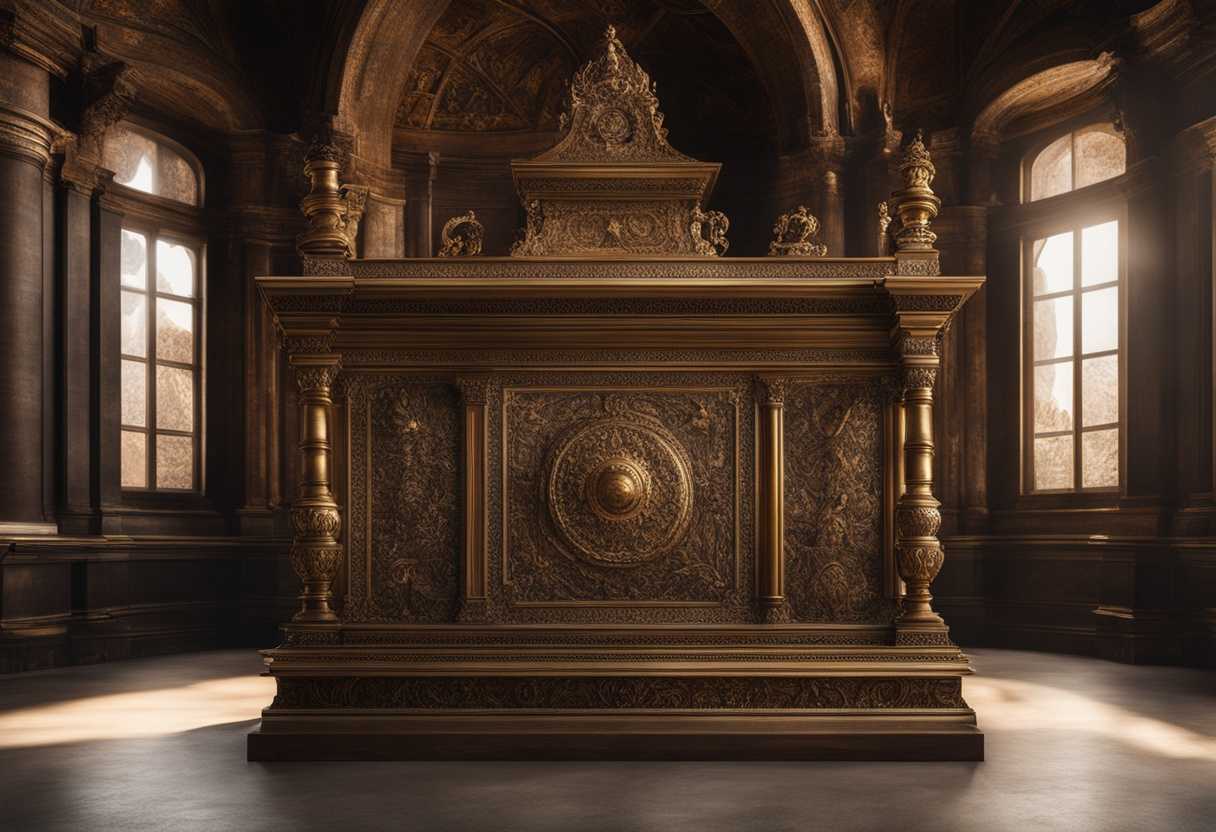
1 “You shall make the altar of acacia wood, five cubits long and five cubits broad. The altar shall be square, and its height shall be three cubits.
2 And you shall make horns for it on its four corners; its horns shall be of one piece with it, and you shall overlay it with bronze.
3 Five cubits shall be the length of the one curtain, and five cubits the breadth of the one curtain for the first set of curtains, and five cubits the length of the one curtain, and five cubits the breadth of the one curtain for the second set of curtains.
4 You shall make for it a grating of network of bronze, and on the net you shall make four bronze rings at its four corners.
5 You shall put it under the ledge of the altar so that the net shall extend halfway down the altar.
6 You shall make poles for the altar, a net of bronze network, to be set halfway up the altar.
7 And you shall put it under the ledge of the altar so that the net shall extend halfway down the altar.
8 It shall be made with cherubim skillfully worked into it.
Biblical Significance of Bronze
The significance of bronze in the Bible extends beyond its physical properties, symbolizing a spiritual foundation of strength, endurance, and divine judgment. Its robustness aligns with various scriptural themes, particularly as a material used in sacred contexts. For instance, the bronze altar discussed in Exodus 27:1-2 highlights its role in the sacrificial system, illustrating that divine judgment necessitates a means of atonement. The altar, made of acacia wood and overlaid with bronze, was designed for the sacrifices of animals, symbolizing the weighty consequence of sin and the need for redemption through sacrificial offerings. This physical representation serves as a tangible reminder that while God is just, He also provides a pathway for atonement.
Additionally, the bronze serpent in Numbers 21:8-9 further emphasizes this duality of judgment and salvation. When the Israelites were plagued by venomous snakes as a consequence of their rebellion, God instructed Moses to create a serpent of bronze and lift it on a pole. Those who looked upon it were healed, symbolizing faith and obedience leading to salvation from judgment. Jesus references this event in John 3:14-15 to foreshadow His crucifixion, where He becomes the ultimate provision for sin’s consequence. Thus, the use of bronze in these key biblical narratives conveys profound theological truths about the severity of sin, God’s holiness, and His merciful nature, enriching the understanding of divine justice interwoven with grace.
Throughout the Scriptures, bronze emerges as a potent symbol representing God’s might and the human condition. The Book of Daniel offers insight into this theme through the statue in Nebuchadnezzar’s dream, where the legs of iron and feet of iron mixed with clay are interpreted as the kingdoms of man, culminating in a depiction of flawed strength. Bronze plays a role in this symbolism, as it is used to illustrate the inferior attributes of the fourth kingdom, contrasting the ultimate sovereignty of God’s eternal kingdom that will crush all earthly powers (Daniel 2:31-44). This portrayal signifies that while bronze may represent strength and durability, it ultimately fails in comparison to God’s everlasting dominion, reinforcing the concept of divine authority over human endeavors.
Furthermore, bronze often signifies refinement and purification. Job’s lamentations in the Bible invoke imagery of bronze, reflecting both suffering and resilience through the metaphor of metal being heated and purified by fire. This alludes to the trials that believers endure, which serve to test and strengthen their faith (Job 23:10). The metaphor of bronze in this context speaks to the transformative process of spiritual growth, where the trials faced by the faithful are akin to the refining of metal—emerging stronger in character and hardened against adversity. Therefore, bronze resonates on multiple levels within biblical narratives, embodying a message of human frailty, divine judgment, and the potential for spiritual fortitude through life’s adversities.
Symbol of Judgment and Strength
In biblical contexts, bronze often symbolizes judgment and strength. Its durability and resistance to corrosion make it a fitting representation of God’s unwavering justice and the strength required to uphold it. This association can be seen in various instances where bronze is used in the construction of altars and instruments for worship, signifying the seriousness of divine judgment and the weight of sin.
Representation of Human Imperfection
Bronze can also represent human imperfection and the need for purification. In contrast to gold, which symbolizes divinity and perfection, bronze serves as a reminder of humanity’s flawed nature. This duality highlights the necessity for redemption and the transformative power of faith, as believers seek to be refined and made pure in the sight of God.
Connection to Warfare and Conflict
Additionally, bronze is often linked to warfare and conflict in the Bible. Its use in weapons and armor signifies the battles faced by the people of God, both physically and spiritually. This connection emphasizes the ongoing struggle against sin and evil, as well as the strength and resilience required to overcome such challenges through faith and divine assistance.
How to Cultivate Stronger Faith and Resilience in Christ
Cultivating stronger faith and resilience in Christ is a deeply personal journey that requires intentionality and openness to God’s guidance. Start by immersing yourself in Scripture; the Bible is not just a book, but a living testament that speaks to our hearts and circumstances. Make it a habit to meditate on verses that resonate with your struggles and aspirations, allowing them to shape your thoughts and actions. Prayer is another vital component—engage in honest conversations with God, sharing your fears and doubts, and seeking His wisdom and strength. Surround yourself with a community of believers who can encourage and uplift you, reminding you that you are not alone in your walk. Finally, embrace challenges as opportunities for growth; remember that resilience is often forged in the fires of adversity. Trust that God is with you every step of the way, and as you lean into Him, your faith will deepen, and you will find the strength to face whatever life throws your way.
Bible References to Bronze Significance:
Numbers 21:4-9: 4 From Mount Hor they set out by the way to the Red Sea, to go around the land of Edom. And the people became impatient on the way.
5 And the people spoke against God and against Moses, “Why have you brought us up out of Egypt to die in the wilderness? For there is no food and no water, and we loathe this worthless food.”
6 Then the Lord sent fiery serpents among the people, and they bit the people, so that many people of Israel died.
7 And the people came to Moses and said, “We have sinned, for we have spoken against the Lord and against you. Pray to the Lord, that he take away the serpents from us.” So Moses prayed for the people.
8 And the Lord said to Moses, “Make a fiery serpent and set it on a pole, and everyone who is bitten, when he sees it, shall live.”
9 So Moses made a bronze serpent and set it on a pole. And if a serpent bit anyone, he would look at the bronze serpent and live.
Deuteronomy 8:7-9: 7 For the Lord your God is bringing you into a good land, a land of brooks of water, of fountains and springs, flowing out in the valleys and hills,
8 a land of wheat and barley, of vines and fig trees and pomegranates, a land of olive trees and honey,
9 a land in which you will eat bread without scarcity, in which you will lack nothing, a land whose stones are iron, and out of whose hills you can dig copper.
1 Kings 7:13-22: 13 And King Solomon sent and brought Hiram from Tyre.
14 He was the son of a widow of the tribe of Naphtali, and his father was a man of Tyre, a worker in bronze. And he was full of wisdom, understanding, and skill for making any work in bronze. He came to King Solomon and did all his work.
15 He cast two pillars of bronze. Eighteen cubits was the height of one pillar, and a line of twelve cubits measured its circumference. It was hollow, and its thickness was four fingers. The second pillar was the same.
16 He also made two capitals of cast bronze to set on the tops of the pillars. The height of the one capital was five cubits, and the height of the other capital was five cubits.
17 There were lattices of checker work with wreaths of chain work for the capitals on the tops of the pillars, a lattice for the one capital and a lattice for the other capital.
18 So he made the pillars, and two rows around on the one network to cover the capitals that were on the top of the pomegranates. And so he did for the other capital.
19 So he set the pillars at the entrance of the temple, one on the south, the other on the north.
20 There were capitals on the two pillars, above the rounded projection next to the latticework.
21 And he set up the pillars at the vestibule of the temple. He set up the pillar on the south and called its name Jachin, and he set up the pillar on the north and called its name Boaz.
22 And on the tops of the pillars was lily-work. Thus the work of the pillars was finished.
2 Chronicles 4:1-18: 1 He made an altar of bronze, twenty cubits long and twenty cubits wide and ten cubits high.
2 And he cast a round molding, half a cubit high, around the top of it.
3 Now figures like oxen were under it, and all around it. And the second row of oxen was below the first row.
4 He also made a sea of cast metal ten cubits from brim to brim, circular in form, and five cubits high, and a line of thirty cubits measured its circumference.
5 It was a handbreadth thick, and its brim was made like the brim of a cup, like the flower of a lily. It held 3,000 baths.
6 He also made ten basins in which to wash, and set five on the south side, and five on the north side, to rinse in them things for the burnt offering. They were made of cast metal.
7 And he made ten golden lampstands as prescribed by the law and set them in the temple, five on the south side and five on the north.
8 He also made ten tables and placed them in the temple, five on the south side and five on the north.
9 Then he made the court of the priests and the great court and doors for the court and overlaid their doors with bronze.
10 He set the sea at the southeast corner of the house, east of the south.
11 Huram also made the pots, the shovels, and the basins. So Huram finished the work that he did for King Solomon on the house of God:
12 the two pillars, the bowls, and the two capitals on the top of the pillars; and the two latticeworks to cover the two bowls of the capitals that were on the top of the pillars;
13 and the four hundred pomegranates for the two lattices, two rows of pomegranates for each latticework to cover the two bowls of the capitals that were on the pillars.
14 He made the stands also, and the basins on the stands,
15 the pots, the shovels, and the basins. All these vessels in the house of the Lord which Hiram made for King Solomon were of burnished bronze.
16 The pots, the shovels, and the basins, all these vessels that Hiram made for King Solomon for the house of the Lord were of burnished bronze.
17 In the plain of the Jordan the king cast them, in the clay ground between Succoth and Zeredah.
18 So Solomon made all these vessels in great quantities, for the weight of the bronze was not sought.
Ezekiel 1:4-14: 4 As I looked, behold, a stormy wind came out of the north, and a great cloud, with brightness around it, and fire flashing forth continually, and in the midst of the fire, as it were gleaming metal.
5 And from the midst of it came the likeness of four living creatures. And this was their appearance: they had a human likeness.
6 but each had four faces, and each of them had four wings.
7 Their legs were straight, and the soles of their feet were like the sole of a calf’s foot. And they sparkled like burnished bronze.
8 Under their wings on their four sides they had human hands.
9 their wings touched one another. Each one of them went straight forward, without turning as they went.
10 As for the likeness of their faces, each had a human face. The four had the face of a lion on the right side, the four had the face of an ox on the left side, and the four had the face of an eagle.
11 Such were their faces. And their wings were spread out above. Each creature had two wings, each of which touched the wing of another, while two covered their bodies.
12 And each went straight forward. Wherever the spirit would go, they went, without turning as they went.
13 As for the likeness of the living creatures, their appearance was like burning coals of fire, like the appearance of torches moving to and fro among the living creatures. And the fire was bright, and out of the fire went forth lightning.
14 And the living creatures darted to and fro, like the appearance of a flash of lightning.
Ezekiel 27:12-13: 12 “Tarshish did business with you because of your great wealth of every kind; silver, iron, tin, and lead they exchanged for your wares.
13 Javan, Tubal, and Meshech traded with you. They exchanged human beings and vessels of bronze for your merchandise.
Daniel 2:31-35: 31 You saw, O king, and behold, a great image. This image, mighty and of exceeding brightness, stood before you, and its appearance was frightening.
32 The head of this image was of fine gold, its chest and arms of silver, its middle and thighs of bronze,
33 its legs of iron, its feet partly of iron and partly of clay.
34 As you looked, a stone was cut out by no human hand, and it struck the image on its feet of iron and clay, and broke them in pieces.
35 Then the iron, the clay, the bronze, the silver, and the gold, all together were broken in pieces, and became like the chaff of the summer threshing floors; and the wind carried them away, so that not a trace of them could be found. But the stone that struck the image became a great mountain and filled the whole earth.
Daniel 10:4-6: 4 On the twenty-fourth day of the first month, as I was standing on the bank of the great river (that is, the Tigris)
5 I lifted up my eyes and looked, and behold, a man clothed in linen, with a belt of fine gold from Uphaz around his waist.
6 His body was like beryl, his face like the appearance of lightning, his eyes like flaming torches, his arms and legs like the gleam of burnished bronze, and the sound of his words like the sound of a multitude.
Revelation 1:12-15: 12 Then I turned to see the voice that was speaking to me, and on turning I saw seven golden lampstands,
13 and in the midst of the lampstands one like a son of man, clothed with a long robe and with a golden sash around his chest.
14 The hairs of his head were white, like white wool, like snow. His eyes were like a flame of fire,
15 his feet were like burnished bronze, refined in a furnace, and his voice was like the roar of many waters.

Reverend Ogunlade is a seasoned Church Minister with over three decades of experience in guiding and nurturing congregations. With profound wisdom and a serene approach, Reverend Ogunlade has carried out various pastoral duties, including delivering uplifting sermons, conducting religious ceremonies, and offering sage counsel to individuals seeking spiritual guidance. Their commitment to fostering harmony and righteousness within their community is exemplified through their compassionate nature, making them a beloved and trusted figure among the congregation.