
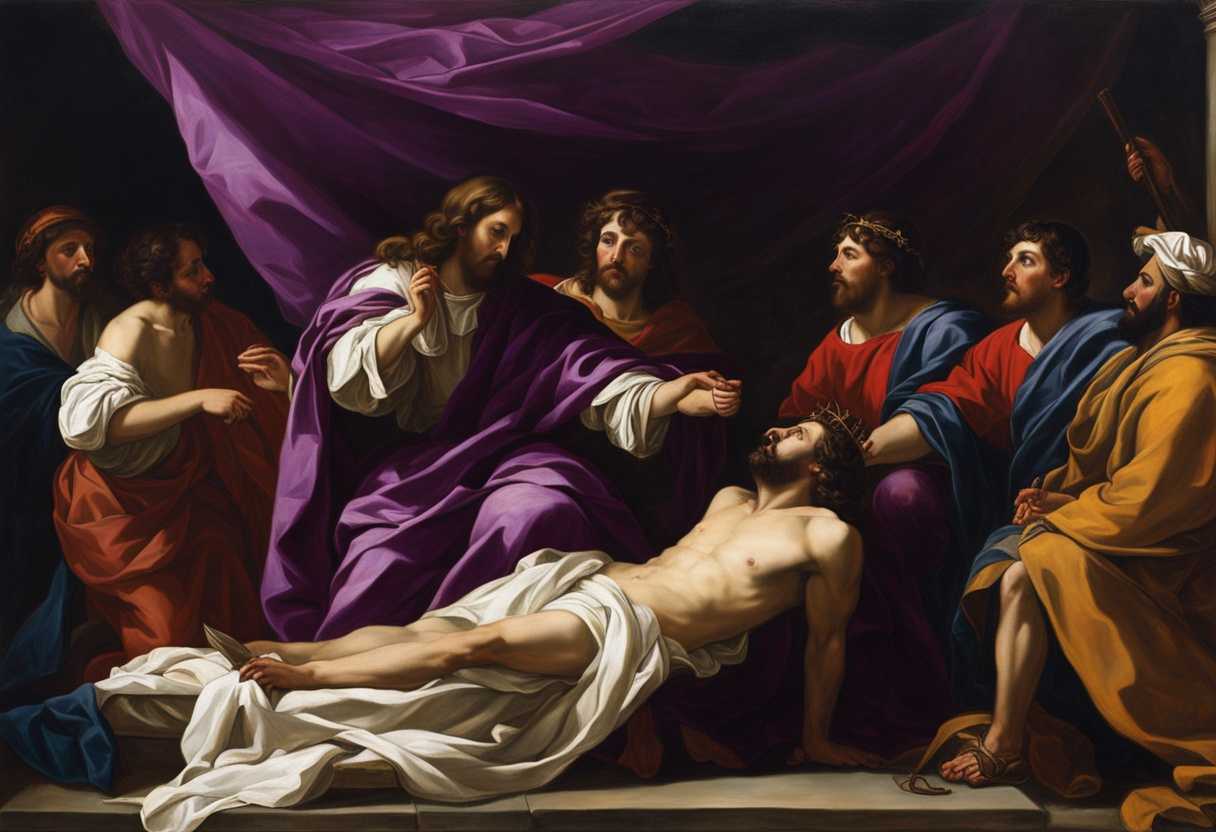
In the Bible, the purple robe is often associated with royalty and nobility, symbolizing the authority and majesty of a king. Specifically, during the trial of Jesus, soldiers dressed Him in a purple robe as a mockery of His claim to kingship (Mark 15:17), highlighting both His suffering and the ironic perception of His kingship by the world.
Scripture
1 Then Pilate took Jesus and flogged him.
2 And the soldiers twisted together a crown of thorns and put it on his head and arrayed him in a purple robe.
3 They came up to him, saying, “Hail, King of the Jews!” and struck him with their hands.
4 Pilate went out again and said to them, “See, I am bringing him out to you that you may know that I find no guilt in him.”
5 So Jesus came out, wearing the crown of thorns and the purple robe. Pilate said to them, “Behold the man!”
Meaning of the Purple Robe in the Bible
The purple robe in the Bible carries profound symbolic significance, particularly in the context of Jesus’ crucifixion. In Mark 15:17, soldiers dress Jesus in a purple robe as a taunt during His trial, sarcastically acknowledging His claim to be “King of the Jews.” This act highlights the stark contrast between societal views of power and authority and the true nature of Christ’s kingship, which is rooted in humility, suffering, and sacrificial love. The color purple has historically been associated with wealth, nobility, and royalty, drawing from the immense value of purple dye in the ancient world. Thus, while the soldiers intended to ridicule Jesus, they inadvertently affirmed His royal identity, setting the stage for a deeper understanding of His messianic role.
Furthermore, the purple robe serves as a poignant reminder of the theme of suffering and the paradox of God’s kingdom. In Philippians 2:8, Paul writes that Jesus “humbled himself by becoming obedient to death—even death on a cross.” This humility contrasts sharply with the expectations of worldly power, where strength often overshadows sacrifice. Ultimately, Jesus’ bearing of the purple robe, meant for mockery, embodies His willingness to bear the weight of sin and shame for humanity. This act of wearing the robe invites believers to reevaluate their understanding of greatness and to embrace a kingdom where the first are last and the last are first (Matthew 20:16), underscoring a kind of royalty that values love, service, and sacrifice over conventional authority.
Beyond its immediate context during the passion narrative, the purple robe can also be viewed through the lens of prophecy and fulfillment within the entire biblical narrative. In the Old Testament, purple was often associated with the priestly garments mentioned in Exodus. The robes worn by high priests not only exemplified their sacred duties but also illustrated the concept of intercession before God on behalf of the people. Thus, in the New Testament depiction of Jesus wearing a purple robe, readers are reminded of the ultimate priestly role He fulfills as the mediator between humanity and God. This connection enhances the understanding of Jesus as the Lamb of God who would take away the sins of the world, drawing a line between the Old Covenant’s rituals and the New Covenant’s reality.
Additionally, the symbolism of the purple robe can extend to themes of identity and belonging. The robe, meant to mock, instead reflects the inclusive nature of Christ’s message. Just as purple signifies royalty, it also serves as a metaphor for the inheritance available to all believers through Christ. As stated in Galatians 3:26–28, through faith in Christ, all followers are adopted as children of God, erasing distinctions of status and heritage. Thus, the purple robe, while wielded as a tool of scorn, becomes a vivid emblem of divine acceptance and the truth that God’s kingdom is a realm where those marginalized by society are elevated. This radical redefinition of identity invites Christians to find their worth not in worldly accolades but in their transformation as heirs in the life of Christ, reinforcing the notion that true dignity is realized in the embrace of love and grace.
Symbol of Royalty and Authority
The purple robe in the Bible often symbolizes royalty and authority. In ancient times, purple dye was rare and expensive, making it a color associated with nobility and power. The use of a purple robe can signify the recognition of a king or a person of high status. This symbolism extends to the portrayal of Jesus, who is referred to as the King of Kings, highlighting the contrast between earthly power and divine authority.
Representation of Suffering and Mockery
The purple robe also serves as a representation of suffering and mockery, particularly in the context of Jesus’ passion. When Jesus was adorned with a purple robe, it was done in a mocking manner by those who did not recognize His true identity. This act of dressing Him in royal garments was intended to ridicule Him as a king, emphasizing the pain and humiliation He endured. Thus, the purple robe becomes a poignant symbol of the juxtaposition between His divine kingship and the scorn He faced from humanity.
Sign of Fulfillment of Prophecy
Additionally, the purple robe can be seen as a sign of the fulfillment of prophecy. Throughout the Old Testament, there are numerous prophecies regarding the coming Messiah, who would be a king. The donning of the purple robe can be interpreted as a moment that fulfills these prophecies, albeit in a way that highlights the irony of His kingship being recognized only in mockery. This aspect underscores the theme of God’s plan being realized through unexpected and often painful circumstances.
How to Embrace Your Spiritual Royalty in Christ
Embracing your spiritual royalty in Christ is a transformative journey that begins with understanding your identity as a beloved child of God. In 1 Peter 2:9, we are reminded that we are a “royal priesthood,” chosen to reflect His light in a world that often feels dark. To truly embrace this royal identity, start by immersing yourself in Scripture, allowing the truth of God’s promises to reshape your self-perception. Spend time in prayer, seeking a deeper relationship with Him, and ask the Holy Spirit to reveal the unique gifts and purpose He has placed within you. Remember, being royal in Christ means serving others with love and humility, just as He did. As you walk in this truth, let go of any feelings of unworthiness or doubt, and instead, wear your spiritual crown with confidence, knowing that you are called to make a difference in the lives of those around you. Embrace your royal status not for personal glory, but to glorify the King who has called you into His marvelous light.
Bible References to the Purple Robe:
Mark 15:16-20: 16 And the soldiers led him away inside the palace (that is, the governor’s headquarters), and they called together the whole battalion.
17 And they clothed him in a purple cloak, and twisting together a crown of thorns, they put it on him.
18 And they began to salute him, “Hail, King of the Jews!”
19 And they struck his head with a reed and spat on him and knelt down in homage to him.
20 And when they had mocked him, they stripped him of the purple cloak and put his own clothes on him. And they led him out to crucify him.
Luke 23:6-11: 6 When Pilate heard this, he asked whether the man was a Galilean.
7 And when he learned that he belonged to Herod’s jurisdiction, he sent him over to Herod, who was himself in Jerusalem at that time.
8 When Herod saw Jesus, he was very glad, for he had long desired to see him, because he had heard about him, and he was hoping to see some sign done by him.
9 Then he questioned him with many words, but he made no answer.
10 The chief priests and the scribes stood by, vehemently accusing him.
11 And Herod with his soldiers treated him with contempt and mocked him. Then, arraying him in splendid clothing, he sent him back to Pilate.
Matthew 27:27-31: 27 Then the soldiers of the governor took Jesus into the governor’s headquarters, and they gathered the whole battalion before him.
28 And they stripped him and put a scarlet robe on him,
29 and twisting together a crown of thorns, they put it on his head and put a reed in his right hand. And kneeling before him, they mocked him, saying, “Hail, King of the Jews!”
30 And they spit on him and took the reed and struck him on the head.
31 And when they had mocked him, they stripped him of the robe and put his own clothes on him and led him away to crucify him.
Esther 8:15: 15 Then Mordecai went out from the presence of the king in royal robes of blue and white, with a great golden crown and a robe of fine linen and purple, and the city of Susa shouted and rejoiced.
Daniel 5:29: 29 Then Belshazzar gave the command, and Daniel was clothed with purple, a chain of gold was put around his neck, and a proclamation was made about him, that he should be the third ruler in the kingdom.
Revelation 18:11-16: 11 And the merchants of the earth weep and mourn for her, since no one buys their cargo anymore,
12 cargo of gold, silver, jewels, pearls, fine linen, purple cloth, silk, scarlet cloth, all kinds of scented wood, all kinds of articles of ivory, all kinds of articles of costly wood, bronze, iron and marble,
13 cinnamon, spice, incense, myrrh, frankincense, wine, oil, fine flour, wheat, cattle and sheep, horses and chariots, and slaves, that is, human souls.
14 The fruit for which your soul longed
has gone from you,
and all your delicacies and your splendors
are lost to you,
never to be found again!
15 The merchants of these wares, who gained wealth from her, will stand far off, in fear of her torment, weeping and mourning aloud,
16 “Alas, alas, for the great city that was clothed in fine linen, in purple and scarlet, adorned with gold, with jewels, and with pearls!”

Rev. François Dupont is a dedicated church minister with a wealth of experience in serving spiritual communities. With a calm and serene demeanor, he has been devoted to sharing the message of love, compassion, and tolerance for over two decades. Through his thoughtful sermons, compassionate counseling, and unwavering support, Rev. Dupont has touched the lives of countless individuals, allowing them to find solace and strength during difficult times. His serene presence and deep understanding of the human condition make him a trusted guide for those seeking spiritual nourishment and guidance.