
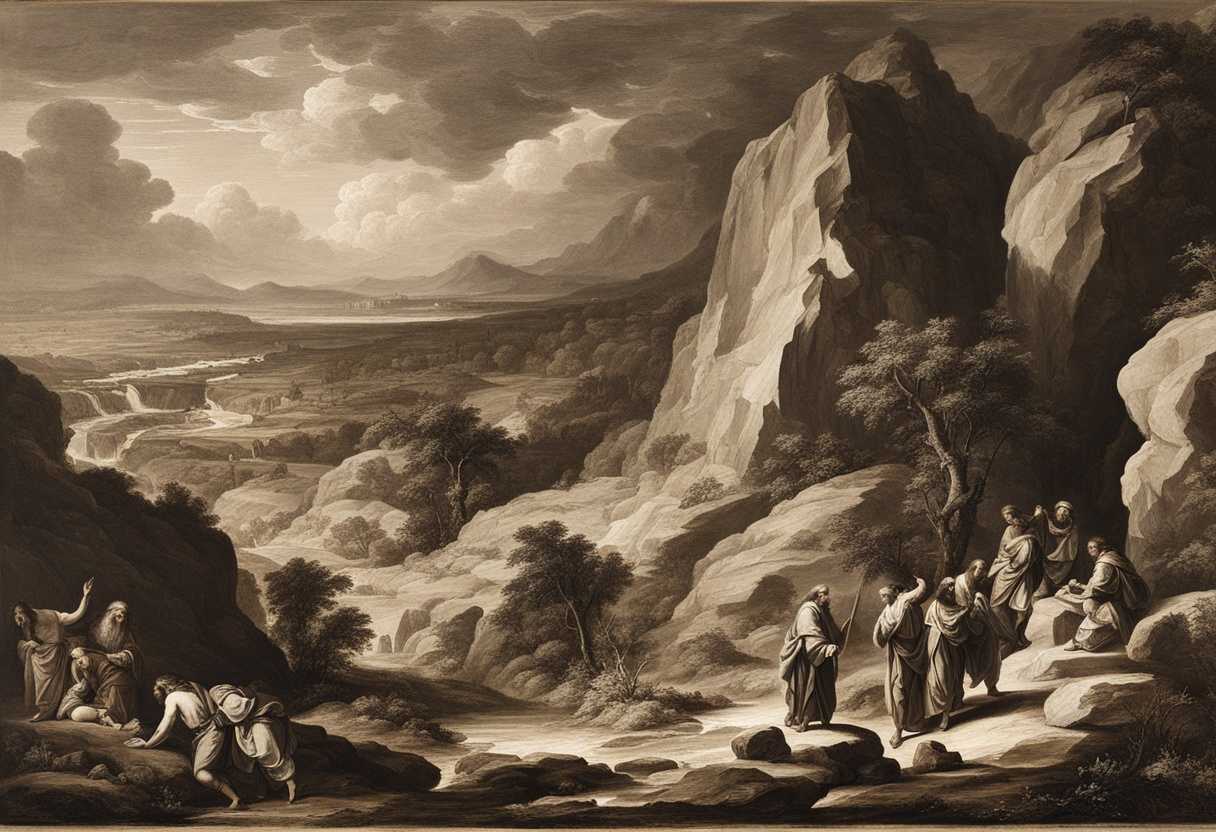
Rephidim is a location mentioned in the Bible, specifically in Exodus 17, where the Israelites camped during their Exodus from Egypt. It is significant as the site where the Israelites struggled with a lack of water and where Moses struck a rock to provide water, demonstrating God’s provision and the testing of the people’s faith.
Scripture
1 All the congregation of the people of Israel moved on from the wilderness of Sin by stages, according to the commandment of the Lord, and camped at Rephidim, but there was no water for the people to drink.
2 Therefore the people quarreled with Moses and said, “Give us water to drink.” And Moses said to them, “Why do you quarrel with me? Why do you test the Lord?”
3 But the people thirsted there for water, and the people grumbled against Moses and said, “Why did you bring us up out of Egypt, to kill us and our children and our livestock with thirst?”
4 So Moses cried to the Lord, “What shall I do with this people? They are almost ready to stone me.”
5 And the Lord said to Moses, “Pass on before the people, taking with you some of the elders of Israel, and take in your hand the staff with which you struck the Nile, and go.
6 Behold, I will stand before you there on the rock at Horeb, and you shall strike the rock, and water shall come out of it, and the people will drink.” And Moses did so, in the sight of the elders of Israel.
7 And he called the name of the place Massah and Meribah, because of the quarreling of the people of Israel, and because they tested the Lord by saying, “Is the Lord among us or not?”
8 Then Amalek came and fought with Israel at Rephidim.
9 So Moses said to Joshua, “Choose for us men, and go out and fight with Amalek. Tomorrow I will stand on the top of the hill with the staff of God in my hand.”
10 So Joshua did as Moses told him, and fought with Amalek, while Moses, Aaron, and Hur went up to the top of the hill.
11 Whenever Moses held up his hand, Israel prevailed, and whenever he lowered his hand, Amalek prevailed.
12 But Moses’ hands grew weary, so they took a stone and put it under him, and he sat on it, while Aaron and Hur held up his hands, one on one side, and the other on the other side. So his hands were steady until the going down of the sun.
13 And Joshua overwhelmed Amalek and his people with the sword.
14 Then the Lord said to Moses, “Write this as a memorial in a book and recite it in the ears of Joshua, that I will utterly blot out the memory of Amalek from under heaven.”
15 And Moses built an altar and called the name of it, The Lord Is My Banner,
16 saying, “A hand upon the throne of the Lord! The Lord will have war with Amalek from generation to generation.”
Meaning of Rephidim in the Bible
Rephidim, mentioned in Exodus 17:1-7, serves as a poignant symbol of the struggles faced by the Israelites during their exodus from Egypt. The location is not merely a geographical point but represents the trials and tribulations inherent in their journey toward the Promised Land. The Israelites found themselves without water, prompting anxiety and complaints against Moses, highlighting a recurring theme in their journey: the challenge of maintaining faith in God amidst dire circumstances. In their demand for water—”Is the LORD among us or not?” (Exodus 17:7)—the narrative captures a moment of spiritual testing that reveals the fragility of faith in the face of physical need.
Moses’ interaction with God at Rephidim, where he strikes the rock to provide water (Exodus 17:5-6), is a profound demonstration of divine provision and mercy. The act itself symbolizes God’s presence and sustenance even in moments of despair, reminding the Israelites—and the readers of the text—that their relationship with God encompasses both dependence and trust. This event also serves as a theological metaphor for the ongoing journey of faith; just as the Israelites faced physical thirst, believers today may encounter spiritual and emotional dry seasons. Rephidim thus represents both a literal thirst of the body and a deeper yearning for faith and assurance that God will meet all needs, which resonates through generations (Philippians 4:19). The struggle at Rephidim ultimately encapsulates the duality of human experience marked by challenges, doubts, and the continual call to rely on God’s provisions.
In addition to its role as a site of physical need, Rephidim evokes themes of leadership and divine guidance during the Israelites’ journey. The narrative illustrates how Moses, under the pressure of the people’s distress, must demonstrate both his faith and leadership capabilities. This dynamic invites a broader reflection on the nature of leadership in times of crisis. Leaders, like Moses, are often tasked with guiding others through spiritual and physical droughts. The pressures of leadership are underscored by the community’s complaints, presenting a case study in collectively navigating faith and trust in divine provision. Thus, Rephidim serves not only as a location of need but also as a crucible in which the character of both the leader and the congregation is tested and refined.
Furthermore, Rephidim stands as a poignant reminder of the communal aspect of faith. The Israelites’ collective anxiety reflects the struggles shared within faith communities, highlighting the importance of unity in facing challenges. This incident underscores the value of collective prayer and seeking God together, as it sets the stage for future encounters with God, such as the giving of the Ten Commandments at Sinai. The events at Rephidim act as a prelude to the covenant relationship that God seeks to establish with His people. Their experiences of doubt and God’s miraculous provision serve to fortify their identity and reliance on Him, reinforcing the significance of collective worship and the communal pursuit of faith amidst trials, thereby enriching the larger narrative of God’s ongoing engagement with His people throughout scripture.
A Place of Testing and Trial
Rephidim serves as a significant location in the biblical narrative where the Israelites faced challenges that tested their faith and reliance on God. The lack of water in this area symbolizes the trials believers encounter in their spiritual journey. It reflects the broader theme of dependence on divine provision, illustrating how God often leads His people into situations that require them to trust Him more deeply.
A Symbol of God’s Provision
Rephidim also represents God’s faithfulness in providing for His people, even in dire circumstances. The miraculous provision of water in this barren place highlights the theme of divine sustenance. This act serves as a reminder that God meets the needs of His followers, reinforcing the belief that He is attentive to their struggles and capable of delivering them from hardship.
A Foreshadowing of Spiritual Warfare
The events at Rephidim can be seen as a foreshadowing of the spiritual battles that believers face. The confrontation with the Amalekites signifies the ongoing struggle against adversaries that seek to undermine faith. This narrative emphasizes the importance of vigilance, prayer, and community support in overcoming challenges, illustrating that spiritual warfare is an integral part of the faith journey.
How to Find Balance Between Rest and Spiritual Struggle
Finding balance between rest and spiritual struggle is a journey that many of us navigate as we seek to deepen our faith. It’s essential to remember that even Jesus took time to rest and recharge, often retreating to quiet places for prayer and reflection (Mark 1:35). This teaches us that rest is not a sign of weakness but a necessary part of our spiritual growth. When we feel overwhelmed by our struggles, it’s okay to pause and allow ourselves the grace to breathe and reflect. Embrace moments of stillness, whether through prayer, meditation, or simply enjoying God’s creation, as these can rejuvenate your spirit and provide clarity. At the same time, don’t shy away from the challenges that test your faith; they often lead to profound growth and deeper understanding. Strive to create a rhythm in your life that honors both your need for rest and your desire to engage in spiritual battles, knowing that both are integral to your journey as a Christian.
Bible References to Rephidim Explained:
Exodus 19:1-2: 1 On the third new moon after the people of Israel had gone out of the land of Egypt, on that day they came into the wilderness of Sinai.
2 They set out from Rephidim and came into the wilderness of Sinai, and they encamped in the wilderness. There Israel encamped before the mountain,
Numbers 33:14-15: 14 And they set out from Alush and camped at Rephidim, where there was no water for the people to drink.
15 They set out from Rephidim and camped in the wilderness of Sinai.
Deuteronomy 25:17-19: 17 “Remember what Amalek did to you on the way as you came out of Egypt,
18 how he attacked you on the way when you were faint and weary, and cut off your tail, those who were lagging behind you, and he did not fear God.
19 Therefore when the Lord your God has given you rest from all your enemies around you, in the land that the Lord your God is giving you for an inheritance to possess, you shall blot out the memory of Amalek from under heaven; you shall not forget.
1 Samuel 15:2-3: 2 Thus says the Lord of hosts, ‘I have noted what Amalek did to Israel in opposing them on the way when they came up out of Egypt.
3 Now go and strike Amalek and devote to destruction all that they have. Do not spare them, but kill both man and woman, child and infant, ox and sheep, camel and donkey.

Reverend Ogunlade is a seasoned Church Minister with over three decades of experience in guiding and nurturing congregations. With profound wisdom and a serene approach, Reverend Ogunlade has carried out various pastoral duties, including delivering uplifting sermons, conducting religious ceremonies, and offering sage counsel to individuals seeking spiritual guidance. Their commitment to fostering harmony and righteousness within their community is exemplified through their compassionate nature, making them a beloved and trusted figure among the congregation.