
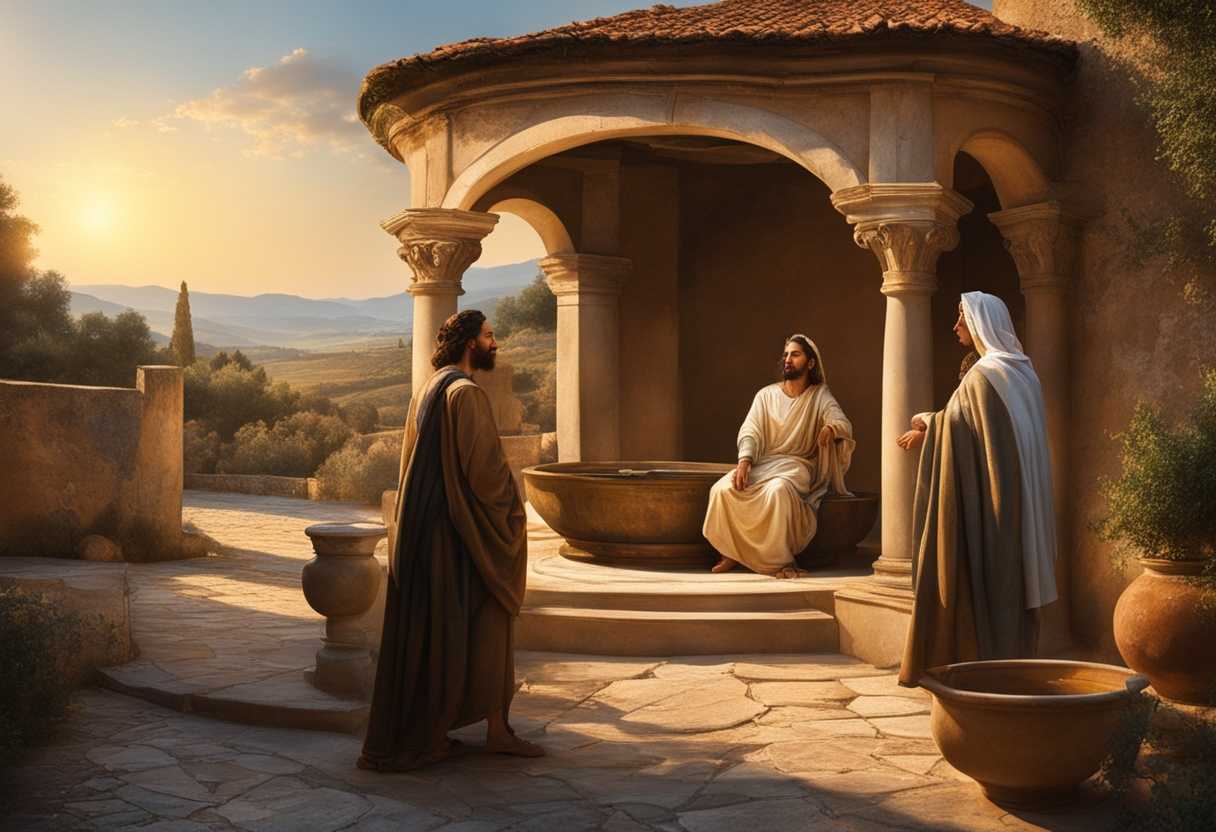
Sychar is a Samaritan town mentioned in the Gospel of John (John 4:5-6), known for its association with the encounter between Jesus and the Samaritan woman at the well. The name Sychar is often interpreted to mean “drunken” or “place of strength,” reflecting its historical and cultural significance in the region.
Scripture
4 Now when Jesus learned that the Pharisees had heard that Jesus was making and baptizing more disciples than John
2 (though Jesus himself did not baptize, but only his disciples),
3 he left Judea and departed again for Galilee.
4 And he had to pass through Samaria.
5 So he came to a town of Samaria called Sychar, near the field that Jacob had given to his son Joseph.
6 Jacob’s well was there; so Jesus, wearied as he was from his journey, was sitting beside the well. It was about the sixth hour.
7 A woman from Samaria came to draw water. Jesus said to her, “Give me a drink.”
8 For his disciples had gone away into the city to buy food.
9 The Samaritan woman said to him, “How is it that you, a Jew, ask for a drink from me, a woman of Samaria?” (For Jews have no dealings with Samaritans.)
10 Jesus answered her, “If you knew the gift of God, and who it is that is saying to you, ‘Give me a drink,’ you would have asked him, and he would have given you living water.”
11 The woman said to him, “Sir, you have nothing to draw water with, and the well is deep. Where do you get that living water?
12 Are you greater than our father Jacob? He gave us the well and drank from it himself, as did his sons and his livestock.
13 Jesus said to her, “Everyone who drinks of this water will be thirsty again,
14 but whoever drinks of the water that I will give him will never be thirsty again. The water that I will give him will become in him a spring of water welling up to eternal life.”
15 The woman said to him, “Sir, give me this water, so that I will not be thirsty or have to come here to draw water.”
16 So Jesus said to her, “Go, call your husband, and come here.”
17 The woman answered him, “I have no husband.” Jesus said to her, “You are right in saying, ‘I have no husband’;
18 There is no fear in love, but perfect love casts out fear. For fear has to do with punishment, and whoever fears has not been perfected in love.
19 The woman said to him, “Sir, I perceive that you are a prophet.
20 Our fathers worshiped on this mountain, but you say that in Jerusalem is the place where people ought to worship.”
21 Jesus said to her, “Woman, believe me, the hour is coming when neither on this mountain nor in Jerusalem will you worship the Father.”
22 You worship what you do not know; we worship what we know, for salvation is from the Jews.
23 But the hour is coming, and is now here, when the true worshipers will worship the Father in spirit and truth, for the Father is seeking such people to worship him.
24 God is spirit, and those who worship him must worship in spirit and truth.
25 The woman said to him, “I know that Messiah is coming (he who is called Christ). When he comes, he will tell us all things.”
26 Jesus said to her, “I who speak to you am he.”
27 Just then his disciples came back. They marveled that he was talking with a woman, but no one said, “What do you seek?” or, “Why are you talking with her?”
28 So the woman left her water jar and went away into town and said to the people,
29 “Come, see a man who told me all that I ever did. Can this be the Christ?”
30 They went out of the town and were coming to him.
31 Meanwhile the disciples were urging him, saying, “Rabbi, eat.”
32 But he said to them, “I have food to eat that you do not know about.”
33 So the disciples said to one another, “Has anyone brought him something to eat?”
34 Jesus said to them, “My food is to do the will of him who sent me and to accomplish his work.”
35 Do you not say, ‘There are yet four months, then comes the harvest’? Look, I tell you, lift up your eyes, and see that the fields are white for harvest.
36 Already the one who reaps is receiving wages and gathering fruit for eternal life, so that sower and reaper may rejoice together.
37 For here the saying holds true, ‘One sows and another reaps.’
38 I sent you to reap that for which you did not labor. Others have labored, and you have entered into their labor.
39 Many Samaritans from that town believed in him because of the woman’s testimony, “He told me all that I ever did.”
40 So when the Samaritans came to him, they asked him to stay with them, and he stayed there two days.
41 And many more believed because of his word.
42 They said to the woman, “It is no longer because of what you said that we believe, for we have heard for ourselves, and we know that this is indeed the Savior of the world.”
Meaning of Sychar in the Bible
Sychar, the Samaritan town referenced in John 4:5-6, serves as a crucial backdrop for a profound dialogue between Jesus and the Samaritan woman at the well. This encounter not only illustrates the breaking of societal and cultural barriers—since Jews and Samaritans generally avoided interaction—but also highlights the transformative nature of Jesus’ ministry. The name Sychar, which some interpretations suggest means “drunken” or “place of strength,” encapsulates the duality of the spiritual awakening experienced by the woman. As she initially comes to draw water in the heat of the day, her physical thirst mirrors a deeper spiritual yearning that she has yet to recognize.
Moreover, the location of Sychar carries implications of redemption and acceptance. In this narrative, Jesus reveals not only his awareness of her personal history—with five husbands and her current living situation—but also his willingness to engage with her despite her past. This exchange marks a pivotal moment in which the woman transitions from a seeker of basic sustenance to a herald of the Gospel, going back to her city and proclaiming the significance of her encounter with Christ (John 4:29). Symbolically, Sychar thus becomes a place where traditional boundaries collapse, allowing for divine revelation and restoration. In essence, Sychar represents the grace of God that reaches out to the marginal and broken, offering them not just living water but a new identity and purpose within the Kingdom of God (John 4:14).
In the narrative of Sychar, we find a significant microcosm of Jesus’ wider mission among those who were often cast aside by society. The town itself is emblematic of Jesus’ outreach to those living on the fringes—both socially and spiritually. By engaging with the Samaritan woman, Jesus demonstrates the depths of His compassion and the inclusivity of His message. This singular moment in Sychar reveals that God’s salvific love is not confined to a particular geography, ethnicity, or social status; it encompasses all humanity, emphasizing that anyone, regardless of their past, is invited to partake in the transformative power of faith.
Furthermore, the experience of the woman at the well serves as a powerful reminder of the importance of personal testimony in the life of a believer. After her encounter with Jesus, the woman’s transformation from an isolated figure to a vibrant witness highlights how personal experiences with God can inspire and encourage others. As she returns to her community, her role shifts; she becomes an ambassador of truth, inviting others to explore their own relationship with Christ. Sychar thus transcends its geographical identity, emerging instead as a symbol for all who encounter the living Christ—a place where individuals are not merely seen in their brokenness but are empowered to share the hope and redemption found in Him. This invitation to relationship encourages believers to reflect on their own “Sychar” moments, wherein they recognized their spiritual thirst and found satisfaction in Christ.
A Place of Encounter and Revelation
Sychar serves as a significant location in the narrative of Jesus’ encounter with the Samaritan woman. This meeting symbolizes the breaking down of cultural and social barriers, as Jesus, a Jew, engages with a Samaritan woman. The broader meaning here reflects the theme of divine revelation and the transformative power of personal encounters with Christ. Sychar becomes a metaphor for places where individuals can experience profound spiritual awakening and understanding.
Symbol of Spiritual Thirst and Fulfillment
The name Sychar can be associated with the concept of thirst, both physical and spiritual. The Samaritan woman’s dialogue with Jesus highlights her search for fulfillment, which ultimately leads her to recognize Jesus as the source of living water. This broader meaning emphasizes the human condition of longing for spiritual satisfaction and the realization that true fulfillment is found in a relationship with God.
A Testament to Inclusivity in the Gospel
Sychar represents a pivotal moment in the Gospel narrative where the message of Jesus extends beyond the Jewish community to include Samaritans, who were often marginalized. This inclusivity signifies the universal nature of the Gospel, illustrating that salvation is available to all, regardless of background or societal status. The broader meaning here underscores the call for believers to embrace diversity and reach out to those who may feel excluded from the faith community.
How to cultivate a deeper faith in Christ
Cultivating a deeper faith in Christ is a journey that requires intentionality and openness to His presence in our lives. Start by immersing yourself in Scripture; the Bible is not just a book, but a living testament of God’s love and guidance. Set aside time each day for prayer, not just as a routine, but as a heartfelt conversation with God—share your joys, struggles, and questions. Surround yourself with a community of believers who can encourage and challenge you in your walk of faith; fellowship is vital for growth. Additionally, practice gratitude by reflecting on the blessings in your life, which can shift your perspective and deepen your trust in God’s plan. Finally, serve others in your community; through acts of kindness, you’ll not only reflect Christ’s love but also experience the joy that comes from living out your faith. Remember, faith is a journey, not a destination, and every step you take brings you closer to the heart of Christ.
Bible References to Sychar in Scripture:

Rev. François Dupont is a dedicated church minister with a wealth of experience in serving spiritual communities. With a calm and serene demeanor, he has been devoted to sharing the message of love, compassion, and tolerance for over two decades. Through his thoughtful sermons, compassionate counseling, and unwavering support, Rev. Dupont has touched the lives of countless individuals, allowing them to find solace and strength during difficult times. His serene presence and deep understanding of the human condition make him a trusted guide for those seeking spiritual nourishment and guidance.