
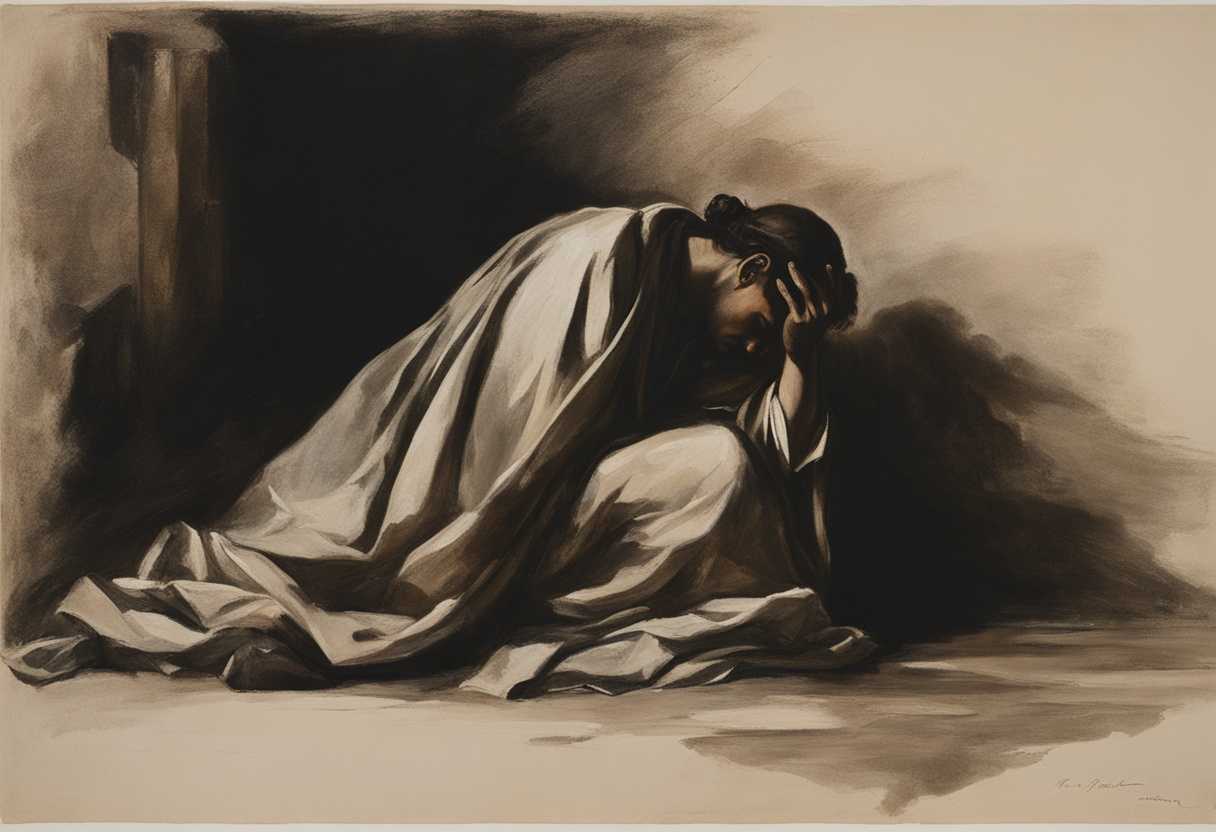
“Woe is me” is an expression of lament or deep sorrow often used in the Bible to convey anguish, distress, or a recognition of impending judgment. It typically signifies a cry for help in the face of overwhelming circumstances or personal sin.
Scripture
1 In the year that King Uzziah died I saw the Lord sitting upon a throne, high and lifted up; and the train of his robe filled the temple.
2 Above him stood the seraphim. Each had six wings: with two he covered his face, and with two he covered his feet, and with two he flew.
3 And one called to another and said: “Holy, holy, holy is the Lord of hosts; the whole earth is full of his glory!”
4 And the foundations of the thresholds shook at the voice of him who called, and the house was filled with smoke.
5 And I said: “Woe is me! For I am lost; for I am a man of unclean lips, and I dwell in the midst of a people of unclean lips; for my eyes have seen the King, the Lord of hosts!”
“Woe is Me” in the Bible Meaning
The phrase “woe is me” appears in several significant passages throughout the Bible, often signifying a moment of profound recognition of one’s own shortcomings or the surrounding despair. For instance, in Isaiah 6:5, the prophet Isaiah responds to a vision of God in His holiness with the lament, “Woe is me! For I am undone; because I am a man of unclean lips, and I dwell in the midst of a people of unclean lips.” Here, Isaiah’s cry underscores the weight of sin and the holiness of God, indicating that an awareness of divine perfection leads to an acute understanding of human frailty and moral failure. This expression can be seen as a turning point towards repentance and transformation, as it positions the individual in a place of humility before God.
Moreover, the phrase resonates within the context of prophetic liturgies, where it often precedes announcements of judgment or calls for repentance. For example, in Jeremiah 10:19, the prophet declares, “Woe is me because of my hurt! My wound is severe! But I said, ‘Truly this is an infirmity, and I must bear it.’” In this case, “woe is me” articulates both personal lament and the broader suffering of the people due to their disobedience to God. Throughout Scripture, expressions of woe serve as poignant reminders of humanity’s need for repentance, the reality of sin, and the comfort that can be found in seeking God’s mercy. In essence, these laments not only reflect sorrow but also act as a precursory step towards healing and hope, inviting the faithful to turn towards restoration through divine grace.
The phrase “woe is me” encapsulates a deep sense of mourning and existential despair, frequently found in moments of anguish or revelation. While the prophets often vocalize this sentiment in contexts filled with grief, other instances present a broader portrayal of human despair. In the book of Lamentations, for example, the stark realities of sorrow echo similar laments as the author reflects on the desolation of Jerusalem. The deep anguish exhibited in such passages emphasizes the collective suffering and the weight of national sin, providing a lens through which to view both personal and communal distress. These laments become a vehicle for expressing the hope that resides in turning back to God, showcasing a duality of despair paired with the yearning for divine intervention.
Additionally, the Gospels provide insight into the emotional landscape of humanity through the teachings of Jesus. While “woe” may not directly appear in the same phrasing, the essence of lament is echoed in the teachings about the trials faced by the poor in spirit and the mourners, promising them comfort and blessings. The Beatitudes capture the sentiment of sorrow entwined with a promise of future hope, offering an invitation to those who experience woe to seek refuge and nourishment in God’s presence. Here, the phrase extends its significance beyond individual lament to signify a collective cry, drawing believers into a shared understanding that recognition of woe can lead to transformative healing. In this light, “woe is me” becomes not just an admission of sorrow but a catalyst for spiritual awakening and communal restoration.
Expression of Deep Distress
The phrase “woe is me” often signifies a profound sense of personal anguish or despair. It reflects an individual’s recognition of their own shortcomings, failures, or the weight of their circumstances. This expression serves as a lamentation, where the speaker acknowledges their suffering and the gravity of their situation, often in the context of sin or moral failure. It highlights the emotional turmoil that accompanies a realization of one’s own limitations and the consequences of one’s actions.
Call for Divine Intervention
In many instances, “woe is me” can be interpreted as a plea for help or intervention from God. The utterance conveys a sense of helplessness and a desire for divine assistance in overcoming trials or tribulations. This expression underscores the belief that, in moments of despair, turning to God is essential for finding solace, guidance, and redemption. It emphasizes the relationship between human vulnerability and the need for divine grace.
Reflection of Societal or National Grief
Beyond personal lament, “woe is me” can also reflect a collective sense of grief or mourning within a community or nation. It serves as a poignant reminder of the broader societal issues that lead to suffering, such as injustice, moral decay, or impending judgment. This communal aspect of the phrase highlights the interconnectedness of individuals within a society and the shared burden of collective sin or hardship, calling for reflection and repentance on a larger scale.
How to Grow Spiritually Through Self-Reflection and Distress
Growing spiritually through self-reflection and distress can be a transformative journey that deepens your relationship with God. When we face challenges and hardships, it’s easy to feel overwhelmed, but these moments can also serve as powerful catalysts for introspection. Take time to pause and reflect on your feelings and experiences—ask yourself what God might be teaching you through your struggles. Journaling can be a helpful tool; write down your thoughts, prayers, and the lessons you’re learning. Remember, even in distress, God is near, and He often uses our trials to refine our character and strengthen our faith. Embrace these moments as opportunities to draw closer to Him, seeking His guidance and wisdom. As you navigate through the storms, you may find that your spiritual roots grow deeper, leading to a more profound understanding of His love and purpose for your life.
Bible References to “Woe is Me”:
Jeremiah 4:13-15: 13 Behold, he comes up like clouds; his chariots like the whirlwind; his horses are swifter than eagles— woe to us, for we are ruined!
14 O Jerusalem, wash your heart from evil, that you may be saved. How long shall your wicked thoughts lodge within you?
15 A lion has gone up from his thicket, a destroyer of nations has set out; he has gone out from his place to make your land a waste; your cities will be ruins without inhabitant.
Micah 7:1-3: 1 Woe is me! For I have become as when the summer fruit has been gathered, as when the grapes have been gleaned: there is no cluster to eat, no first-ripe fig that my soul desires.
2 The godly has perished from the earth,
and there is no one upright among mankind;
they all lie in wait for blood,
and each hunts the other with a net.
3 Their hands are on what is evil, to do it well; the prince and the judge ask for a bribe, and the great man utters the evil desire of his soul; thus they weave it together.
Lamentations 3:1-6: 1 I am the man who has seen affliction
under the rod of his wrath;
2 He has driven and brought me into darkness without any light;
3 Surely against me he turns his hand
again and again the whole day.
4 He has made my flesh and my skin waste away; he has broken my bones;
5 He has besieged and enveloped me with bitterness and tribulation;
6 He has made me dwell in darkness like the dead of long ago.
Habakkuk 3:16-19: 16 I hear, and my body trembles; my lips quiver at the sound; rottenness enters into my bones; my legs tremble beneath me. Yet I will quietly wait for the day of trouble to come upon people who invade us.
17 Though the fig tree should not blossom,
nor fruit be on the vines,
the produce of the olive fail
and the fields yield no food,
the flock be cut off from the fold
and there be no herd in the stalls,
18 yet I will rejoice in the Lord; I will take joy in the God of my salvation.
19 God, the Lord, is my strength;
he makes my feet like the deer’s;
he makes me tread on my high places.
Job 10:15-17: 15 If I am guilty, woe to me! If I am in the right, I cannot lift up my head, for I am filled with disgrace and look on my affliction.
16 For it increases. You hunt me like a lion
and again work wonders against me.
17 You renew your witnesses against me
and increase your vexation toward me;
you bring fresh troops against me.
Psalm 120:1-3: 1 In my distress I called to the Lord, and he answered me.
2 Deliver me, O Lord, from lying lips, from a deceitful tongue.
3 What shall be given to you, and what more shall be done to you, you deceitful tongue?
Ezekiel 24:15-18: 15 The word of the Lord came to me:
16 “Son of man, behold, I am about to take the delight of your eyes away from you at a stroke; yet you shall not mourn or weep, nor shall your tears run down.”
17 “Sigh, but not aloud; make no mourning for the dead. Bind on your turban, and put your shoes on your feet; do not cover your lips, nor eat the bread of men.”
18 So I spoke to the people in the morning, and at evening my wife died. And on the next morning I did as I was commanded.
Zephaniah 1:14-18: 14 The great day of the Lord is near, near and hastening fast; the sound of the day of the Lord is bitter; the mighty man cries aloud there.
15 A day of wrath is that day,
a day of distress and anguish,
a day of ruin and devastation,
a day of darkness and gloom,
a day of clouds and thick darkness,
16 a day of trumpet blast and battle cry against the fortified cities and against the lofty battlements.
17 I will bring distress on mankind, so that they shall walk like the blind, because they have sinned against the Lord; their blood shall be poured out like dust, and their flesh like dung.
18 Neither their silver nor their gold
shall be able to deliver them
on the day of the wrath of the Lord.
Revelation 8:13-9:1: 13 Then I looked, and I heard an eagle crying with a loud voice as it flew directly overhead, “Woe, woe, woe to those who dwell on the earth, at the blasts of the other trumpets that the three angels are about to blow!”
1 And the fifth angel blew his trumpet, and I saw a star fallen from heaven to earth, and he was given the key to the shaft of the bottomless pit.

Rev. François Dupont is a dedicated church minister with a wealth of experience in serving spiritual communities. With a calm and serene demeanor, he has been devoted to sharing the message of love, compassion, and tolerance for over two decades. Through his thoughtful sermons, compassionate counseling, and unwavering support, Rev. Dupont has touched the lives of countless individuals, allowing them to find solace and strength during difficult times. His serene presence and deep understanding of the human condition make him a trusted guide for those seeking spiritual nourishment and guidance.