
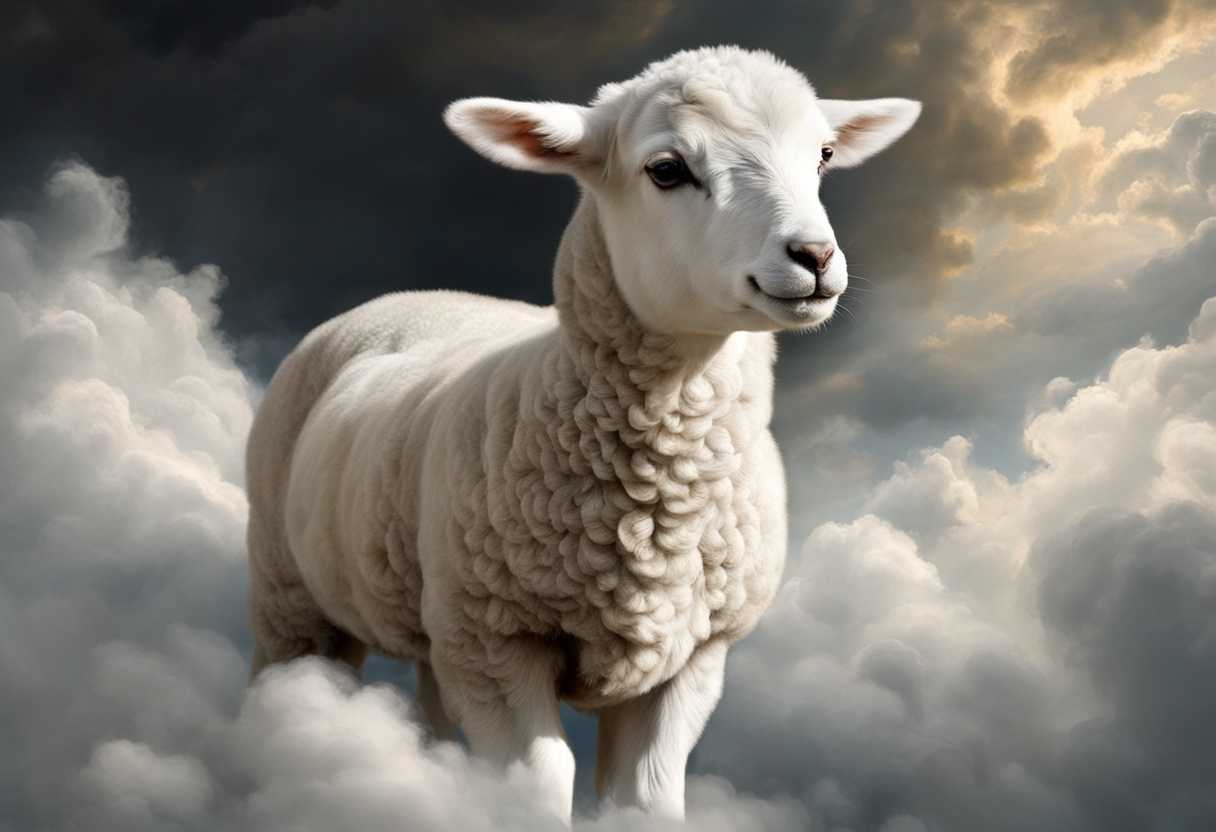
In the Bible, a lamb often symbolizes innocence, purity, and sacrifice, particularly in reference to Jesus Christ, the “Lamb of God” (John 1:29). The image of a lamb in clouds can represent divine presence and spiritual hope, suggesting comfort and protection from God.
Scripture
7 And Isaac said to his father Abraham, “My father!” And he said, “Here I am, my son.” He said, “Behold, the fire and the wood, but where is the lamb for a burnt offering?”
8 Abraham said, “God will provide for himself the lamb for a burnt offering, my son.” So they went both of them together.
9 When they came to the place of which God had told him, Abraham built the altar there and laid the wood in order and bound Isaac his son and laid him on the altar, on top of the wood.
10 Then Abraham reached out his hand and took the knife to slaughter his son.
11 But the angel of the Lord called to him from heaven and said, “Abraham, Abraham!” And he said, “Here I am.”
12 He said, “Do not lay your hand on the boy or do anything to him, for now I know that you fear God, seeing you have not withheld your son, your only son, from me.”
13 And Abraham lifted up his eyes and looked, and behold, behind him was a ram, caught in a thicket by his horns. And Abraham went and took the ram and offered it up as a burnt offering instead of his son.
14 So Abraham called the name of that place, “The Lord will provide”; as it is said to this day, “On the mount of the Lord it shall be provided.”
Biblical Significance of a Lamb in Clouds
The symbolism of a lamb in the Bible extends beyond its explicit references to innocence and sacrifice; it resonates deeply with themes of divine presence, protection, and the promise of redemption. For instance, in Exodus 12, the Paschal Lamb serves as a pivotal figure in the Israelites’ deliverance from slavery in Egypt, embodying the concept of sacrificial love that spares and gives life. This lamb’s blood marked the houses of the Israelites, serving as a sign of salvation, a precursor to the ultimate sacrifice of Christ, the “Lamb of God,” who would take away the sins of the world (John 1:29). The association of clouds in this imagery further enriches its meaning, as clouds in the Bible often signify God’s glory and presence, as witnessed in Exodus 16:10, where God manifests before the people.
When envisioning a lamb in clouds, one can also draw upon the comforting notion of God’s protective oversight. In Psalm 91:1-2, believers are reassured of taking refuge under God’s wings, an image evoking the same comfort found in the gentle presence of a lamb. The lamb in this context can encourage faith, embodying the tranquil assurance that God is ever-watchful, enveloping His followers in love and care. This imagery resonates with the New Testament’s portrayal of Jesus as the Good Shepherd (John 10:11-15), who lays down His life for the sheep, reiterating the lamb’s role as a symbol of guidance, safety, and ultimate sacrifice. Thus, the interplay of the lamb and clouds serves to encapsulate both a divine promise of salvation and the abiding comfort of God’s presence throughout the believer’s journey.
Further reflecting on the biblical significance of a lamb associated with clouds, we can consider the vision presented in the Book of Revelation. In this apocalyptic text, the lamb is depicted as standing at the center of God’s throne, surrounded by an atmosphere of glory reminiscent of a divine cloud. This imagery suggests that the lamb is not only a symbol of sacrifice but also a central figure in the eschatological hope—the fulfillment of God’s promises. The ethereal setting of clouds aligns with the idea of divine judgment and glory, illustrating that the presence of the lamb embodies the culmination of God’s redemptive narrative throughout history. The intertwining of the lamb with the clouds represents both the mystery of God’s providence and the assurance of His coming kingdom.
Additionally, the prophetic literature of the Old Testament often portrays lambs as symbols of peace and restoration, particularly in the context of God’s covenant promises. For instance, Isaiah speaks of a future where a lamb will lie down with other creatures, hinting at an era defined by harmony and divine rule. The association of these animals with clouds—often depicting God’s presence—can signify hope and a future coming of peace, reflecting God’s promise to restore creation to its intended glory. In this light, a lamb amidst clouds serves as a poignant reminder of God’s overarching plan for redemption, imbuing believers with a sense of security and anticipation as they await the completion of His will in the world, much like the faithful Israelites awaited deliverance in their own narratives. Thus, the lamb enshrined in clouds acts as a multifaceted symbol of hope, encompassing themes of innocence, divine protection, fulfillment of promises, and the ultimate restoration of creation.
Symbol of Sacrifice and Redemption
In biblical tradition, the lamb is often associated with sacrifice and the concept of atonement. The imagery of a lamb in the clouds can evoke the idea of divine intervention and the promise of redemption. The lamb represents innocence and purity, qualities that are essential for a sacrifice meant to atone for sin. The clouds can symbolize the presence of God, suggesting that the sacrificial act is not only a human endeavor but also a divine plan for salvation.
Representation of Hope and Divine Presence
The sight of a lamb in the clouds can also signify hope and the assurance of God’s presence. Clouds often represent the heavens and the divine realm, while a lamb embodies gentleness and peace. This imagery can serve as a reminder of God’s care and protection over His people, offering comfort in times of distress. The combination of the lamb and clouds can symbolize the promise of a brighter future, where divine grace and mercy prevail.
Foreshadowing of Christ’s Role
In Christian theology, the lamb is frequently seen as a foreshadowing of Christ, who is referred to as the “Lamb of God.” The presence of a lamb in the clouds can symbolize the anticipation of Christ’s return and the fulfillment of God’s promises. This imagery can evoke a sense of expectation for the ultimate reconciliation between humanity and the divine, highlighting the transformative power of faith and the hope of eternal life.
How to Embrace Sacrifice for a Deeper Faith
Embracing sacrifice as a pathway to a deeper faith can be both challenging and transformative. It often requires us to step outside our comfort zones, whether that means giving up our time to serve others, letting go of material possessions, or even enduring personal hardships for the sake of our beliefs. I’ve found that when we willingly make these sacrifices, we create space for God to work in our lives in profound ways. It’s in those moments of surrender that we often discover a deeper connection to Christ, who exemplified ultimate sacrifice through His love and service. Remember, it’s not about the size of the sacrifice but the heart behind it; even small acts of kindness and generosity can lead to significant spiritual growth. So, as you navigate your faith journey, consider what you might be called to let go of or give up, and trust that in doing so, you’ll find a richer, more vibrant relationship with God.
Bible References to Lamb in Clouds:
Exodus 12:3-13: 3 Tell all the congregation of Israel that on the tenth day of this month every man shall take a lamb according to their fathers’ houses, a lamb for a household.
4 And if the household is too small for a lamb, then he and his nearest neighbor shall take according to the number of persons; according to what each can eat you shall make your count for the lamb.
5 Your lamb shall be without blemish, a male a year old.
6 and you shall keep it until the fourteenth day of this month, when the whole assembly of the congregation of Israel shall kill their lambs at twilight.
7 Then they shall take some of the blood and put it on the two doorposts and the lintel of the houses in which they eat it.
8 They shall eat the flesh that night, roasted on the fire; with unleavened bread and bitter herbs they shall eat it.
9 Do not eat any of it raw or boiled in water, but roasted, its head with its legs and its inner parts.
10 And you shall let none of it remain until the morning; anything that remains until the morning you shall burn.
11 In this manner you shall eat it: with your belt fastened, your sandals on your feet, and your staff in your hand. And you shall eat it in haste. It is the Lord’s Passover.
12 For I will pass through the land of Egypt that night, and I will strike all the firstborn in the land of Egypt, both man and beast; and on all the gods of Egypt I will execute judgments: I am the Lord.
13 The blood shall be a sign for you, on the houses where you are. And when I see the blood, I will pass over you, and no plague will befall you to destroy you when I strike the land of Egypt.
Leviticus 4:32-35: 32 And if he brings a lamb as his offering for a sin offering, he shall bring a female without blemish.
33 And all its fat he shall remove as the fat is removed from the lamb, and the priest shall burn it on the altar, on top of the Lord’s food offerings. And the priest shall make atonement for him for the sin which he has committed, and he shall be forgiven.
34 And the priest shall take some of the blood of the sin offering with his finger and put it on the horns of the altar of burnt offering and pour out all the rest of its blood at the base of the altar.
35 And all its fat he shall remove as the fat of the lamb is removed from the sacrifice of peace offerings, and the priest shall burn it on the altar, on top of the Lord’s food offerings. And the priest shall make atonement for him for the sin which he has committed, and he shall be forgiven.
Isaiah 53:6-7: 6 All we like sheep have gone astray;
we have turned—every one—to his own way;
and the Lord has laid on him
the iniquity of us all.
7 He was oppressed, and he was afflicted,
yet he opened not his mouth;
like a lamb that is led to the slaughter,
and like a sheep that before its shearers is silent,
so he opened not his mouth.
John 1:29-36: 29 The next day he saw Jesus coming toward him, and said, “Behold, the Lamb of God, who takes away the sin of the world!
30 This is he of whom I said, ‘After me comes a man who ranks before me, because he was before me.’
31 I myself did not know him, but for this purpose I came baptizing with water, that he might be revealed to Israel.”
32 And John bore witness: “I saw the Spirit descend from heaven like a dove, and it remained on him.
33 I myself did not know him, but he who sent me to baptize with water said to me, ‘He on whom you see the Spirit descend and remain, this is he who baptizes with the Holy Spirit.’
34 And I have seen and have borne witness that this is the Son of God.”
35 The next day again John was standing with two of his disciples,
36 and he looked at Jesus as he walked by and said, “Behold, the Lamb of God!”
Revelation 5:6-14: 6 And between the throne and the four living creatures and among the elders I saw a Lamb standing, as though it had been slain, with seven horns and with seven eyes, which are the seven spirits of God sent out into all the earth.
7 And he went and took the scroll from the right hand of him who was seated on the throne.
8 And when he had taken the scroll, the four living creatures and the twenty-four elders fell down before the Lamb, each holding a harp, and golden bowls full of incense, which are the prayers of the saints.
9 And they sang a new song, saying, “Worthy are you to take the scroll and to open its seals, for you were slain, and by your blood you ransomed people for God from every tribe and language and people and nation,
10 and you have made them a kingdom and priests to our God, and they shall reign on the earth.”
11 Then I looked, and I heard around the throne and the living creatures and the elders the voice of many angels, numbering myriads of myriads and thousands of thousands,
12 saying with a loud voice, “Worthy is the Lamb who was slain, to receive power and wealth and wisdom and might and honor and glory and blessing!”
13 And I heard every creature in heaven and on earth and under the earth and in the sea, and all that is in them, saying, “To him who sits on the throne and to the Lamb be blessing and honor and glory and might forever and ever!”
14 And the four living creatures said, “Amen!” and the elders fell down and worshiped.
Revelation 7:9-17: 9 After this I looked, and behold, a great multitude that no one could number, from every nation, from all tribes and peoples and languages, standing before the throne and before the Lamb, clothed in white robes, with palm branches in their hands,
10 and crying out with a loud voice, “Salvation belongs to our God who sits on the throne, and to the Lamb!”
11 And all the angels were standing around the throne and around the elders and the four living creatures, and they fell on their faces before the throne and worshiped God,
12 saying, “Amen! Blessing and glory and wisdom and thanksgiving and honor and power and might be to our God forever and ever! Amen.”
13 Then one of the elders addressed me, saying, “Who are these, clothed in white robes, and from where have they come?”
14 I said to him, “Sir, you know.” And he said to me, “These are the ones coming out of the great tribulation. They have washed their robes and made them white in the blood of the Lamb.
15 “Therefore they are before the throne of God, and serve him day and night in his temple; and he who sits on the throne will shelter them with his presence.”
16 They shall hunger no more, neither thirst anymore; the sun shall not strike them, nor any scorching heat.
17 For the Lamb in the midst of the throne will be their shepherd, and he will guide them to springs of living water, and God will wipe away every tear from their eyes.
Revelation 14:1-5: 1 Then I looked, and behold, on Mount Zion stood the Lamb, and with him 144,000 who had his name and his Father’s name written on their foreheads.
2 And I heard a voice from heaven like the roar of many waters and like the sound of loud thunder. The voice I heard was like the sound of harpists playing on their harps,
3 and they were singing a new song before the throne and before the four living creatures and before the elders. No one could learn that song except the 144,000 who had been redeemed from the earth.
4 It is these who have not defiled themselves with women, for they are virgins. It is these who follow the Lamb wherever he goes. These have been redeemed from mankind as firstfruits for God and the Lamb,
5 and in their mouth no lie was found, for they are blameless.
Revelation 19:7-9: 7 Let us rejoice and exult and give him the glory, for the marriage of the Lamb has come, and his Bride has made herself ready;
8 it was granted her to clothe herself with fine linen, bright and pure— for the fine linen is the righteous deeds of the saints.
9 And the angel said to me, “Write this: Blessed are those who are invited to the marriage supper of the Lamb.” And he said to me, “These are the true words of God.”

Reverend Ogunlade is a seasoned Church Minister with over three decades of experience in guiding and nurturing congregations. With profound wisdom and a serene approach, Reverend Ogunlade has carried out various pastoral duties, including delivering uplifting sermons, conducting religious ceremonies, and offering sage counsel to individuals seeking spiritual guidance. Their commitment to fostering harmony and righteousness within their community is exemplified through their compassionate nature, making them a beloved and trusted figure among the congregation.