
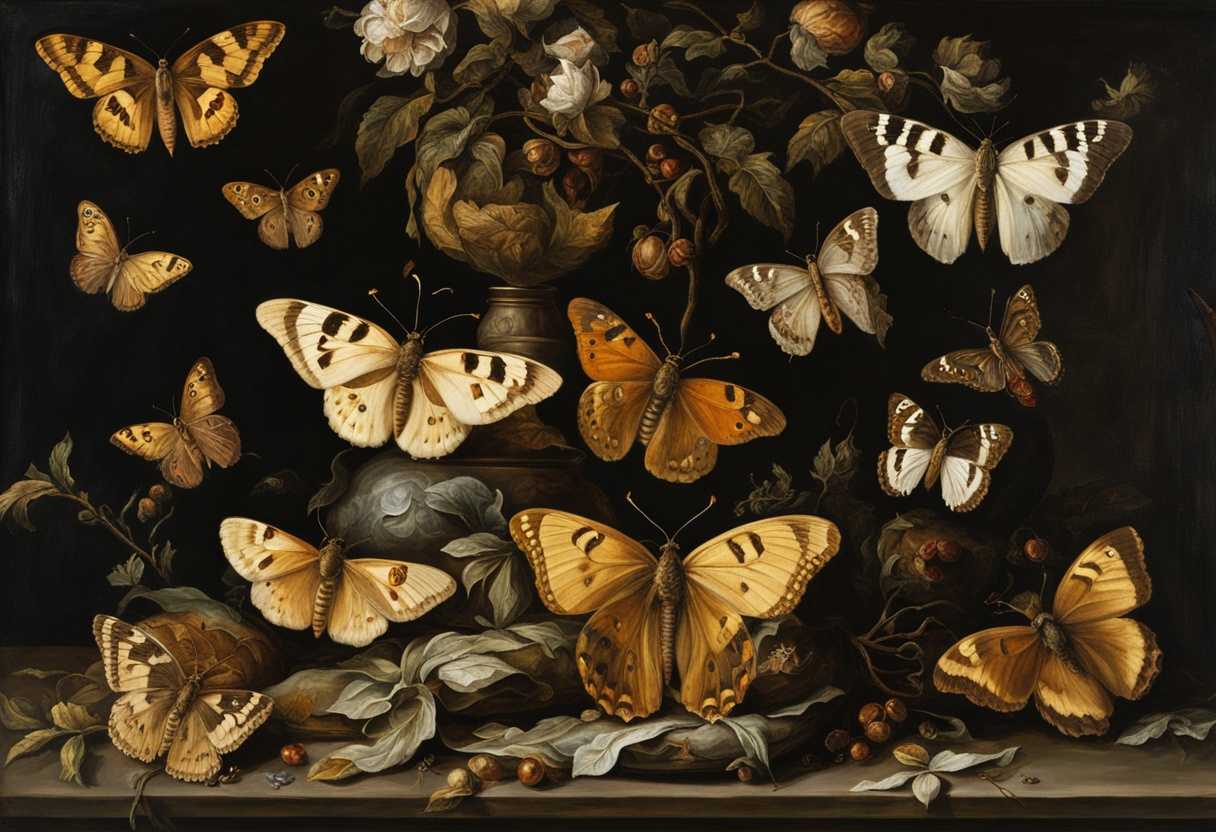
In the Bible, moths are often used as symbols of decay and transience, representing how material possessions are temporary and can be easily destroyed (Matthew 6:19-20). They highlight the importance of focusing on spiritual riches that endure rather than earthly wealth that can perish.
Scripture
18 Even in his servants he puts no trust,
and his angels he charges with error;
19 how much more those who dwell in houses of clay,
whose foundation is in the dust,
who are crushed like the moth.
20 Between morning and evening they are beaten to pieces;
they perish forever without anyone regarding it.
21 Is not their tent-cord plucked up within them, do they not die, and that without wisdom?’
Biblical Significance of Moths
Moths in the Bible signify the ephemeral nature of material wealth and earthly concerns, drawing attention to their inherent fragility. In Matthew 6:19-20, Jesus instructs His followers, “Do not lay up for yourselves treasures on earth, where moth and rust destroy and where thieves break in and steal; but lay up for yourselves treasures in heaven…” This verse emphasizes the stark contrast between transient earthly possessions and eternal spiritual treasures. The reference to moths serves as a poignant reminder that even the most cherished material items are susceptible to decay and destruction, urging believers to prioritize their spiritual well-being over temporary belongings.
Furthermore, the symbolism of moths extends to themes of judgment and warning. In Isaiah 50:9, it is noted, “Behold, the Lord God will help me; who will condemn me? Behold, all of them will wear out like a garment; the moth will eat them up.” This imagery illustrates the inevitable fate of those who oppose God’s ways, reinforcing that even the mightiest will succumb to decay. Ultimately, moths serve as a theological metaphor for the transient nature of earthly pursuits, portraying the significance of living a life anchored in faith and eternal values, which endure beyond the physical realm. Through these biblical references, the moth becomes a cautionary symbol that calls the faithful to seek the lasting rewards of spiritual devotion.
Additionally, the presence of moths in biblical literature can also symbolize the destructive power of vanity and superficiality. In the book of Job, there is an acknowledgment of the fleeting nature of human life and its material attachments. Job reflects on how, like moths that consume clothing, our worldly desires can lead to deterioration of our spiritual integrity. This notion aligns with the broader theme in biblical texts that caution against the attachment to physical appearances and material possessions, instead advocating for a life that values humility and the richness of the soul.
Moreover, the metaphor of moths appears in prophetic literature, underscoring the idea of societal decay and moral decline. The prophet Hosea, for example, uses the constricting imagery of moths to denote the corruptive influence pervasive in society. The destructive action of moths on fabric represents how unchecked sin can eat away at the fabric of community and individual character. By invoking moths in this context, the scripture not only warns of judgment but also emphasizes a call for repentance and renewal. Thus, while moths may seem insignificant creatures, their biblical significance invites believers to ponder deeply about the fragility of worldly accomplishments and the importance of nurturing one’s spiritual life amidst life’s inevitable decay.
Symbol of Transience and Impermanence
Moths serve as a powerful symbol of the fleeting nature of life and material possessions. Their brief existence highlights the idea that earthly treasures are temporary and can easily be destroyed or lost. This symbolism encourages believers to focus on spiritual wealth rather than accumulating material goods, reminding them that life is but a vapor and that true value lies in eternal matters.
Representation of Destruction and Decay
In biblical literature, moths are often associated with decay and destruction. Their ability to consume and destroy fabrics and materials serves as a metaphor for the inevitable decline of worldly things. This representation can be seen as a warning against placing too much trust in the physical world, as it is subject to deterioration and corruption. It emphasizes the need for spiritual vigilance and the importance of nurturing one’s faith amidst the decay of earthly concerns.
Metaphor for Spiritual Transformation
Moths undergo a significant transformation in their life cycle, evolving from caterpillars to winged creatures. This metamorphosis can be viewed as a metaphor for spiritual growth and renewal. Just as a moth emerges from its cocoon, believers are called to undergo a transformation through faith, shedding their old selves and embracing a new life in Christ. This process of renewal signifies hope and the possibility of becoming something beautiful and purposeful, despite past struggles or imperfections.
How to Embrace Impermanence in Your Christian Journey
Embracing impermanence in your Christian journey can be a profound way to deepen your faith and understanding of God’s plan for your life. Life is a series of seasons, each filled with its own challenges and blessings, and recognizing that nothing is permanent can help us appreciate the beauty of each moment. In Ecclesiastes 3:1, we are reminded that “to everything, there is a season,” which encourages us to accept change as a natural part of our spiritual growth. When we face trials or transitions, instead of clinging to what was, we can lean into prayer and seek God’s guidance, trusting that He is with us in every phase. This mindset not only fosters resilience but also opens our hearts to new experiences and lessons that God has in store for us. So, let’s embrace the fleeting nature of life, knowing that each moment is an opportunity to grow closer to Christ and to reflect His love in a world that is ever-changing.
Bible References to Moths and Their Significance:
Job 13:25-28: 25 Will you frighten a driven leaf
and pursue dry chaff?
26 For you write bitter things against me and make me inherit the iniquities of my youth.
27 You put my feet in the stocks and watch all my paths; you set a limit for the soles of my feet.
28 And he, as a rotten thing, consumeth, as a garment that is moth eaten.
Job 27:18-20: 18 He builds his house like a moth’s, like a booth that a watchman makes.
19 He goes to bed rich, but will do so no more; he opens his eyes, and his wealth is gone.
20 Terrors overtake him like a flood; in the night a whirlwind carries him off.
Isaiah 50:9-11: 9 Behold, the Lord God helps me; who will declare me guilty?
10 Who among you fears the Lord
and obeys the voice of his servant?
Let him who walks in darkness
and has no light
trust in the name of the Lord
and rely on his God.
11 Behold, all you who kindle a fire, who equip yourselves with burning torches! Walk by the light of your fire, and by the torches that you have kindled! This you have from my hand: you shall lie down in torment.
Isaiah 51:7-9: 7 “Listen to me, you who know righteousness,
the people in whose heart is my law;
fear not the reproach of man,
nor be dismayed at their revilings.
8 For the moth will eat them up like a garment,
and the worm will eat them like wool;
but my righteousness will be forever,
and my salvation to all generations.
9 Awake, awake, put on strength, O arm of the Lord;
awake, as in days of old,
the generations of long ago.
Was it not you who cut Rahab in pieces,
who pierced the dragon?
Hosea 5:11-13: 11 Ephraim is oppressed, crushed in judgment, because he was determined to go after filth.
12 Therefore I am like a moth to Ephraim,
and like dry rot to the house of Judah.
13 When Ephraim saw his sickness,
and Judah his wound,
then Ephraim went to Assyria,
and sent to the great king.
But he is not able to cure you
or heal your wound.
Matthew 6:19-21: 19 “Do not lay up for yourselves treasures on earth, where moth and rust destroy and where thieves break in and steal,
20 but lay up for yourselves treasures in heaven, where neither moth nor rust destroys and where thieves do not break in and steal.
21 For where your treasure is, there your heart will be also.
Luke 12:32-34: 32 “Fear not, little flock, for it is your Father’s good pleasure to give you the kingdom.”
33 Sell your possessions, and give to the needy. Provide yourselves with moneybags that do not grow old, with a treasure in the heavens that does not fail, where no thief approaches and no moth destroys.
34 For where your treasure is, there will your heart be also.

Rev. François Dupont is a dedicated church minister with a wealth of experience in serving spiritual communities. With a calm and serene demeanor, he has been devoted to sharing the message of love, compassion, and tolerance for over two decades. Through his thoughtful sermons, compassionate counseling, and unwavering support, Rev. Dupont has touched the lives of countless individuals, allowing them to find solace and strength during difficult times. His serene presence and deep understanding of the human condition make him a trusted guide for those seeking spiritual nourishment and guidance.