
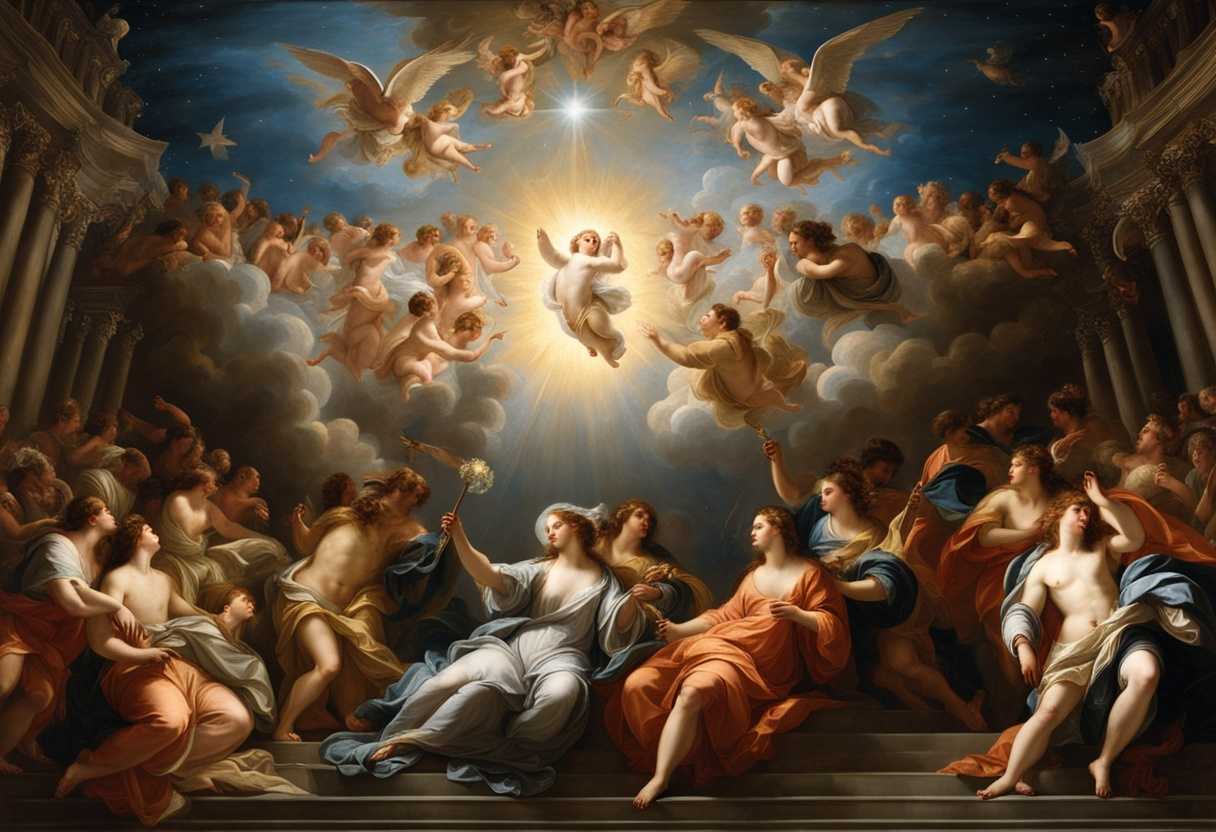
In Genesis, “host” typically refers to a group or assembly of beings or entities, often in the context of heavenly bodies or armies. For example, “hosts of heaven” can denote the celestial bodies or angelic beings that serve God.
Scripture
2 Thus the heavens and the earth were finished, and all the host of them.
2 And on the seventh day God finished his work that he had done, and he rested on the seventh day from all his work that he had done.
3 So God blessed the seventh day and made it holy, because on it God rested from all his work that he had done in creation.
“Host” Definition in Genesis: Biblical Context
In the book of Genesis, the term “host” carries significant theological weight, often signifying both the created order of the heavens and the divine governance over it. The phrase “hosts of heaven” (found in Genesis 2:1, for example) presents a vision of the celestial realm, illustrating the majesty and complexity of God’s creation. This idea is further expanded in passages such as Psalm 148:2, which calls upon the “hosts” to praise the Lord, indicating that these heavenly beings, including angels and stars, have a purpose in God’s divine plan. Thus, the concept of “host” encapsulates a broader understanding of God’s sovereignty over all creation, emphasizing the organized structure of celestial beings that exist not merely as spectators but as active participants in the unfolding narrative of salvation and divine intention.
Moreover, the idea of “host” can also be seen in a military context, referring to God’s armies or the collective power of divine forces ready to engage in spiritual warfare. For instance, in Genesis 32:2, Jacob encounters “the hosts of God,” which signifies both protection and a reminder of God’s authority over earthly and spiritual realms. This duality—between celestial beings and divine armies—illustrates a comprehensive view of how the term “host” encompasses the multifaceted nature of creation, its governance, and the ever-present reality of the spiritual battle underpinning human existence. In this light, “host” is not merely a functional designation but a profound declaration of God’s omnipotent order and the interconnecting roles played by all elements of creation, whether heavenly or earthly.
The concept of “host” in Genesis also resonates with the broader theme of community and fellowship among created beings. This is exemplified in the notion of “hosts” as not just individual celestial entities, but rather as a collective that participates in the divine narrative. The idea that these hosts coexist within a structured hierarchy suggests a design in which every entity fulfills a unique role, contributing to God’s overarching purpose. This interplay can also be seen in the relationships between human beings and the divine, highlighting the interconnectedness of earthly and heavenly realms.
Furthermore, the term “host” extends its implications into the realm of divine provision and sustenance. Biblical scholars often explore how this notion reflects God’s abundance in supplying not just physical needs when speaking of earthly “hosts” like flocks, but also spiritual nourishment through divine interactions or revelations. Specifically, the use of “host” can evoke a sense of God’s thoughtful orchestration of the universe, reminding humanity of both their place within a larger cosmic framework and the divine oversight that governs all life. Thus, the term encapsulates both community and provision, enhancing our understanding of how “host” embodies God’s creative authority and relational fidelity throughout the biblical narrative.
Divine Creation and Authority
In the context of Genesis, the term “host” often refers to the celestial beings or the heavenly bodies created by God. This usage emphasizes God’s sovereignty and authority over all creation, including the stars, angels, and other heavenly entities. The “host” signifies not just a multitude but also the organized structure of creation under God’s command, illustrating the divine order established at the beginning of time.
Community and Gathering
Another broader meaning of “host” in Genesis can be understood as a gathering or community. This interpretation highlights the relational aspect of creation, where beings—whether human or divine—come together in unity. The concept of a “host” can reflect the idea of fellowship and the importance of community in God’s design, suggesting that relationships are integral to the created order.
Warfare and Protection
The term “host” can also imply a sense of warfare or protection, particularly in the context of spiritual battles. In Genesis, the idea of a “host” may allude to the armies of heaven that serve God and protect His creation. This interpretation underscores the notion of divine intervention and the ongoing struggle between good and evil, where the “host” represents the forces that stand against chaos and disorder in the world.
How to Embrace Faith in Heavenly Guardianship
Embracing faith in heavenly guardianship is a beautiful journey that invites us to trust in the divine protection and guidance that surrounds us. As you navigate the ups and downs of life, take a moment to reflect on the comforting promise found in Psalm 91:11, which assures us that God commands His angels to guard us in all our ways. This assurance can transform your daily experiences; when faced with uncertainty or fear, remind yourself that you are never alone. Cultivate a habit of prayer, inviting your heavenly guardians into your life, and be open to the subtle ways they may guide you—through intuition, scripture, or the kindness of others. As you deepen your relationship with God, you’ll find that faith in His guardianship not only brings peace but also empowers you to live boldly, knowing that you are held in a loving embrace that transcends earthly challenges.
Bible References to the Definition of “Host” in Genesis:
Genesis 21:22-34: 22 At that time Abimelech and Phicol the commander of his army said to Abraham, “God is with you in all that you do.
23 Now therefore swear to me here by God that you will not deal falsely with me or with my descendants or with my posterity, but as I have dealt kindly with you, so you will deal with me and with the land where you have sojourned.”
24 Abraham said, “I will swear.”
25 When Abraham reproved Abimelech about a well of water that Abimelech’s servants had seized.
26 And Abimelech said, “I do not know who has done this thing; you did not tell me, and I have not heard of it until today.”
27 So Abraham took sheep and oxen and gave them to Abimelech, and the two men made a covenant.
28 Then Abraham set seven ewe lambs of the flock apart.
29 And Abimelech said to Abraham, “What is the meaning of these seven ewe lambs that you have set apart?”
30 He said, “You shall take these seven ewe lambs from my hand, so that you may be a witness for me that I dug this well.”
31 Therefore that place was called Beersheba, because there both of them swore an oath.
32 Thus they made a covenant at Beersheba.
33 Abraham planted a tamarisk tree in Beersheba and called there on the name of the Lord, the Everlasting God.
34 So Abraham sojourned in the land of the Philistines for many days.
Genesis 32:1-2: 1 Jacob went on his way, and the angels of God met him.
2 And when Jacob saw them, he said, “This is God’s camp!” So he called the name of that place Mahanaim.
Genesis 32:3-8: 3 And Jacob sent messengers before him to Esau his brother in the land of Seir, the country of Edom.
4 He commanded them, “Thus you shall say to my lord Esau: Thus says your servant Jacob, ‘I have sojourned with Laban and stayed until now.
5 I have oxen, donkeys, flocks, male servants, and female servants. I have sent to tell my lord, in order that I may find favor in your sight.’”
6 And the messengers returned to Jacob, saying, “We came to your brother Esau, and he is coming to meet you, and there are four hundred men with him.”
7 Then Jacob was greatly afraid and distressed.
8 for he thought, “I may appease him with the present that goes ahead of me, and afterward I shall see his face. Perhaps he will accept me.”
Genesis 32:9-12: 9 And Jacob said, “O God of my father Abraham and God of my father Isaac, O Lord who said to me, ‘Return to your country and to your kindred, that I may do you good,’
10 I am not worthy of the least of all the deeds of steadfast love and all the faithfulness that you have shown to your servant, for with only my staff I crossed this Jordan, and now I have become two camps.
11 Please deliver me from the hand of my brother, from the hand of Esau, for I fear him, that he may come and attack me, the mothers with the children.
12 But you said, ‘I will surely do you good, and make your offspring as the sand of the sea, which cannot be numbered for multitude.’
Genesis 32:13-21: 13 So he stayed there that night, and from what he had with him he took a present for his brother Esau,
14 two hundred female goats and twenty male goats, twenty ewes and twenty rams,
15 thirty milking camels and their calves, forty cows and ten bulls, twenty female donkeys and ten male donkeys.
16 He delivered them into the hand of his servants, every drove by itself, and said to his servants, “Pass on ahead of me and put a space between drove and drove.”
17 He commanded the first, “When Esau my brother meets you and asks you, ‘To whom do you belong? Where are you going? And whose are these ahead of you?’
18 then you shall say, ‘They belong to your servant Jacob. They are a present sent to my lord Esau. And moreover, he is behind us.’”
19 And you shall say, ‘Moreover, your servant Jacob is behind us.’” For he thought, “I may appease him with the present that goes ahead of me, and afterward I shall see his face. Perhaps he will accept me.”
20 and you shall say, ‘Moreover, your servant Jacob is behind us.’” For he thought, “I may appease him with the present that goes ahead of me, and afterward I shall see his face. Perhaps he will accept me.”
21 So the present passed on before him, and he himself stayed that night in the camp.
Genesis 32:22-32: 24 And Jacob was left alone. And a man wrestled with him until the breaking of the day.
23 The same night he arose and took his two wives, his two female servants, and his eleven children, and crossed the ford of the Jabbok.
24 And Jacob was left alone. And a man wrestled with him until the breaking of the day.
25 When he saw that he did not prevail against him, he touched his hip socket, and Jacob’s hip was put out of joint as he wrestled with him.
26 Then he said, “Let me go, for the day has broken.” But Jacob said, “I will not let you go unless you bless me.”
27 And he said to him, “What is your name?” And he said, “Jacob.”
28 Then he said, “Your name shall no longer be called Jacob, but Israel, for you have striven with God and with men, and have prevailed.”
29 Then Jacob asked him, “Please tell me your name.” But he said, “Why is it that you ask my name?” And there he blessed him.
30 So Jacob called the name of the place Peniel, saying, “For I have seen God face to face, and yet my life has been delivered.”
31 The sun rose upon him as he passed Penuel, limping because of his hip.
32 Therefore to this day the people of Israel do not eat the sinew of the thigh that is on the hip socket, because he touched the socket of Jacob’s hip on the sinew of the thigh.
Genesis 33:1-11: 1 And Jacob lifted up his eyes and looked, and behold, Esau was coming, and four hundred men with him. So he divided the children among Leah and Rachel and the two female servants.
2 And he put the servants with their children in front, then Leah with her children, and Rachel and Joseph last of all.
3 He himself went on before them, bowing himself to the ground seven times, until he came near to his brother.
4 But Esau ran to meet him and embraced him and fell on his neck and kissed him, and they wept.
5 And when Esau lifted up his eyes and saw the women and children, he said, “Who are these with you?” Jacob said, “The children whom God has graciously given your servant.”
6 Then the servants drew near, they and their children, and bowed down.
7 Then Leah also came forward with her children, and they bowed down.
8 Esau said, “What do you mean by all this company that I met?” Jacob answered, “To find favor in the sight of my lord.”
9 But Esau said, “I have enough, my brother; keep what you have for yourself.”
10 But Jacob said, “No, please, if I have found favor in your sight, then accept my present from my hand. For I have seen your face, which is like seeing the face of God, and you have accepted me.
11 Please accept my blessing that is brought to you, because God has dealt graciously with me, and because I have enough.” Thus he urged him, and he took it.
Genesis 33:12-17: 12 Then Esau said, “Let us journey on our way, and I will go ahead of you.”
13 But Jacob said to him, “My lord knows that the children are frail, and that the nursing flocks and herds are a care to me. If they are driven hard for one day, all the flocks will die.
14 Let my lord pass on ahead of his servant, and I will lead on slowly, at the pace of the livestock that are ahead of me and at the pace of the children, until I come to my lord in Seir.”
15 So Esau said, “Let me leave with you some of the people who are with me.” But he said, “What need is there? Let me find favor in the sight of my lord.”
16 So Esau returned that day on his way to Seir.
17 But Jacob journeyed to Succoth, and built himself a house and made booths for his livestock. Therefore the name of the place is called Succoth.
Genesis 33:18-20: 18 And Jacob came safely to the city of Shechem, which is in the land of Canaan, on his way from Paddan-aram, and he camped before the city.
19 And from the sons of Hamor, Shechem’s father, he bought for a hundred pieces of money the piece of land on which he had pitched his tent.
20 There he erected an altar and called it El-Elohe-Israel.

Reverend Michael Johnson is an experienced Church Minister with a profound expertise in spirituality and guidance. With a serene presence and a compassionate heart, he has faithfully served his congregation for over 20 years, leading them on a spiritual journey towards inner peace and enlightenment. Reverend Johnson’s extensive knowledge of religious philosophies and profound understanding of human nature have made him a trusted confidant and mentor to many, as he seamlessly weaves his profound wisdom into life teachings. Reverend Johnson’s calming demeanor and empathetic nature continue to uplift and heal souls, nurturing a sense of unity and tranquility within his community.