
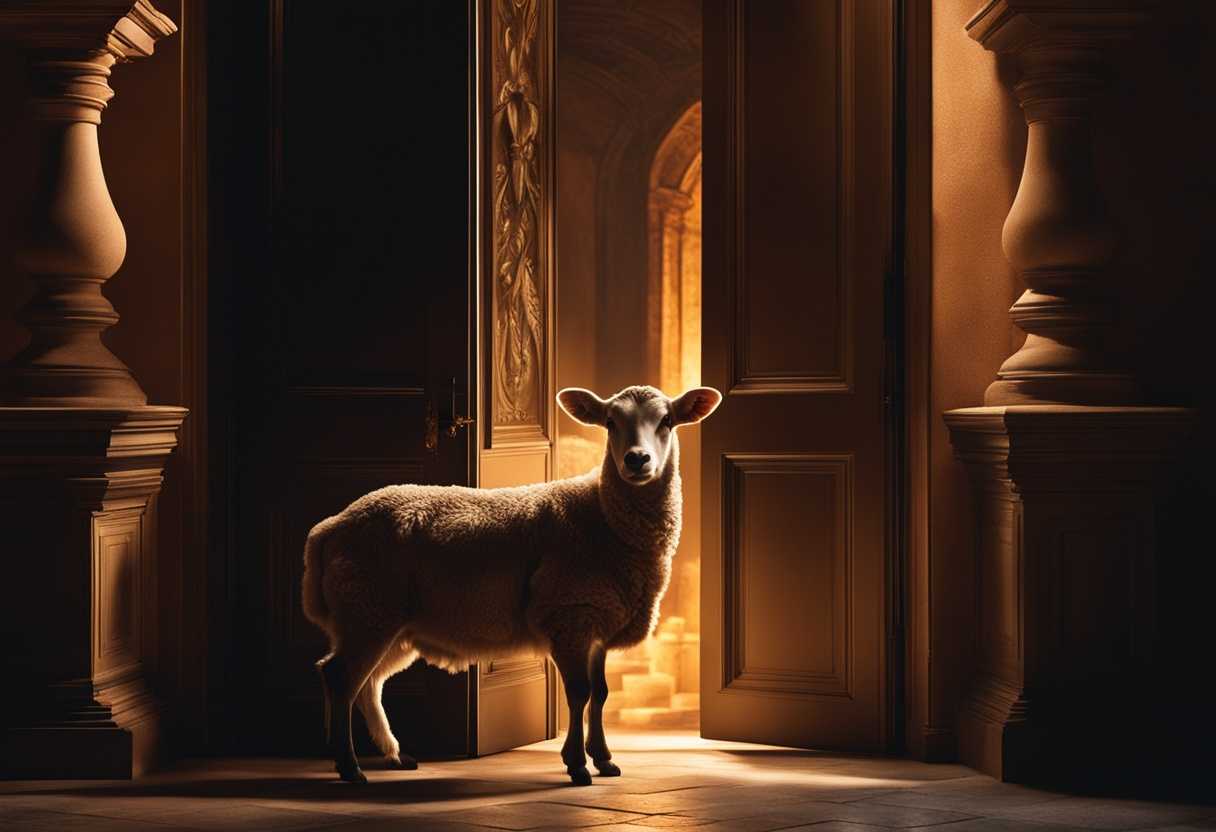
The Paschal Lamb, in the Bible, refers to the sacrificial lamb whose blood was used during the Exodus to mark the doors of the Israelites, ensuring their protection from the final plague (Exodus 12:1-13). In a Christian context, the Paschal Lamb symbolizes Jesus Christ, who is seen as the ultimate sacrifice for humanity’s sins (John 1:29).
Scripture
1 The Lord said to Moses and Aaron in the land of Egypt,
2 “This month shall be for you the beginning of months. It shall be the first month of the year for you.
3 Tell all the congregation of Israel that on the tenth day of this month every man shall take a lamb according to their fathers’ houses, a lamb for a household.
4 And if the household is too small for a lamb, then he and his nearest neighbor shall take according to the number of persons; according to what each can eat you shall make your count for the lamb.
5 Your lamb shall be without blemish, a male a year old.
6 and you shall keep it until the fourteenth day of this month, when the whole assembly of the congregation of Israel shall kill their lambs at twilight.
7 Then they shall take some of the blood and put it on the two doorposts and the lintel of the houses in which they eat it.
8 They shall eat the flesh that night, roasted on the fire; with unleavened bread and bitter herbs they shall eat it.
9 Do not eat any of it raw or boiled in water, but roasted, its head with its legs and its inner parts.
10 And you shall let none of it remain until the morning; anything that remains until the morning you shall burn.
11 In this manner you shall eat it: with your belt fastened, your sandals on your feet, and your staff in your hand. And you shall eat it in haste. It is the Lord’s Passover.
12 For I will pass through the land of Egypt that night, and I will strike all the firstborn in the land of Egypt, both man and beast; and on all the gods of Egypt I will execute judgments: I am the Lord.
13 The blood shall be a sign for you, on the houses where you are. And when I see the blood, I will pass over you, and no plague will befall you to destroy you when I strike the land of Egypt.
14 “This day shall be for you a memorial day, and you shall keep it as a feast to the Lord; throughout your generations, as a statute forever, you shall keep it as a feast.”
15 Seven days you shall eat unleavened bread. On the first day you shall remove leaven out of your houses, for if anyone eats what is leavened, from the first day until the seventh day, that person shall be cut off from Israel.
16 On the first day you shall hold a holy assembly, and on the seventh day a holy assembly. No work shall be done on those days. But what everyone needs to eat, that alone may be prepared by you.
17 And you shall observe the Feast of Unleavened Bread, for on this very day I brought your hosts out of the land of Egypt. Therefore you shall observe this day, throughout your generations, as a statute forever.
18 In the first month, from the fourteenth day of the month at evening, you shall eat unleavened bread until the twenty-first day of the month at evening.
19 For seven days no leaven is to be found in your houses. If anyone eats what is leavened, that person will be cut off from the congregation of Israel, whether he is a sojourner or a native of the land.
20 You shall eat nothing leavened; in all your dwelling places you shall eat unleavened bread.”
21 Then Moses called all the elders of Israel and said to them, “Go and select lambs for yourselves according to your clans, and kill the Passover lamb.
22 Take a bunch of hyssop and dip it in the blood that is in the basin, and touch the lintel and the two doorposts with the blood that is in the basin. None of you shall go out of the door of his house until the morning.
23 For the Lord will pass through to strike the Egyptians, and when he sees the blood on the lintel and on the two doorposts, the Lord will pass over the door and will not allow the destroyer to enter your houses to strike you.
24 You shall observe this rite as a statute for you and for your sons forever.
25 And when you come to the land that the Lord will give you, as he has promised, you shall keep this service.
26 And when your children say to you, ‘What do you mean by this service?’
27 Then you shall say, ‘It is the sacrifice of the Lord’s Passover, for he passed over the houses of the people of Israel in Egypt, when he struck the Egyptians but spared our houses.’” And the people bowed their heads and worshiped.
28 Then the people of Israel went and did so; as the Lord had commanded Moses and Aaron, so they did.
Definition of Paschal Lamb in Scripture
The concept of the Paschal Lamb transcends its immediate historical context in the Exodus narrative, embodying a profound theological significance both in Judaism and Christianity. In Exodus 12:1-13, the Israelites were commanded to sacrifice a lamb and mark their doorposts with its blood, a act that signified deliverance from death and the promise of liberation from slavery in Egypt. This event stands as a foundational moment in Jewish religious identity, marking the establishment of Passover as a vital remembrance of God’s covenantal faithfulness. The lamb’s blood functioned as a protective sign, highlighting themes of obedience, sacrifice, and divine mercy.
In Christian theology, the Paschal Lamb is deeply intertwined with Christological interpretations. As indicated in John 1:29, where John the Baptist identifies Jesus as “the Lamb of God, who takes away the sin of the world,” the symbolism of the Paschal Lamb is redefined through the lens of Christ’s crucifixion and resurrection. Jesus’ sacrificial death is seen as a fulfillment of the Passover lamb’s narrative, serving as a new covenant that offers redemption for all humanity (1 Corinthians 5:7). This dual role emphasizes the continuity between the Hebrew Scriptures and the New Testament, framing Jesus not only as the fulfillment of prophecy but also as a universal savior who brings spiritual freedom and new life, thus reinforcing the significance of sacrifice, salvation, and hope in the Christian faith.
The concept of the Paschal Lamb extends beyond mere symbolism to address themes of suffering, redemption, and covenant throughout various scriptures. In the Hebrew Bible, the Prophets echo the sacrificial motif when they emphasize that God desires obedience rather than sacrifices, suggesting that the true essence of the Paschal Lamb lies in the heart of worship and submission to Divine will (Hosea 6:6). This perspective shifts the focus from the ritual actions of offering a lamb to an internalized recognition of the need for genuine repentance and a relationship with God. The Paschal Lamb, therefore, foreshadows a deeper spiritual truth: that deliverance comes not solely through the blood of animals but through a contrite heart devoted to following God’s commandments.
Furthermore, the importance of the Lamb is echoed in the book of Revelation, where John envisions the Lamb as central to God’s redemptive plan. The depiction of Christ as the Lamb who was slain (Revelation 5:6) reinforces the idea of sacrificial love, suggesting a cosmic battle against sin and death that has eternal ramifications. The Lamb is presented not just as a historical figure, but as a divine agent of salvation whose victory assures believers of their eternal hope. In this context, the Paschal Lamb transcends its original Passover significance, serving as a powerful symbol of ultimate sacrifice and divine grace that invites all creation into the redemptive narrative of God’s Kingdom. This understanding highlights a continuum within scripture, culminating in the promise of salvation and reconciliation for those who acknowledge the Lamb’s significance in both past and present faith traditions.
Symbol of Sacrifice and Redemption
The Paschal Lamb serves as a profound symbol of sacrifice and redemption within the biblical narrative. It represents the idea that through the shedding of innocent blood, deliverance from sin and death is achieved. This concept is foundational in understanding the sacrificial system established in the Old Testament, where the lamb’s blood was a means of atonement, foreshadowing the ultimate sacrifice of Christ in the New Testament.
Fulfillment of Prophecy
The Paschal Lamb also embodies the fulfillment of prophetic expectations regarding the Messiah. Throughout the scriptures, the lamb is depicted as a figure of hope and salvation, pointing towards a future deliverer who would take away the sins of the world. This connection highlights the continuity between the Old and New Testaments, illustrating how the events surrounding the Paschal Lamb are integral to the overarching narrative of God’s redemptive plan.
Community and Identity
In addition to its sacrificial significance, the Paschal Lamb plays a crucial role in shaping the identity and communal practices of the Israelites. The observance of the Passover, centered around the lamb, fosters a sense of belonging and remembrance among the people. It serves as a ritual that not only commemorates their liberation from slavery in Egypt but also reinforces their covenant relationship with God, emphasizing themes of faith, obedience, and communal identity.
How to Embrace Sacrifice for a Deeper Faith
Embracing sacrifice as a pathway to a deeper faith can be both challenging and transformative. It often requires us to step outside our comfort zones, whether that means giving up our time to serve others, letting go of material possessions, or even enduring personal hardships for the sake of our beliefs. Reflecting on Jesus’ ultimate sacrifice on the cross can inspire us to view our own sacrifices not as losses, but as opportunities to grow closer to God and to embody His love in the world. Start small—perhaps by volunteering your time or resources to those in need—and allow these acts of kindness to deepen your connection with Christ. Remember, every sacrifice made in love brings us one step closer to understanding the profound depth of His grace and the joy that comes from living a life dedicated to serving others. As you embrace this journey, you may find that your faith flourishes in ways you never imagined, transforming not just your relationship with God, but also your perspective on life itself.
Bible References to the Paschal Lamb:
Leviticus 23:4-8: 4 “These are the appointed feasts of the Lord, the holy convocations, which you shall proclaim at the time appointed for them.
5 In the first month, on the fourteenth day of the month at twilight, is the Lord’s Passover.
6 And on the fifteenth day of the same month is the Feast of Unleavened Bread to the Lord; for seven days you shall eat unleavened bread.
7 On the first day you shall have a holy convocation; you shall not do any ordinary work.
8 But you shall present a food offering to the Lord for seven days. On the seventh day is a holy convocation; you shall not do any ordinary work.”
Numbers 9:1-14: 1 And the Lord spoke to Moses in the wilderness of Sinai, in the first month of the second year after they had come out of the land of Egypt, saying:
2 “Let the people of Israel keep the Passover at its appointed time.
3 On the fourteenth day of this month, at twilight, you shall keep it at its appointed time; according to all its statutes and all its rules you shall keep it.
4 So Moses told the people of Israel that they should keep the Passover.
5 And they kept the Passover in the first month, on the fourteenth day of the month, at twilight, in the wilderness of Sinai; according to all that the Lord commanded Moses, so the people of Israel did.
6 And there were certain men who were unclean through touching a dead body, so that they could not keep the Passover on that day, and they came before Moses and Aaron on that day.
7 And those men said to him, “We are unclean through touching a dead body. Why are we kept from bringing the Lord’s offering at its appointed time among the people of Israel?”
8 And Moses said to them, “Wait, that I may hear what the Lord will command concerning you.”
9 And the Lord spoke to Moses, saying,
10 “Speak to the people of Israel, saying, If any one of you or of your descendants is unclean through touching a dead body, or is on a long journey, he shall still keep the Passover to the Lord.”
11 In the second month on the fourteenth day at twilight, they shall keep it.
12 They shall leave none of it until the morning, nor break any of its bones; according to all the statute for the Passover they shall keep it.
13 But the man who is clean and is not on a journey, and yet fails to keep the Passover, that person shall be cut off from his people because he did not bring the Lord’s offering at its appointed time; that man shall bear his sin.
14 And if a stranger sojourns among you and would keep the Passover to the Lord, according to the statute of the Passover and according to its rule, so shall he do. You shall have one statute, both for the sojourner and for the native.”
Deuteronomy 16:1-8: 1 “Observe the month of Abib and keep the Passover to the Lord your God, for in the month of Abib the Lord your God brought you out of Egypt by night.
2 You shall offer the Passover sacrifice to the Lord your God, from the flock or the herd, at the place that the Lord will choose, to make his name dwell there.
3 You shall eat no leavened bread with it. Seven days you shall eat it with unleavened bread, the bread of affliction—for you came out of the land of Egypt in haste—that all the days of your life you may remember the day when you came out of the land of Egypt.
4 And no leaven shall be seen with you in all your territory for seven days, and none of the flesh that you sacrifice on the evening of the first day shall remain all night until morning.
5 You may not offer the Passover sacrifice within any of your towns that the Lord your God is giving you,
6 but at the place that the Lord your God will choose, to make his name dwell in it, there you shall offer the Passover sacrifice, in the evening at sunset, at the time you came out of Egypt.
7 You shall cook it and eat it at the place that the Lord your God will choose. And in the morning you shall turn and go to your tents.
8 Six days you shall eat unleavened bread, and on the seventh day there shall be a solemn assembly to the Lord your God. You shall do no work on it.
1 Corinthians 5:7-8: 7 Cleanse out the old leaven that you may be a new lump, as you really are unleavened. For Christ, our Passover lamb, has been sacrificed.
8 Let us therefore celebrate the festival, not with the old leaven, the leaven of malice and evil, but with the unleavened bread of sincerity and truth.
John 1:29-36: 29 The next day he saw Jesus coming toward him, and said, “Behold, the Lamb of God, who takes away the sin of the world!
30 This is he of whom I said, ‘After me comes a man who ranks before me, because he was before me.’
31 I myself did not know him, but for this purpose I came baptizing with water, that he might be revealed to Israel.”
32 And John bore witness: “I saw the Spirit descend from heaven like a dove, and it remained on him.
33 I myself did not know him, but he who sent me to baptize with water said to me, ‘He on whom you see the Spirit descend and remain, this is he who baptizes with the Holy Spirit.’
34 And I have seen and have borne witness that this is the Son of God.”
35 The next day again John was standing with two of his disciples,
36 and he looked at Jesus as he walked by and said, “Behold, the Lamb of God!”
1 Peter 1:18-21: 18 knowing that you were ransomed from the futile ways inherited from your forefathers, not with perishable things such as silver or gold,
19 but with the precious blood of Christ, like that of a lamb without blemish or spot.
20 He was foreknown before the foundation of the world but was made manifest in the last times for the sake of you
21 who through him are believers in God, who raised him from the dead and gave him glory, so that your faith and hope are in God.
Revelation 5:6-14: 6 And between the throne and the four living creatures and among the elders I saw a Lamb standing, as though it had been slain, with seven horns and with seven eyes, which are the seven spirits of God sent out into all the earth.
7 And he went and took the scroll from the right hand of him who was seated on the throne.
8 And when he had taken the scroll, the four living creatures and the twenty-four elders fell down before the Lamb, each holding a harp, and golden bowls full of incense, which are the prayers of the saints.
9 And they sang a new song, saying, “Worthy are you to take the scroll and to open its seals, for you were slain, and by your blood you ransomed people for God from every tribe and language and people and nation,
10 and you have made them a kingdom and priests to our God, and they shall reign on the earth.”
11 Then I looked, and I heard around the throne and the living creatures and the elders the voice of many angels, numbering myriads of myriads and thousands of thousands,
12 saying with a loud voice, “Worthy is the Lamb who was slain, to receive power and wealth and wisdom and might and honor and glory and blessing!”
13 And I heard every creature in heaven and on earth and under the earth and in the sea, and all that is in them, saying, “To him who sits on the throne and to the Lamb be blessing and honor and glory and might forever and ever!”
14 And the four living creatures said, “Amen!” and the elders fell down and worshiped.

Reverend Michael Johnson is an experienced Church Minister with a profound expertise in spirituality and guidance. With a serene presence and a compassionate heart, he has faithfully served his congregation for over 20 years, leading them on a spiritual journey towards inner peace and enlightenment. Reverend Johnson’s extensive knowledge of religious philosophies and profound understanding of human nature have made him a trusted confidant and mentor to many, as he seamlessly weaves his profound wisdom into life teachings. Reverend Johnson’s calming demeanor and empathetic nature continue to uplift and heal souls, nurturing a sense of unity and tranquility within his community.