
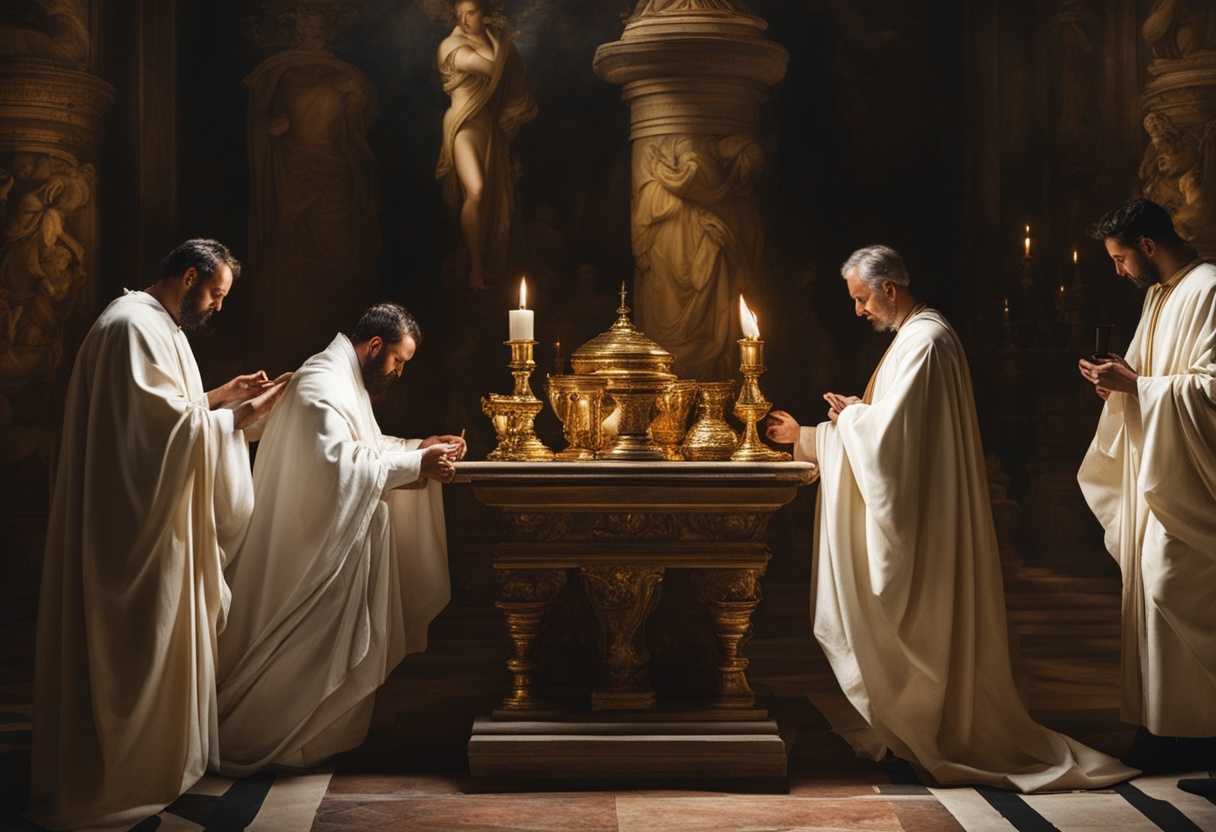
In the Bible, “sacerdotal” pertains to the priestly functions and roles, particularly as seen in the Levitical priesthood, where priests mediating between God and the people perform rituals, sacrifices, and maintain holiness. This concept emphasizes the importance of the priests’ intercessory role in worship and religious practices.
Scripture
1 “Then bring near to you Aaron your brother, and his sons with him, from among the people of Israel, to serve me as priests—Aaron and Aaron’s sons, Nadab and Abihu, Eleazar and Ithamar.”
2 And you shall make holy garments for Aaron your brother, for glory and for beauty.
3 You shall speak to all the skillful, whom I have filled with a spirit of skill, that they make Aaron’s garments to consecrate him for my priesthood.
4 These are the garments that they shall make: a breastpiece, an ephod, a robe, a coat of checker work, a turban, and a sash. They shall make holy garments for Aaron your brother and his sons to serve me as priests.
5 They shall take the gold, blue and purple and scarlet yarns, and fine twined linen.
6 “And they shall make the ephod of gold, of blue and purple and scarlet yarns, and of fine twined linen, skillfully worked.
7 It shall have two shoulder pieces attached to its two edges, so that it may be joined together.
8 And the skillfully woven band on it shall be made like it and be of one piece with it, of gold, blue and purple and scarlet yarns, and fine twined linen.
9 You shall take two onyx stones, and engrave on them the names of the sons of Israel,
10 six of their names on the one stone, and the remaining six on the other stone, in the order of their birth.
11 With the work of an engraver in stone, like the engravings of a signet, you shall engrave the two stones with the names of the sons of Israel. You shall enclose them in settings of gold filigree.
12 And you shall set the two stones on the shoulder pieces of the ephod, as stones of remembrance for the sons of Israel. And Aaron shall bear their names before the Lord on his two shoulders for remembrance.
13 You shall make settings of gold filigree,
14 two chains of pure gold, twisted like cords; and you shall attach the corded chains to the settings.
15 “You shall make a breastpiece of judgment, in skilled work. In the style of the ephod you shall make it—of gold, blue and purple and scarlet yarns, and fine twined linen shall you make it.
16 It shall be square and doubled, a span its length and a span its breadth.
17 You shall set in it four rows of stones. A row of sardius, topaz, and carbuncle shall be the first row;
18 and the second row a turquoise, a sapphire, and an emerald;
19 and the third row a jacinth, an agate, and an amethyst;
20 and the fourth row a beryl, an onyx, and a jasper. They shall be set in gold filigree.
21 There shall be twelve stones with their names according to the names of the sons of Israel. They shall be like signets, each engraved with its name, for the twelve tribes.
22 You shall make on the breastpiece twisted chains like cords, of pure gold.
23 You shall make on the breastpiece two rings of gold, and shall put the two rings on the two edges of the breastpiece.
24 and you shall put the two cords of gold in the two rings at the edges of the breastpiece.
25 And the other two ends of the two cords you shall attach to the two settings of filigree, and so attach it in front to the shoulder pieces of the ephod.
26 And you shall make two rings of gold, and attach them to the two shoulder pieces of the ephod, at its front, above the skillfully woven band of the ephod.
27 And you shall make two rings of gold, and attach them in front to the lower part of the two shoulder pieces of the ephod, at its seam above the skillfully woven band of the ephod.
28 And they shall bind the breastpiece by its rings to the rings of the ephod with a lace of blue, so that it may lie on the skillfully woven band of the ephod, so that the breastpiece shall not come loose from the ephod.
29 So Aaron shall bear the names of the sons of Israel in the breastpiece of judgment on his heart, when he goes into the Holy Place, to bring them to regular remembrance before the Lord.
30 And in the breastpiece of judgment you shall put the Urim and the Thummim, and they shall be on Aaron’s heart, when he goes in before the Lord. Thus Aaron shall bear the judgment of the people of Israel on his heart before the Lord regularly.
31 “You shall make the robe of the ephod all of blue.”
32 It shall have an opening for the head in the middle of it, with a woven binding around the opening, like the opening in a garment, so that it may not tear.
33 On its hem you shall make pomegranates of blue and purple and scarlet yarns, around its hem, with bells of gold between them,
34 A golden bell and a pomegranate, a golden bell and a pomegranate, around the hem of the robe.
35 It shall be on Aaron when he ministers, and its sound shall be heard when he goes into the Holy Place before the Lord, and when he comes out, so that he does not die.
36 “You shall make a plate of pure gold and engrave on it, like the engraving of a signet, ‘Holy to the Lord.’
37 You shall fasten it on a cord of blue and it shall be on the turban; it shall be at the front of the turban.
38 It shall be on Aaron’s forehead, and Aaron shall bear any guilt from the holy things that the people of Israel consecrate as their holy gifts. It shall regularly be on his forehead, that they may be accepted before the Lord.
39 “You shall weave the coat in checker work of fine linen, and you shall make a turban of fine linen, and you shall make a sash embroidered with needlework.
40 “For Aaron’s sons you shall make coats and sashes and caps. You shall make them for glory and beauty.
41 And you shall put them on Aaron your brother, and on his sons with him, and shall anoint them and ordain them and consecrate them, that they may serve me as priests.
42 You shall make for them linen undergarments to cover their naked flesh. They shall reach from the hips to the thighs;
43 They shall be on Aaron and on his sons when they go into the tent of meeting or when they come near the altar to minister in the Holy Place, lest they bear guilt and die. This shall be a statute forever for him and for his offspring after him.
Sacerdotal Definition in the Bible
The term “sacerdotal” in the Bible underscores the significance of the priestly role as mediators between God and humanity, particularly embodied in the Levitical priesthood established in the Old Testament. In Exodus 28:1, God commands Moses to consecrate Aaron and his sons as priests, illustrating the divine appointment and responsibility of these individuals to carry out sacred duties on behalf of the people. This role is further emphasized in Leviticus 16, which details the Day of Atonement, a pivotal ritual where the high priest makes atonement for the sins of the people, symbolizing the necessary intercession that enables them to maintain their relationship with God. The priests were tasked with performing sacrifices, which were intrinsic to the covenantal relationship between God and Israel, highlighting the gravity of sin and the need for redemption.
Moreover, the sacerdotal theme finds its fulfillment in the New Testament through the person of Jesus Christ, who is referred to as the Great High Priest in Hebrews 4:14-16. Unlike the Levitical priests, who had to repeatedly offer sacrifices for the people’s sins, Christ offered Himself once for all, thus perfecting the way for direct access to God (Hebrews 10:10). This transition underscores the shift from the old covenant system of mediators to a new covenant where believers are considered a “royal priesthood” (1 Peter 2:9) with direct access to God through Christ. Therefore, the baptizing and sacraments performed by modern ministers also carry the sacerdotal dimension, wherein they participate in the ongoing priestly work of Christ, facilitating communal worship and intercession as the body of Christ continues to mediate God’s grace to the world.
The concept of the sacerdotal role extends throughout the biblical narrative, illustrating the divine design for intercession and ritual worship. In the Old Testament, the priests were not only responsible for sacrifices but also served as teachers of the law and guardians of the covenant, as highlighted in Deuteronomy 33:10. Their dual responsibility emphasized the comprehensive role of the priesthood in guiding Israel in both spiritual and communal aspects of life. The priests were expected to maintain holiness and lead the people in following divine ordinances, thus reinforcing their vital role as spiritual leaders within the community.
In the New Testament, the sacerdotal theme continues to evolve as the early church reinterprets the priestly role through the teachings of Jesus and the apostles. In Revelation 1:6, believers are described as a kingdom of priests, reiterating the notion that the sacrificial system of the old covenant has transitioned into a new reality, where every follower of Christ shares in the priesthood. This democratization of the sacerdotal function emphasizes that all believers have roles in intercession, prayer, and worship, creating a vibrant community where each person actively participates in bringing about God’s kingdom. Thus, the interplay between the Old and New Testaments regarding the priesthood highlights an ongoing evolution of understanding, revealing ever-deepening layers of meaning within the concept of being sacred servants and representatives of God to the world.
The Role of Mediators in Worship
The term “sacerdotal” relates to the priestly function within the biblical context, emphasizing the role of priests as mediators between God and the people. This concept underscores the importance of having designated individuals who perform sacred rituals, offer sacrifices, and intercede on behalf of the community. The sacerdotal system highlights the need for a structured approach to worship, where specific roles are established to maintain the sanctity of religious practices.
The Concept of Holiness and Separation
Sacerdotalism also embodies the idea of holiness and separation in the biblical narrative. Priests were set apart from the general population, symbolizing a divine calling to serve in a sacred capacity. This separation not only signifies the importance of purity and righteousness in approaching God but also reflects the broader theme of holiness that permeates the scriptures. The priestly lineage serves as a reminder of the call to live a life that is distinct and dedicated to divine service.
The Fulfillment of Sacerdotal Functions in Christ
In the New Testament, the concept of sacerdotalism is reinterpreted through the person of Jesus Christ, who is seen as the ultimate High Priest. This fulfillment signifies a shift from the traditional priestly roles to a new understanding of access to God. Through Christ’s sacrificial act, the barriers that once existed between humanity and the divine are removed, allowing all believers to approach God directly. This transformation emphasizes the universal priesthood of all believers, where the sacerdotal function is no longer confined to a specific lineage but is accessible to everyone who follows Christ.
How to Embrace Your Role as a Mediator in Christ
Embracing your role as a mediator in Christ is a beautiful calling that invites you to be a bridge between God and others, reflecting His love and grace in every interaction. Start by cultivating a heart of compassion and understanding, recognizing that everyone you encounter is on their own journey, often filled with struggles and doubts. Pray for wisdom and discernment, asking the Holy Spirit to guide your words and actions so that you can effectively communicate the hope found in Christ. Remember, being a mediator doesn’t mean you have to have all the answers; sometimes, simply listening and being present can be the most powerful way to show Christ’s love. As you engage with others, share your own experiences of grace and redemption, allowing your testimony to shine as a beacon of hope. Ultimately, let your life be a reflection of Christ’s love, drawing others closer to Him through your genuine care and support.
Bible References to Sacerdotal Definition:
Leviticus 8:1-36: 1 Then the Lord spoke to Moses, saying,
2 “Take Aaron and his sons with him, and the garments and the anointing oil and the bull of the sin offering and the two rams and the basket of unleavened bread,”
3 And Moses said to Aaron, “Take a bull calf for a sin offering and a ram for a burnt offering, both without blemish, and offer them before the Lord.
4 And Moses did as the Lord commanded him, and the congregation was assembled at the entrance of the tent of meeting.
5 And Moses said to the congregation, “This is the thing that the Lord has commanded to be done.”
6 And Moses brought Aaron and his sons and washed them with water.
7 And he put the coat on him and tied the sash around his waist and clothed him with the robe and put the ephod on him and tied the skillfully woven band of the ephod around him, binding it to him with the band.
8 And he placed the breastpiece on him, and in the breastpiece he put the Urim and the Thummim.
9 And he set the turban on his head, and on the turban, in front, he set the golden plate, the holy crown, as the Lord commanded Moses.
10 And Moses took the anointing oil and anointed the tabernacle and all that was in it, and consecrated them.
11 And he sprinkled some of it on the altar seven times and anointed the altar and all its utensils and the basin and its stand to consecrate them.
12 And he poured some of the anointing oil on Aaron’s head and anointed him to consecrate him.
13 And Moses brought Aaron’s sons and clothed them with coats and tied sashes around their waists and bound caps on them, as the Lord commanded Moses.
14 Then he brought the bull of the sin offering, and Aaron and his sons laid their hands on the head of the bull of the sin offering.
15 Then he killed it, and Moses took the blood, and with his finger put it on the horns of the altar around it and purified the altar and poured out the blood at the base of the altar and consecrated it to make atonement for it.
16 And he took all the fat that was on the entrails and the long lobe of the liver and the two kidneys with their fat, and Moses burned them on the altar.
17 But the bull and its skin and its flesh and its dung he burned up with fire outside the camp, as the Lord commanded Moses.
18 Then he presented the ram of the burnt offering, and Aaron and his sons laid their hands on the head of the ram.
19 And he killed it, and Moses threw the blood against the sides of the altar.
20 Then he took the fat and the fat tail and all the fat that was on the entrails and the long lobe of the liver and the two kidneys with their fat, and Moses burned them on the altar.
21 And he washed the entrails and the legs with water, and Moses burned the whole ram on the altar. It was a burnt offering with a pleasing aroma, a food offering for the Lord, as the Lord commanded Moses.
22 Then he presented the other ram, the ram of ordination, and Aaron and his sons laid their hands on the head of the ram.
23 And he killed it, and Moses took some of its blood and put it on the lobe of Aaron’s right ear and on the thumb of his right hand and on the big toe of his right foot.
24 And he presented Aaron’s sons, and Moses put some of the blood on the lobes of their right ears and on the thumbs of their right hands and on the big toes of their right feet. And Moses threw the blood against the sides of the altar.
25 And he took the fat, and the fat tail, and all the fat that was on the entrails, and the long lobe of the liver and the two kidneys with their fat, and Moses burned them on the altar.
26 And out of the basket of unleavened bread that was before the Lord, he took one unleavened loaf and one loaf of bread with oil and one wafer and placed them on the pieces of fat and on the right thigh.
27 And he put all these in the hands of Aaron and in the hands of his sons and waved them as a wave offering before the Lord.
28 Then Moses took them from their hands and burned them on the altar with the burnt offering. This was an ordination offering for a pleasing aroma, a food offering to the Lord.
29 And Moses took the breast and waved it for a wave offering before the Lord. It was Moses’ portion of the ram of ordination, as the Lord commanded Moses.
30 Then Moses took some of the anointing oil and of the blood that was on the altar and sprinkled it on Aaron and his garments, and also on his sons and his sons’ garments. So he consecrated Aaron and his garments, and his sons and his sons’ garments with him.
31 And Moses said to Aaron and his sons, “Boil the flesh at the entrance of the tent of meeting, and there eat it and the bread that is in the basket of ordination offerings, as I commanded, saying, ‘Aaron and his sons shall eat it.’
32 And that which was left of the flesh and the bread you shall burn up with fire.
33 And you shall not go outside the entrance of the tent of meeting for seven days, until the days of your ordination are completed, for it will take seven days to ordain you.
34 As has been done today, the Lord has commanded to be done to make atonement for you.
35 Therefore you shall stay at the entrance of the tent of meeting day and night for seven days, and keep the charge of the Lord, that you may not die, for so I am commanded.
36 Thus Aaron and his sons did all the things that the Lord commanded by Moses.
Numbers 18:1-32: 1 So the Lord said to Aaron, “You and your sons and your father’s house with you shall bear iniquity connected with the sanctuary, and you and your sons with you shall bear iniquity connected with your priesthood.
2 And with you bring your brothers also, the tribe of Levi, the tribe of your father, that they may join you and minister to you while you and your sons with you are before the tent of the testimony.
3 They shall keep guard over you and over the whole tent, but shall not come near to the vessels of the sanctuary or to the altar lest they, and you, die.
4 They shall join you and attend to the needs of the tent of meeting for all the service of the tent, and no outsider shall come near you.
5 And you shall keep guard over the sanctuary and over the altar, that there may never again be wrath on the people of Israel.
6 Behold, I have taken your brothers the Levites from among the people of Israel. They are a gift to you, given to the Lord, to do the service of the tent of meeting.
7 And you and your sons with you shall guard your priesthood for all that concerns the altar and that is within the veil; and you shall serve. I give your priesthood as a gift, and any outsider who comes near shall be put to death.”
8 Then the Lord spoke to Aaron, “Behold, I have given you charge of the contributions made to me, all the consecrated things of the people of Israel. I have given them to you as a portion and to your sons as a perpetual due.
9 This shall be yours of the most holy things, reserved from the fire: every offering of theirs, every grain offering of theirs and every sin offering of theirs and every guilt offering of theirs, which they render to me, shall be most holy to you and to your sons.
10 You shall eat it in a holy place, because it is your due and your sons’ due, from the Lord’s food offerings, for so I am commanded.
11 This also is yours: the contribution of their gift, all the wave offerings of the people of Israel. I have given them to you, and to your sons and daughters with you, as a perpetual due. Everyone who is clean in your house may eat it.
12 All the best of the oil and all the best of the wine and of the grain, the firstfruits of what they give to the Lord, I give to you.
13 The first ripe fruits of all that is in their land, which they bring to the Lord, shall be yours. Everyone who is clean in your house may eat it.
14 Everything devoted in Israel shall be yours.
15 Everything that opens the womb of all flesh, whether man or beast, which they offer to the Lord, shall be yours. Nevertheless, the firstborn of man you shall redeem, and the firstborn of unclean animals you shall redeem.
16 They shall have the firstfruits of all the fruit of every tree, and you shall receive the firstfruits of all that is in the land to the Lord.
17 But the firstborn of a cow, or the firstborn of a sheep, or the firstborn of a goat, you shall not redeem; they are holy. You shall sprinkle their blood on the altar and shall burn their fat as a food offering, with a pleasing aroma to the Lord.
18 But the flesh of the bull and its skin and its dung you shall burn with fire outside the camp; it is a sin offering.
19 All the holy contributions that the people of Israel present to the Lord I give to you, and to your sons and daughters with you, as a perpetual due. It is a covenant of salt forever before the Lord for you and for your offspring with you.
20 And the Lord said to Aaron, “You shall have no inheritance in their land, neither shall you have any portion among them. I am your portion and your inheritance among the people of Israel.
21 “To the Levites I have given every tithe in Israel for an inheritance, in return for their service that they do, their service in the tent of meeting,
22 So the people of Israel shall no longer come near the tent of meeting, lest they bear sin and die.
23 But the Levites shall do the service of the tent of meeting, and they shall bear their iniquity. It shall be a perpetual statute throughout your generations, and among the people of Israel they shall have no inheritance.
24 For the tithe of the people of Israel, which they present as a contribution to the Lord, I have given to the Levites for an inheritance. Therefore I have said of them that they shall have no inheritance among the people of Israel.”
25 Then the Lord spoke to Moses, saying,
26 “Moreover, you shall speak and say to the Levites, ‘When you take from the people of Israel the tithe that I have given you from them for your inheritance, then you shall present a contribution from it to the Lord, a tithe of the tithe.
27 And this your contribution shall be counted to you as though it were the grain of the threshing floor, and as the fullness of the winepress.
28 So you shall also present a contribution to the Lord from all your tithes, which you receive from the people of Israel. And from it you shall give the Lord’s contribution to Aaron the priest.
29 Out of all the gifts to you, you shall present every contribution due to the Lord; from each its best part is to be dedicated.’
30 Therefore you shall say to them, ‘When you have offered from it the best of it, then the rest shall be counted as the Levites’ property, as if it were the produce of the threshing floor and as the produce of the winepress.
31 And you may eat it in any place, you and your households, for it is your reward in return for your service in the tent of meeting.
32 And you shall bear no sin by reason of it, when you have contributed the best of it. But you shall not profane the holy things of the people of Israel, lest you die.’”
Hebrews 5:1-10: 1 For every high priest chosen from among men is appointed to act on behalf of men in relation to God, to offer gifts and sacrifices for sins.
2 He can deal gently with the ignorant and wayward, since he himself is beset with weakness.
3 Because of this he is obligated to offer sacrifice for his own sins just as he does for those of the people.
4 And no one takes this honor for himself, but only when called by God, just as Aaron was.
5 So also Christ did not exalt himself to be made a high priest, but was appointed by him who said to him, “You are my Son, today I have begotten you”;
6 as he says also in another place, “You are a priest forever, after the order of Melchizedek.”
7 In the days of his flesh, Jesus offered up prayers and supplications, with loud cries and tears, to him who was able to save him from death, and he was heard because of his reverence.
8 Although he was a son, he learned obedience through what he suffered.
9 And being made perfect, he became the source of eternal salvation to all who obey him,
10 being designated by God a high priest after the order of Melchizedek.
Hebrews 7:1-28: 1 For this Melchizedek, king of Salem, priest of the Most High God, met Abraham returning from the slaughter of the kings and blessed him,
2 and to him Abraham apportioned a tenth part of everything. He is first, by translation of his name, king of righteousness, and then he is also king of Salem, that is, king of peace.
3 He is without father or mother or genealogy, having neither beginning of days nor end of life, but resembling the Son of God he continues a priest forever.
4 See how great this man was to whom Abraham the patriarch gave a tenth of the spoils!
5 And those descendants of Levi who receive the priestly office have a commandment in the law to take tithes from the people, that is, from their brothers, though these also are descended from Abraham.
6 But this man who does not have his descent from them received tithes from Abraham and blessed him who had the promises.
7 It is beyond dispute that the inferior is blessed by the superior.
8 In the one case tithes are received by mortal men, but in the other case, by one of whom it is testified that he lives.
9 One might even say that Levi himself, who receives tithes, paid tithes through Abraham,
10 for he was still in the loins of his ancestor when Melchizedek met him.
11 Now if perfection had been attainable through the Levitical priesthood (for under it the people received the law), what further need would there have been for another priest to arise after the order of Melchizedek, rather than one named after the order of Aaron?
12 For when there is a change in the priesthood, there is necessarily a change in the law as well.
13 For the one of whom these things are spoken belonged to another tribe, from which no one has ever served at the altar.
14 For it is evident that our Lord was descended from Judah, and in connection with that tribe Moses said nothing about priests.
15 This becomes even more evident when another priest arises in the likeness of Melchizedek,
16 who has become a priest, not on the basis of a legal requirement concerning bodily descent, but by the power of an indestructible life.
17 For it is witnessed of him, “You are a priest forever, after the order of Melchizedek.”
18 For on the one hand, a former commandment is set aside because of its weakness and uselessness,
19 (for the law made nothing perfect); but on the other hand, a better hope is introduced, through which we draw near to God.
20 And it was not without an oath. For those who formerly became priests were made such without an oath,
21 but this one was made a priest with an oath by the one who said to him: “The Lord has sworn and will not change his mind, ‘You are a priest forever.’”
22 This makes Jesus the guarantor of a better covenant.
23 The former priests were many in number, because they were prevented by death from continuing in office,
24 but he holds his priesthood permanently, because he continues forever.
25 Consequently, he is able to save to the uttermost those who draw near to God through him, since he always lives to make intercession for them.
26 For it was indeed fitting that we should have such a high priest, holy, innocent, unstained, separated from sinners, and exalted above the heavens.
27 He has no need, like those high priests, to offer sacrifices daily, first for his own sins and then for those of the people, since he did this once for all when he offered up himself.
28 For the law appoints men in their weakness as high priests, but the word of the oath, which came later than the law, appoints a Son who has been made perfect forever.
1 Peter 2:4-10: 4 As you come to him, a living stone rejected by men but in the sight of God chosen and precious,
5 you yourselves like living stones are being built up as a spiritual house, to be a holy priesthood, to offer spiritual sacrifices acceptable to God through Jesus Christ.
6 For it stands in Scripture: “Behold, I am laying in Zion a stone, a cornerstone chosen and precious, and whoever believes in him will not be put to shame.”
7 So the honor is for you who believe, but for those who do not believe, “The stone that the builders rejected has become the cornerstone,”
8 and “A stone of stumbling, and a rock of offense.” They stumble because they disobey the word, as they were destined to do.
9 But you are a chosen race, a royal priesthood, a holy nation, a people for his own possession, that you may proclaim the excellencies of him who called you out of darkness into his marvelous light.
10 Once you were not a people, but now you are God’s people; once you had not received mercy, but now you have received mercy.
Revelation 1:5-6: 5 and from Jesus Christ the faithful witness, the firstborn of the dead, and the ruler of kings on earth. To him who loves us and has freed us from our sins by his blood.
6 and made us a kingdom, priests to his God and Father, to him be glory and dominion forever and ever. Amen.
Revelation 5:9-10: 9 And they sang a new song, saying, “Worthy are you to take the scroll and to open its seals, for you were slain, and by your blood you ransomed people for God from every tribe and language and people and nation,
10 and you have made them a kingdom and priests to our God, and they shall reign on the earth.”

Reverend Michael Johnson is an experienced Church Minister with a profound expertise in spirituality and guidance. With a serene presence and a compassionate heart, he has faithfully served his congregation for over 20 years, leading them on a spiritual journey towards inner peace and enlightenment. Reverend Johnson’s extensive knowledge of religious philosophies and profound understanding of human nature have made him a trusted confidant and mentor to many, as he seamlessly weaves his profound wisdom into life teachings. Reverend Johnson’s calming demeanor and empathetic nature continue to uplift and heal souls, nurturing a sense of unity and tranquility within his community.