
Leviticus 8:1-36 is about the ritual of consecrating Aaron and his sons as priests, symbolizing their purification, dedication, and authorization to serve God on behalf of the Israelites.
1 Then the Lord spoke to Moses, saying,
2 “Take Aaron and his sons with him, and the garments and the anointing oil and the bull of the sin offering and the two rams and the basket of unleavened bread,”
3 And Moses said to Aaron, “Take a bull calf for a sin offering and a ram for a burnt offering, both without blemish, and offer them before the Lord.
4 And Moses did as the Lord commanded him, and the congregation was assembled at the entrance of the tent of meeting.
5 And Moses said to the congregation, “This is the thing that the Lord has commanded to be done.”
6 And Moses brought Aaron and his sons and washed them with water.
7 And he put the coat on him and tied the sash around his waist and clothed him with the robe and put the ephod on him and tied the skillfully woven band of the ephod around him, binding it to him with the band.
8 And he placed the breastpiece on him, and in the breastpiece he put the Urim and the Thummim.
9 And he set the turban on his head, and on the turban, in front, he set the golden plate, the holy crown, as the Lord commanded Moses.
10 And Moses took the anointing oil and anointed the tabernacle and all that was in it, and consecrated them.
11 And he sprinkled some of it on the altar seven times and anointed the altar and all its utensils and the basin and its stand to consecrate them.
12 And he poured some of the anointing oil on Aaron’s head and anointed him to consecrate him.
13 And Moses brought Aaron’s sons and clothed them with coats and tied sashes around their waists and bound caps on them, as the Lord commanded Moses.
14 Then he brought the bull of the sin offering, and Aaron and his sons laid their hands on the head of the bull of the sin offering.
15 Then he killed it, and Moses took the blood, and with his finger put it on the horns of the altar around it and purified the altar and poured out the blood at the base of the altar and consecrated it to make atonement for it.
16 And he took all the fat that was on the entrails and the long lobe of the liver and the two kidneys with their fat, and Moses burned them on the altar.
17 But the bull and its skin and its flesh and its dung he burned up with fire outside the camp, as the Lord commanded Moses.
18 Then he presented the ram of the burnt offering, and Aaron and his sons laid their hands on the head of the ram.
19 And he killed it, and Moses threw the blood against the sides of the altar.
20 Then he took the fat and the fat tail and all the fat that was on the entrails and the long lobe of the liver and the two kidneys with their fat, and Moses burned them on the altar.
21 And he washed the entrails and the legs with water, and Moses burned the whole ram on the altar. It was a burnt offering with a pleasing aroma, a food offering for the Lord, as the Lord commanded Moses.
22 Then he presented the other ram, the ram of ordination, and Aaron and his sons laid their hands on the head of the ram.
23 And he killed it, and Moses took some of its blood and put it on the lobe of Aaron’s right ear and on the thumb of his right hand and on the big toe of his right foot.
24 And he presented Aaron’s sons, and Moses put some of the blood on the lobes of their right ears and on the thumbs of their right hands and on the big toes of their right feet. And Moses threw the blood against the sides of the altar.
25 And he took the fat, and the fat tail, and all the fat that was on the entrails, and the long lobe of the liver and the two kidneys with their fat, and Moses burned them on the altar.
26 And out of the basket of unleavened bread that was before the Lord, he took one unleavened loaf and one loaf of bread with oil and one wafer and placed them on the pieces of fat and on the right thigh.
27 And he put all these in the hands of Aaron and in the hands of his sons and waved them as a wave offering before the Lord.
28 Then Moses took them from their hands and burned them on the altar with the burnt offering. This was an ordination offering for a pleasing aroma, a food offering to the Lord.
29 And Moses took the breast and waved it for a wave offering before the Lord. It was Moses’ portion of the ram of ordination, as the Lord commanded Moses.
30 Then Moses took some of the anointing oil and of the blood that was on the altar and sprinkled it on Aaron and his garments, and also on his sons and his sons’ garments. So he consecrated Aaron and his garments, and his sons and his sons’ garments with him.
31 And Moses said to Aaron and his sons, “Boil the flesh at the entrance of the tent of meeting, and there eat it and the bread that is in the basket of ordination offerings, as I commanded, saying, ‘Aaron and his sons shall eat it.’
32 And that which was left of the flesh and the bread you shall burn up with fire.
33 And you shall not go outside the entrance of the tent of meeting for seven days, until the days of your ordination are completed, for it will take seven days to ordain you.
34 As has been done today, the Lord has commanded to be done to make atonement for you.
35 Therefore you shall stay at the entrance of the tent of meeting day and night for seven days, and keep the charge of the Lord, that you may not die, for so I am commanded.
36 Thus Aaron and his sons did all the things that the Lord commanded by Moses.
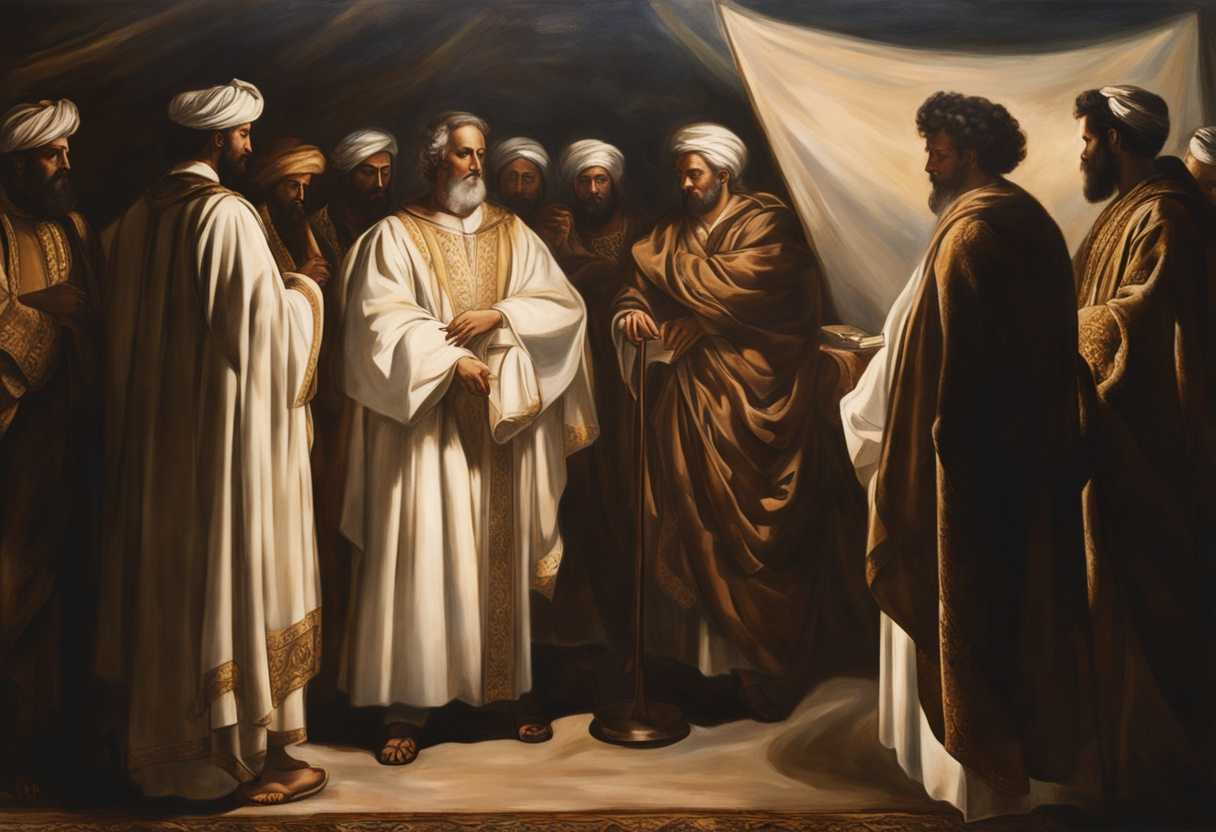
Setting the Scene for Leviticus 8:1-36
In Leviticus 8:1-36, we find ourselves in the Tabernacle courtyard, a sacred and solemn place where the Israelites have gathered to witness a significant event. The scene is filled with anticipation and reverence as Moses, the chosen leader of the Israelites, prepares to consecrate Aaron and his sons as priests. The air is thick with the scent of burning incense and the sound of prayers being whispered.
Surrounding Moses and Aaron are the elders of Israel, dressed in their finest garments, their faces reflecting a mixture of awe and respect. The Tabernacle itself stands tall and majestic in the background, its intricate design a testament to the Israelites’ devotion to their God. The sun is beginning to set, casting a warm glow over the scene and adding to the sense of holiness that permeates the air.
As Moses follows the precise instructions given to him by God, the onlookers watch in silence, fully aware of the significance of this moment. The rituals of consecration unfold with meticulous care, each step symbolizing the sanctification of Aaron and his sons for their sacred duties. The scene is a powerful reminder of the Israelites’ commitment to their faith and their unwavering belief in the power of God’s presence among them.
What is Leviticus 8:1-36 about?
This verse from the Bible holds tremendous significance as it captures a pivotal moment in the establishment of the priesthood in the Israelite community. Through the act of consecrating Aaron and his sons as priests in the tabernacle, Moses is essentially setting them apart for a sacred purpose, entrusting them with the responsibility of serving as the intermediaries between the people and God. This ceremony symbolizes a profound spiritual connection and signifies a divine calling that Aaron and his sons are called to fulfill.
Imagine the solemn atmosphere within the tabernacle as this consecration takes place – the incense filling the air, the flickering light of the sacred lamps, and the prayers of the people offering blessings and support. This moment marks a new chapter in the religious life of the Israelites, as the priesthood becomes an essential institution for their worship and connection with God. This verse reminds us of the importance of sacred rituals and the significance of those called to serve in positions of spiritual leadership as we reflect on it. Contemplate the weight of this responsibility and the dedication required to fulfill such a sacred duty.
Understanding what Leviticus 8:1-36 really means
The eighth chapter of Leviticus delves into the consecration of Aaron and his sons as priests, a pivotal moment in establishing the Levitical priesthood. This chapter underscores the significance of holiness, obedience, and the crucial role of mediation between God and His people. The phrase “The LORD spoke to Moses, saying…” serves as a constant reminder of the divine origin of the instructions, emphasizing the necessity of adhering to God’s commands with precision. Each mention of “Take Aaron and his sons with him, and the garments, and the anointing oil…” symbolizes purity, dedication, and the sanctity associated with the priestly office. The repetition of “Moses did as the LORD commanded him…” reinforces the theme of obedience to God’s directives.
In exploring related biblical passages, Exodus 28-29 lays the groundwork for the priestly garments and consecration ceremony, providing context for Leviticus 8. Hebrews 7:26-28 contrasts the Levitical priesthood with Jesus’ perfect high priesthood, while 1 Peter 2:9 addresses New Testament believers as a “royal priesthood,” linking the Old Testament priesthood to the calling of all Christians. The relevance of Leviticus 8:1-36 to contemporary audiences is evident in its emphasis on holiness and obedience, urging individuals to lead lives dedicated to God’s commands. The concept of mediation, exemplified by Aaron and his sons in the Old Testament and by Jesus in the New Testament, remains crucial in bridging the gap between humanity and God.
The consecration of the priests in Leviticus serves as a poignant reminder of the significance of community and leadership. Just as Aaron and his sons were set apart to guide and serve the Israelites, leaders today are called to shepherd their communities with wisdom and humility. An illustrative anecdote can be likened to a meticulously planned wedding, where every detail symbolizes dedication and readiness for a sacred union. Similarly, the consecration ceremony in Leviticus 8 brought the community closer to God, emphasizing the importance of preparation, dedication, and the sacredness of their role as mediators.
In conclusion, Leviticus 8:1-36 prompts reflection on the essential values of holiness, obedience, and mediation in our relationship with God. It challenges us to assess our commitment to God’s commands and our willingness to serve and lead within our communities. Just as Aaron and his sons were consecrated for a sacred purpose, we are called to live lives that honor God and reflect His holiness in all we do.
How can we effectively consecrate ourselves for service to God?
God instructs Moses to consecrate Aaron and his sons for service in the priesthood in Leviticus 8. The consecration process included washing with water, putting on the priestly garments, anointing with oil, and offering sacrifices. This elaborate consecration ceremony symbolized the setting apart of Aaron and his sons for holy service to God.
To consecrate ourselves effectively for service to God today, we can follow the example of Aaron and his sons by purifying ourselves from sin through confession and repentance, putting on the spiritual armor of God (Ephesians 6:10-18), being filled with the Holy Spirit, and offering ourselves as living sacrifices (Romans 12:1). We can seek the anointing of the Holy Spirit to equip us for service and to guide us in fulfilling God’s purposes for our lives, just as the priests were consecrated with oil as a symbol of God’s anointing and empowerment. Approaching God with humility, reverence, and a willingness to surrender our lives completely to His will is essential in dedicating ourselves to His service. We can position ourselves to be used by God for His kingdom purposes and to bring glory to His name by consecrating ourselves through faith, obedience, and a desire to honor God in all that we do.
Application
Let’s heed the lessons from Leviticus 8:1-36 and embrace obedience and reverence in our lives. Just like the priests diligently prepared and consecrated themselves, let’s also commit to our spiritual journey with earnestness. It’s time to align our actions with God’s teachings and walk the path of righteousness wholeheartedly. Will you answer the call to obedience and holiness today?

Reverend Michael Johnson is an experienced Church Minister with a profound expertise in spirituality and guidance. With a serene presence and a compassionate heart, he has faithfully served his congregation for over 20 years, leading them on a spiritual journey towards inner peace and enlightenment. Reverend Johnson’s extensive knowledge of religious philosophies and profound understanding of human nature have made him a trusted confidant and mentor to many, as he seamlessly weaves his profound wisdom into life teachings. Reverend Johnson’s calming demeanor and empathetic nature continue to uplift and heal souls, nurturing a sense of unity and tranquility within his community.