
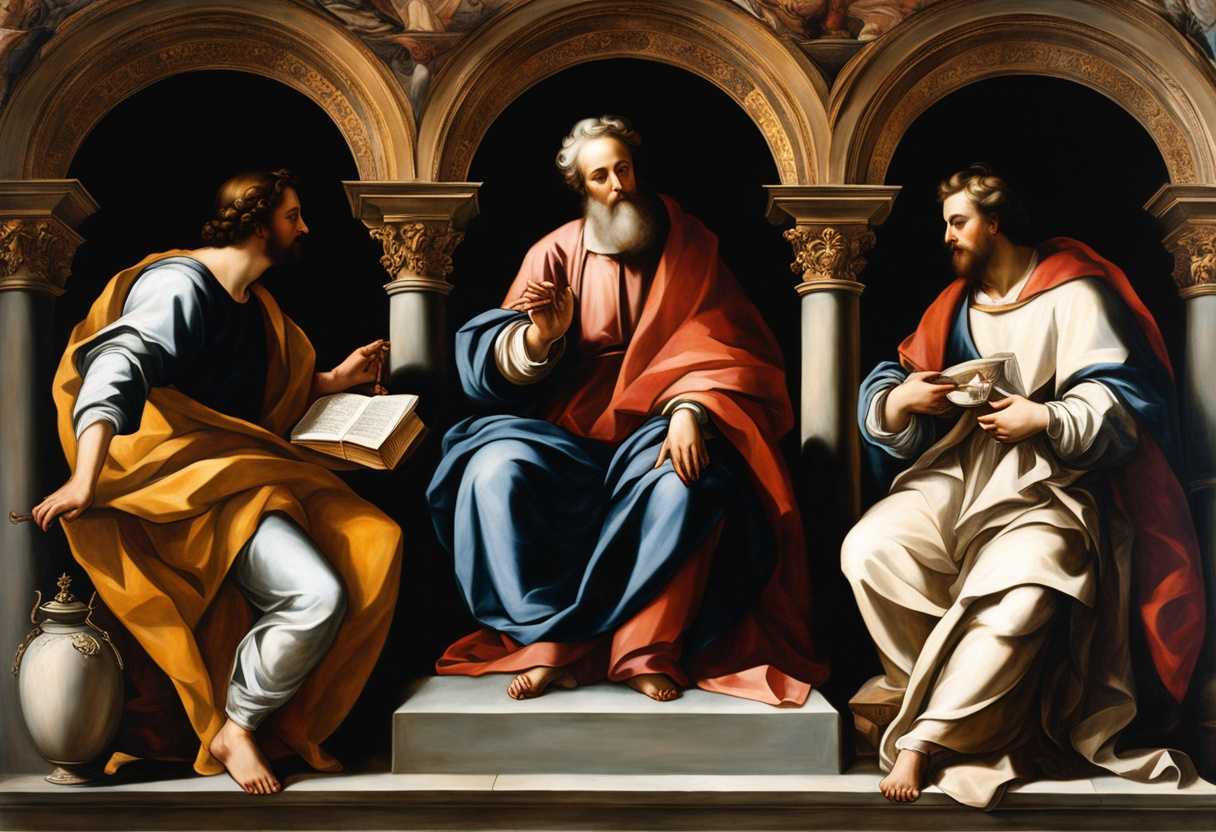
In the Bible, “Trinitarian” refers to the doctrine of the Trinity, which posits that one God exists in three distinct persons: Father, Son (Jesus Christ), and Holy Spirit. This concept emphasizes the unity of God in essence while recognizing the individuality of each person within the Godhead, as seen in passages such as Matthew 28:19 and 2 Corinthians 13:14.
Scripture
26 Then God said, “Let us make man in our image, after our likeness. And let them have dominion over the fish of the sea and over the birds of the heavens and over the livestock and over all the earth and over every creeping thing that creeps on the earth.”
27 So God created man in his own image,
in the image of God he created him;
male and female he created them.
Trinitarian Definition in the Bible
The concept of the Trinity, encapsulated in the term “Trinitarian,” reflects a central tenet of Christian theology that underscores the coexistence and coequality of the Father, the Son, and the Holy Spirit. Each person of the Godhead is fully and completely God, yet they are distinct from one another. This unity in diversity is articulated in Matthew 28:19, where Jesus commands His disciples to baptize “in the name of the Father and of the Son and of the Holy Spirit.” This commissioning not only illustrates the threefold aspect of God’s nature but also affirms the authority of each person in the act of baptism, signifying their integral role in the salvation narrative.
Moreover, in 2 Corinthians 13:14, the Apostle Paul provides a Trinitarian blessing, invoking each person of the Trinity: “The grace of the Lord Jesus Christ, the love of God and the fellowship of the Holy Spirit be with you all.” This passage highlights the relational aspect of the Trinity and the dynamic interaction within the Godhead, emphasizing that the life of a believer is enriched through the grace of Christ, the love of the Father, and the fellowship provided by the Holy Spirit. As such, the Trinitarian doctrine moves beyond mere theological definition, revealing the relational nature of God and inviting believers into a deeper communion with each distinct person of the Trinity, reflective of their interwoven identities and purposes within the larger framework of salvation and divine love.
In addition to the foundational texts that emphasize the coequal and coeternal nature of the Father, Son, and Holy Spirit, the Trinitarian concept is mirrored in the profound relationship observed throughout the New Testament narratives and epistles. For instance, the opening verses of John’s Gospel provide a rich theological portrayal of the Word (Logos), which is identified with Christ and described as being both with God and being God (John 1:1). This dual affirmation of distinctness and unity underscores the core idea of Trinitarianism: that in the essence of God, there is relationship and communion. The divine nature is not isolated; rather, it is characterized by an eternal dialogue, a communion that speaks to the very nature of love, which in turn invites believers into an intimate relationship with each person of the Trinity.
Additionally, in the Acts of the Apostles, there are illustrations that further reinforce the Trinitarian framework, particularly the scenes of early church practices. The promise of the Holy Spirit in Acts 2 not only emphasizes the Spirit’s divine role in empowering the church but also showcases the active presence of all three persons of the Trinity in the life of believers. This event of Pentecost illustrates the fulfillment of Jesus’ promise during His earthly ministry, highlighting how the Father sends the Spirit in the Son’s name, establishing a continued divine presence and guidance for the faith community. The interwoven actions of the Father, Son, and Holy Spirit throughout the narrative of the early church provide a practical demonstration of Trinitarian theology, where the very mission of the church is rooted in the active work and unified purpose of the Godhead. This underscores that the essence of God is encapsulated not just in a theological definition, but in the lived experience of believers who seek to engage with each aspect of their relationship with the Trinitarian God.
The Nature of God as Triune
The concept of the Trinity emphasizes that God exists as three distinct persons—Father, Son, and Holy Spirit—yet is one in essence. This understanding challenges the notion of a singular, monolithic deity and invites believers to explore the relational dynamics within the Godhead. The Trinitarian view highlights the complexity of God’s nature, suggesting that love, community, and relationality are intrinsic to God’s being. This perspective encourages believers to reflect on their own relationships and the importance of community in their spiritual lives.
The Role of Each Person in Salvation
In a Trinitarian framework, each person of the Trinity plays a unique role in the process of salvation. The Father is often seen as the creator and initiator of the plan of redemption, the Son as the one who accomplishes salvation through His life, death, and resurrection, and the Holy Spirit as the one who applies that salvation to believers’ lives. This understanding underscores the collaborative work of the Trinity in the believer’s journey, emphasizing that salvation is not merely a one-time event but an ongoing relationship with each person of the Godhead.
The Call to Reflect Trinitarian Relationships
The Trinitarian definition also serves as a model for human relationships. Just as the Father, Son, and Holy Spirit exist in perfect unity and harmony, believers are called to reflect this relational dynamic in their interactions with one another. This includes fostering love, mutual respect, and cooperation within the community of faith. The Trinitarian model encourages believers to pursue unity in diversity, recognizing that while individuals may have different roles and gifts, they are all part of the same body of Christ, working together for the common good.
How to Embrace the Trinity in Daily Life
Embracing the Trinity in our daily lives is a beautiful journey that invites us to deepen our relationship with God, Jesus, and the Holy Spirit. Start by recognizing the presence of each person of the Trinity in your everyday moments—acknowledge God the Father as the creator and sustainer of your life, Jesus as your personal Savior and friend, and the Holy Spirit as your guide and comforter. You might begin your day with a prayer that honors each aspect of the Trinity, asking for wisdom from the Holy Spirit, strength from Jesus, and love from the Father. Throughout your day, practice gratitude for the blessings you receive, reflecting on how each person of the Trinity plays a role in your life. When faced with challenges, turn to prayer, seeking the guidance of the Holy Spirit, and remember that Jesus walked this earth and understands your struggles. By intentionally inviting the Trinity into your thoughts and actions, you’ll find a deeper sense of peace and purpose, allowing your faith to flourish in every aspect of your life.
Bible References to Trinitarian Doctrine:
Matthew 28:18-20: 18 And Jesus came and said to them, “All authority in heaven and on earth has been given to me.
19 Go therefore and make disciples of all nations, baptizing them in the name of the Father and of the Son and of the Holy Spirit,
20 teaching them to observe all that I have commanded you. And behold, I am with you always, to the end of the age.
John 1:1-14: 1 In the beginning was the Word, and the Word was with God, and the Word was God.
2 He was in the beginning with God.
3 All things were made through him, and without him was not any thing made that was made.
4 In him was life, and the life was the light of men.
5 The light shines in the darkness, and the darkness has not overcome it.
6 There was a man sent from God, whose name was John.
7 He came as a witness, to bear witness about the light, that all might believe through him.
8 He was not the light, but came to bear witness about the light.
9 The true light, which gives light to everyone, was coming into the world.
10 He was in the world, and the world was made through him, yet the world did not know him.
11 He came to his own, and his own people did not receive him.
12 But to all who did receive him, who believed in his name, he gave the right to become children of God,
13 who were born, not of blood nor of the will of the flesh nor of the will of man, but of God.
14 And the Word became flesh and dwelt among us, and we have seen his glory, glory as of the only Son from the Father, full of grace and truth.
John 14:16-17: 16 And I will ask the Father, and he will give you another Helper, to be with you forever,
17 even the Spirit of truth, whom the world cannot receive, because it neither sees him nor knows him. You know him, for he dwells with you and will be in you.
John 14:26: 26 But the Helper, the Holy Spirit, whom the Father will send in my name, he will teach you all things and bring to your remembrance all that I have said to you.
John 15:26: 26 “But when the Helper comes, whom I will send to you from the Father, the Spirit of truth, who proceeds from the Father, he will bear witness about me.
John 16:13-15: 13 When the Spirit of truth comes, he will guide you into all the truth, for he will not speak on his own authority, but whatever he hears he will speak, and he will declare to you the things that are to come.
14 He will glorify me, for he will take what is mine and declare it to you.
15 All that the Father has is mine; therefore I said that he will take what is mine and declare it to you.
2 Corinthians 13:14: 14 The grace of the Lord Jesus Christ and the love of God and the fellowship of the Holy Spirit be with you all.
Ephesians 1:3-14: 3 Blessed be the God and Father of our Lord Jesus Christ, who has blessed us in Christ with every spiritual blessing in the heavenly places,
4 even as he chose us in him before the foundation of the world, that we should be holy and blameless before him.
5 he predestined us for adoption to himself as sons through Jesus Christ, according to the purpose of his will,
6 to the praise of his glorious grace, with which he has blessed us in the Beloved.
7 In him we have redemption through his blood, the forgiveness of our trespasses, according to the riches of his grace,
8 which he lavished upon us, in all wisdom and insight
9 making known to us the mystery of his will, according to his purpose, which he set forth in Christ
10 as a plan for the fullness of time, to unite all things in him, things in heaven and things on earth.
11 In him we have obtained an inheritance, having been predestined according to the purpose of him who works all things according to the counsel of his will,
12 so that we who were the first to hope in Christ might be to the praise of his glory.
13 In him you also, when you heard the word of truth, the gospel of your salvation, and believed in him, were sealed with the promised Holy Spirit,
14 who is the guarantee of our inheritance until we acquire possession of it, to the praise of his glory.
Colossians 1:15-20: 15 He is the image of the invisible God, the firstborn of all creation.
16 For by him all things were created, in heaven and on earth, visible and invisible, whether thrones or dominions or rulers or authorities—all things were created through him and for him.
17 And he is before all things, and in him all things hold together.
18 And he is the head of the body, the church. He is the beginning, the firstborn from the dead, that in everything he might be preeminent.
19 For in him all the fullness of God was pleased to dwell,
20 and through him to reconcile to himself all things, whether on earth or in heaven, making peace by the blood of his cross.
Hebrews 1:1-3: 1 Long ago, at many times and in many ways, God spoke to our fathers by the prophets,
2 but in these last days he has spoken to us by his Son, whom he appointed the heir of all things, through whom also he created the world.
3 He is the radiance of the glory of God and the exact imprint of his nature, and he upholds the universe by the word of his power. After making purification for sins, he sat down at the right hand of the Majesty on high,
1 Peter 1:1-2: 1 Peter, an apostle of Jesus Christ, To those who are elect exiles of the Dispersion in Pontus, Galatia, Cappadocia, Asia, and Bithynia,
2 according to the foreknowledge of God the Father, in the sanctification of the Spirit, for obedience to Jesus Christ and for sprinkling with his blood: May grace and peace be multiplied to you.
1 John 5:6-8: 6 This is he who came by water and blood—Jesus Christ; not by the water only but by the water and the blood. And the Spirit is the one who testifies, because the Spirit is the truth.
For there are three that testify:
8 the Spirit and the water and the blood; and these three agree.

Reverend Michael Johnson is an experienced Church Minister with a profound expertise in spirituality and guidance. With a serene presence and a compassionate heart, he has faithfully served his congregation for over 20 years, leading them on a spiritual journey towards inner peace and enlightenment. Reverend Johnson’s extensive knowledge of religious philosophies and profound understanding of human nature have made him a trusted confidant and mentor to many, as he seamlessly weaves his profound wisdom into life teachings. Reverend Johnson’s calming demeanor and empathetic nature continue to uplift and heal souls, nurturing a sense of unity and tranquility within his community.