
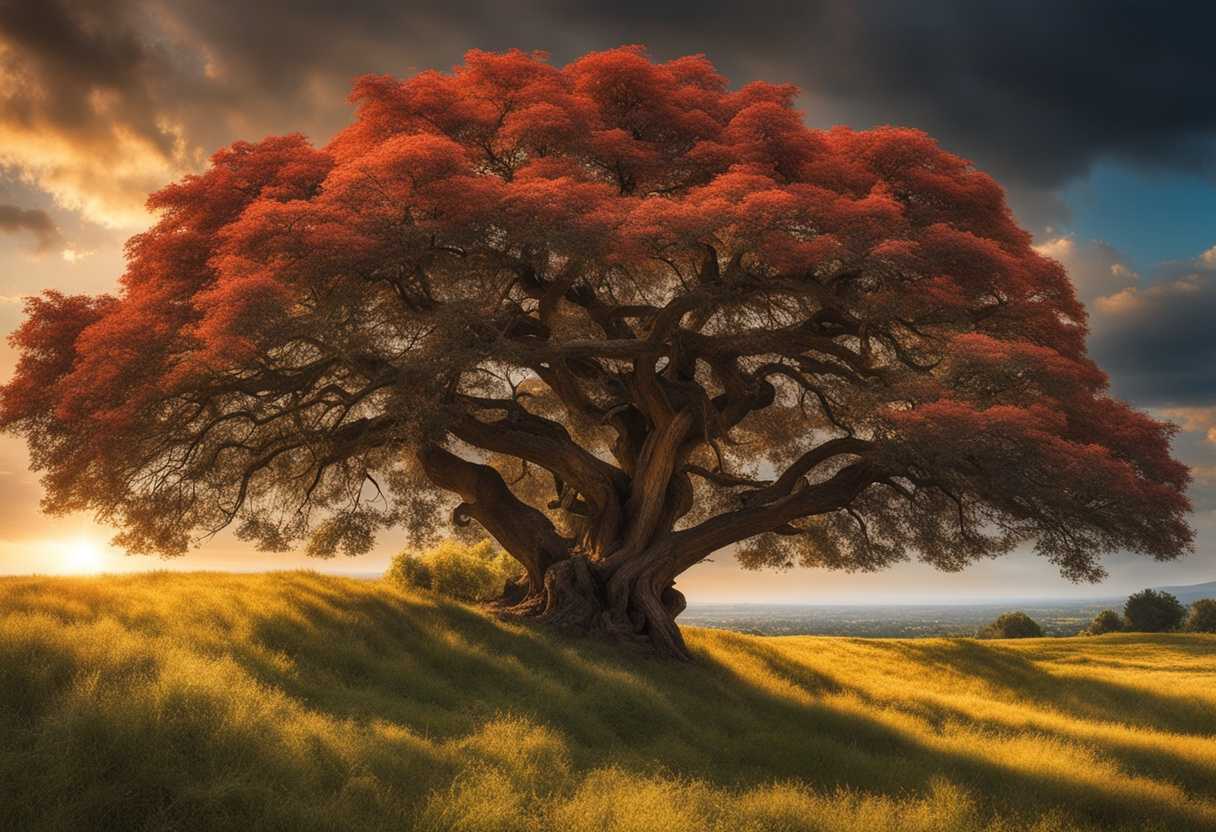
In the Bible, the acacia tree is often associated with resilience and durability, symbolizing God’s enduring presence. It was used to construct sacred objects, such as the Ark of the Covenant in Exodus 25:10, highlighting its significance in religious rituals and worship.
Scripture
10 “They shall make an ark of acacia wood. Two cubits and a half shall be its length, a cubit and a half its breadth, and a cubit and a half its height.”
11 You shall overlay it with pure gold, inside and outside shall you overlay it, and you shall make on it a molding of gold around it.
12 And cast four rings of gold for it and put them on its four feet, two rings on the one side of it, and two rings on the other side of it.
13 You shall make poles of acacia wood and overlay them with gold.
14 And you shall put the poles into the rings on the sides of the ark to carry the ark by them.
15 The poles shall remain in the rings of the ark; they shall not be taken from it.
16 And you shall put into the ark the testimony that I shall give you.
17 You shall make a mercy seat of pure gold.
18 And you shall make two cherubim of gold; of hammered work shall you make them, on the two ends of the mercy seat.
19 And make one cherub on the one end, and one cherub on the other end. Of one piece with the mercy seat shall you make the cherubim on its two ends.
20 The cherubim shall spread out their wings above, overshadowing the mercy seat with their wings, their faces one to another; toward the mercy seat shall the faces of the cherubim be.
21 And you shall put the mercy seat on the top of the ark, and in the ark you shall put the testimony that I shall give you.
22 There I will meet with you, and from above the mercy seat, from between the two cherubim that are on the ark of the testimony, I will speak with you about all that I will give you in commandment for the people of Israel.
Biblical Significance of the Acacia Tree
The acacia tree, specifically the Acacia acacia (also known as shittah in Hebrew), holds rich symbolism within the biblical narrative, primarily representing resilience, strength, and the divine presence of God. As noted in Exodus 25:10, where Acacia wood is specified for the construction of the Ark of the Covenant, the tree symbolizes something sturdy and impervious to decay. This is a vivid representation of God’s everlasting covenant with His people—a promise that endures across generations, much like the durable wood of the acacia tree. Furthermore, the Ark, made from this wood and overlaid with gold, reflects the divine glory and holiness, signifying that God desires to dwell among His people.
Beyond its physical attributes, the acacia tree’s presence in the wilderness represents sustenance and protection, as the wood is also utilized in the creation of the Tabernacle and its furnishings (Exodus 26:15-30). The tree’s flourishing in arid environments speaks to God’s provision in barren circumstances, echoing themes of hope and rejuvenation. In broader theological terms, the use of acacia in sacred items underscores the relationship between the material and the spiritual—an invitation for believers to recognize the presence of the divine in the mundane. Thus, the acacia tree stands not only as a literal source of building material but also as a profound symbol of faith and God’s persistent presence throughout the biblical narrative.
The acacia tree emerges throughout scripture as a symbol of divine provision and steadfastness, echoing the themes of promise and renewal. In the arid landscapes of the ancient Near East, where survival hinged on access to natural resources, the acacia tree represents a source of sustenance and vitality. Its ability to thrive in desolate conditions reflects God’s ability to nurture growth and life in the most challenging of circumstances. This thematic resonance extends beyond mere survival; it signifies God’s promise to sustain His people even when hope seems distant, invoking images of the Israelites’ journey through the wilderness.
Additionally, acacia’s frequent usage in sacred contexts invites believers to find deeper meaning in their connection to the divine. The wood’s inherent qualities—its durability and resistance to decay—can be viewed as a metaphor for the eternal nature of God’s words and promises. This intertwining of the material with the spiritual further illustrates a call for believers to engage with their faith actively. The acacia tree, therefore, becomes not just an element of the tabernacle or the Ark of the Covenant, but a spiritual symbol calling to mind God’s enduring faithfulness and the commitment of His people to uphold their covenantal relationship. Ultimately, the acacia tree stands as a testament to resilience, serving as a reminder of the hope and strength found in trusting the divine, regardless of life’s wilderness moments.
Symbol of Endurance and Resilience
The acacia tree is known for its ability to thrive in harsh environments, symbolizing endurance and resilience. In biblical contexts, this characteristic can be interpreted as a representation of faith and strength in the face of adversity. Just as the acacia withstands drought and poor soil, believers are encouraged to remain steadfast in their faith, even when faced with life’s challenges.
Representation of Divine Presence
The acacia tree is often associated with the construction of sacred spaces and objects in the Bible. Its use in the building of the Tabernacle signifies a connection to the divine. The tree’s durability and beauty can be seen as a metaphor for God’s enduring presence among His people, reminding them of His faithfulness and the importance of creating spaces that honor Him.
Symbol of Purity and Holiness
The acacia tree is also linked to the concept of purity and holiness in biblical texts. Its wood was used for sacred items, suggesting that it embodies qualities of sanctity and separation from the ordinary. This association encourages believers to pursue a life of holiness, striving to be set apart for God’s purposes, much like the materials used in the worship of Him.
How to Strengthen Your Faith and Connection to God
Strengthening your faith and connection to God is a deeply personal journey, and it often begins with intentionality in your daily life. Start by carving out time for prayer and reflection; this sacred space allows you to communicate openly with God, sharing your joys, fears, and desires. Dive into the Scriptures, not just as a historical text but as a living guide that speaks to your heart today. Consider journaling your thoughts and prayers, which can help you track your spiritual growth and recognize God’s hand in your life. Surround yourself with a community of believers who uplift and challenge you, as fellowship can ignite your passion for faith. Lastly, serve others in your community; acts of kindness not only reflect Christ’s love but also deepen your understanding of His grace. Remember, faith is a journey, not a destination, and every step you take brings you closer to the heart of God.
Bible References to the Acacia Tree:
Exodus 26:15-30: 15 You shall make upright frames for the tabernacle of acacia wood.
16 Ten cubits shall be the length of a board, and a cubit and a half shall be the breadth of each board.
17 There shall be two tenons in each board, fitted to one another. So shall he make for all the boards of the tabernacle.
18 And you shall make fifty clasps of bronze, and put the clasps into the loops, and couple the tent together that it may be a single whole.
19 And you shall make forty bases of silver under the twenty frames, two bases under one frame for its two tenons, and two bases under the next frame for its two tenons.
20 And you shall make forty bases of silver under the twenty frames, two bases under one frame for its two tenons, and two bases under the next frame for its two tenons.
21 In the first row there shall be a curtain of blue and purple and scarlet yarns and fine twined linen, with cherubim skillfully worked into it.
22 There shall be two tenons for each board, fitted to one another; so shall you do for all the boards of the tabernacle.
23 There shall be two tenons in one board, set in order, that one may be joined to the other.
24 And they shall be double at the two corners of the house.
25 And there shall be eight frames with their bases of silver, sixteen bases; two bases under one frame, and two bases under another frame.
26 And you shall make bars of acacia wood, five for the frames of the one side of the tabernacle,
27 And five bars for the frames of the one side of the tabernacle, and five bars for the frames of the other side of the tabernacle, and five bars for the frames of the side of the tabernacle at the rear westward.
28 and the middle bar in the center of the frames shall pass through from end to end.
29 And you shall overlay the frames with gold and shall make their rings of gold for holders for the bars, and you shall overlay the bars with gold.
30 Then you shall erect the tabernacle according to the plan for it that you were shown on the mountain.
Exodus 27:1-8: 1 “You shall make the altar of acacia wood, five cubits long and five cubits broad. The altar shall be square, and its height shall be three cubits.
2 And you shall make horns for it on its four corners; its horns shall be of one piece with it, and you shall overlay it with bronze.
3 Five cubits shall be the length of the one curtain, and five cubits the breadth of the one curtain for the first set of curtains, and five cubits the length of the one curtain, and five cubits the breadth of the one curtain for the second set of curtains.
4 You shall make for it a grating of network of bronze, and on the net you shall make four bronze rings at its four corners.
5 You shall put it under the ledge of the altar so that the net shall extend halfway down the altar.
6 You shall make poles for the altar, a net of bronze network, to be set halfway up the altar.
7 And you shall put it under the ledge of the altar so that the net shall extend halfway down the altar.
8 It shall be made with cherubim skillfully worked into it.
Exodus 30:1-10: 1 “You shall make an altar on which to burn incense; you shall make it of acacia wood.
2 A cubit shall be its length, and a cubit its breadth. It shall be square, and two cubits shall be its height. Its horns shall be of one piece with it.
3 You shall overlay it with pure gold, its top and around its sides and its horns. And you shall make a molding of gold around it.
4 A golden altar, a holy anointing oil, and a fragrant incense.
5 And you shall make the poles of acacia wood and overlay them with gold.
6 And you shall put it in front of the veil that is above the ark of the testimony, in front of the mercy seat that is above the testimony, where I will meet with you.
7 And Aaron shall burn fragrant incense on it. Every morning when he dresses the lamps he shall burn it,
8 And when Aaron sets up the lamps at twilight, he shall burn it, a regular incense offering before the Lord throughout your generations.
9 You shall not offer unauthorized incense on it, or a burnt offering, or a grain offering, and you shall not pour a drink offering on it.
10 Aaron shall make atonement on its horns once a year. With the blood of the sin offering of atonement, he shall make atonement for it once in the year throughout your generations. It is most holy to the Lord.”
Exodus 37:1-9: 1 He made the ark of acacia wood. Two cubits and a half was its length, a cubit and a half its breadth, and a cubit and a half its height.
2 He overlaid it with pure gold inside and outside, and made a molding of gold around it.
3 He cast four rings of gold for its four feet, two rings on its one side and two rings on its other side.
4 He made poles of acacia wood and overlaid them with gold.
5 And he put the poles into the rings on the sides of the ark to carry the ark.
6 He made the mercy seat of pure gold. Two cubits and a half was its length, and a cubit and a half its breadth.
7 And he made two cherubim of gold. He made them of hammered work on the two ends of the mercy seat,
8 He made the basin of bronze and its stand of bronze, from the mirrors of the ministering women who ministered in the entrance of the tent of meeting.
9 The cherubim spread out their wings above, overshadowing the mercy seat with their wings, with their faces one to another; toward the mercy seat were the faces of the cherubim.
Exodus 38:1-7: 1 He made the altar of burnt offering of acacia wood.
2 And he made horns for it on its four corners. Its horns were of one piece with it, and he overlaid it with bronze.
3 And he made all the utensils of the altar, the pots, the shovels, the basins, the forks, and the fire pans. He made all its utensils of bronze.
4 He made for the altar a grating, a network of bronze, under its ledge, extending halfway down.
5 They made the altar of acacia wood. It was square, five cubits long, five cubits wide, and three cubits high.
6 He made the poles of acacia wood and overlaid them with bronze.
7 And he put the poles through the rings on the sides of the altar to carry it with them. He made it hollow, with boards.
Deuteronomy 10:1-5: 2 And I will write on the tablets the words that were on the first tablets that you broke, and you shall put them in the ark.”
2 And I will write on the tablets the words that were on the first tablets that you broke, and you shall put them in the ark.”
3 So I made an ark of acacia wood, and cut two tablets of stone like the first, and went up the mountain with the two tablets in my hand.
4 And he wrote on the tablets, in the same writing as before, the Ten Commandments that the Lord had spoken to you on the mountain out of the midst of the fire on the day of the assembly.
5 Then I turned and came down from the mountain and put the tablets in the ark that I had made. And there they are, as the Lord commanded me.”
Isaiah 41:17-20: 17 When the poor and needy seek water, and there is none, and their tongue is parched with thirst, I the Lord will answer them; I the God of Israel will not forsake them.
18 I will open rivers on the bare heights, and fountains in the midst of the valleys. I will make the wilderness a pool of water, and the dry land springs of water.
19 I will put in the wilderness the cedar, the acacia, the myrtle, and the olive. I will set in the desert the cypress, the plane and the pine together,
20 that they may see and know,
may consider and understand together,
that the hand of the Lord has done this,
the Holy One of Israel has created it.

Reverend Michael Johnson is an experienced Church Minister with a profound expertise in spirituality and guidance. With a serene presence and a compassionate heart, he has faithfully served his congregation for over 20 years, leading them on a spiritual journey towards inner peace and enlightenment. Reverend Johnson’s extensive knowledge of religious philosophies and profound understanding of human nature have made him a trusted confidant and mentor to many, as he seamlessly weaves his profound wisdom into life teachings. Reverend Johnson’s calming demeanor and empathetic nature continue to uplift and heal souls, nurturing a sense of unity and tranquility within his community.