
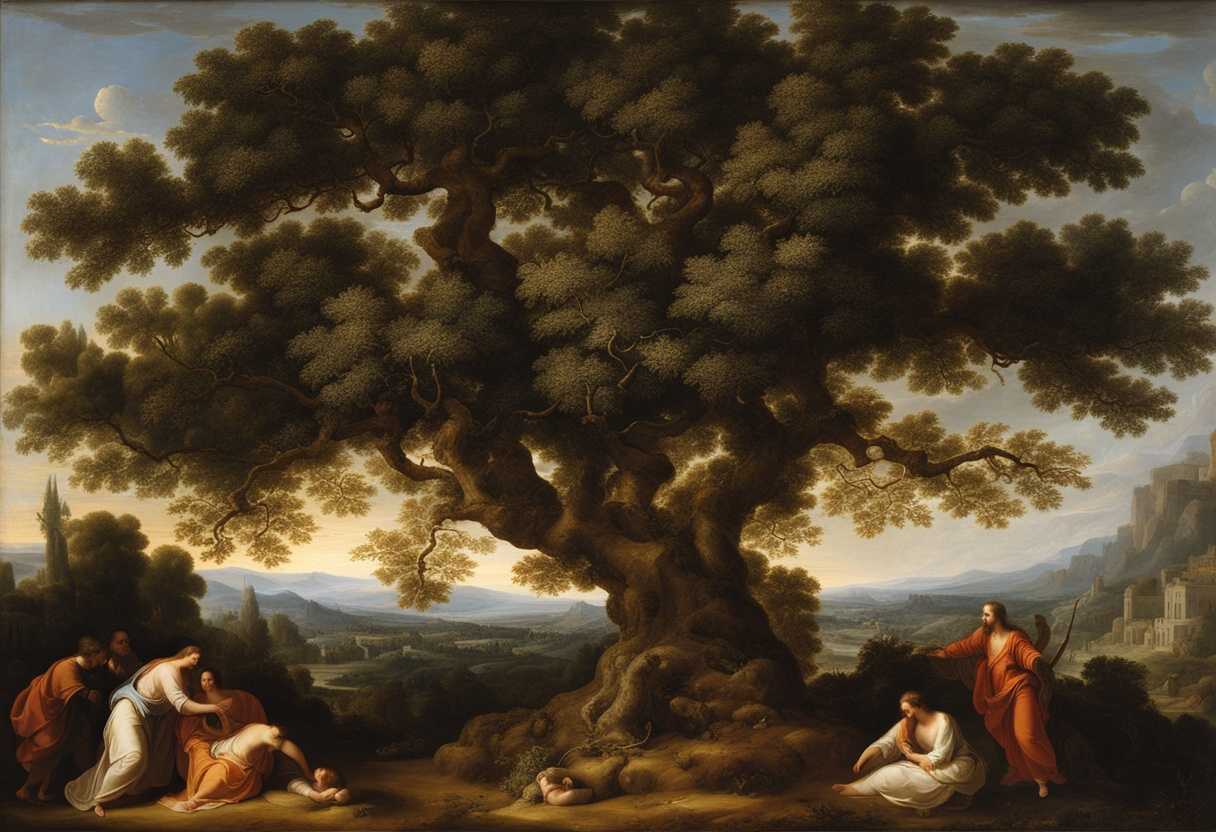
In the Bible, “grafted in” refers to the inclusion of Gentiles into the fellowship of God’s people, as illustrated in Romans 11:17-24, where Paul describes how wild olive branches (Gentiles) are grafted into the cultivated olive tree (Israel), signifying their participation in the blessings of God’s covenant. This metaphor emphasizes unity and shared blessings between Jews and Gentiles in the faith.
Scripture
11 But if some of the branches were broken off, and you, although a wild olive shoot, were grafted in among the others and now share in the nourishing root of the olive tree,
18 do not be arrogant toward the branches. If you are, remember it is not you who support the root, but the root that supports you.
19 Then you will say, “Branches were broken off so that I might be grafted in.”
20 That is true. They were broken off because of their unbelief, but you stand fast through faith. So do not become proud, but fear.
21 For if God did not spare the natural branches, neither will he spare you.
22 Note then the kindness and the severity of God: severity toward those who have fallen, but God’s kindness to you, provided you continue in his kindness. Otherwise you too will be cut off.
11 And even they, if they do not continue in their unbelief, will be grafted in, for God has the power to graft them in again.
24 For if you were cut from what is by nature a wild olive tree, and grafted, contrary to nature, into a cultivated olive tree, how much more will these, the natural branches, be grafted back into their own olive tree.
Grafted In: Biblical Meaning Explained
The metaphor of being “grafted in,” as Paul illustrates in Romans 11:17-24, holds profound theological significance regarding the relationship between Israel and the Gentile nations. In this passage, Paul draws upon the imagery of an olive tree to depict God’s covenant people—Israel—as the cultivated tree bearing the promise and blessings of God. The wild olive branches, representing the Gentiles, being grafted in signifies a radical inclusion into this covenant community. This act of grafting underscores that salvation through Christ is available to all, breaking down the barriers that historically separated Jews and Gentiles (Ephesians 2:14-16). This vivid illustration not only points to the grace of God that extends beyond ethnic lines but also highlights the importance of humility and gratitude from those who have been included, as Paul warns the Gentile believers against boasting, reminding them that their standing is dependent on the root—the faithfulness of God to His chosen people.
Furthermore, the broader implications of being “grafted in” emphasize the unity of the body of Christ. The inclusion of Gentiles affirms God’s plan for a diverse people united in faith, as seen in Galatians 3:28, where Paul asserts that in Christ, there is neither Jew nor Gentile, male nor female, slave nor free. This teaching elucidates the grand narrative of redemption, wherein all believers are invited to participate in the spiritual heritage originally entrusted to Israel. The act of being grafted in suggests that every believer, regardless of their background, shares equally in the blessings of God’s grace and is called to contribute to the growth and health of the Church, cultivating love and unity as members of one body under Christ (1 Corinthians 12:12-14). Thus, the concept of “grafted in” serves as a powerful reminder of God’s inclusive love and the transformative power of faith that creates a new community of believers.
The concept of being “grafted in” illustrates the transformative power of God’s grace that not only invites individuals from diverse backgrounds to partake in the blessings of His covenant but also emphasizes the responsive nature of faith itself. In the Old Testament, the prophetic literature often points to a time when the nations would come to worship the God of Israel, suggesting an ever-expanding vision of God’s people. Psalms, for example, celebrates the inclusion of all nations in praising God (Psalm 117), further reinforcing the idea that the reach of God’s love transcends ethnic and cultural boundaries. This anticipation of a unifying act culminates in the New Testament with the advent of Jesus, who establishes a new covenant that is accessible to everyone, beckoning mankind into a relationship defined not by lineage, but by faith.
Additionally, the metaphor of grafting speaks to spiritual growth and transformation, where new members, represented by the wild branches, are called to bear fruit that reflects the character of the root, which is Christ. As seen in the teachings of Jesus in John 15, the image of the vine and branches underlines the necessity for believers to remain intimately connected to Him to flourish spiritually. This connection empowers each believer to live out their faith authentically, producing love, joy, peace, and other fruits of the Spirit that serve to demonstrate the reality of God’s kingdom on earth. Thus, being “grafted in” is not just about inclusion; it is a call to actively participate in a life-giving relationship with Christ, contributing to the broader mission of the Church and embodying the love of God in action. This overarching narrative invites every believer into a dynamic relationship with both God and one another, fostering an environment where spiritual growth can thrive.
Spiritual Inclusion and Unity
The concept of being “grafted in” signifies the inclusion of individuals from diverse backgrounds into the family of God. This metaphor illustrates how those who were once considered outsiders or separate from the covenant community are now welcomed and embraced. It emphasizes the unity of believers, regardless of their ethnic or cultural origins, highlighting that faith in God transcends all barriers and creates a new identity in Christ.
Transformation and New Life
Grafting also symbolizes transformation and the infusion of new life. Just as a branch is grafted onto a tree to receive nourishment and vitality, believers who are grafted into the body of Christ experience spiritual renewal and growth. This process signifies the power of God to change lives, enabling individuals to bear fruit that reflects their new identity and purpose in Him.
Divine Sovereignty and Purpose
The act of grafting underscores God’s sovereignty in His plan for salvation. It illustrates that God, in His wisdom, has the authority to choose and incorporate individuals into His divine narrative. This concept serves as a reminder that God’s purposes are not limited to a specific group but extend to all who respond to His call, affirming His desire for a diverse and inclusive community of faith.
How to Foster Inclusion for a Stronger Faith Community
Fostering inclusion within our faith community is not just a noble goal; it’s a reflection of Christ’s love for all people. As we strive to be better Christians, we must actively seek to embrace diversity in our congregations, recognizing that each person brings unique gifts and perspectives that enrich our collective worship. Start by reaching out to those who may feel marginalized or overlooked—whether due to race, socioeconomic status, or differing beliefs—and invite them into fellowship. Create spaces for open dialogue where everyone feels safe to share their stories and experiences. Remember, Jesus broke barriers and welcomed the outcasts, and by doing the same, we not only strengthen our community but also deepen our understanding of God’s boundless grace. Let’s commit to being a church that reflects the beautiful tapestry of humanity, where every voice is heard and valued, ultimately leading us all closer to the heart of God.
Bible References to Grafted In Meaning:
Ephesians 2:11-22: 11 Therefore remember that at one time you Gentiles in the flesh, called “the uncircumcision” by what is called the circumcision, which is made in the flesh by hands—
12 remember that you were at that time separated from Christ, alienated from the commonwealth of Israel and strangers to the covenants of promise, having no hope and without God in the world.
13 But now in Christ Jesus you who once were far off have been brought near by the blood of Christ.
14 For he himself is our peace, who has made us both one and has broken down in his flesh the dividing wall of hostility
15 by abolishing the law of commandments expressed in ordinances, that he might create in himself one new man in place of the two, so making peace,
16 and might reconcile us both to God in one body through the cross, thereby killing the hostility.
17 And he came and preached peace to you who were far off and peace to those who were near.
18 For through him we both have access in one Spirit to the Father.
19 So then you are no longer strangers and aliens, but you are fellow citizens with the saints and members of the household of God,
20 built on the foundation of the apostles and prophets, Christ Jesus himself being the cornerstone,
21 in whom the whole structure, being joined together, grows into a holy temple in the Lord.
22 In him you also are being built together into a dwelling place for God by the Spirit.
John 15:1-8: 1 “I am the true vine, and my Father is the vinedresser.”
2 Every branch in me that does not bear fruit he takes away, and every branch that does bear fruit he prunes, that it may bear more fruit.
3 Already you are clean because of the word that I have spoken to you.
4 Abide in me, and I in you. As the branch cannot bear fruit by itself, unless it abides in the vine, neither can you, unless you abide in me.
5 I am the vine; you are the branches. Whoever abides in me and I in him, he it is that bears much fruit, for apart from me you can do nothing.
6 If anyone does not abide in me he is thrown away like a branch and withers; and the branches are gathered, thrown into the fire, and burned.
7 If you abide in me, and my words abide in you, ask whatever you wish, and it will be done for you.
8 By this my Father is glorified, that you bear much fruit and so prove to be my disciples.
Galatians 3:26-29: 26 for in Christ Jesus you are all sons of God, through faith.
27 For as many of you as were baptized into Christ have put on Christ.
28 There is neither Jew nor Greek, there is neither slave nor free, there is no male and female, for you are all one in Christ Jesus.
29 And if you are Christ’s, then you are Abraham’s offspring, heirs according to promise.
Colossians 1:21-23: 21 And you, who once were alienated and hostile in mind, doing evil deeds,
22 he has now reconciled in his body of flesh by his death, in order to present you holy and blameless and above reproach before him,
23 if indeed you continue in the faith, stable and steadfast, not shifting from the hope of the gospel that you heard, which has been proclaimed in all creation under heaven, and of which I, Paul, became a minister.
1 Corinthians 12:12-27: 12 For just as the body is one and has many members, and all the members of the body, though many, are one body, so it is with Christ.
13 For in one Spirit we were all baptized into one body—Jews or Greeks, slaves or free—and all were made to drink of one Spirit.
14 For the body does not consist of one member but of many.
15 If the foot should say, “Because I am not a hand, I do not belong to the body,” that would not make it any less a part of the body.
16 and if the ear should say, “Because I am not an eye, I do not belong to the body,” that would not make it any less a part of the body.
17 If the whole body were an eye, where would be the sense of hearing? If the whole body were an ear, where would be the sense of smell?
18 But as it is, God arranged the members in the body, each one of them, as he chose.
19 If all were a single member, where would the body be?
20 As it is, there are many parts, yet one body.
21 The eye cannot say to the hand, “I have no need of you,” nor again the head to the feet, “I have no need of you.”
22 On the contrary, the parts of the body that seem to be weaker are indispensable,
23 and on those parts of the body that we think less honorable we bestow the greater honor, and our unpresentable parts are treated with greater modesty,
24 which our more presentable parts do not require. But God has so composed the body, giving greater honor to the part that lacked it,
25 that there may be no division in the body, but that the members may have the same care for one another.
26 If one member suffers, all suffer together; if one member is honored, all rejoice together.
27 Now you are the body of Christ and individually members of it.
Isaiah 56:3-8: 3 Let not the foreigner who has joined himself to the Lord say, “The Lord will surely separate me from his people”; and let not the eunuch say, “Behold, I am a dry tree.”
4 For thus says the Lord: “To the eunuchs who keep my Sabbaths, who choose the things that please me and hold fast my covenant,
5 I will give them an everlasting name that shall not be cut off.
6 “And the foreigners who join themselves to the Lord, to minister to him, to love the name of the Lord, and to be his servants, everyone who keeps the Sabbath and does not profane it, and holds fast my covenant—”
7 these I will bring to my holy mountain,
and make them joyful in my house of prayer;
their burnt offerings and their sacrifices
will be accepted on my altar;
for my house shall be called a house of prayer
for all peoples.”
8 The Lord God, who gathers the outcasts of Israel, declares, “I will gather yet others to him besides those already gathered.”
Jeremiah 11:16-17: 16 The Lord once called you ‘a green olive tree, beautiful with good fruit.’ But with the roar of a great tempest he will set fire to it, and its branches will be consumed.
17 The Lord of hosts, who planted you, has decreed disaster against you, because of the evil that the house of Israel and the house of Judah have done, provoking me to anger by making offerings to Baal.
Acts 10:34-48: 34 So Peter opened his mouth and said: “Truly I understand that God shows no partiality,
35 but in every nation anyone who fears him and does what is right is acceptable to him.
36 As for the word that he sent to Israel, preaching good news of peace through Jesus Christ (he is Lord of all),
37 you yourselves know what happened throughout all Judea, beginning from Galilee after the baptism that John proclaimed:
38 how God anointed Jesus of Nazareth with the Holy Spirit and with power. He went about doing good and healing all who were oppressed by the devil, for God was with him.
39 And we are witnesses of all that he did both in the country of the Jews and in Jerusalem. They put him to death by hanging him on a tree,
40 but God raised him on the third day and made him to appear,
41 not to all the people but to us who had been chosen by God as witnesses, who ate and drank with him after he rose from the dead.
42 And he commanded us to preach to the people and to testify that he is the one appointed by God to be judge of the living and the dead.
43 To him all the prophets bear witness that everyone who believes in him receives forgiveness of sins through his name.”
44 While Peter was still saying these things, the Holy Spirit fell on all who heard the word.
45 And the believers from among the circumcised who had come with Peter were amazed, because the gift of the Holy Spirit was poured out even on the Gentiles.
46 For they were hearing them speaking in tongues and extolling God. Then Peter declared,
47 “Can anyone withhold water for baptizing these people, who have received the Holy Spirit just as we have?”
48 And he commanded them to be baptized in the name of Jesus Christ. Then they asked him to remain for some days.
Matthew 21:33-46: 33 “Hear another parable. There was a master of a house who planted a vineyard and put a fence around it and dug a winepress in it and built a tower and leased it to tenants, and went into another country.
34 When the season for fruit drew near, he sent his servants to the tenants to get his fruit.
35 And the tenants took his servants and beat one, killed another, and stoned another.
36 Again he sent other servants, more than the first. And they did the same to them.
37 Finally he sent his son to them, saying, ‘They will respect my son.’
38 But when the tenants saw the son, they said to themselves, ‘This is the heir. Come, let us kill him and have his inheritance.’
39 And they took him and threw him out of the vineyard and killed him.
40 Now when the owner of the vineyard comes, what will he do to those tenants?”
41 They said to him, “He will put those wretches to a miserable death and let out the vineyard to other tenants who will give him the fruits in their seasons.”
42 Jesus said to them, “Have you never read in the Scriptures: “‘The stone that the builders rejected has become the cornerstone; this was the Lord’s doing, and it is marvelous in our eyes’?
43 Therefore I tell you, the kingdom of God will be taken away from you and given to a people producing its fruits.
44 And the one who falls on this stone will be broken to pieces; and when it falls on anyone, it will crush him.”
45 When the chief priests and the Pharisees heard his parables, they perceived that he was speaking about them.
46 And although they were seeking to arrest him, they feared the crowds, because they held him to be a prophet.

Reverend Ogunlade is a seasoned Church Minister with over three decades of experience in guiding and nurturing congregations. With profound wisdom and a serene approach, Reverend Ogunlade has carried out various pastoral duties, including delivering uplifting sermons, conducting religious ceremonies, and offering sage counsel to individuals seeking spiritual guidance. Their commitment to fostering harmony and righteousness within their community is exemplified through their compassionate nature, making them a beloved and trusted figure among the congregation.