
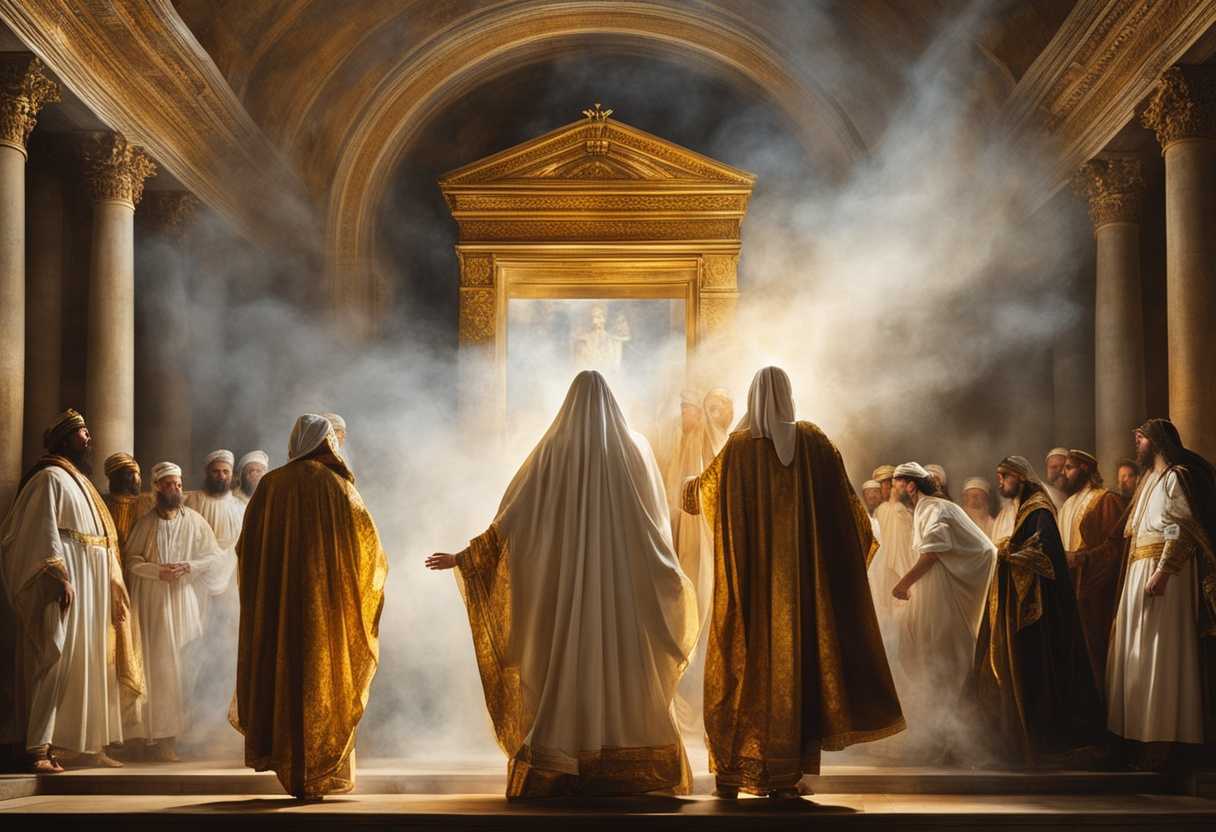
In the Bible, “behind the veil” refers to the innermost sacred area of the Temple, known as the Holy of Holies, where God’s presence dwelled and access was limited to the high priest once a year (Hebrews 9:3-7). It symbolizes separation between God and humanity, with Christ’s sacrifice granting believers direct access to God (Hebrews 10:19-20).
Scripture
31 And you shall make a veil of blue and purple and scarlet yarns and fine twined linen. It shall be made with cherubim skillfully worked into it.
32 And you shall hang it on four pillars of acacia overlaid with gold, with hooks of gold, on four bases of silver.
33 And you shall hang the veil from the clasps, and bring the ark of the testimony in there within the veil. And the veil shall separate for you the Holy Place from the Most Holy.
34 You shall put the mercy seat on the ark of the testimony in the Most Holy Place.
35 And you shall set the table outside the veil, and the lampstand on the south side of the tabernacle opposite the table, and you shall put the table on the north side.
“Behind the Veil” in the Bible
The idea of “behind the veil” in the Bible carries profound theological significance, representing both a literal and metaphorical barrier between the divine and humanity. In the Old Testament, the veil separated the Holy of Holies—where the presence of God resided—from the rest of the Temple. Only the high priest could enter this sacred space, and even then, only once a year on the Day of Atonement, as detailed in Leviticus 16:2. This separation underscored the holiness of God and the sinfulness of humanity, demonstrating that direct access to God was not freely available and required atonement.
However, the New Testament transforms this understanding through the sacrificial work of Jesus Christ. Hebrews 10:19-20 asserts that through His blood, believers have new access to God, symbolized by the tearing of the veil at Jesus’ crucifixion (Matthew 27:51). This act not only signified the end of the sacrificial system but opened a path for all believers to come into a direct relationship with God, thereby emphasizing themes of grace and redemption. Thus, “behind the veil” captures the transition from separation to intimacy with God, underscoring the belief that through Christ, believers can approach God’s presence with confidence and hope. This concept invites believers to reflect on their identity in Christ and the communal aspect of faith, encouraging them to draw near to God with assurance and sincerity.
In addition to the significance of the veil as a symbol of separation and access, it also represents divine mystery and revelation. The veil not only restricted human entrance into the presence of God but also shielded the profound holiness and majesty that could not be fully comprehended by human understanding. Consider the imagery presented in the writings of Paul, particularly in 2 Corinthians 3, where he discusses how the veil serves as a metaphor for spiritual blindness. Paul contrasts the glory of the old covenant, marked by Moses’ veil, which obscured the true nature of God’s revelation, with the clarity provided through Christ. In this sense, “behind the veil” also alludes to the transformative experience of believers who encounter the unveiled glory of God in their lives through the Holy Spirit.
Moreover, the concept of “behind the veil” extends into eschatological themes found in scriptures like Revelation. The heavenly sanctuary, depicted in Revelation, invites believers to envision a time when the veil will be entirely lifted, allowing for unmediated fellowship with God. This final revelation connects the present experience of God’s presence with future fulfillment, where there will be no barrier separating humanity from the divine anymore. Hence, behind the veil represents not just a past incident but an ongoing narrative of redemption and the ultimate hope for restoration in the presence of God. It encapsulates the journey of faith towards eternal communion, urging believers to live in the light of this truth while eagerly anticipating the future glory that awaits them.
Spiritual Access to God
The phrase “behind the veil” often symbolizes the access believers have to God’s presence. In the Old Testament, the veil separated the Holy of Holies from the rest of the temple, indicating that only certain individuals could approach God. The tearing of the veil signifies that through faith, all believers can now enter into a direct relationship with God, breaking down the barriers that once existed.
The Mystery of Divine Presence
“Behind the veil” can also represent the mystery of God’s presence and the hidden aspects of His nature. It suggests that while God is accessible, there are still profound mysteries that remain beyond human understanding. This concept encourages believers to seek a deeper relationship with God, acknowledging that there are layers of divine truth that may not be fully revealed in this life.
Transformation and Renewal
Additionally, “behind the veil” can symbolize the transformative process that occurs when one enters into God’s presence. It signifies a place of renewal and change, where individuals are transformed by their encounters with the divine. This transformation often leads to a deeper understanding of one’s purpose and identity in relation to God, highlighting the importance of spiritual growth and renewal in the life of a believer.
How to Enhance Your Faith Through Divine Revelation
Enhancing your faith through divine revelation is a deeply personal journey that invites you to open your heart and mind to the ways God communicates with us. Start by immersing yourself in Scripture, allowing the words to resonate within you and reveal deeper truths about your life and relationship with God. Prayer is another vital avenue; approach it not just as a monologue but as a dialogue, where you listen for God’s gentle whispers in your spirit. Consider the moments of inspiration or conviction you experience in your daily life—these can be divine revelations guiding you toward a more profound faith. Surround yourself with a community of believers who can share their insights and experiences, as their stories can illuminate your path. Remember, faith is not a destination but a journey, and each revelation, big or small, is a stepping stone that brings you closer to understanding the divine love that surrounds you. Embrace these moments with gratitude, and watch as your faith flourishes in ways you never imagined.
Bible References to “Behind the Veil”:
Leviticus 16:2-15: 2 and the Lord said to Moses, “Tell Aaron your brother not to come at any time into the Holy Place inside the veil, before the mercy seat that is on the ark, so that he may not die. For I will appear in the cloud over the mercy seat.
3 But in this way Aaron shall come into the Holy Place: with a bull from the herd for a sin offering and a ram for a burnt offering.
4 He shall put on the holy linen coat and shall have the linen undergarment on his body, and he shall tie the linen sash around his waist, and wear the linen turban; these are the holy garments. He shall bathe his body in water and then put them on.
5 And he shall take from the congregation of the people of Israel two male goats for a sin offering, and one ram for a burnt offering.
6 “Aaron shall offer the bull as a sin offering for himself and shall make atonement for himself and for his house.
7 Then he shall take the two goats and set them before the Lord at the entrance of the tent of meeting.
8 And Aaron shall cast lots over the two goats, one lot for the Lord and the other lot for Azazel.
9 And Aaron shall present the goat on which the lot fell for the Lord and use it as a sin offering,
10 But the goat on which the lot fell for Azazel shall be presented alive before the Lord to make atonement over it, that it may be sent away into the wilderness to Azazel.
11 “Aaron shall present the bull as a sin offering for himself, and shall make atonement for himself and for his house.
12 And he shall take a censer full of coals of fire from the altar before the Lord, and two handfuls of sweet incense beaten small, and he shall bring it inside the veil
13 and put the incense on the fire before the Lord, that the cloud of the incense may cover the mercy seat that is over the testimony, so that he does not die.
14 And he shall take some of the blood of the bull and sprinkle it with his finger on the front of the mercy seat on the east side, and in front of the mercy seat he shall sprinkle some of the blood with his finger seven times.
15 “Then he shall kill the goat of the sin offering that is for the people and bring its blood inside the veil and do with its blood as he did with the blood of the bull, sprinkling it over the mercy seat and in front of the mercy seat.”
Hebrews 6:19-20: 19 We have this as a sure and steadfast anchor of the soul, a hope that enters into the inner place behind the curtain,
20 where Jesus has gone as a forerunner on our behalf, having become a high priest forever after the order of Melchizedek.
Hebrews 9:1-8: Now even the first covenant had regulations for worship and an earthly place of holiness.
2 For a tent was prepared, the first section, in which were the lampstand and the table and the bread of the Presence. It is called the Holy Place.
3 Behind the second curtain was a second section called the Most Holy Place,
4 having the golden altar of incense and the ark of the covenant covered on all sides with gold, in which was a golden urn holding the manna, and Aaron’s staff that budded, and the tablets of the covenant.
5 Above it were the cherubim of glory overshadowing the mercy seat.
6 These preparations having thus been made, the priests go regularly into the first section, performing their ritual duties.
7 but into the second only the high priest goes, and he but once a year, and not without taking blood, which he offers for himself and for the unintentional sins of the people.
8 By this the Holy Spirit indicates that the way into the holy places is not yet opened as long as the first section is still standing.
Matthew 27:50-51: 50 And Jesus cried out again with a loud voice and yielded up his spirit.
51 And behold, the curtain of the temple was torn in two, from top to bottom. And the earth shook, and the rocks were split.
2 Corinthians 3:12-16: 12 Since we have such a hope, we are very bold,
13 not like Moses, who would put a veil over his face so that the Israelites might not gaze at the outcome of what was being brought to an end.
14 But their minds were hardened. For to this day, when they read the old covenant, that same veil remains unlifted, because only through Christ is it taken away.
15 Yes, to this day whenever Moses is read a veil lies over their hearts.
16 But when one turns to the Lord, the veil is removed.
Hebrews 10:19-22: 19 Therefore, brothers, since we have confidence to enter the holy places by the blood of Jesus,
20 by the new and living way that he opened for us through the curtain, that is, through his flesh,
21 and since we have a great priest over the house of God,
22 let us draw near with a true heart in full assurance of faith, with our hearts sprinkled clean from an evil conscience and our bodies washed with pure water.
Exodus 40:1-3: 1 Then the Lord said to Moses:
2 On the first day of the first month you shall erect the tabernacle of the tent of meeting.
3 Then you shall put the ark of the testimony in it and screen the ark with the veil.
Leviticus 21:21-23: 21 No man of the offspring of Aaron the priest who has a blemish shall come near to offer the Lord’s food offerings; since he has a blemish, he shall not come near to offer the bread of his God.
22 He may eat the bread of his God, both of the most holy and of the holy things,
23 but he shall not go through the veil or approach the altar, because he has a blemish, that he may not profane my sanctuaries, for I am the Lord who sanctifies them.”
Hebrews 9:11-12: 11 But when Christ appeared as a high priest of the good things that have come, then through the greater and more perfect tent (not made with hands, that is, not of this creation)
12 he entered once for all into the holy places, not by means of the blood of goats and calves but by means of his own blood, thus securing an eternal redemption.

Reverend Ogunlade is a seasoned Church Minister with over three decades of experience in guiding and nurturing congregations. With profound wisdom and a serene approach, Reverend Ogunlade has carried out various pastoral duties, including delivering uplifting sermons, conducting religious ceremonies, and offering sage counsel to individuals seeking spiritual guidance. Their commitment to fostering harmony and righteousness within their community is exemplified through their compassionate nature, making them a beloved and trusted figure among the congregation.