
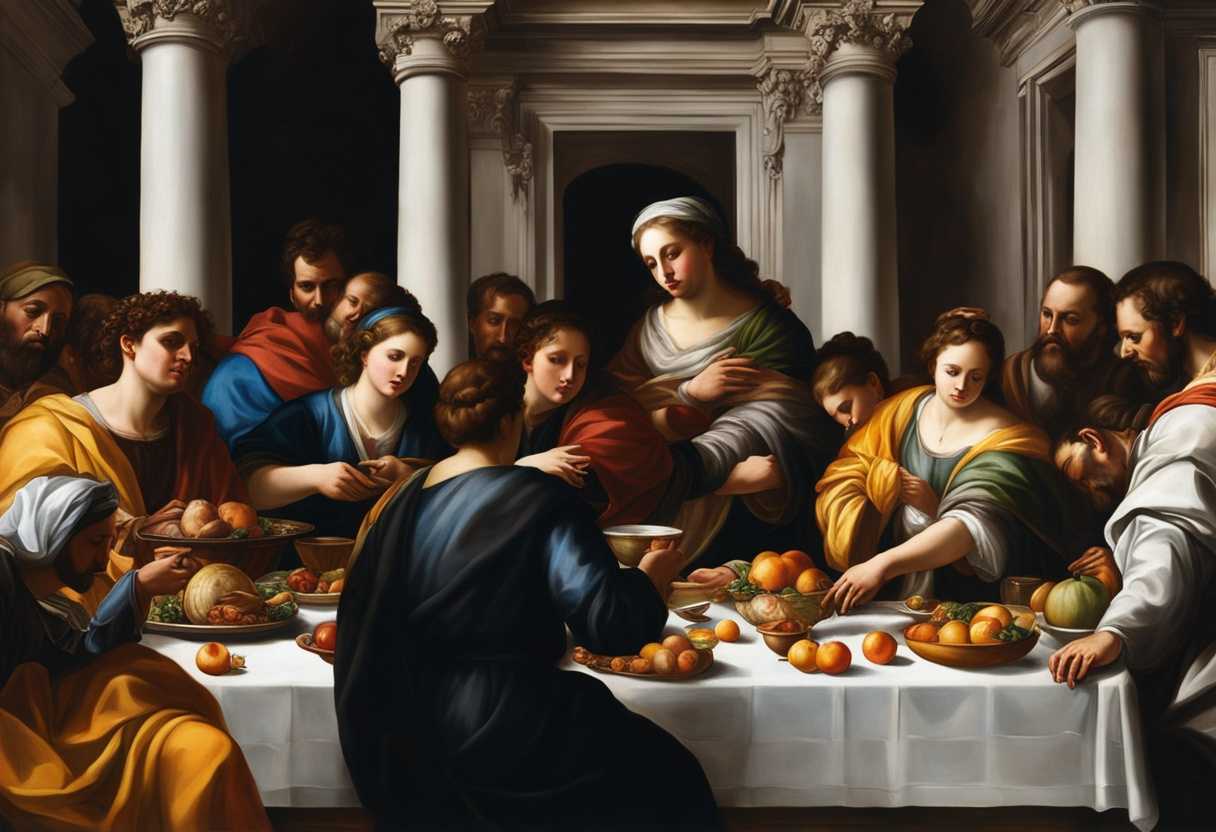
Ministration in the Bible refers to acts of service, assistance, or ministry, often related to the spiritual care and support provided by individuals or groups within the church. It emphasizes the role of believers in serving God and others through various forms of support, teaching, and care, as illustrated in passages like Acts 6:1-4, where the apostles tasked others with the ministration of food to ensure the community’s needs were met.
Scripture
1 “Then bring near to you Aaron your brother, and his sons with him, from among the people of Israel, to serve me as priests—Aaron and Aaron’s sons, Nadab and Abihu, Eleazar and Ithamar.”
2 And you shall make holy garments for Aaron your brother, for glory and for beauty.
3 You shall speak to all the skillful, whom I have filled with a spirit of skill, that they make Aaron’s garments to consecrate him for my priesthood.
4 These are the garments that they shall make: a breastpiece, an ephod, a robe, a coat of checker work, a turban, and a sash. They shall make holy garments for Aaron your brother and his sons to serve me as priests.
Meaning of Ministration in the Bible
Ministration in the Bible transcends mere acts of service; it embodies the essence of communal support and spiritual stewardship among believers. This concept is woven throughout Scripture, highlighting the responsibility of the church to care for both physical and spiritual needs. For example, in Acts 6:1-4, the apostles recognized the importance of ensuring equitable distribution of resources to widows, which led to the appointment of deacons specifically for this ministration. This moment underscores how ministration functions as a means of fostering community, reflecting God’s love, and ensuring that no member of the body of Christ is overlooked.
Furthermore, ministration is echoed in Galatians 5:13, where Paul encourages believers to serve one another in love, illustrating that true freedom in Christ manifests itself through acts of service. The body of Christ is called to utilize their gifts for the edification of others, as noted in 1 Peter 4:10, which instructs believers to administer their gifts as good stewards of God’s varied grace. Thus, ministration serves as both a practical and spiritual practice, reminding believers that their service is part of a larger mission to reflect Christ’s love and grace to the world. This holistic approach underscores the idea that every act of service, no matter how small, contributes to the kingdom of God and enhances the life of the church community.
Ministration in the Bible captures a rich tapestry of service that is foundational to the life of the church and its members. It emphasizes not just individual acts of charity, but the collective responsibility of Christians to serve one another as an expression of their faith. For instance, the Old Testament places a strong emphasis on hospitality and care for the marginalized, as seen in laws that command the Israelites to leave the edges of their fields unharvested for the poor and the stranger (Leviticus 23:22). This principle illustrates how ministration was intended to be a communal practice, where supporting one another was rooted in the covenantal relationship the people had with God.
Moreover, the life of Jesus provides a profound example of ministration as He engaged in acts of healing, feeding, and teaching, demonstrating that true leadership flows from servitude. His washing of the disciples’ feet symbolizes the humility intrinsic to ministration, urging followers to embody this attitude in their relationships with one another. In the parable of the Good Samaritan, Jesus further expands the definition of ministration, showing that the call to serve transcends cultural boundaries and expectations. These examples illustrate that ministration is not merely about fulfilling obligations; it is about embodying Christ’s love in action, thereby nurturing a vibrant and interconnected faith community. Ultimately, ministration becomes a vital expression of love that reflects God’s grace and fosters unity within the body of Christ.
The Service of Others
Ministration in the Bible often refers to the act of serving others, reflecting the core principle of selflessness and love that is central to Christian teachings. This service can manifest in various forms, including providing for the physical needs of the community, offering emotional support, or engaging in spiritual guidance. The emphasis on serving others highlights the importance of humility and the call to put the needs of others before one’s own, embodying the teachings of Christ.
Spiritual Gifts and Empowerment
Another significant aspect of ministration is the concept of spiritual gifts. In the biblical context, ministration involves the use of these gifts to build up the body of Christ and to fulfill God’s purpose in the world. Each believer is endowed with unique abilities and talents that are meant to be utilized for the benefit of the community and the advancement of the Gospel. This understanding encourages individuals to recognize their role within the church and to actively participate in ministry, fostering a sense of belonging and purpose.
Divine Calling and Purpose
Ministration also carries the connotation of a divine calling or purpose. It signifies that individuals are not merely serving out of obligation but are responding to a higher calling from God. This perspective instills a sense of mission and intentionality in acts of service, as believers seek to align their actions with God’s will. The idea of ministration as a calling encourages a deeper commitment to serving others and fulfilling one’s role in the larger narrative of God’s plan for humanity.
How to Grow in Faith through Service and Community
Growing in faith through service and community is a beautiful journey that not only deepens your relationship with God but also enriches the lives of those around you. When you step outside of your comfort zone to serve others—whether it’s volunteering at a local shelter, participating in church activities, or simply lending a helping hand to a neighbor—you embody the love of Christ in action. This selfless service fosters a sense of connection and belonging within your community, reminding you that we are all part of a larger family in Christ. As you engage with others, you’ll find that your faith is strengthened through shared experiences, prayers, and the stories of those you serve. Remember, it’s in these moments of giving that you often receive the greatest blessings, as God works through you to touch the lives of others and, in turn, enrich your own spiritual journey. So, take that step—get involved, serve with an open heart, and watch how your faith flourishes in the warmth of community.
Bible References to Ministration in Scripture:
Numbers 3:5-10: 5 And the Lord spoke to Moses, saying:
6 “Bring the tribe of Levi near, and set them before Aaron the priest, that they may minister to him.
7 They shall keep guard over him and over the whole congregation before the tent of meeting, as they minister at the tabernacle.
8 They shall guard all the furnishings of the tent of meeting, and keep guard over the people of Israel as they minister at the tabernacle.
9 And you shall give the Levites to Aaron and his sons; they are wholly given to him from among the people of Israel.
10 And you shall appoint Aaron and his sons, and they shall guard their priesthood. But if any outsider comes near, he shall be put to death.”
1 Chronicles 16:4-6: 4 Then he appointed some of the Levites as ministers before the ark of the Lord, to invoke, to thank, and to praise the Lord, the God of Israel.
5 Asaph was the chief, and second to him were Zechariah, Jeiel, Shemiramoth, Jehiel, Mattithiah, Eliab, Benaiah, Obed-edom, and Jeiel, who were to play harps and lyres; Asaph was to sound the cymbals,
6 and Benaiah and Jahaziel the priests were to blow trumpets regularly before the ark of the covenant of God.
2 Chronicles 8:12-15: 12 Then Solomon offered up burnt offerings to the Lord on the altar of the Lord that he had built before the vestibule,
13 According to the commandment of David his father, he appointed the divisions of the priests for their service, and the Levites for their offices of praise and ministry before the priests as the duty of each day required, and the gatekeepers in their divisions at each gate, for so David the man of God had commanded.
14 According to the ruling of David his father, he appointed the divisions of the priests for their service, and the Levites for their offices of praise and ministry before the priests as the duty of each day required, and the gatekeepers in their divisions at each gate, for so David the man of God had commanded.
15 And they did not turn aside from what the king had commanded the priests and Levites concerning any matter and concerning the treasuries.
Nehemiah 12:44-47: 44 On that day men were appointed over the storerooms, the contributions, the firstfruits, and the tithes, to gather into them the portions required by the Law for the priests and for the Levites according to the fields of the towns, for Judah rejoiced over the priests and the Levites who ministered.
45 And they performed the service of their God and the service of purification, as did the singers and the gatekeepers, according to the command of David and his son Solomon.
46 For long ago in the days of David and Asaph there were directors of the singers, and there were songs of praise and thanksgiving to God.
47 And all Israel in the days of Zerubbabel and in the days of Nehemiah gave the daily portions for the singers and the gatekeepers; and they set apart that which was for the Levites; and the Levites set apart that which was for the sons of Aaron.
Isaiah 61:6-7: 6 but you shall be called the priests of the Lord;
they shall speak of you as the ministers of our God;
you shall eat the wealth of the nations,
and in their glory you shall boast.
7 Instead of your shame there shall be a double portion; instead of dishonor they shall rejoice in their lot; therefore in their land they shall possess a double portion; they shall have everlasting joy.
Acts 6:1-7: 1 Now in these days when the disciples were increasing in number, a complaint by the Hellenists arose against the Hebrews because their widows were being neglected in the daily distribution.
2 And the twelve summoned the full number of the disciples and said, “It is not right that we should give up preaching the word of God to serve tables.
3 Therefore, brothers, pick out from among you seven men of good repute, full of the Spirit and of wisdom, whom we will appoint to this duty.
4 But we will devote ourselves to prayer and to the ministry of the word.”
5 And what they said pleased the whole gathering, and they chose Stephen, a man full of faith and of the Holy Spirit, and Philip, and Prochorus, and Nicanor, and Timon, and Parmenas, and Nicolaus, a proselyte of Antioch.
6 They set before the apostles, and when they had prayed, they laid their hands on them.
7 And the word of God continued to increase, and the number of the disciples multiplied greatly in Jerusalem, and a great many of the priests became obedient to the faith.
Romans 12:6-8: 6 Having gifts that differ according to the grace given to us, let us use them: if prophecy, in proportion to our faith;
7 if service, in our serving; the one who teaches, in his teaching;
8 the one who exhorts, in his exhortation; the one who contributes, in generosity; the one who leads, with zeal; the one who does acts of mercy, with cheerfulness.
1 Corinthians 12:4-11: 4 Now there are varieties of gifts, but the same Spirit;
5 and there are varieties of service, but the same Lord;
6 and there are varieties of activities, but it is the same God who empowers them all in everyone.
7 To each is given the manifestation of the Spirit for the common good.
8 For to one is given through the Spirit the utterance of wisdom, and to another the utterance of knowledge according to the same Spirit,
9 to another faith by the same Spirit, to another gifts of healing by the one Spirit,
10 to another the working of miracles, to another prophecy, to another the ability to distinguish between spirits, to another various kinds of tongues, to another the interpretation of tongues.
11 All these are empowered by one and the same Spirit, who apportions to each one individually as he wills.
2 Corinthians 3:5-9: 5 Not that we are sufficient in ourselves to claim anything as coming from us, but our sufficiency is from God,
6 who has made us sufficient to be ministers of a new covenant, not of the letter but of the Spirit. For the letter kills, but the Spirit gives life.
7 Now if the ministry of death, carved in letters on stone, came with such glory that the Israelites could not gaze at Moses’ face because of its glory, which was being brought to an end,
8 will not the ministry of the Spirit have even more glory?
9 For if there was glory in the ministry of condemnation, the ministry of righteousness must far exceed it in glory.
Ephesians 4:11-13: 11 And he gave the apostles, the prophets, the evangelists, the shepherds and teachers,
12 to equip the saints for the work of ministry, for building up the body of Christ,
13 until we all attain to the unity of the faith and of the knowledge of the Son of God, to mature manhood, to the measure of the stature of the fullness of Christ,
1 Timothy 4:13-16: 13 Until I come, devote yourself to the public reading of Scripture, to exhortation, to teaching.
14 Do not neglect the gift you have, which was given you by prophecy when the council of elders laid their hands on you.
15 Practice these things, immerse yourself in them, so that all may see your progress.
16 Keep a close watch on yourself and on the teaching. Persist in this, for by so doing you will save both yourself and your hearers.
Hebrews 8:1-6: Now the point in what we are saying is this: we have such a high priest, one who is seated at the right hand of the throne of the Majesty in heaven,
2 a minister in the holy places, in the true tent that the Lord set up, not man.
3 For every high priest is appointed to offer gifts and sacrifices; thus it is necessary for this priest also to have something to offer.
4 Now if he were on earth, he would not be a priest at all, since there are priests who offer gifts according to the law.
They serve a copy and shadow of the heavenly things.
6 But as it is, Christ has obtained a ministry that is as much more excellent than the old as the covenant he mediates is better, since it is enacted on better promises.
1 Peter 4:10-11: 10 As each has received a gift, use it to serve one another, as good stewards of God’s varied grace:
11 whoever speaks, as one who speaks oracles of God; whoever serves, as one who serves by the strength that God supplies—in order that in everything God may be glorified through Jesus Christ. To him belong glory and dominion forever and ever. Amen.

Reverend Michael Johnson is an experienced Church Minister with a profound expertise in spirituality and guidance. With a serene presence and a compassionate heart, he has faithfully served his congregation for over 20 years, leading them on a spiritual journey towards inner peace and enlightenment. Reverend Johnson’s extensive knowledge of religious philosophies and profound understanding of human nature have made him a trusted confidant and mentor to many, as he seamlessly weaves his profound wisdom into life teachings. Reverend Johnson’s calming demeanor and empathetic nature continue to uplift and heal souls, nurturing a sense of unity and tranquility within his community.