
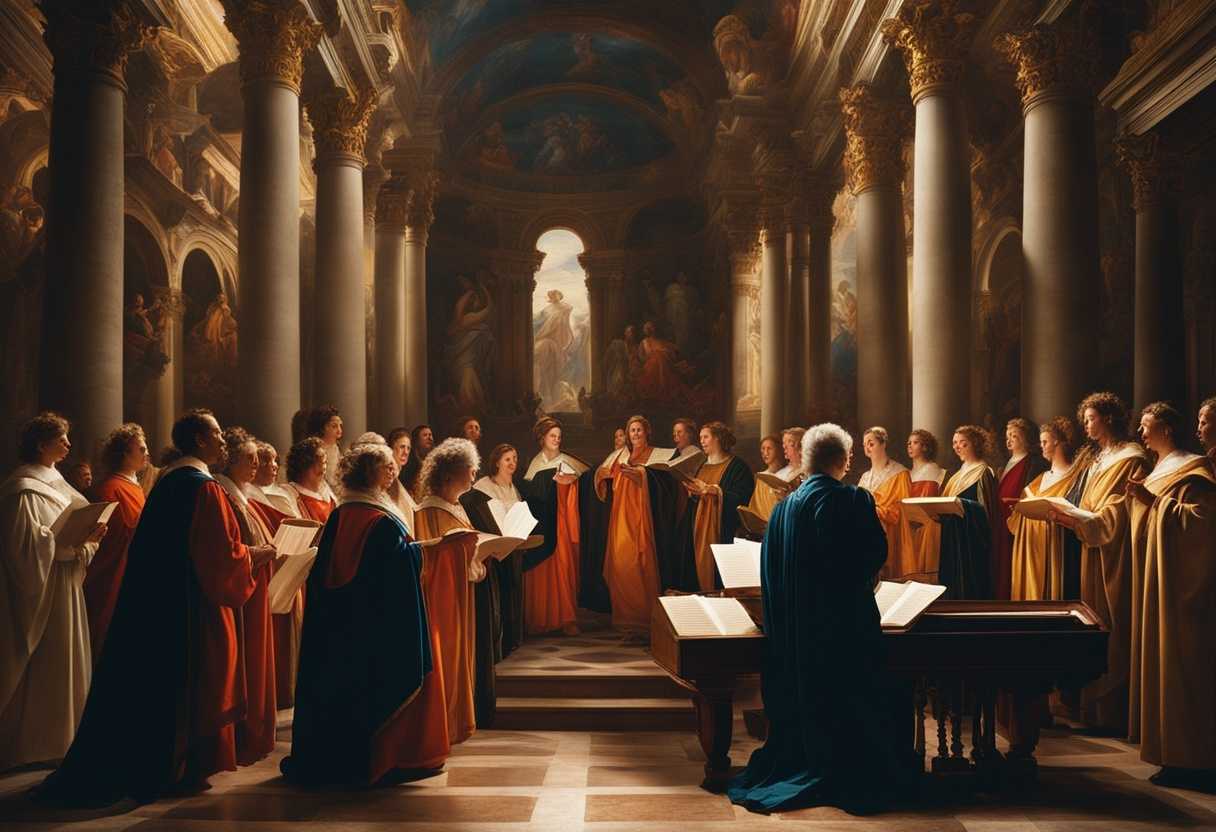
In the Bible, “choirs” often refer to groups of singers or musicians dedicated to worship and praise, particularly in the context of temple services, as seen in passages like 1 Chronicles 25. These choirs played a significant role in enhancing the worship experience and uplifting the congregation through song.
Scripture
16 David also commanded the chiefs of the Levites to appoint their brothers as the singers who should play loudly on musical instruments, on harps and lyres and cymbals, to raise sounds of joy.
17 So the Levites appointed Heman the son of Joel; and of his brothers Asaph the son of Berechiah; and of the sons of Merari, their brothers, Ethan the son of Kushaiah;
18 and with them their brothers of the second order, Zechariah, Jaaziel, Shemiramoth, Jehiel, Unni, Eliab, Benaiah, Maaseiah, Mattithiah, Eliphelehu, and Mikneiah, and the gatekeepers Obed-edom and Jeiel.
19 The singers Heman, Asaph, and Ethan were to sound bronze cymbals;
20 Zechariah, Aziel, Shemiramoth, Jehiel, Unni, Eliab, Maaseiah, and Benaiah were to play harps according to Alamoth;
21 but Mattithiah, Eliphelehu, Mikneiah, Obed-edom, Jeiel, and Azaziah were to lead with lyres according to the Sheminith.
22 Chenaniah, leader of the Levites in music, should direct the music, for he understood it.
23 Berechiah and Elkanah were to be gatekeepers for the ark.
24 Shebaniah, Joshaphat, Nethanel, Amasai, Zechariah, Benaiah, and Eliezer, the priests, should blow the trumpets before the ark of God. And Obed-edom and Jehiah were to be gatekeepers for the ark.
Biblical Definition of Choirs
The concept of choirs in the Bible extends beyond mere musical ensembles to embody a communal aspect of worship and praise that reflects the corporate identity of God’s people. In 1 Chronicles 25, we see the organization of musicians and singers for temple worship, where David appointed specific individuals to lead in singing and playing instruments as a form of devotion. This practice highlights the integral role of music in the Jewish tradition, linking communal emotions and spiritual experience through praise. The joined voices singing “a new song” (Psalm 96:1) illustrate how choirs symbolize unity and shared faith, allowing individuals to collectively express their reverence and joy in God’s presence.
Moreover, choirs serve as a reminder of the beauty and diversity within the body of Christ. Colossians 3:16 encourages believers to let the word of Christ dwell richly among them, using psalms, hymns, and spiritual songs to teach and admonish one another. This instruction underscores that choir participation is not merely about the performance of music but about teaching and encouraging one another through song. By functioning as vessels of worship, choirs foster an environment where the community can engage with God, reflecting both personal devotion and communal fidelity. Thus, the incorporation of choirs in biblical worship connects the faithful not only to the divine but also to one another, enhancing the overall experience of being the body of Christ in worship.
In addition to their role in worship, choirs in the Bible reflect the theological significance of praising God through communal voices, acting as a mirror of communal life among the faithful. For instance, the singing of hymns and psalms by the Israelites during various festivals, such as the Passover and the Feast of Tabernacles, serves to narrate their collective history and affirm their identity as God’s chosen people. Through these occasions, choirs allowed individuals to recapture the story of salvation and deliverance through song, fostering a sense of belonging and shared heritage. Consequently, the formation of choirs becomes an act of remembrance and proclamation, binding congregations together in their collective faith and persistence in the face of adversity.
Additionally, the New Testament continues the emphasis on music in community worship settings, where the early church’s gatherings included hymn-singing as a method of unity and doctrine reinforcement. This emphasis reinforces the notion that choirs not only entertain but actively edify the faithful. The Apostle Paul speaks about the importance of singing as a means of fostering spiritual harmony, allowing congregants to convey their joyful faith while offering a glimpse into their spiritual state. This intrinsic connection between music and unity reflects the belief that when believers sing together, they participate in a divine dialogue that transcends individual experience, affirming their shared commitment to the faith and enriching their worship. In this light, choirs become not only a feature of biblical worship but a transformative experience that deepens communal bonds and facilitates a deeper encounter with God.
The Role of Worship in Community
Choirs in the Bible symbolize the collective expression of worship and praise within a community. They serve as a unifying force, bringing together individuals to participate in a shared experience of reverence and adoration. This communal aspect highlights the importance of collective worship in fostering a sense of belonging and spiritual connection among believers.
The Significance of Music in Spiritual Life
The presence of choirs in biblical texts underscores the vital role of music in spiritual life. Music is often portrayed as a means of communicating with the divine, expressing emotions, and enhancing the worship experience. The use of choirs reflects the belief that music can elevate the soul, inspire devotion, and facilitate a deeper connection with God.
The Symbolism of Order and Harmony
Choirs also represent the principles of order and harmony within the worship setting. The structured arrangement of voices and the coordination required for choral singing symbolize the beauty of unity in diversity. This reflects a broader theological theme that emphasizes the importance of harmony in both the church and the world, illustrating how different voices can come together to create a cohesive and uplifting expression of faith.
How to Cultivate a Deeper Faith Through Worship and Service
Cultivating a deeper faith through worship and service is a beautiful journey that invites us to connect more intimately with God and our community. Start by immersing yourself in worship—whether through music, prayer, or scripture reading—allowing these moments to draw you closer to the heart of God. Consider setting aside time each week to engage in communal worship, where the collective energy of fellow believers can uplift your spirit and deepen your understanding of God’s love. Alongside worship, actively seek opportunities to serve others; this could be volunteering at a local shelter, helping a neighbor, or simply offering a listening ear to someone in need. Service not only reflects Christ’s love but also opens your heart to the transformative power of selflessness. As you intertwine worship and service, you’ll find that your faith grows richer and more vibrant, leading you to a life that mirrors the love and grace of Jesus. Remember, it’s in these acts of devotion and kindness that we truly experience the fullness of our faith.
Bible References to Choirs in Scripture:
1 Chronicles 25:1-8: 1 David and the chiefs of the service also set apart for the service the sons of Asaph, and of Heman, and of Jeduthun, who prophesied with lyres, with harps, and with cymbals.
2 Of the sons of Asaph: Zaccur, Joseph, Nethaniah, and Asharelah, sons of Asaph, under the direction of Asaph, who prophesied under the direction of the king.
3 They were all under the direction of their father in the music in the house of the Lord with cymbals, harps, and lyres for the service of the house of God.
4 Of Heman, the sons of Heman: Bukkiah, Mattaniah, Uzziel, Shebuel and Jerimoth, Hananiah, Hanani, Eliathah, Giddalti, and Romamti-ezer, Joshbekashah, Mallothi, Hothir, and Mahazioth.
5 All these were the sons of Heman the king’s seer, according to the promise of God to exalt him, for God had given Heman fourteen sons and three daughters.
6 They were all under the direction of their father in the music in the house of the Lord with cymbals, harps, and lyres for the service of the house of God.
7 The number of them along with their brothers, who were trained in singing to the Lord, all who were skillful, was 288.
8 And they cast lots for their duties, small and great, teacher and pupil alike.
2 Chronicles 5:12-14: 12 and all the Levitical singers, Asaph, Heman, and Jeduthun, their sons and kinsmen, arrayed in fine linen, with cymbals, harps, and lyres, stood east of the altar with 120 priests who were trumpeters;
13 and it was the duty of the trumpeters and singers to make themselves heard in unison in praise and thanksgiving to the Lord, and when the song was raised, with trumpets and cymbals and other musical instruments, in praise to the Lord, “For he is good, for his steadfast love endures forever,” the house, the house of the Lord, was filled with a cloud,
14 so that the priests could not stand to minister because of the cloud, for the glory of the Lord filled the house of God.
2 Chronicles 20:21-22: 21 And when he had taken counsel with the people, he appointed those who were to sing to the Lord and praise him in holy attire, as they went before the army, and say, “Give thanks to the Lord, for his steadfast love endures forever.”
22 And when they began to sing and praise, the Lord set an ambush against the men of Ammon, Moab, and Mount Seir, who had come against Judah, so that they were routed.
Nehemiah 12:27-43: 27 And at the dedication of the wall of Jerusalem they sought the Levites in all their places, to bring them to Jerusalem to celebrate the dedication with gladness, with thanksgivings and with singing, with cymbals, harps, and lyres.
28 And the sons of the singers gathered together from the district surrounding Jerusalem and from the villages of the Netophathites;
29 And from the house of Gilgal, and from the fields of Geba and Azmaveth, for the singers had built for themselves villages around Jerusalem.
30 And the priests and the Levites purified themselves, and they purified the people and the gates and the wall.
31 Then I brought the leaders of Judah up onto the wall and appointed two great choirs that gave thanks. One went to the south on the wall to the Dung Gate.
32 And after them went Hoshaiah and half of the leaders of Judah,
33 On that day men were appointed over the storerooms, the contributions, the firstfruits, and the tithes, to gather into them the portions required by the Law for the priests and for the Levites according to the fields of the towns, for Judah rejoiced over the priests and the Levites who ministered.
34 And Judah, Benjamin, Shemaiah, and Jeremiah,
35 and certain of the priests’ sons with trumpets: Zechariah the son of Jonathan, son of Shemaiah, son of Mattaniah, son of Micaiah, son of Zaccur, son of Asaph,
36 and his relatives, Shemaiah, Azarel, Milalai, Gilalai, Maai, Nethanel, Judah, and Hanani, with the musical instruments of David the man of God. And Ezra the scribe went before them.
37 At the Fountain Gate they went up straight before them by the stairs of the city of David, at the ascent of the wall, above the house of David, to the Water Gate on the east.
38 The other choir of those who gave thanks went to the north, and I followed them with half of the people, on the wall, above the Tower of the Ovens, to the Broad Wall,
39 and above the Gate of Ephraim, and by the Gate of Yeshanah, and by the Fish Gate and the Tower of Hananel and the Tower of the Hundred, to the Sheep Gate; and they came to a halt at the Gate of the Guard.
40 So the two choirs stood in the house of God, and I and half of the officials with me;
41 And the priests Eliakim, Maaseiah, Miniamin, Micaiah, Elioenai, Zechariah, and Hananiah, with trumpets,
42 and the singers sang with Jezrahiah as their leader.
43 And they offered great sacrifices that day and rejoiced, for God had made them rejoice with great joy; the women and children also rejoiced. And the joy of Jerusalem was heard far away.
Psalms 68:24-26: 24 Your procession is seen, O God, the procession of my God, my King, into the sanctuary—
25 The singers in front, the musicians last,
between them virgins playing tambourines.
26 Bless God in the great congregation,
the Lord, O you who are of Israel’s fountain!
Psalms 149:1-6: 1 Praise the Lord! Sing to the Lord a new song, his praise in the assembly of the godly!
2 Let Israel be glad in his Maker; let the children of Zion rejoice in their King!
3 Let them praise his name with dancing,
making melody to him with tambourine and lyre!
4 For the Lord takes pleasure in his people; he adorns the humble with salvation.
5 Let the godly exult in glory; let them sing for joy on their beds.
6 Let the high praises of God be in their throats
and two-edged swords in their hands,
Ephesians 5:18-20: 18 And do not get drunk with wine, for that is debauchery, but be filled with the Spirit,
19 addressing one another in psalms and hymns and spiritual songs, singing and making melody to the Lord with your heart,
giving thanks always and for everything to God the Father in the name of our Lord Jesus Christ,
Colossians 3:16-17: 16 Let the word of Christ dwell in you richly, teaching and admonishing one another in all wisdom, singing psalms and hymns and spiritual songs, with thankfulness in your hearts to God.
17 And whatever you do, in word or deed, do everything in the name of the Lord Jesus, giving thanks to God the Father through him.

Reverend Michael Johnson is an experienced Church Minister with a profound expertise in spirituality and guidance. With a serene presence and a compassionate heart, he has faithfully served his congregation for over 20 years, leading them on a spiritual journey towards inner peace and enlightenment. Reverend Johnson’s extensive knowledge of religious philosophies and profound understanding of human nature have made him a trusted confidant and mentor to many, as he seamlessly weaves his profound wisdom into life teachings. Reverend Johnson’s calming demeanor and empathetic nature continue to uplift and heal souls, nurturing a sense of unity and tranquility within his community.