
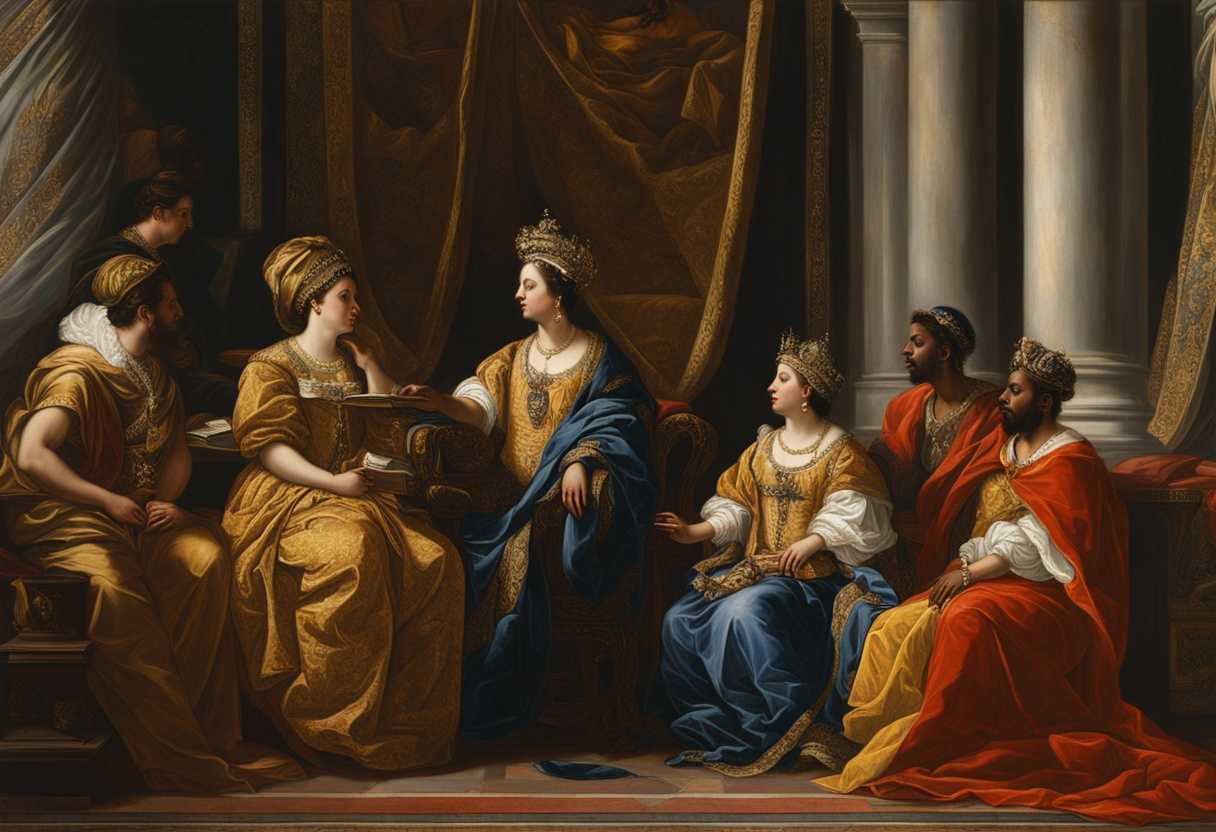
The Queen of Sheba is depicted in the Bible as a wealthy and wise ruler who visited King Solomon to test his wisdom with difficult questions (1 Kings 10:1-2). Her visit symbolizes the recognition of Solomon’s wisdom and the international reputation of Israel during his reign.
Scripture
23 Thus King Solomon excelled all the kings of the earth in riches and in wisdom.
2 She came to Jerusalem with a very great retinue, with camels bearing spices and very much gold and precious stones. And when she came to Solomon, she told him all that was on her mind.
3 And Solomon answered all her questions; there was nothing hidden from the king that he could not explain to her.
4 And when the queen of Sheba had seen all the wisdom of Solomon, the house that he had built,
5 the food of his table, the seating of his officials, and the attendance of his servants, and their clothing, his cupbearers, and his burnt offerings that he offered at the house of the Lord, there was no more breath in her.
6 She said to the king, “The report was true that I heard in my own land of your words and of your wisdom,
7 So I did not believe the reports until I came and my own eyes had seen it. And behold, the half was not told me. Your wisdom and prosperity surpass the report that I heard.
8 Happy are your men! Happy are your servants, who continually stand before you and hear your wisdom!
9 Then she gave the king 120 talents of gold, and a very great quantity of spices and precious stones. Never again came such an abundance of spices as these that the queen of Sheba gave to King Solomon.
10 Then she gave the king 120 talents of gold, and a very great quantity of spices and precious stones. Never again came such an abundance of spices as these that the queen of Sheba gave to King Solomon.
11 Moreover, the fleet of Hiram, which brought gold from Ophir, brought from Ophir a very great amount of almug wood and precious stones.
12 The king also made of the almug wood supports for the house of the Lord and for the king’s house, lyres also and harps for the singers. No such almug wood has come or been seen to this day.
13 King Solomon gave to the queen of Sheba all that she desired, whatever she asked, besides what was given her by the bounty of King Solomon. So she turned and went back to her own land with her servants.
Queen of Sheba’s Significance in the Bible
The interaction between the Queen of Sheba and King Solomon, as recounted in 1 Kings 10:1-13, carries rich symbolic meaning that extends beyond the historical narrative. Her journey represents the pursuit of wisdom and truth, depicting a universal quest that transcends geographical and cultural boundaries. In verse 1, she comes “to test him with hard questions,” indicating that true wisdom is not confined within any single tradition; instead, it invites dialogue and inquiry. The Queen’s acknowledgment of Solomon’s wisdom serves as a recognition of the divine gifts granted to him by God, which are echoed in 1 Kings 3:5-14, where Solomon famously asks for wisdom to govern his people justly. Thus, the encounter signifies the importance of humility and the willingness to learn from others, illustrating a key biblical tenet that wisdom often comes from collaboration and openness.
Moreover, the narrative emphasizes the broader implications of the Israelite temple and kingdom under Solomon’s reign. Sheba’s visit symbolizes the nations’ willingness to approach Israel for insight, reflecting God’s intention for Israel to serve as a light to the nations (Isaiah 49:6). In this light, the Queen of Sheba becomes an archetype of those who seek truth, wisdom, and a relationship with the divine. The gifts she presents to Solomon—a gesture of respect and acknowledgment of his greatness—further underscore the theme of reciprocity in wisdom and knowledge (1 Kings 10:10). Ultimately, the Queen of Sheba teaches that the pursuit of wisdom, understanding, and divine truth is a noble endeavor that invites cooperation, reflection, and a spirit of openness among people across the world.
In addition to her role as a seeker of wisdom, the Queen of Sheba serves as a powerful embodiment of the inclusion of diverse peoples within the narrative of God’s redemptive plan. Her story acts as a precursor to later biblical themes where the nations are invited to partake in the spiritual blessings of Israel. By coming to Solomon, she symbolizes a bridge between cultures—her presence in Jerusalem underscores the universality of God’s wisdom, which is accessible beyond ethnic or national boundaries. The biblical portrayal of her journey highlights that divine wisdom is not restricted to a singular people but is available to all who earnestly seek it, as evidenced in various prophetic writings that envision a day when all nations will come to worship the one true God.
Furthermore, the Queen of Sheba is often interpreted as a foreshadowing of the openness of the Gospel to the Gentiles. Her encounter with Solomon represents a significant moment when the wisdom of God is acknowledged even by royal figures from distant lands. This sets the stage for later New Testament dialogues, where Jesus refers to her as an example of faith (Matthew 12:42), underscoring a theme of recognition and reverence for divine truth that transcends time. Consequently, the significance of the Queen of Sheba extends beyond her historical journey; she is an emblem of the search for understanding and wisdom in various cultural contexts, urging both individuals and nations to remain open-hearted and curious in their own spiritual quests. Her legacy, therefore, encourages believers to embrace diverse perspectives while fostering a deeper appreciation for the wisdom that comes from God.
Symbol of Wisdom and Inquiry
The Queen of Sheba represents the pursuit of wisdom and knowledge. Her journey to meet King Solomon signifies the importance of seeking understanding and truth. This narrative illustrates that wisdom is not confined to one culture or nation; rather, it transcends boundaries and invites individuals to explore and learn from one another. The Queen’s inquiry into Solomon’s wisdom highlights the value of dialogue and the exchange of ideas, emphasizing that true wisdom often comes from diverse perspectives.
Representation of Wealth and Prosperity
The Queen of Sheba is also a symbol of wealth and prosperity. Her visit to Solomon, laden with gifts, underscores the significance of material abundance in the ancient world. This aspect of her character reflects the broader biblical theme that wealth can be a means to honor God and support the community. The exchange between her and Solomon serves as a reminder that prosperity should be shared and used for the greater good, reinforcing the idea that material blessings can lead to spiritual enrichment when used wisely.
A Model of Respect and Diplomacy
The Queen of Sheba exemplifies respect and diplomacy in her interactions with Solomon. Her visit is marked by admiration and a desire for mutual understanding, showcasing the importance of respectful engagement between different cultures and leaders. This narrative encourages readers to appreciate the value of diplomacy and the potential for collaboration across cultural divides. The Queen’s respectful approach serves as a model for contemporary relationships, highlighting the need for openness and dialogue in fostering peace and cooperation.
How to Cultivate God’s Wisdom for a Better Life
Cultivating God’s wisdom in our lives is a transformative journey that begins with a humble heart and a willingness to seek His guidance in every aspect of our daily existence. Start by immersing yourself in Scripture, allowing the words of Proverbs and the teachings of Jesus to shape your understanding of what true wisdom looks like. Prayer is essential; it’s in those quiet moments of conversation with God that we can discern His voice and receive clarity on our decisions. Surround yourself with a community of believers who can offer support and share their insights, as iron sharpens iron. Remember, wisdom isn’t just about knowledge; it’s about applying that knowledge in love and service to others. As you practice patience, seek understanding, and embrace humility, you’ll find that God’s wisdom not only enriches your life but also radiates through your actions, drawing others closer to Him.
Bible References to Queen of Sheba:
2 Chronicles 9:1-12: 1 Now when the queen of Sheba heard of the fame of Solomon, she came to Jerusalem to test him with hard questions, having a very great retinue and camels bearing spices and very much gold and precious stones. And when she came to Solomon, she told him all that was on her mind.
2 And Solomon answered all her questions; there was nothing hidden from Solomon that he could not explain to her.
3 And when the queen of Sheba had seen the wisdom of Solomon, the house that he had built,
4 the food of his table, the seating of his officials, and the attendance of his servants, and their clothing, his cupbearers, and their clothing, and his burnt offerings that he offered at the house of the Lord, there was no more breath in her.
5 And she said to the king, “The report was true that I heard in my own land of your words and of your wisdom,
6 Moreover, the food of his table, the seating of his officials, and the attendance of his servants, and their clothing, his cupbearers, and their clothing, and his burnt offerings that he offered at the house of the Lord, there was no more breath in her.
7 And I did not believe the reports until I came and my own eyes had seen it. And behold, the half of the greatness of your wisdom was not told me; you surpass the report that I heard.
8 Blessed be the Lord your God, who has delighted in you and set you on his throne as king for the Lord your God! Because your God loved Israel and would establish them forever, he has made you king over them, that you may execute justice and righteousness.”
9 Then she gave the king 120 talents of gold, and a very great quantity of spices, and precious stones. Never again came such an abundance of spices as these that the queen of Sheba gave to King Solomon.
10 Moreover, the servants of Hiram and the servants of Solomon, who brought gold from Ophir, brought algum wood and precious stones.
11 Moreover, the fleet of Hiram, which brought gold from Ophir, brought from Ophir a very great amount of almug wood and precious stones.
12 And King Solomon gave to the queen of Sheba all that she desired, whatever she asked besides what she had brought to the king. So she turned and went back to her own land with her servants.
Matthew 12:42: 42 The queen of the South will rise up at the judgment with this generation and condemn it, for she came from the ends of the earth to hear the wisdom of Solomon, and behold, something greater than Solomon is here.
Luke 11:31: 31 The queen of the South will rise up at the judgment with the men of this generation and condemn them, for she came from the ends of the earth to hear the wisdom of Solomon, and behold, something greater than Solomon is here.

Rev. François Dupont is a dedicated church minister with a wealth of experience in serving spiritual communities. With a calm and serene demeanor, he has been devoted to sharing the message of love, compassion, and tolerance for over two decades. Through his thoughtful sermons, compassionate counseling, and unwavering support, Rev. Dupont has touched the lives of countless individuals, allowing them to find solace and strength during difficult times. His serene presence and deep understanding of the human condition make him a trusted guide for those seeking spiritual nourishment and guidance.