
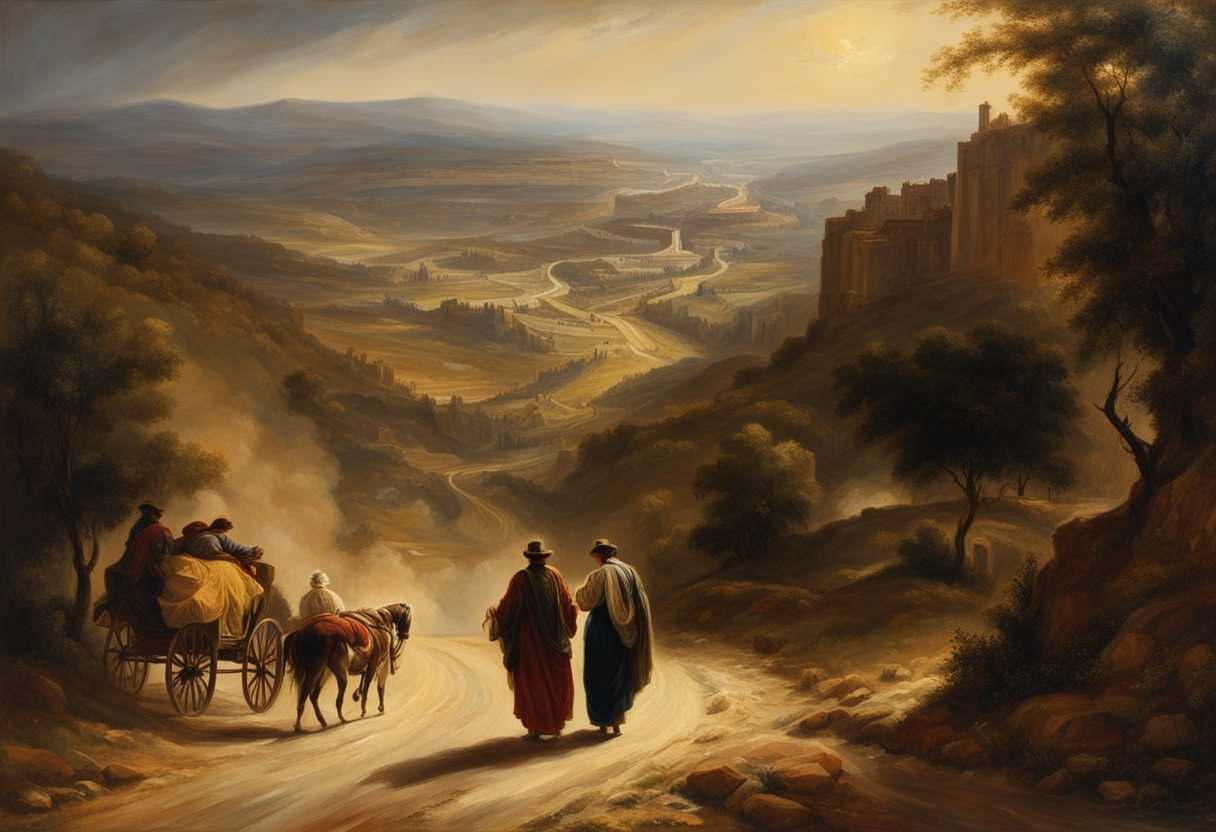
The Jericho Road in the Bible primarily refers to the route from Jerusalem to Jericho, known for its steep descent and dangerous conditions, making it a place where travelers were vulnerable to robbery and ambush. It is most famously mentioned in the Parable of the Good Samaritan (Luke 10:25-37), illustrating themes of compassion and neighborly love.
Scripture
25 And behold, a lawyer stood up to put him to the test, saying, “Teacher, what shall I do to inherit eternal life?”
26 He said to him, “What is written in the Law? How do you read it?”
27 And he answered, “You shall love the Lord your God with all your heart and with all your soul and with all your strength and with all your mind, and your neighbor as yourself.”
28 And he said to him, “You have answered correctly; do this, and you will live.”
29 But he, desiring to justify himself, said to Jesus, “And who is my neighbor?”
30 Jesus replied, “A man was going down from Jerusalem to Jericho, and he fell among robbers, who stripped him and beat him and departed, leaving him half dead.
31 Now by chance a priest was going down that road, and when he saw him he passed by on the other side.
32 So too, a Levite, when he came to the place and saw him, passed by on the other side.
33 But a Samaritan, as he journeyed, came to where he was, and when he saw him, he had compassion.
34 He went to him and bound up his wounds, pouring on oil and wine. Then he set him on his own animal and brought him to an inn and took care of him.
35 And the next day he took out two denarii and gave them to the innkeeper, saying, ‘Take care of him, and whatever more you spend, I will repay you when I come back.’
36 Which of these three, do you think, proved to be a neighbor to the man who fell among the robbers?”
37 He said, “The one who showed him mercy.” And Jesus said to him, “You go, and do likewise.”
Meaning of Jericho Road in Scripture
The Jericho Road serves as a powerful symbol in the Bible, particularly in the context of the Parable of the Good Samaritan found in Luke 10:25-37. In this parable, a man is attacked by robbers while traveling on this treacherous path, and he is left for dead. Several figures pass by without helping him, but it is the Samaritan—historically seen as an outsider—who stops to care for him. This narrative highlights the broader biblical principle of loving one’s neighbor (Mark 12:31) and challenges societal norms by emphasizing that compassion transcends cultural and ethnic boundaries. The Jericho Road thus becomes a metaphor for the journeys of life, where we encounter suffering and injustice, calling us to act with empathy and kindness.
Furthermore, the perilous nature of the Jericho Road serves to remind believers of their own vulnerabilities and the necessity of support from others. It reflects the idea that life’s path can be fraught with danger, much like the journey faced by the man in the parable. Matthew 7:12, often referred to as the Golden Rule, echoes this sentiment by urging individuals to treat others as they would like to be treated. Through the lens of the Jericho Road, the call to action is clear: we are urged not only to acknowledge the existence of suffering around us but also to actively engage in alleviating it, embodying the transformative love of Christ in every interaction. In essence, the Jericho Road symbolizes the moral responsibility we hold for one another, urging an awareness that our paths may intersect with the needs of others at any moment.
The Jericho Road also serves as an emblem of the spiritual journey that many believers undertake—a journey that can be fraught with trials, both external and internal. In the biblical narrative, this road was known for its steep descents and treacherous bends, reflecting the challenges one may face in life. This is echoed in various scriptures that speak to the theme of perseverance through hardship. For instance, in the writings of the Apostle Paul, believers are often encouraged to endure trials with faith, likening the Christian walk to a race that requires resilience and steadfastness. The Jericho Road, therefore, becomes not just a physical pathway but a spiritual metaphor for those navigating the complexities of faith in a world filled with distractions and dangers.
Moreover, the quiet nature of the Jericho Road during the encounter of the Good Samaritan emphasizes the importance of presence in moments of need. In a broader biblical context, the call to be present for one another is a significant theme found throughout the Scriptures. When the community fails to respond, as seen with the priest and the Levite, it highlights the consequences of apathy and neglect. Conversely, the Good Samaritan exemplifies active engagement, which resonates with the teachings of Christ about humility and service to others. This theme of compassion is not constrained to a single narrative; it appears in various forms throughout scripture, urging believers to heed the call to love and care for the marginalized. Thus, the Jericho Road stands for a collective responsibility, inviting reflection on how our daily journeys can be avenues for grace, kindness, and service to those who, like the man in the parable, find themselves vulnerable and in need of aid.
The Journey of Life and Its Challenges
The Jericho Road symbolizes the journey of life, often fraught with difficulties and dangers. Just as the road from Jerusalem to Jericho was known for its treacherous terrain and the potential for ambush, life presents various challenges that can lead to hardship and suffering. This broader meaning encourages individuals to be aware of the struggles that others face and to approach life with compassion and empathy.
The Call to Compassion and Action
The Jericho Road also represents the moral imperative to help those in need. The story associated with this road highlights the importance of taking action to assist those who are suffering or marginalized. This broader meaning emphasizes that true compassion goes beyond mere feelings; it requires tangible actions to uplift and support others, regardless of their background or circumstances.
The Importance of Neighborly Love
In a broader theological context, the Jericho Road serves as a reminder of the commandment to love one’s neighbor. This concept transcends cultural and social boundaries, urging individuals to extend kindness and support to all, especially those who are vulnerable. The road thus becomes a metaphor for the interconnectedness of humanity and the responsibility we have to care for one another in our shared journey.
How to Foster Compassion and Love in Daily Life
Fostering compassion and love in our daily lives is a beautiful journey that begins with small, intentional acts. As we wake each morning, let’s remind ourselves of the profound commandment to love our neighbors as ourselves (Mark 12:31). This can be as simple as offering a warm smile to a stranger, listening attentively to a friend in need, or volunteering our time to help those less fortunate. It’s essential to cultivate a heart that sees beyond our own struggles and recognizes the shared humanity in everyone we encounter. When we practice empathy—putting ourselves in others’ shoes—we not only reflect Christ’s love but also create a ripple effect of kindness in our communities. Remember, even the smallest gestures can have a significant impact, so let’s strive to be vessels of love and compassion, allowing God’s light to shine through us in every interaction.
Bible References to Jericho Road Significance:

Rev. François Dupont is a dedicated church minister with a wealth of experience in serving spiritual communities. With a calm and serene demeanor, he has been devoted to sharing the message of love, compassion, and tolerance for over two decades. Through his thoughtful sermons, compassionate counseling, and unwavering support, Rev. Dupont has touched the lives of countless individuals, allowing them to find solace and strength during difficult times. His serene presence and deep understanding of the human condition make him a trusted guide for those seeking spiritual nourishment and guidance.